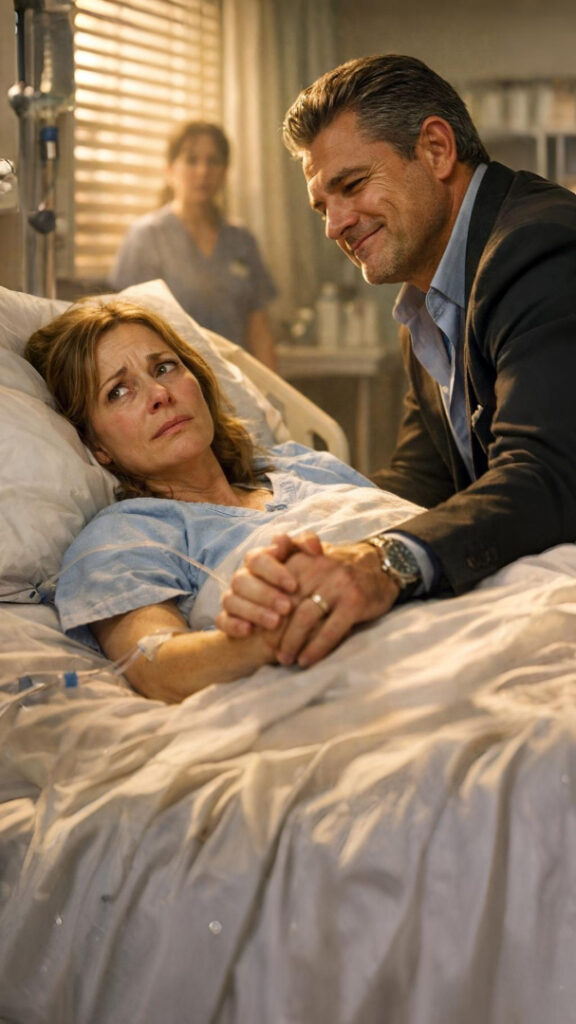
Chapter 1 — The Sentence That Broke Me
When the doctor’s lips moved, I thought I’d misheard him.
Three days.
That was all.
The words hung in the sterile air, floating between the beeping machines and the scent of antiseptic. My hands trembled, but not from fear—at least not yet. I looked at my husband, expecting the kind of silence that carries love. The kind that says, we’ll fight this together.
Instead, he smiled.
It wasn’t the smile I had memorized through forty years of mornings and meals and quiet evenings. It was new. Crooked. Cold. The kind of smile a man wears when he’s been waiting too long for something ugly.
He took my hand and squeezed it gently, almost lovingly.
Then he said, “Finally! Only three days… Your house and your money are mine now.”
For a moment, the world fell completely still. Even the monitors seemed to hesitate before resuming their steady rhythm. I remember staring at him, searching for some sign that he was joking—that the man beside my bed wasn’t the same one who used to bring me soup when I had the flu, or warm my feet under the blanket on winter nights.
But there was no trace of that man.
I watched him stand, fix his tie, and give the nurse a polite nod as if he’d just closed a business deal. My breath came shallow. My chest ached. I couldn’t cry; not yet. The tears felt like they belonged to someone else.
He leaned down one last time, whispered near my ear, “Don’t worry, dear. I’ll make sure everything’s… taken care of.”
Then he walked out.
The door clicked behind him—a small, meaningless sound that split my life in two.
For a long time, I stared at the ceiling tiles. They were all the same, perfect white squares, lined in straight rows. I started counting them, just to keep from screaming.
One. Two. Three.
Three days.
That’s what the doctor had said.
Three days to die.
Three days to watch my life dissolve into his greed.
I turned my head toward the window. Outside, the city moved on—people walking fast, cars rushing by, someone laughing near the entrance of the hospital. The world didn’t stop just because mine had shattered.
And that realization hurt more than the diagnosis.
I thought of the years behind me: every paycheck I’d handed over, every dinner I’d cooked, every time I’d said yes when my heart begged me to say no. I had built him a life—brick by brick, dollar by dollar—and now he was counting the hours until I was gone.
The nurse came in, adjusting my IV. Her hands were gentle, her eyes kind, but I barely saw her. My mind was somewhere else—tracing memories like photographs left too close to the sun.
That afternoon, the cleaning lady came in quietly, her mop squeaking across the tiles. She smiled at me, a simple, human smile. And something in me—something fragile and desperate—reached for it.
“Could you come closer?” I whispered. My voice didn’t sound like mine anymore.
She hesitated, then stepped forward, her hands clasped.
“I need your help,” I said. “Help me, and you’ll never have to work again.”
Her eyes widened, confusion flickering into fear, then curiosity.
But she nodded.
And that was the moment—small, quiet, and invisible to the world—when my story stopped being about dying.
It became about reclaiming what was mine.
Chapter 2 — What I Gave Him
Before sickness carved itself into my bones, before hospitals and whispers of death, I was a woman who believed in devotion. Not the kind sung about in cheap songs, but the kind built day after day, in small, invisible sacrifices no one ever claps for.
He was my husband, my reason, my mirror. At least that’s what I used to tell myself. I wanted to believe that love could still mean safety, that partnership meant more than survival.
For decades, I carried that belief like a candle in the wind.
I worked double shifts when his business fell apart. Sold jewelry I swore I’d keep forever. I emptied my savings to pay his debts, his dreams, his second chances. Each time, he said it was the last time. Each time, I believed him.
“Just a little longer, Margaret,” he’d say.
And I’d nod, smile, and write another check.
When the economy crashed, I took on extra work. I cooked for others, cleaned houses, looked after neighbors’ children. My hands cracked from the detergent; my knees ached; but I never complained. I told myself I was strong because I could endure. Because he needed me to.
He called me his rock. I used to think it was a compliment.
Now I see it for what it was—a way to remind me that rocks don’t move. Rocks don’t speak. Rocks stay where they’re placed.
There were birthdays I spent alone because he was “at meetings.”
Anniversaries he forgot entirely.
And every time I dared to ask where he’d been, he’d look at me with those calm eyes and say, “You worry too much.”
So I learned to stop asking.
I became a quiet woman. Not out of peace, but out of exhaustion.
I remember the first house we bought. It was old, small, but it was ours. I painted every room myself, humming old songs under my breath. He stood in the doorway once, watching me roll the pale blue paint across the wall, and said, “You really make a house feel alive.”
Back then, those words meant everything.
Later, when the house became bigger—three stories, marble floors, endless silence—I realized I’d been the one keeping it alive all along. Without me, it was just stone and furniture. Without me, even the clocks seemed to slow down.
I gave him everything because I thought love was measured in how much you could bear.
But love, I’ve learned, shouldn’t drain you. It should fill you.
The night before my diagnosis, I was the one paying the bills, sorting out the papers, making sure everything was in order. He came home late, smelling of cologne that wasn’t mine, and said he was “exhausted.”
I asked him if he was happy.
He looked at me, genuinely puzzled.
“Happy? What kind of question is that?”
And I remember thinking—he didn’t even understand what I was asking.
Three decades of marriage, and he still thought happiness was about comfort. Money. Control.
I went to bed that night feeling older than I had ever felt. Not because of time, but because of wear. The kind of wear that comes from giving too much to someone who only knows how to take.
I used to picture us growing old together—gray hair, quiet mornings, the smell of coffee and forgiveness. But now, looking back, I see the cracks had always been there. Small at first, like hairline fractures. Then wider, deeper, until one day, the foundation simply gave way.
He used to tell his friends I was “the kind of woman who never complains.”
They’d laugh, raise their glasses, and toast to his good fortune.
If only they knew that silence is rarely a virtue.
Sometimes it’s just what’s left when you’ve run out of words.
The cleaning lady’s name was Rosa. She’d been with us for twelve years. She’d seen everything—the quiet arguments, the way he snapped his fingers when he wanted something, the way I smiled anyway.
That day in the hospital, when I asked for her help, I saw the shock in her eyes. But I also saw something else. Recognition.
She knew the kind of man he was. She had cleaned up his messes too—literal and otherwise.
“I’ll help you,” she said softly, “but what do you want me to do?”
I looked at her, my mind already piecing together a plan that was more instinct than strategy. I didn’t know yet what shape revenge would take. Only that I couldn’t die like this—with my name erased and my life rewritten by a man who thought I was already gone.
I whispered, “I want to make sure he never gets what he’s waiting for.”
Rosa didn’t ask more. She just nodded, the kind of nod that women give each other when words are no longer necessary.
When she left, I lay back against the pillow, my chest rising and falling slowly. For the first time in years, I wasn’t thinking about how to keep everything together.
I was thinking about how to finally let it fall apart.
And as strange as it sounds, that thought—destruction—felt like peace.
Because maybe some things must break before they can be truly rebuilt.
Chapter 3 — The Face Behind the Smile
The third morning after my diagnosis began like any other—sunlight trying to sneak through the hospital blinds, a nurse whispering polite encouragements, and the faint sound of wheels rolling down the corridor.
But inside me, something had shifted.
I no longer felt like a dying woman.
I felt like someone watching a play she’d unknowingly starred in for too long—and finally seeing the stage lights for what they were.
He came early that morning, wearing his favorite gray suit. The one he used for funerals and bank meetings. I remember thinking how well it fit him, how perfectly composed he looked standing by the door, pretending to check his watch.
“Good morning,” he said, as though we were strangers trapped in polite conversation.
I studied him. The silver hair combed back, the faint smell of aftershave that used to make me feel safe. His smile was back—thin, rehearsed, and hollow.
“You look better today,” he added.
“Do I?” I asked. My voice came out steady, surprising even me.
He moved closer, pulling a chair to my bedside. His tone softened, the way people talk to someone they think is fading.
“I’ve been thinking about… everything. Maybe we should talk about the future.”
The future.
My future, he meant. Or rather, the lack of it.
He leaned in, speaking low, as if afraid the walls could hear him.
“You know, it would be easier for everyone if we got some things sorted. The accounts, the will, the property titles. You always wanted to make things simple.”
I looked at him, really looked. For the first time in years, I didn’t see my husband.
I saw a man counting minutes in dollars.
“How long have you been waiting for this?” I asked quietly.
His eyes flickered.
“What are you talking about?”
I smiled—small, brittle. “For me to disappear.”
He laughed then. Softly at first, then louder, the sound bouncing off the sterile walls.
“Don’t be dramatic. You’re tired. I’m just trying to help.”
I wanted to believe that tone once meant care. Now it sounded like control wrapped in silk.
When he left, he kissed my forehead. A gesture so familiar that for a fleeting moment, I felt the ghost of comfort. But his lips were cold, detached, like someone performing a duty rather than offering affection.
The door shut. And with that sound, something inside me finished breaking.
I reached for my phone with trembling hands. My contacts list was short—most people fade when your world grows small. But Rosa answered on the second ring.
“He was there again?” she asked.
“Yes,” I whispered. “And I think he’s already planning my funeral… and his new life.”
Silence. Then her voice, steady and low: “Tell me what you need.”
“I need you to find the papers,” I said. “Everything with my name on it. The safe in the office. The keys should still be in the top drawer.”
She hesitated only a second. “What do you want me to do after that?”
“Bring them to me. Quietly. And don’t tell anyone you’ve spoken to me.”
When I hung up, I let the phone fall beside me. The heart monitor kept its steady rhythm—proof that I was still here, that I wasn’t gone yet, not by his timing or anyone else’s.
That afternoon, I asked the nurse for a notebook. She handed me one from the supply cart—plain, blue cover, the kind used for hospital notes. I began to write.
Names. Dates. Numbers.
Memories too painful to keep in my head.
I wrote about the first time he lied to me, the first time he made me feel small, the first time I chose to stay quiet instead of walking away. Each word felt like an incision—sharp but necessary.
I wrote until my fingers cramped and the ink smudged beneath my hand.
By the time night fell, Rosa had done what I asked. She appeared in the doorway like a shadow, her apron folded neatly, her eyes darting around before stepping inside.
“I have them,” she whispered, clutching a brown envelope.
She handed it to me, and I felt the weight of it—years of signatures, promises, and control bound in thin paper.
“Thank you,” I said. “You’ve just saved my life.”
Rosa frowned. “But you said you only had—”
“Three days,” I finished. “That’s what they said. But I’ve decided to use them differently.”
She nodded slowly, understanding something deeper than the words.
After she left, I opened the envelope and spread the documents across my lap. Deeds. Contracts. Account numbers. Everything he thought was already his.
I smiled for the first time in days.
A small, dangerous smile.
Because I knew something he didn’t—dying women are invisible.
No one questions what they do in their final hours.
And in that invisibility, I found power.
I picked up the phone again, dialed a number I hadn’t called in years. A name from another life—an old lawyer friend I’d once helped when his wife was sick.
“Margaret?” he answered, surprised. “It’s been ages.”
“I need your help,” I said. “And I don’t have much time.”
He listened as I told him everything. The betrayal, the papers, the diagnosis.
When I finished, he was silent for a long moment.
Then he said, “If what you’re saying is true, you can still change everything. But you have to act fast.”
“I intend to,” I replied.
When I hung up, the hospital room felt different. The same walls, the same hum of machines—but something had shifted. I wasn’t the woman waiting to die anymore.
I was the woman rewriting the ending.
And somewhere in that realization, in that quiet, deliberate rage, I began to see his downfall—slow, inevitable, and entirely of his own making.
Because monsters never believe their victims will stand up.
Until the day they do.
Chapter 4 — The Quiet Before the Storm
The hospital at night was a strange kind of quiet. Not peaceful—never that—but heavy, like the air had weight. Machines whispered, distant footsteps echoed down long corridors, and I lay awake, tracing the ceiling cracks as though they could map my next move.
The plan had begun to take shape, thin as smoke but real enough to breathe. It was Rosa who’d brought me food she wasn’t supposed to, who slipped in and out unnoticed, who carried pieces of my old life in a small black bag. And it was she who had taken the brown envelope back with her that evening, promising to keep it safe until I called.
She didn’t ask questions. She knew that sometimes silence is the loudest kind of loyalty.
By the second night, the doctor came in again with his rehearsed sympathy. “We’ll keep you comfortable,” he said, the way one might speak about a dying candle. I nodded, let him think I was fading, while my mind ran faster than it had in years.
I asked him for a discharge the next morning.
He blinked. “You want to go home?”
“Yes,” I said, steady. “If I’m going to die, I want my own walls to watch me do it.”
He hesitated, then finally agreed. Paperwork was signed. Machines disconnected. Rosa came to fetch me in a borrowed car that smelled faintly of pine and old leather.
As the city passed by through the window, I felt the strange thrill of freedom. My body was weak, but my mind was sharp—sharp enough to know that I wasn’t going home to rest.
We drove in silence. When we reached the gate, she looked at me, her hands tight on the wheel.
“He’s home,” she murmured.
“Good,” I said. “Let him be.”
He didn’t expect me back so soon. When I opened the door, he was on the phone, laughing. That sound—so careless, so certain—hit me like a slap. He froze when he saw me standing there, pale and fragile but alive.
“Margaret,” he said, his voice catching for the first time in months. “You shouldn’t have left the hospital.”
I smiled faintly. “I know. But you looked lonely.”
He stammered, pretending concern. “You need to rest. I’ll call someone—”
“No,” I cut him off. “You’ll listen.”
And he did. Maybe it was the tone—quiet but cold, the tone of someone who’s already crossed the line between pain and clarity. I told him I wanted to spend my final days in peace, that I wanted no arguments, no noise. He nodded quickly, relieved.
He thought I’d surrendered.
That night, I didn’t sleep. I sat by the window, watching the garden. The roses I’d planted were dying—neglected, thirsty, their petals folding inward like secrets. I decided I wouldn’t let my life end that way.
Rosa returned the next morning with the envelope. Inside, she’d added something new: photographs of documents she’d found in his office drawer. Letters, receipts, a hidden account under his name only. Money he’d moved quietly over the years, preparing for a life without me.
I read every page. My hands shook, but not from illness.
It wasn’t grief anymore. It was clarity.
When I looked up, Rosa was watching me. “What will you do?” she asked.
“I’ll make sure he gets everything he deserves,” I said softly.
The next step came naturally. I called the lawyer again. We spoke in careful code, aware that anything could be overheard. He drafted new papers, updated my will, changed beneficiaries, sealed trust accounts. Everything that once had his name was rewritten in mine—or in Rosa’s, for safekeeping.
It took less than twenty-four hours to undo what had taken him a lifetime to build.
The irony didn’t escape me.
He spent decades taking from me in small, invisible ways. Now, with a few strokes of ink, I was taking everything back.
He didn’t notice. Not yet. He was too busy preparing for the end, calling relatives, pretending to mourn me in advance. I overheard him once, telling someone on the phone, “She’s comfortable now. The doctors said she won’t last long.”
He said it with the same voice one uses to confirm a shipment’s arrival.
That night, as he slept, I sat across the room watching him. The rise and fall of his chest, the peacefulness of a man certain the world is his. I used to find comfort in that rhythm. Now it only reminded me how blind I had been.
For years, I thought endurance was strength. That surviving his indifference meant I was winning. But endurance without boundaries is just another kind of slow death.
The next morning, I felt a strange calm settle over me. Rosa brewed coffee, humming softly in the kitchen. The house smelled alive again.
He came down in his robe, surprised to find me awake and dressed.
“You’re up early,” he said, half-smiling.
“There’s something I’d like to do today,” I told him.
“Oh?”
“I want to visit the bank. I need to settle a few things before…” I let my voice trail off.
He nodded quickly, already picturing signatures, transfers, control. “Of course. I’ll drive you.”
Perfect.
At the bank, he stood beside me, his hand resting lightly on my shoulder as if guiding a child. The clerk greeted us politely, unaware of the small war unfolding in front of her desk.
“I’d like to make a few changes,” I said. “These accounts—” I pushed the folder forward—“they’ll need to be updated.”
He leaned in, smiling at the clerk. “My wife isn’t feeling well. I’ll handle the details.”
But I didn’t move.
And neither did the clerk, waiting for my signature.
“Actually,” I said, looking him in the eyes, “I’ll handle them myself.”
He blinked, startled.
And for the first time, I saw it—fear. Tiny, but real.
It thrilled me.
He didn’t argue in public. He couldn’t. His pride wouldn’t allow it. So he stepped back, lips tight, while I signed each page carefully, deliberately, sealing his fate with every stroke.
When we left, he was silent. The air between us felt different, charged.
That night, he poured himself a drink and asked, almost casually, “What was that today?”
I met his gaze. “A correction.”
He stared at me, searching for the weak woman he’d known, but she was gone.
And in that silence between us, I realized something profound:
He wasn’t the storm. He never was.
He was just the weather I’d learned to survive.
The real storm—quiet, deliberate, unstoppable—was me.
Chapter 5 — When Silence Turns to Fire
The morning after the bank visit, the air in the house changed. I could feel it—thicker, slower, almost watchful. He moved differently now, cautious, his eyes following me from room to room as if I were a ghost he wasn’t sure he believed in.
For the first time in years, I let him see me thinking. I didn’t hide it anymore. I walked through the house with a purpose that didn’t belong to a dying woman. He noticed. He didn’t know what to do with it.
At breakfast, he tried small talk. The clinking of silverware was the only thing that filled the silence between us.
“You’ve been quiet lately,” he said, pretending casual curiosity.
“Have I?” I replied.
“Yes. You look… different.”
“I am different.”
He looked up from his plate, frowning slightly. “You sound almost happy.”
“Maybe I am.”
That answer unsettled him more than anger ever could. He liked me predictable—gentle, subdued, always apologizing for existing too loudly. Now my calm frightened him, though he would never admit it.
He asked what I planned to do with the rest of my time.
“Whatever I want,” I said.
He laughed, but there was no amusement in it.
Later that day, I sat by the window again, watching him through the reflection in the glass. He was on the phone, whispering—urgent, defensive. I couldn’t hear the words, but I knew the tone. It was the sound of a man losing control.
That night, Rosa brought me tea. She didn’t ask questions, just handed me the cup and waited. Her presence was steady, grounding.
“He’s worried,” she said softly.
“Good,” I answered. “He should be.”
She hesitated. “He asked me if you’ve been talking to anyone. He said you’ve been… strange.”
I smiled faintly. “Tell him whatever you like. I trust you.”
She nodded once. “I’ll tell him you sleep a lot.”
We both knew I hadn’t slept in days.
The third day came with rain—gentle, endless rain that wrapped the house in gray. I woke up before dawn, my chest heavy but my mind alert. I took the notebook from the nightstand and read the pages I’d written in the hospital. Every line felt like a blade I had sharpened myself.
I added one more entry: He thinks I’m dying. Let him think that. When I’m gone, he’ll finally learn what it means to lose everything he never valued.
When I finished writing, I tore out the last page, folded it, and slipped it into Rosa’s pocket when she came to clear the dishes.
“If something happens to me,” I whispered, “give this to my lawyer.”
She met my eyes and nodded. No questions. Just understanding.
That afternoon, he came to me with a strange softness. The kind of voice he used to use when he wanted something expensive.
“I’ve been thinking,” he began, “maybe we should go away for a few days. Somewhere peaceful. You need rest.”
“Rest?” I asked.
“Yes. The sea always helped you think. We could leave tomorrow. I’ll take care of everything.”
There it was—the plan forming behind his charm. He still thought I was naive enough to let him “take care” of things.
“Tomorrow,” I repeated. “That sounds lovely.”
He smiled, relieved, believing he’d won.
That night, I called my lawyer one last time. “Everything’s ready,” he said. “Once you sign, it’s irreversible.”
“I’ll sign in the morning,” I told him. “If anything happens after that, you know what to do.”
When dawn broke, the rain had stopped. The air smelled clean, almost new. I dressed slowly, choosing the same cream-colored dress I’d worn the day we moved into this house. I wanted him to remember it.
At breakfast, he poured my coffee, his hands too steady to be genuine. “Feeling well enough for the trip?”
“I’ve never felt better,” I said.
We left before noon. The drive was long, quiet, suffocating. He played soft music, the kind meant to distract. I kept my eyes on the road, counting the miles, waiting for him to make his move.
He didn’t. Not yet.
When we reached the small coastal town, he checked us into a hotel overlooking the water. Everything was perfect. Too perfect.
Dinner was served on the terrace. Candlelight, sea breeze, wine. He raised his glass. “To us,” he said.
I raised mine too. “To truth.”
He hesitated, glass halfway lifted.
“What truth?”
I leaned back, watching the reflection of the candle flicker in his wineglass. “The one you’ve spent years avoiding.”
His jaw tightened. “You shouldn’t talk like that. You need to stay calm.”
“I am calm,” I said. “It’s you who looks nervous.”
He laughed, the kind of laugh that doesn’t reach the eyes. “You’ve been saying strange things lately, Margaret. Maybe the medication—”
“Don’t,” I cut him off. “Don’t you dare make me small again.”
The wind picked up, scattering napkins, rattling glasses. For a moment, he didn’t move. Then he reached across the table, his fingers brushing mine—not tenderly, but to regain control.
“Let’s go upstairs,” he said.
I pulled my hand back. “No. I like it here.”
He sighed, the mask slipping just a little. “You always did have a dramatic streak.”
“And you always did underestimate me.”
We stared at each other for a long moment, the sound of waves breaking somewhere below. Finally, he stood, threw his napkin on the table, and walked away.
When I returned to the room later, he was gone. His suitcase too.
He hadn’t even said goodbye.
I laughed—quiet, disbelieving. After everything, he’d chosen to flee rather than fight. It was almost poetic.
The next morning, Rosa called. Her voice trembled with a strange excitement.
“He came back to the house last night,” she said. “He tore the office apart looking for papers. I think he knows.”
“Let him look,” I said. “There’s nothing left for him to find.”
And it was true.
Everything he thought he owned—every account, every property, every scrap of security—was already beyond his reach. The lawyer had filed it all before we left.
I hung up and stepped onto the balcony. The sea stretched endlessly before me, calm and blue. For the first time in years, I felt the weight of him lifting from my shoulders.
He had wanted me gone. And in a way, he was right.
The woman who loved him, the one who forgave, who endured, who bent herself into silence—that woman had died long before the doctor’s words.
What stood in her place was someone new.
Someone who finally understood that silence, once broken, can burn like fire.