Chapter 1 – The Courtroom of Eyes
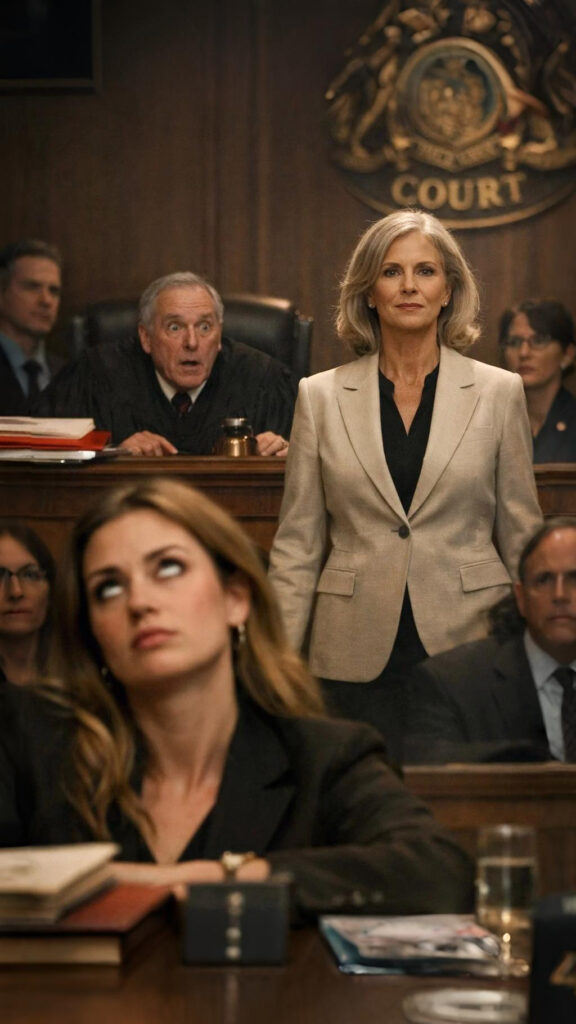
When I entered the courtroom, the sound of my own footsteps felt too loud. Every pair of eyes seemed to follow me — not because they knew who I was, but because they thought they did.
My daughter sat near the front, elegant in her carefully chosen navy suit, pretending not to see me. When she finally turned, her expression said more than words ever could. The slight roll of her eyes, the faint sigh, the way she whispered something to her lawyer — all of it carried the weight of years of contempt disguised as pity.
To her, I was just the embarrassing mother who didn’t know when to stop fighting.
I found my seat quietly. The wooden bench was cold, and my hands trembled as I adjusted the papers in my lap — not from fear, but from the knowledge that everything about this day had been designed to humiliate me.
The whispers started before the judge even entered. “Is that the mother?” someone muttered. “She looks nervous.” Another voice: “Didn’t she lose her house? Poor woman.”
No one knew the truth.
My lawyer — young, polite, overly cautious — leaned toward me and murmured, “Just stay calm, Mrs. Hall. We’ll speak when it’s your turn.”
Mrs. Hall. The name they used as if it belonged to someone fragile, someone ordinary.
The bailiff called for order. The room fell still as the judge entered, robes flowing, expression unreadable. I’d seen that look before — authority masking curiosity. He adjusted his glasses, scanning the papers before him.
Then his gaze lifted.
He saw me.
For a fraction of a second, the mask slipped. His eyes widened, just slightly. And then, under his breath, so quietly that only the clerk beside him heard, he whispered, “Is that her?”
The question rippled through the silence like a spark finding dry wood. Heads turned. My daughter stiffened in her seat, glancing toward me, confused, sensing that something had shifted — but not yet understanding what.
The judge cleared his throat, pretending composure, but I could feel the tremor in his voice. “We’ll begin shortly,” he said, though his eyes remained fixed on me as if recalling a face from a long-buried memory.
For a moment, I wondered if he remembered the night thirty years ago when I stood in another courtroom, but on the other side of the bench. When my name carried a different kind of power.
He wouldn’t say it out loud. Not yet.
My daughter leaned toward her lawyer. “What’s going on?” she whispered. “Why is he looking at her like that?”
No one answered.
The air had changed.
I kept my hands still, the papers perfectly aligned, every movement measured. I knew that the smallest sign of reaction could give me away too soon. Let them wonder. Let them question.
Because the truth wasn’t ready to be spoken — not until they showed me their full cruelty first.
Across the room, my daughter’s husband entered late, flustered, carrying documents as if his performance would save them both. He avoided my gaze. I almost pitied him. He had no idea what this day would cost.
The clerk called my name formally, and for a moment, I almost didn’t recognize it. I had lived too many lives under too many versions of that name. Some had been erased, others buried under my own silence.
But now, it echoed through the courtroom — steady, undeniable.
I rose. The floor creaked beneath my shoes. My daughter looked away again, exhaling through her nose like a teenager forced to sit through a lecture. She didn’t know this was the beginning of her education.
When I reached the witness stand, the judge’s eyes followed me again. There was something human behind the professionalism — a mix of recognition and guilt. He knew something. He remembered something.
And for the first time in years, I let a faint smile touch my lips.
Not the smile of a defeated woman. The smile of someone who has waited long enough to be underestimated.
The silence in the room deepened until you could almost hear the ticking of the clock above the door.
Every heartbeat, every breath, every unspoken question hung between us.
They thought this was a hearing about property. About inheritance. About a daughter trying to declare her mother incompetent.
But that wasn’t the real case.
The real case had begun the moment I walked into the room and the judge whispered, “Is that her?”
And though no one else knew it yet, the verdict — the true one — had already been written long before today.
I just needed them to realize who they were judging.
Who they had betrayed.
And who, at last, had returned to speak.
Chapter 2 – The Past She Buried
That night, after the first day in court, I couldn’t sleep. The sound of the gavel still echoed in my ears, blending with the whisper that had frozen the entire room — “Is that her?”
It had been decades since anyone had said those words about me. Back then, they were spoken with respect, sometimes fear, but never confusion. The world had a short memory, and I had helped it forget.
In the dim light of my apartment, I poured tea I didn’t drink. The window reflected a woman older than her years, with eyes that had seen too much and learned to reveal nothing. Beneath the calm exterior, though, something was stirring — not anger, but awakening.
The papers on my kitchen table were not just legal documents. They were fragments of my life, the pieces my daughter believed she could erase.
She thought this case was about money. About the house. About inheritance.
But it wasn’t.
It was about history. About legacy. About the truth she was too proud to face.
When she was a child, I used to tell her stories about the people I worked for — names that appeared in newspapers, faces that smiled on magazine covers. She thought I was exaggerating, or living in fantasies of a forgotten youth. She never asked how I afforded her schooling, her piano lessons, the trips she bragged about to her friends.
She never knew the cost.
I had spent twenty years building something few women were allowed to build — a network of influence hidden behind quiet gestures and closed doors. I’d been called the “shadow behind decisions,” though no one ever printed my name beside that title.
And when it all fell apart — when the men who’d used me for my strategy and silence turned on each other — I disappeared.
I became someone else.
Mrs. Hall.
The widow who baked pies for church sales. The mother who stayed quiet. The woman who never corrected anyone’s assumptions.
Until my daughter decided to use the courts to take what she thought was mine.
The irony almost made me laugh.
She believed she was protecting her inheritance, but she was walking straight into the only arena I ever truly ruled — the theater of truth, power, and exposure.
When dawn came, I put on my old coat. Inside the pocket, hidden beneath the lining, was a small key — the last relic from that other life. I ran my fingers over it and felt the weight of everything it unlocked.
At ten o’clock, I met my lawyer at the café across from the courthouse. He looked nervous, flipping through his notes as if paper could protect him from what was coming.
“Mrs. Hall,” he said, avoiding my eyes, “your daughter’s petition paints a strong picture. They claim emotional instability, poor memory, questionable decisions. It’s… persuasive.”
“Persuasive,” I repeated, tasting the word. “Do you believe it?”
He hesitated. “No. But others might.”
“Good,” I said. “Let them.”
He blinked. “I’m sorry?”
“Let them believe I’m weak,” I said, stirring my untouched coffee. “It’s better that way.”
He didn’t understand. He wasn’t supposed to.
The courtroom was the same the next morning — same sterile air, same hollow quiet. But the energy had changed. I could feel it. The judge avoided my eyes this time, as though uncertain of what he’d seen the day before.
My daughter entered, flanked by her lawyer and her husband, their expressions rehearsed — grief for the cameras, indignation for the record. She had learned well from the world I once moved through. She knew how to perform righteousness.
What she didn’t know was that performance was my invention.
When the hearing began, she spoke first. Her voice was steady, trained, almost elegant. She talked about my “mental decline,” about my “confused decisions,” about how she feared I might “harm myself financially.”
The courtroom listened. Heads nodded. Pens scratched across paper.
And I watched, silent, as my own daughter weaponized compassion.
When it was my turn, I stood slowly, every motion deliberate. “Your Honor,” I began, my voice calm but edged with something that made the stenographer pause. “My daughter believes I’m no longer capable of making rational decisions. I don’t blame her. She never knew me.”
The lawyer tried to interrupt, but the judge raised a hand. He wanted to hear more.
So I gave him a little more. Not too much — just enough to make him wonder again.
I spoke of years unaccounted for, of decisions made in rooms that no longer existed. I mentioned people by first name only — names that made the judge shift in his seat. A few jurors exchanged glances.
My daughter’s lawyer objected, claiming irrelevance.
The judge overruled.
And for the first time, I saw a flicker of fear on my daughter’s face.
She didn’t recognize the woman standing before her.
She had grown up thinking her mother was a relic, a ghost of a simpler time. But now she saw something else — the trace of a power she’d never imagined, a history she couldn’t control.
When the session ended, reporters were already gathering outside, drawn by the tension they couldn’t yet name.
I walked past them without a word.
Behind me, I heard one whisper to another, “Who is she?”
I almost turned. Almost.
But I didn’t need to. The answer would come soon enough.
That night, alone again, I opened a small metal box from the back of my closet. Inside were documents older than my daughter, photographs she’d never seen, and letters signed by men who’d since vanished into history books.
I traced my finger over one seal in particular — a crest that once opened every door in the city.
They thought I’d gone quietly.
They thought I’d let them bury my name.
But now, my own daughter had called me back into the light, thinking she could shame me.
She had no idea she’d just reopened the past.
And once the past begins to speak, it never forgets the sound of its own voice.
Chapter 3 – The Daughter’s Stage
By the third day, the courthouse felt like a theater built for a play I had already written years ago. The benches creaked, the air conditioning hummed like static, and everyone spoke in hushed tones as though anticipating a revelation they couldn’t quite describe.
My daughter arrived early that morning. Her lipstick was darker than usual, her hair pinned back in the style she’d worn during her first job interview—the one I had arranged through a favor she never knew I called in. She was nervous, but determined to hide it. The camera crews outside were growing bolder, and she had learned to walk with the poise of someone who believed herself the heroine.
She wanted this day to belong to her.
When I entered the room, she turned deliberately, meeting my gaze for the first time since the hearing began. There was no love there. Only performance.
She was ready to prove herself the victim of a mother gone astray.
“Good morning, Mother,” she said, loud enough for the reporters to hear. “I hope you understand this is for your own good.”
Her lawyer smiled, a gesture rehearsed to appear humane. “Mrs. Hall, our only concern is your wellbeing.”
I sat down, letting the words hang unanswered. I had spent a lifetime studying language—how it can conceal more than it reveals. Every sentence my daughter spoke sounded like a cage.
The judge entered moments later. He didn’t meet my eyes this time, but I saw the hesitation in his step, the faint tremor in his hand as he adjusted his robe. Whatever memory my presence had stirred, it was now beginning to take shape.
The hearing opened with testimony from my daughter. She spoke of my “erratic behavior,” my “financial recklessness,” the supposed “confusion” that had made her fear for my safety. She had gathered statements—neighbors, a doctor, even a former colleague of mine from decades ago who’d traded his integrity for her favor.
Each witness painted me as fragile. Forgetful. A woman sliding quietly into decline.
I listened. I nodded. I let them weave the story they wanted the world to hear.
Because in the end, the most powerful truth is the one that grows in silence.
When it was my turn to respond, I rose slowly. The courtroom stilled again. The judge cleared his throat but didn’t stop me.
“My daughter believes I am unwell,” I began. “She says I’ve forgotten who I am. Perhaps she’s right—perhaps I did forget for a time. I forgot that I was the one who built everything she stands on.”
Her face flushed, a flicker of panic beneath her practiced calm.
“You claim I am irresponsible,” I continued. “But tell me, what did I pay for your first apartment? For your husband’s education? For the business you now call your own? Do you remember the exact amount?”
No one spoke.
“Let me remind you,” I said softly. “Two hundred and forty-six thousand dollars. Every cent wired from accounts in my name. Do you know where that money came from?”
The lawyer tried to interject—“Relevance, Your Honor”—but the judge didn’t look at him. His eyes were locked on me.
“It came,” I said, “from a company that doesn’t exist anymore. Because I dissolved it before they could find out who was running it. Do you recall that company, Judge Walters?”
A pause.
His expression betrayed him—recognition. A flicker of memory.
The room shifted. Even my daughter turned to look at him, confused. “What is she talking about?” she asked, but he didn’t answer.
He knew.
He remembered.
I could almost hear the calculation in his silence—how far he could let me go before the truth became too inconvenient.
“Mrs. Hall,” he finally said, his voice tight, “this court is concerned with your current financial and emotional stability, not with events from decades ago.”
“I understand,” I replied. “But you see, my stability has never depended on anyone’s approval. Especially not now.”
I sat down again, and the silence that followed was heavier than anything I’d said.
Outside, during the recess, reporters surrounded my daughter. They asked about the name I’d mentioned, the dissolved company, the judge’s reaction. She brushed them off, smiling too brightly, insisting it was all confusion—“My mother has a vivid imagination,” she told them.
But the seed was already planted.
People love a mystery more than they love certainty.
That evening, after the courthouse emptied, I lingered in the corridor. The fluorescent lights flickered, humming softly. My daughter’s lawyer passed by, pretending not to notice me, but I stopped him with a single question.
“Do you know who your client’s mother used to be?”
He hesitated. “You were a businesswoman, I assume.”
I smiled. “No. I was the one who kept businessmen out of prison.”
He paled, offering a stiff nod before walking away faster than before.
Back in my apartment, I sat at my desk and opened the metal box again. Inside were not just old letters but signatures—agreements made in rooms where silence was currency. Deals struck under my guidance, masked through intermediaries. I had destroyed the originals long ago, but I kept these copies for one reason: insurance.
My daughter thought this was about property.
She had no idea she had put herself on trial.
As I sorted through the papers, I found a photograph of her as a child, standing in front of our old house, holding the first violin I’d ever bought her. Her smile was genuine then. Innocent. Before she learned how to disguise love as ambition.
I felt something ache deep inside me—not regret, exactly, but a tired kind of sorrow. She had become everything the world rewarded: beautiful, articulate, ruthless.
She had learned well from me.
And that was precisely what would destroy her.
The next morning, I would bring evidence—not of incompetence or confusion, but of legacy. I would show them who I had been and, by extension, who they had underestimated.
The courtroom would see more than an aging widow.
They would see the woman behind the curtain, the one they’d whispered about long ago.
And my daughter, sitting there with her perfect posture and cold eyes, would finally understand that she hadn’t inherited my weakness.
She’d inherited my fire.
But she’d aimed it at the wrong person.
Chapter 4 – The Room of Shadows
When I arrived at the courthouse that morning, the light felt wrong—too white, too sharp, as if even the sun wanted to expose something. Reporters clustered near the steps, their cameras flashing, voices tumbling over one another in search of a quote. My daughter’s name was already circulating through online headlines, paired with mine in ways that made her carefully curated image tremble.
I watched her from a distance as she posed for the cameras. Her smile was steady, her hand delicately resting on her lawyer’s arm. She looked like a woman in control of her story. But I had written stories longer than she’d been alive, and I knew how quickly a narrative can turn against its author.
Inside, the courtroom was quieter than usual. The clerk’s shoes clicked across the floor. The bailiff avoided my eyes. Even the judge seemed hesitant to begin. The day’s agenda was clear: the presentation of financial records, testimony from the family accountant, a routine exercise in numbers and credibility.
Except the numbers I carried with me were not routine.
When the session began, my daughter’s lawyer called the accountant to the stand. He was an old man, one who had worked for me long before he ever met her. He adjusted his glasses, cleared his throat, and began reciting figures like verses from a scripture he didn’t believe in. My daughter sat upright, serene, convinced that precision was her ally.
“Can you confirm,” her lawyer asked, “that these transactions demonstrate irregularities—unusual transfers, unsanctioned withdrawals, unaccounted income?”
The accountant hesitated. “They do,” he said, “but—”
“No further comment is necessary,” the lawyer interrupted.
But I could see it. The small tremor in the accountant’s hand. The way he avoided looking at me.
When my lawyer rose to cross-examine, his voice was steady but tentative. “Mr. Crane, you’ve worked with Mrs. Hall for how long?”
“Thirty-four years,” the man said quietly.
“During that time,” my lawyer continued, “did you ever find her to be… incapable of understanding financial matters?”
A pause.
“No,” he said finally. “She was the most precise person I’ve ever worked with. She knew every cent before it was printed.”
My daughter’s expression faltered, just for a second.
“Then how do you explain the missing funds?” her lawyer demanded.
Mr. Crane exhaled slowly. “Because,” he said, looking directly at me now, “they were not missing. They were redirected.”
The room tensed.
“Redirected where?” the lawyer asked.
The accountant swallowed hard. “To a foundation. One established under a different name, but with Mrs. Hall’s signature hidden within its documents. The same foundation that funded several judicial scholarships over two decades ago.”
The judge froze. His pen stopped moving.
I could almost hear the silence settle, thick and electric.
My daughter’s lawyer stammered, “What does that have to do with this case?”
“Everything,” I said, rising before my lawyer could stop me.
The judge looked at me warily. “Mrs. Hall, you’ll have your turn.”
“This is my turn,” I replied. My voice was calm, too calm. “For years, I managed networks that funneled money through invisible paths. Some called it corruption. Others called it survival. But it built this city, this very courthouse, and the careers of men who now pretend they don’t remember.”
I turned to my daughter. “You wanted to prove I’d lost my mind. That I’d forgotten who I was. But the truth is, I remember too well. And that frightens them.”
Her face drained of color.
The judge cleared his throat. “Mrs. Hall, please refrain—”
“You remember too, don’t you, Judge Walters?” I said quietly. “Those scholarships that saved reputations, that paid for silence. Do you recall who signed the authorizations?”
He didn’t answer.
Because he couldn’t.
The gallery began to murmur. The reporters scribbled frantically. My daughter’s lawyer demanded a recess. The judge, pale now, agreed.
The gavel struck once, but the sound was hollow. The damage was done.
During the break, my daughter cornered me in the corridor. Her eyes were sharp, her voice a hiss. “What are you doing?”
“What you should have done,” I said.
“You’re destroying everything!”
“No,” I corrected her, “I’m revealing everything. There’s a difference.”
“You’ll ruin us!”
I looked at her carefully, searching for the child I once held, the girl who believed the world was fair because I made it so. “No,” I said again. “I’ll free us.”
She didn’t understand yet. She couldn’t.
That night, I sat by the window of my apartment, the city below alive with restless lights. My lawyer had begged me to stop talking, to let the evidence speak for itself. But silence had cost me too much already.
I opened a folder I had kept sealed for decades. Inside were names, numbers, correspondences, and one letter written in a hand I knew too well—the judge’s, thanking me for “discretion that saved a future.”
I wondered if he remembered writing it.
Outside, sirens wailed distantly. The city never slept, and neither did guilt.
I thought of my daughter again, how she had tried to build a life from the ruins of mine, never realizing the foundation beneath her feet was made of secrets.
She would wake soon to find her name trending in every newspaper. They would question her credibility, her inheritance, her truth.
And she would finally feel what I had carried all these years—the weight of being known and unknown at once.
The next day would not be about property. It would not be about competence. It would be about history finally dragging its ghosts into daylight.
And for the first time since stepping into that courtroom, I felt something close to peace.
Not because I had won.
But because I had stopped pretending to lose.
Chapter 5 – The Reckoning
The morning began in silence. Not the quiet of peace, but the heavy kind that presses against your chest and listens to what your heart refuses to say.
Outside the courthouse, cameras waited like vultures. The air was colder, the sky the color of ash. My name had already spread through every corner of the city—half myth, half scandal. By the time I stepped out of the car, I could feel the pull of whispers wrapping around me like smoke.
My daughter was already there, standing at the top of the steps, her face pale beneath layers of defiance. She looked smaller now. The cameras that once flattered her had turned cruel, seeking the cracks in her composure.
When she saw me, she forced a smile that trembled at the edges. “You’re enjoying this, aren’t you?”
I didn’t answer.
Because it wasn’t joy. It was justice disguised as inevitability.
Inside, the courtroom was crowded. The air tasted of nerves and perfume. Reporters filled the back rows, their pens ready, their eyes sharp. The judge entered without looking at me, but the tightness in his jaw betrayed the fear beneath the mask.
This was the day they would try to end it—to decide if I was fit to control my own life, my own fortune, my own name. But they didn’t understand that I had already taken control by exposing theirs.
My daughter’s lawyer opened the session with trembling politeness. “Your Honor, we request the court to consider the emotional and psychological strain Mrs. Hall is experiencing. Her outbursts yesterday—”
“Outbursts?” I interrupted, my voice steady. “You mean truth.”
He cleared his throat. “Her statements were… sensational. Potentially damaging to reputations unrelated to this case.”
“Then those reputations were built on fragile ground,” I said.
The judge struck the gavel once. “Mrs. Hall, please. Let us proceed.”
I sat, folding my hands over the folder that had slept in my possession for twenty years. My lawyer glanced at it as if it were a ticking bomb.
When the time came for my testimony, I stood again.
“I was accused,” I began, “of being forgetful. Of being unstable. Of losing control of my own affairs. But tell me, Your Honor, how can someone be called unstable for remembering too much?”
The judge’s pen stilled.
I opened the folder. One by one, I placed the documents on the table before me—letters, signatures, records of transactions, each a relic from the city’s hidden past.
“These,” I said softly, “are pieces of history everyone agreed to forget. Except me.”
My daughter rose abruptly. “You can’t—these are confidential!”
“No, my dear,” I said, meeting her eyes. “They were confidential. Now they are evidence.”
Her lawyer rushed forward, his voice rising, “Your Honor, this is irrelevant, this—”
“Sit down,” the judge said quietly.
It was the tone that silences storms.
He leaned forward, studying the papers with a face drained of color. His hands trembled once before he regained control. He recognized them. Of course he did.
For years, those documents had lived in the dark—proof of secret donations, hidden beneficiaries, the quiet exchange of favors that had built entire careers.
Including his.
I watched the realization settle over the room like a slow dawn.
The reporters knew they were witnessing more than a family dispute. They smelled the story behind the story. The daughter, the inheritance, the mother who wasn’t senile but strategic.
The judge closed the folder. His voice was a whisper of authority cracking under weight. “We will recess for fifteen minutes.”
No one moved for several seconds after he left.
Then chaos.
Reporters flooded the aisle, cameras flashed, my daughter shouted for order that no longer existed. Her voice cracked in a way that made something deep inside me ache. I had not wanted to destroy her—only to free her from the illusion she thought was power.
When the room finally cleared, I remained seated. My lawyer stood beside me, unsure whether to congratulate or fear me.
“Was this your plan all along?” he asked.
I didn’t look at him. “No,” I said. “Plans end. This is continuation.”
He didn’t understand, but that didn’t matter.
Outside, the crowd was swelling. The story had escaped the walls. I could hear my name being spoken with both awe and suspicion. Who is she? What did she uncover?
I stepped out into the cold air. The city that had once erased me was speaking my name again.
From the bottom of the courthouse steps, my daughter called out, “What happens now?”
I turned. She stood framed against the stone pillars, hair undone, her voice trembling. “You’ve ruined us both.”
“No,” I said, softly but clearly enough for her to hear. “I’ve released us.”
She shook her head, tears threatening the precision of her mascara. “You don’t understand, Mother. They’ll come after you now.”
“They already did,” I said. “And I survived.”
For a moment, neither of us moved. The wind carried the echoes of our silence.
Then she turned away, walking down the steps slowly, swallowed by the swarm of reporters and flashes.
I remained there, alone at the top, watching the storm unfold.
It wasn’t victory. It wasn’t revenge.
It was truth, raw and irreversible.
That night, in the quiet of my apartment, I watched the evening news. My daughter’s face appeared beside mine on every channel. Her voice, once polished, now trembled through statements of denial. They called it The Hall Affair, though none of them knew what it truly meant.
I turned off the television and sat in the dark.
The silence felt different now. Not the silence of exile, but of aftermath.
I thought about the girl my daughter used to be—the one who believed in fairness, who laughed without fear of being seen as weak.
I wondered if that girl was still buried somewhere beneath the woman who tried to destroy me.
And for the first time since the trial began, I whispered into the stillness, “I forgive you.”
The words surprised me. They didn’t sound like surrender.
They sounded like closure.
Tomorrow, the papers would twist the story again. They always did. But it didn’t matter anymore.
Because the truth was mine, and finally, so was my life.