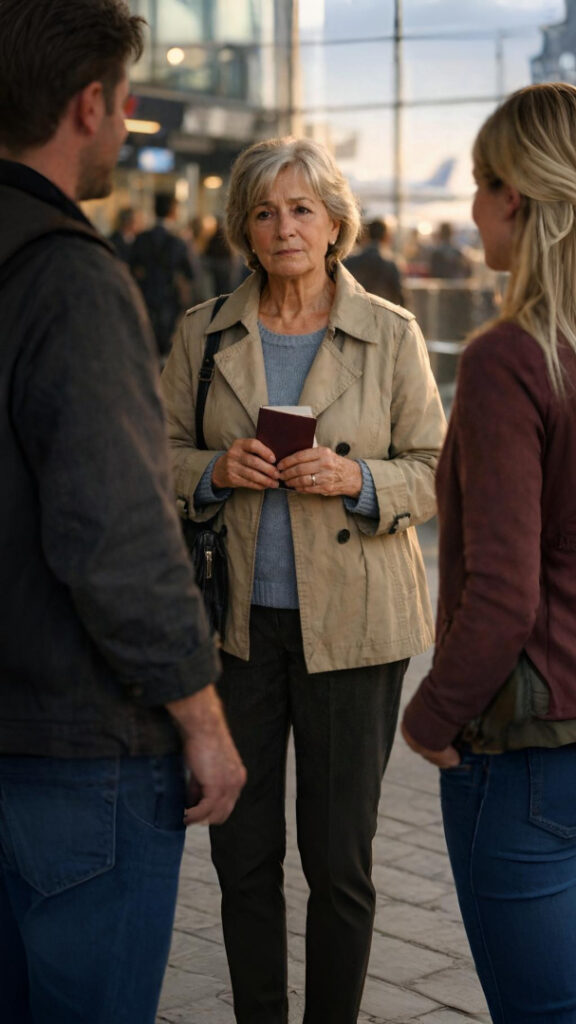
Chapter 1 – The Invisible Sacrifice
I am sixty-three years old now.
Old enough to have learned how to be quiet.
Old enough to know when my presence is convenient rather than wanted.
But back then, I still believed love was something you proved by giving more.
I bought the plane tickets months in advance.
Three of them.
Window seats, because the kids liked watching the clouds.
Extra legroom, because my knees had started to ache on long flights.
I didn’t tell anyone how much they cost.
I never do.
I only said, “Don’t worry about it. I’ve got it covered.”
And I meant more than the tickets.
For years, I had been the invisible foundation beneath everyone else’s comfort.
The quiet constant.
The one who filled in the gaps before anyone noticed they existed.
When my son and his wife struggled financially, I stepped in.
Not once.
Not twice.
So many times that it stopped being a favor and became an expectation.
I paid for school supplies.
Doctor visits.
Winter coats that the children would outgrow in a single season.
I sent money without being asked.
And sometimes after being asked in a tone that assumed the answer.
Every transfer felt small on its own.
But together, they built a life I was never invited to fully live.
I skipped trips for myself.
Postponed replacing furniture that creaked when I sat down.
Learned to stretch groceries for an extra week.
I told myself it was temporary.
That family worked like this.
That one day, when things settled, there would be gratitude.
And love.
The grandchildren were my reward.
Or so I thought.
I babysat whenever they called.
Canceled appointments.
Rescheduled my own life around theirs.
When I arrived, they would run to me, arms open, voices high with excitement.
“Grandma’s here!”
Those moments convinced me everything was worth it.
Even when I noticed how quickly the adults disappeared once I walked through the door.
Even when dinner plans somehow excluded me unless I cooked.
Even when my presence became background noise.
I told myself not to be sensitive.
That’s what women of my generation were taught.
Endure quietly.
Give generously.
Expect little.
When the idea of the family trip came up, I was the first to offer help.
“I’ll take care of the flights,” I said.
“It’s easier that way.”
My son smiled with relief.
His wife nodded, already moving on to the next detail.
No one asked if it was a burden.
No one asked if I wanted anything in return.
I watched them plan activities.
Hotels.
Restaurants.
I wasn’t included in those conversations.
But I told myself that didn’t matter.
I was going for the children.
For the laughter.
For the photos.
For the illusion that I belonged somewhere inside that picture.
The tickets sat printed on my kitchen table for weeks.
Every time I passed them, I felt a strange mix of pride and something heavier.
A quiet ache I couldn’t name yet.
Still, I folded the papers carefully.
Slid them into an envelope.
And smiled when I handed them over.
“Thank you, Mom,” my son said.
It sounded sincere.
It always did.
I didn’t know then that this would be the last time I offered without hesitation.
The last time I believed giving more would finally make me matter.
I didn’t know that something as small as a single sentence, spoken later, would force me to see everything I had been pretending not to notice.
For now, I was still the giver.
Still the one who paid.
Still the woman who believed love was proven through sacrifice.
And I was about to learn how invisible that kind of love can be.
Chapter 2 – The Sentence That Split the Air
Airports have their own kind of chaos.
People rushing, voices echoing, children tugging at sleeves, announcements dissolving into static.
It’s a place where no one really listens—everyone just moves.
I remember holding my purse close, the tickets tucked neatly inside, my fingers pressing against the envelope like it contained something sacred.
It did, in a way.
My effort.
My love.
Months of quiet anticipation.
They arrived late, my son pushing the luggage cart, his wife walking beside him, phone in hand.
The children ran ahead, waving, already shouting about airplanes and snacks.
“Grandma, are we going soon?” one of them asked, eyes bright with excitement.
“Yes, sweetheart,” I said, smiling. “We’ll be flying together in just a few minutes.”
The sentence would not age well.
At the counter, I opened my bag, ready to hand the tickets to the attendant.
That’s when my daughter-in-law turned to me, her voice oddly casual, like she was commenting on the weather.
“Oh—about that,” she said.
“We actually gave your ticket to my mom. The grandkids love her more.”
I thought I hadn’t heard right.
The noise around us felt distant, muffled, like someone had closed a door in my head.
I blinked once, twice.
My son didn’t meet my eyes.
He just nodded slightly, as if this had already been discussed and agreed upon somewhere I wasn’t invited.
“She’s been feeling lonely,” he murmured. “We thought it would be nice for her to come.”
I waited for someone to notice how wrong that was.
For the air to shift.
For one of them to say, “Of course, Mom, we’re joking.”
But no one did.
Instead, the clerk asked for confirmation, and my daughter-in-law smiled brightly, handing over passports.
Just not mine.
I felt something inside me stretch, a slow tearing.
It wasn’t anger yet.
It was disbelief dressed as calm.
So I nodded.
Because that’s what I do.
I nod, I understand, I make things easier.
“Of course,” I said softly.
“Of course.”
The words tasted like ash.
She thanked me—thanked me—for “understanding.”
Her hand touched my arm briefly, light as static.
Then she turned away to take a selfie with the children.
I watched them pose, the four of them framed by the brightness of the terminal windows.
My family.
My legacy.
And in that instant, I realized I wasn’t part of the picture anymore.
My son finally looked at me.
There was guilt in his eyes, but not enough to stop him.
He opened his mouth as if to speak, but nothing came out.
Silence was easier.
I nodded again.
Because silence has always been my native language.
I walked away before anyone could see my hands trembling.
Found a quiet spot near the glass, where planes taxied slowly in the distance, graceful and unaware.
I thought about all the dinners I had missed so they could go out.
The late nights spent ironing shirts before interviews.
The quiet mornings I sent money with a cheerful text: “Just in case you need it.”
Apparently, they had needed it.
But not me.
A woman sitting nearby smiled politely, assuming I was waiting for someone.
I smiled back.
Because I was good at pretending.
My phone buzzed—messages from friends, a reminder from the pharmacy, a weather alert.
Nothing from them.
I stayed there, still as a shadow, until I saw them moving toward the gate.
My son carrying one of the kids, his wife laughing at something on her phone.
Her mother walked beside them, clutching her boarding pass like a prize.
They looked like a complete family.
For a brief second, I considered calling out.
Saying something—anything—to make them stop.
To remind them that I existed.
But I didn’t.
I just watched until they disappeared behind the glass doors.
The automatic panels closed with a hiss, sealing the moment like a wound.
When the silence settled again, I exhaled.
It was a small, controlled breath, the kind you take before making a choice you can’t undo.
Because something in me had shifted.
The quiet woman who always gave, who always forgave—she was still there, but she had started to open her eyes.
I picked up my purse and stood slowly.
For the first time in years, I had no one waiting for me and nowhere to rush to.
The emptiness should have felt crushing.
Instead, it felt strangely clean.
I left the terminal without looking back.
Outside, the air was colder than I expected.
The parking lot shimmered under the afternoon sun, cars moving in and out, lives intersecting for brief moments before diverging forever.
I walked until the sound of airplanes faded, replaced by the dull hum of the highway.
The world went on, oblivious.
But inside me, something had cracked wide open.
I didn’t cry.
Not yet.
Not because I wasn’t hurt—God knows I was—but because the hurt was still finding its shape.
I sat on a bench near the exit and watched people come and go, their arms full of luggage, their faces bright with expectation.
They were all going somewhere.
And for the first time in a long while, I wondered where I would go if I wasn’t always following someone else’s plans.
It was a dangerous thought.
And a liberating one.
I didn’t know then that this quiet moment—this pause between humiliation and action—would become the invisible line dividing the woman I had been from the woman I was about to become.
But the first cracks in obedience had already formed.
And once something starts to break, it rarely stops at the surface.
Chapter 3 – The Weight of Silence
The ride home felt longer than it should have.
Maybe because there was too much quiet, or maybe because silence has a way of stretching time until it feels like punishment.
I sat in the back of the taxi, hands folded in my lap, my reflection trembling faintly in the window.
The driver asked if I was heading home from a trip.
I smiled and said yes.
It was easier than explaining that I hadn’t gone anywhere.
When the car stopped in front of my house, everything looked the same.
The hydrangeas I had planted last spring had started to wilt.
A few petals lay scattered across the walkway, pale blue against the gray stone.
I unlocked the door, stepped inside, and was met by the faint smell of dust and lavender.
It’s strange how quickly a house becomes unfamiliar when you come back feeling like a different person.
I set my purse on the table.
The envelope with my unused ticket was still inside, edges slightly crumpled now.
It looked small and ridiculous—like proof of how easily I could be replaced.
For a long while, I just stood there.
Then, slowly, I sat down and took off my shoes.
They had been new.
Bought for the trip.
Comfortable, elegant, the kind I thought would make me look like I belonged beside my son’s well-dressed wife and her polished family.
Now they just looked unnecessary.
I don’t remember crying right away.
The tears came later, without warning, when I opened the fridge and saw the small carton of juice I had bought for the grandkids.
It was their favorite kind—apple and mango.
I had imagined handing it to them before the flight, hearing their laughter fill my kitchen.
Instead, I poured a glass for myself.
It tasted too sweet.
I sat at the table, the clock ticking softly above me, and let my thoughts wander where they wanted.
They went to my son first.
The boy who once held my hand at airports, nervous about flying, always asking, “Will you sit next to me, Mom?”
Then they went to his wife, with her smooth voice and sharper eyes.
I had tried to love her.
Tried to be patient with the little comments, the polite corrections, the moments she turned my efforts into inconveniences.
And then, inevitably, my thoughts found their way to myself.
The woman who had said nothing.
The woman who always said nothing.
I thought about the quiet nod at the airport, how natural it had felt to agree to something that broke me.
It wasn’t the first time I had done it.
I’d been nodding all my life.
“Yes, I’ll help.”
“Yes, I understand.”
“Yes, it’s fine.”
My silence had become a kind of currency.
And I’d spent it all.
At some point, I moved to the living room and turned on the TV, not to watch, just to have noise.
The light flickered across the empty space, voices rising and fading, none of them meaning anything.
It filled the room the way people fill their lives with distractions when the truth gets too loud.
The truth was this: I had become invisible long before the airport.
That moment wasn’t a beginning—it was the confirmation of something I had been refusing to admit.
I was no longer needed.
Not as a mother.
Not as a grandmother.
Not even as a convenient wallet.
They had replaced me, and the world hadn’t ended.
That realization should have crushed me.
Instead, it made me strangely alert.
Because beneath the ache, there was a new kind of awareness growing quietly.
A voice that wasn’t quite mine yet, but close.
“You can stop now,” it whispered.
Stop what?
Giving?
Trying?
Believing?
All of it.
The first night, I didn’t sleep much.
I kept hearing the same words again and again—The grandkids love her more.
They looped in my head like a cruel refrain, but with every repetition, their sharpness dulled a little.
By morning, I could almost breathe through them.
I made coffee, black and strong.
The kitchen filled with steam, and for the first time, I didn’t imagine anyone else sitting at the table.
No noise.
No interruptions.
Just me.
It was lonely.
But also peaceful in a way I hadn’t expected.
Later, I took out a small notebook from the drawer where I kept old bills and receipts.
On the first blank page, I wrote: Things I’ve done for others.
The list grew faster than I thought it would.
Groceries.
School tuition.
Medical bills.
Holidays.
Birthdays.
Loans I’d never see again.
Next page: Things I’ve done for myself.
The pen hovered for a long moment.
Then I wrote one word.
Nothing.
It looked too final, so I crossed it out and left the space empty.
By afternoon, I decided to clean the house.
Not out of duty this time, but out of clarity.
Each object I touched carried a memory—some warm, some heavy.
The family photos stayed on the shelves, but I turned one of them face down: the one from Christmas two years ago, where my daughter-in-law stood in the middle, hand on my son’s shoulder, while I lingered at the edge of the frame.
The picture had always bothered me.
Now I understood why.
It was the visual proof of a slow erasure.
And I had smiled through it.
That evening, I opened the curtains and watched the sunset bleed into the horizon.
A small airplane crossed the orange sky, its trail thin and white, vanishing slowly.
Maybe theirs.
Maybe not.
It didn’t matter.
I whispered something to the empty room.
“I hope the kids are happy.”
Then I added, after a pause, “But I hope I will be too.”
The words surprised me.
They sounded unfamiliar, yet solid, like something real taking form inside my chest.
And as the light faded, I realized that sometimes silence isn’t weakness.
Sometimes it’s the sound of the old self stepping aside to make space for someone new.
The world outside went on, unaware.
But inside that small, quiet house, a woman who had spent her life giving finally began to hear her own voice.
Chapter 4 – The Quiet Before the Decision
The next morning, sunlight spilled through the blinds, soft and hesitant, as if unsure whether it was welcome.
I sat at the kitchen table, hands wrapped around a cup of coffee gone cold.
The house was still, filled with the faint hum of the refrigerator and the distant chirping of birds.
It felt like a waiting room for a life I hadn’t yet chosen.
I tried to distract myself with ordinary things—watering the plants, sorting mail, folding laundry—but everything seemed to echo the same thought: They left without me.
And I had let them.
My phone buzzed once, breaking the stillness.
A message from my son.
“We just landed. Kids say hi!”
I stared at the screen for a long time.
No apology.
No acknowledgment.
Just cheerful normalcy, as if the scene at the airport had been a mild misunderstanding rather than a betrayal.
I typed and deleted three replies before finally sending nothing.
Let silence answer.
I stepped outside to the small porch, the one I used to decorate with flowers each summer.
The air smelled faintly of rain and cut grass.
Across the street, a neighbor waved.
I waved back automatically.
To everyone else, life looked ordinary.
Only I knew that something irreversible had begun inside me.
That evening, I found myself pulling out old letters—birthday cards, Mother’s Day notes, childish drawings scrawled with “I love you, Grandma.”
They used to make me smile.
Now they made my chest tighten with a kind of nostalgia that felt heavier than grief.
I sat on the floor surrounded by pieces of my past, paper memories of a time when my love still had a place to land.
It struck me how easily it had all changed.
How quickly affection could be redirected to someone more convenient.
My daughter-in-law’s mother—“Nana,” they called her now—was probably reading bedtime stories at that very moment.
My grandkids would laugh, unaware of what had been taken from me.
From us.
I wondered if she had ever paid for their school trips, or stayed up through fevers, or skipped her own meals so her son could have one more chance at something.
I doubted it.
But she was there, and I wasn’t.
Sometimes, presence is all it takes to rewrite love.
The next day, I woke up earlier than usual.
The sun hadn’t risen yet, and the world outside was painted in shades of blue and gray.
I brewed fresh coffee, stronger this time, and sat by the window.
My reflection looked tired, but alert.
Something inside me had settled overnight.
Not peace—something quieter, sharper.
Resolve.
I took out a folder from the desk drawer.
Inside were copies of my will, bank statements, and a document with my son’s name listed as joint owner on one of my accounts.
I remembered adding him years ago.
“Just in case something happens,” I had said.
He’d smiled, grateful, and told me not to worry.
I had worried anyway.
Now I wondered why I’d never worried about myself.
I looked at the numbers—savings, property, the small pension that had kept everything afloat.
It wasn’t much by anyone else’s standards, but it was the result of a lifetime of work.
Every dollar carried a piece of me.
And I had been giving it away without question.
The idea came quietly, almost shyly.
Not out of spite, but clarity.
I needed to reclaim something.
My time.
My choices.
My worth.
I called the bank.
The woman on the other end was polite, her voice soft and practiced.
“Yes, we can remove a joint holder,” she said. “You’ll just need to come in person with ID.”
“Today,” I said. “I’d like to do it today.”
After hanging up, I felt my hands tremble—not from fear, but from the unfamiliar sensation of moving toward myself.
Before leaving, I dressed carefully.
Pressed blouse, dark slacks, the small gold earrings I hadn’t worn in months.
There’s a kind of armor in dignity.
I saw it now.
At the bank, everything smelled of paper and sanitizer.
I signed the forms, initials looping neatly beside my name.
The clerk smiled.
“All done, ma’am.”
That was it.
No dramatic music.
No thunder.
Just a quiet, irreversible step.
On the way home, I stopped at a small café I used to visit years ago.
The waitress recognized me and asked, “Haven’t seen you in a while.”
I smiled.
“I’ve been… busy with other people’s lives.”
She laughed lightly, not knowing how true that was.
When I got home, the answering machine blinked with a new message.
It was my son again.
“Hey, Mom, hope you’re okay. Just wanted to let you know we’re having a great time. The kids keep asking for you. Maybe we can call later?”
I didn’t press play again.
Didn’t rewind to hear his tone.
I simply deleted it.
For the rest of the evening, I moved through the house differently.
I cooked a small dinner, one portion.
I ate slowly.
No noise, no phone, no background chatter.
Just quiet.
And somewhere between the first and last bite, I felt something like satisfaction bloom in my chest.
Small, but real.
Not revenge.
Not even justice.
Just a shift in balance—the weight of years redistributing itself.
As night fell, I stood by the window again.
The street was calm, the houses glowing faintly under the soft pulse of porch lights.
It was an ordinary night.
And yet, everything had changed.
I wasn’t the same woman who had walked away from the airport, eyes burning, heart split open.
That woman had lived in reaction.
This one was beginning to act.
The difference was subtle but enormous.
I turned off the lights, feeling the quiet wrap around me—not as emptiness, but as space.
Room to breathe.
Room to decide what came next.
Because the truth was simple now:
They had left me behind.
But I was finally learning how to move forward.
Chapter 5 – The Echo of Return
Three days passed before the first real silence broke.
Not the quiet kind—the heavy one. The kind that arrives after pretending nothing happened.
I was slicing apples in the kitchen when the phone rang again.
This time, I answered.
“Mom,” my son’s voice came through, lighter than I expected, like he was calling from a world untouched by guilt.
“We’re back! The trip was amazing. The kids can’t stop talking about it. They brought you something.”
I didn’t speak right away.
The knife in my hand hovered above the cutting board.
The apples had started to brown.
“That’s nice,” I said finally.
My voice was calm. Too calm.
He didn’t notice.
“They want to see you tomorrow,” he continued. “We’ll stop by after lunch. You’ll love the pictures.”
I imagined the photos—smiling faces on beaches, dinners lit by golden light, arms linked around someone else.
A life I had funded but didn’t live.
“Tomorrow is fine,” I said.
And hung up before my composure could fracture.
That night, I slept uneasily.
Dreams flickered in fragments: boarding gates, voices calling names that weren’t mine, a small child reaching out while I stood behind glass.
When I woke, the house felt colder.
Maybe it was just nerves.
Maybe it was the instinct that something final was about to happen.
I spent the morning cleaning again, not out of need but to steady my hands.
Every movement—a cloth over the table, a plate stacked neatly—felt like punctuation, the rhythm of a sentence nearing its end.
At exactly one fifteen, I saw their car pull up.
A sleek gray sedan that had once belonged to me before I gave it to them “temporarily.”
That word had lost its meaning years ago.
The children were the first to run up the path, laughter spilling into the air like a memory that refused to fade.
I opened the door before they could knock.
“Grandma!” they shouted, wrapping their small arms around my waist.
Their warmth hit me like sunlight through winter glass.
It hurt in a way I hadn’t prepared for.
Behind them, my son appeared, holding a small bag.
His wife followed, her smile polished, as though rehearsed.
“We missed you,” she said.
The words sounded practiced, too smooth to be true.
I stepped aside and let them in.
The air between us carried something invisible but sharp.
The children ran to the living room, spreading souvenirs across the coffee table.
Shells, postcards, a tiny snow globe with the name of the city spinning in silver letters.
“Look, Grandma!” one of them said.
“We got you this!”
It was a keychain—a plastic heart with the word Family printed across it.
I turned it in my hand, the irony so perfect it almost made me laugh.
“Thank you, sweetheart,” I said softly.
“It’s lovely.”
My daughter-in-law moved toward the kitchen, her voice light.
“The trip was wonderful. My mother hadn’t traveled in years, you know. It meant the world to her.”
I nodded.
“I’m sure it did.”
She didn’t hear the undercurrent.
Or maybe she did and ignored it.
My son stood by the window, shifting his weight.
He looked uneasy now, like he sensed the conversation drifting somewhere dangerous.
“Mom,” he began, “I hope you understand about the trip. It wasn’t meant to hurt you. It was just—complicated.”
“Complicated,” I repeated, tasting the word like something spoiled.
“You mean convenient.”
He sighed.
“Please don’t make this harder than it has to be.”
The sentence landed like a slap.
Harder than what, exactly?
Being replaced? Being silent?
I set the keychain down gently on the table.
The small plastic heart clicked against the wood.
“You know,” I said, my voice low, steady, “for years, I thought love was proven through sacrifice. I thought giving everything would make me indispensable.”
My daughter-in-law shifted uncomfortably, opening her mouth to speak.
I didn’t let her.
“But all it did,” I continued, “was teach you that I would never stop giving. That my limits were imaginary.”
My son’s eyes darted toward the children.
“Mom, not now. They’re here.”
“Exactly,” I said. “They’re here. And they should see what it looks like when someone finally decides enough is enough.”
The room went still.
Even the children sensed the change, their small voices fading into the background.
“I’ve spent my whole life making sure everyone else was comfortable,” I said. “Now it’s my turn.”
I picked up the folder from the counter—the same one from the bank.
It was already open.
“I changed the accounts,” I said quietly. “And my will. I wanted to tell you in person.”
His face drained of color.
“Mom, what—why would you—”
“Because I finally understand something,” I interrupted. “Love without respect is just dependency. And I’ve had enough of that.”
My daughter-in-law stepped forward, her voice sharp now.
“This is ridiculous. We’re family.”
I looked at her then, really looked.
At the perfect hair, the expensive shoes, the practiced outrage.
And I almost pitied her.
“Family,” I said, “isn’t what you take. It’s what you protect.”
Silence.
My son’s eyes dropped to the floor.
The children shifted uneasily, sensing something they couldn’t name.
I softened my tone when I looked at them.
“Sweethearts, your grandma loves you. Always will. But sometimes adults forget how to be kind to the people who love them most.”
The eldest nodded solemnly, though I doubted he understood.
Still, it mattered that I said it.
My son finally spoke, his voice low.
“I don’t know what to say.”
“Then don’t,” I replied. “Just remember this moment. I will.”
They left not long after, the atmosphere brittle, words unsaid hanging like smoke.
The children waved from the car, their small faces pressed to the window.
I waved back.
When the car disappeared down the street, I stood there for a long time, feeling the stillness wrap around me again.
It wasn’t emptiness this time.
It was clarity.
Inside, the house felt lighter.
The keychain lay on the table, catching a glint of light from the window.
I turned it once more, the word Family gleaming faintly before fading into shadow.
And for the first time, I understood that losing what doesn’t see you isn’t really loss at all.
It’s the first breath of freedom.