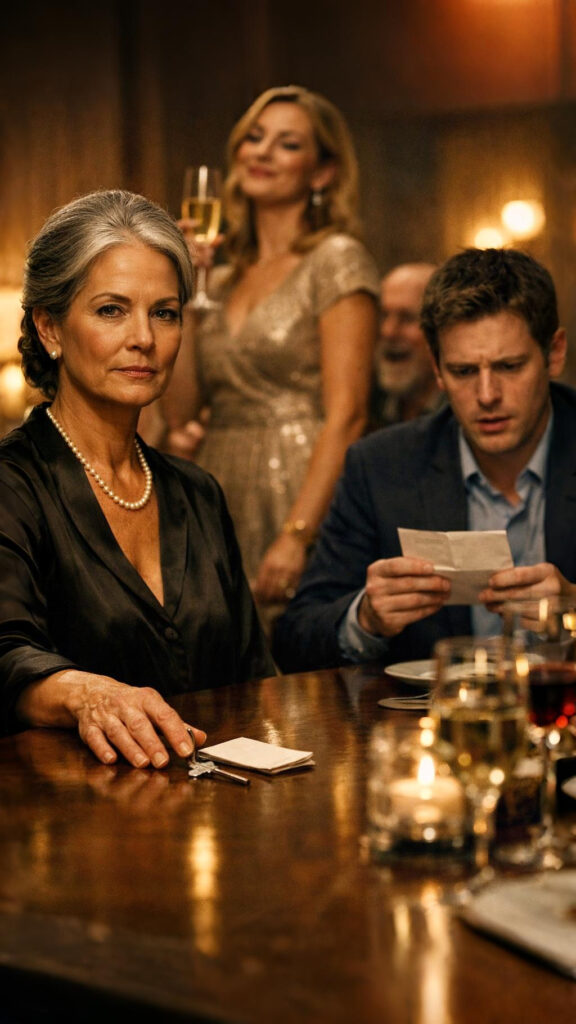
Chapter 1 – The Toast That Burned
The restaurant smelled of garlic and celebration.
It was their anniversary—fifteen years of marriage. I had paid for the venue, the wine, the endless appetizers that arrived in silver trays. It wasn’t the first time. I had done the same every year, like a tradition no one asked for but everyone expected.
My son looked radiant, his arm resting proudly around her shoulders. She was beautiful, yes, but beautiful in the way of someone who never had to worry about bills or consequences. I had made sure of that.
When the waiter poured champagne into our glasses, she stood up, her smile sharp and rehearsed.
“A toast,” she said, lifting her glass high. “To the mother-in-law who always pays, but will never be a real mom.”
Laughter. Light, careless, slicing through the air. My son laughed too—hesitant at first, then louder when she glanced at him.
Something in my chest went very still.
The restaurant noise faded into a low hum. The chandelier above us seemed to tremble slightly, catching the reflection of my untouched glass. I didn’t blink. I just watched them—watched how quickly the world could turn cruel in the hands of those you love.
I smiled. It was a small, polite thing, the kind of smile that hides decades. Then I set my glass down.
“Cheers,” I whispered, though no one heard it.
The conversation resumed, careless as before. She leaned into him, whispering something. He laughed again. The laughter hurt more than her words. It was the confirmation. It was the proof that he belonged to her world now, and I was an outsider they tolerated because my wallet still opened when theirs couldn’t.
I remembered the first dinner I ever paid for. He had just married her, and they were struggling. “It’s temporary, Mom,” he had said. “Just until we’re stable.” That was fifteen years ago. Stability had arrived, but the gratitude never did.
I stirred my coffee slowly, watching the swirl of dark liquid, as if I could dissolve the words she had said in it.
Never be a real mom.
I had raised him alone after his father passed. I sold the car, the jewelry, even my wedding ring to help with his college tuition. I never told him how much I struggled. That was my silent pride.
But in that restaurant, under that chandelier, the pride cracked a little.
My son reached for the bottle of champagne, refilled her glass, and then his. He didn’t refill mine. Maybe he didn’t notice. Maybe he did.
I glanced around the table. Her parents were smiling too, proud of their daughter, of the life she had carved. They had never liked me—too simple, too quiet, too willing to give. They saw my generosity as weakness.
But weakness has limits. Even oceans end at a shore.
She leaned back, tilting her head toward me. “You’re quiet, Mother,” she said. “Don’t tell me you’re offended—it was just a joke.”
I met her eyes and smiled again. “Of course,” I said. “Just a joke.”
But the tone was different now—cooler, measured. A kind of calm that only comes before a storm.
Inside my purse, folded neatly, was a letter. I had written it days before, unsure if I’d ever use it. A single envelope containing a decision. A key rested beside it, wrapped in tissue paper. I didn’t bring it for drama. I brought it because I was ready.
Her toast didn’t create the change. It only confirmed that the change was overdue.
I finished my coffee and placed the spoon carefully on the saucer. Around me, laughter kept spilling like cheap perfume—loud, persistent, false. My son told a story about their new vacation plans, something about the beach house I had helped them buy “in my name, just temporarily.”
Temporary. The word returned like a ghost.
When the waiter came to clear the table, I placed my hand on the envelope inside my purse. Just feeling it there gave me strength, like a pulse reminding me I was still alive, still capable of ending the cycle.
They ordered dessert. I declined. I didn’t have an appetite for sweetness anymore.
My son looked at me, his expression softening a little. “Mom, don’t be upset. You know how she is. She jokes.”
“I know,” I said. My voice surprised even me—steady, almost gentle. “You should enjoy your evening.”
He smiled, relieved. He didn’t understand that the calm in my tone wasn’t forgiveness. It was closure.
The check arrived. Of course, it landed beside me, like it always did. No one reached for it. No one even pretended to. I paid, left a tip, and rose from my seat.
“Leaving already?” she asked, eyebrows arched in mock concern.
“Yes,” I said. “I think it’s time.”
My son half-stood. “But we were going to take a photo—”
“Next time,” I interrupted softly.
He hesitated, then sat back down. I turned to leave, the sounds of celebration fading behind me. Outside, the night air was cool and merciful. I walked slowly toward my car, feeling the weight of fifteen years slide off my shoulders with every step.
In my hand, the key felt heavier than metal. It carried everything they had taken for granted.
I didn’t look back. Not yet. That part would come later.
Chapter 2 – Fifteen Years of Paying
Money has a strange way of buying silence. For fifteen years, I mistook that silence for love.
Every bill they couldn’t pay, I covered. Every holiday they couldn’t afford, I funded. Every broken appliance, every overdue rent, every promise that began with “just this once”—it all fell on me.
I used to think it was natural. A mother’s duty. A continuation of what I had always done: hold the family together when no one else could.
After his father died, I learned how to stretch a single dollar until it screamed. I took extra shifts at the bakery, skipped meals, and smiled through exhaustion. My son never saw that part. He only saw the table always set, the lights never turned off, the tuition paid on time.
That’s what love looked like to me then—sacrifice without receipt.
When he married her, I didn’t question his choice. She was young, ambitious, full of life. I wanted to believe she’d bring joy into his days. And in the beginning, she did. Until the money ran low.
That’s when the phone calls began.
“Mom, the rent’s higher than we expected.”
“Mom, she lost her job, just for a few weeks.”
“Mom, could you help us get a small loan? Just temporary.”
Always temporary. That word was the cornerstone of their gratitude.
I wired money. I sold furniture. I even mortgaged my house once, quietly, so they wouldn’t worry. My son never asked where it came from. He just thanked me, kissed my cheek, and said he’d pay it back someday.
Someday never came.
Birthdays, anniversaries, baby showers—I paid for them all. I told myself it was love, not pity. I convinced myself that generosity was a kind of inheritance, something noble. I didn’t realize it was turning into a leash.
She began to expect it. The way she’d look at me when the waiter brought the check. The way she’d mention “family tradition” whenever something expensive appeared on her wish list.
Once, I overheard her telling a friend, “His mom helps because she feels guilty. It’s what keeps her relevant.”
I laughed it off when I heard it. But the words stayed, lingering in the corners of my mind like smoke after a fire.
I didn’t want relevance. I wanted respect.
I remember the year they moved into the house I helped them buy. It was supposed to be a short arrangement—just until they could refinance. I signed the mortgage under my name, because their credit was too fragile. I paid the property tax, the insurance, even the renovations.
When I visited, she’d greet me like a guest. “Take off your shoes, please,” she’d say, pointing to a mat near the door. I obeyed. It was easier than arguing.
On holidays, I’d bring gifts for the children—books, clothes, little things that reminded me of when my son was small. She’d thank me, then quietly exchange them later for store credit. I knew because I once found the receipts.
Still, I kept giving. I told myself love must persist, even when it’s unseen.
Fifteen years is a long time to keep pretending.
Some nights, I’d sit alone at my kitchen table, going through receipts. Grocery bills, school donations, car repairs—all of them written in my handwriting. A record of invisible devotion.
I realized I could measure my love in numbers.
$4,000 for their wedding.
$12,300 for the down payment.
$800 monthly “until they stabilized.”
Fifteen years of stabilization.
I began to understand something no one tells you: when generosity becomes routine, it stops being kindness and turns into expectation.
The first time I said no, it felt strange. He had called, asking for help with a new business idea. “Just a small investment,” he said, “you’ll get it back.”
“I can’t,” I told him.
The silence on the phone was heavier than the years between us.
“Are you okay, Mom?” he asked finally, as if my refusal meant something was wrong with me.
I almost apologized. Almost. But I didn’t.
After that, things changed. The visits became shorter. The conversations, thinner. My phone stopped ringing unless there was a bill attached.
And yet, despite it all, I kept paying for their dinners. For appearances. For peace.
Because mothers, we think peace can be bought.
That night at the restaurant, when she raised her glass to mock me, I realized every dollar I’d spent had only purchased distance. They saw me not as a mother, but as a sponsor of their comfort.
The insult didn’t sting because it was cruel—it stung because it was true.
I had given them everything, and in return, I had erased myself.
As I drove home after the dinner, the city lights blurred behind the windshield. I tried to recall the last time my son had hugged me without needing something. I couldn’t.
The house felt too quiet when I walked in. I placed my purse on the counter, sat down, and opened the drawer where I kept my financial papers. Folders, receipts, a lifetime of proof.
Each page whispered the same story: love misused, patience misplaced, silence mistaken for agreement.
I stared at the numbers until they blurred into one thought—enough.
Fifteen years of paying. Fifteen years of hoping gratitude would grow. But gratitude doesn’t grow in spoiled soil.
The letter on the table was already written, sealed in an envelope. I read it once more before sliding the key inside. My handwriting looked calm, almost peaceful. The decision was no longer emotional—it was arithmetic.
The total had been reached.
I folded the letter carefully, like closing the last chapter of a book no one would ever thank me for writing.
And for the first time in years, I slept without guilt.
Chapter 3 – The Key on the Table
The next morning began with a kind of stillness I hadn’t felt in years.
It wasn’t peace, not yet. It was the quiet that comes after a decision has already been made, when every sound feels distant, like echoes through thick glass.
I made coffee, though I didn’t drink it. I sat by the window, watching the pale light spread over the street. The envelope was still there on the table, resting beside the key. The letter inside it was simple—barely two paragraphs. It said only what needed to be said.
No anger. No accusations. Just a statement of truth.
By the time I drove to their house that afternoon, the sun was heavy in the sky, pressing against the windshield. I knew they would still be asleep; late nights were common for them, parties and friends who never seemed to leave. But I wasn’t there to see them. I was there to leave something behind.
The house looked different in daylight. My name might still have been on the papers, but nothing about it belonged to me anymore. The flowers I’d planted had been replaced with trimmed hedges. The front porch, once warm and cluttered with life, was now spotless, sterile.
I let myself in quietly, using the same key I’d given them fifteen years ago.
The air inside smelled of perfume and faint wine. There were children’s toys scattered near the couch, a half-finished puzzle on the coffee table. Familiar things, but none of them held the warmth of family.
I walked to the kitchen. On the counter, their anniversary cake sat half-eaten, the knife still beside it. I stared at it for a long time before setting the key down. The small metallic sound echoed in the silence like punctuation.
Then, beside it, I placed the envelope.
I didn’t hesitate.
The letter said:
The house is yours now. The deeds are transferred. I’ve cleared the taxes and loans. You won’t need to call me again for help. Take care of each other. Take care of my grandchildren. You won’t hear from me for a while.
I folded my hands once over the envelope, as if sealing it not just with ink, but with something deeper—years of unspoken exhaustion, of quiet forgiveness that finally reached its limit.
A car door slammed outside. I froze. My son’s voice drifted through the hallway, cheerful, unsuspecting.
“Mom?”
I hadn’t planned on seeing him. My chest tightened. For a moment, I thought about leaving before he entered the kitchen, but my feet didn’t move fast enough. He appeared at the doorway, still in yesterday’s clothes, his hair messy from sleep.
“What are you doing here?” he asked, half-smiling. Then his eyes dropped to the counter.
The key. The envelope.
He didn’t move at first. I saw his expression shift—curiosity, confusion, and then something like fear. He reached for the letter.
“Mom, what’s this?”
His voice cracked slightly, the way it used to when he was a boy. I said nothing. I just watched as he tore the envelope open and read.
When his eyes lifted, they were pale, as if all color had drained from them.
“Mom… tell me you didn’t do this.”
I looked at him gently. “It’s already done.”
He stepped forward, holding the paper as though it might vanish. “You—You gave it to us? All of it?”
“Yes.”
“Why? You can’t just—You can’t walk away like this. We didn’t mean—”
“You did,” I interrupted softly. “You meant every word. And that’s all right.”
He blinked, trying to find an argument, but words deserted him. Behind him, she appeared, still wearing her robe, hair tousled, confusion tightening her features.
“What’s going on?” she asked.
He turned to her, voice shaking. “She—She signed it over. The house. Everything.”
Her mouth fell open. “What? Why would she—?”
I met her gaze. “Because I’ve paid enough. And because I want peace more than property.”
For the first time, she didn’t have a clever reply. She just stared, maybe realizing that cruelty has a cost, even when it’s disguised as humor.
My son dropped the letter onto the table, rubbing his forehead. “Mom, please, we can fix this. Don’t—don’t just disappear.”
“I’m not disappearing,” I said. “I’m just… leaving the noise.”
He looked lost, the way a child does when the lights go out too fast. I wanted to hold him, to comfort him the way I used to, but I knew that kind of comfort would only drag me back into the same cycle.
So I picked up my purse, nodded once, and started toward the door.
“Mom,” he called after me. “Wait. Please.”
I paused at the doorway but didn’t turn around. “You have a home now. You have everything you wanted. Take care of it.”
He didn’t answer. Neither did she. The silence between us was heavier than any argument could have been.
Outside, the air was bright and clean, the kind of brightness that hurts the eyes after too long indoors. I walked to my car, every step lighter than the last.
When I reached the end of the street, I looked at the house one final time. The curtains shifted slightly. A silhouette moved past the window—my son, perhaps, still standing there, holding that piece of paper.
I wondered what part hurt him most—the loss of what I’d given, or the realization of how easily I could let go.
The wind carried the faint sound of children’s laughter from the backyard. My grandchildren. I smiled then, not with bitterness, but with something close to release.
I had built a life around giving, but for the first time, I had given something to myself.
Freedom.
When I drove away, I didn’t cry. The tears had already been spent in quieter years, behind closed doors, in rooms filled with unpaid gratitude.
Now, there was only the road, the open sky, and the strange calm that follows a long-delayed goodbye.
I didn’t look back again.
Chapter 4 – The Panic After Silence
The silence that followed was not relief—it was confusion, the kind that hums in the chest when something you’ve depended on disappears overnight.
They didn’t call for two days. I expected that. Pride takes time to adjust when the source of comfort cuts the cord. On the third day, the phone rang. I watched it vibrate on the counter, blinking with my son’s name, but I didn’t answer.
He left a message. His voice was strained, the way it gets when he’s trying not to sound desperate.
“Mom, listen, this isn’t funny. We need to talk. There’s a lot you don’t understand about what you did. Call me, okay?”
I listened once. Then deleted it.
That night, I made soup for one. The house felt wide, breathing differently without the constant pull of obligation. I slept early and dreamed of nothing.
The next morning, he showed up at my door. No call this time. I heard the car before I saw it—the familiar way he parked too close to the hedge, slammed the door, heavy footsteps across the porch.
When I opened the door, his face was pale and drawn, his tie loosened, eyes rimmed with exhaustion.
“Mom, what’s going on?” he demanded before I could even greet him. “Do you realize what you’ve done?”
I stepped aside to let him in. “I know exactly what I’ve done.”
He paced the living room, hands moving wildly. “You can’t just give away your property like that! Do you know how that looks? They’re already calling me from the bank asking questions—”
“Then tell them it’s a gift,” I said simply.
He stopped pacing. “A gift? Mom, this isn’t normal. You don’t just hand over your life’s savings. You sound—”
He caught himself before finishing the sentence, but I heard the word anyway.
Crazy.
I smiled faintly. “That’s what she’ll say too, won’t she? That I’ve lost my mind?”
He didn’t respond. He didn’t need to. The silence filled in the words.
“Your wife’s already spoken to a lawyer, hasn’t she?”
He flinched. Just a small movement, but enough.
“She said we should ‘make sure you’re protected,’” he muttered. “It’s not like that, Mom. She’s just worried.”
“About what?” I asked. “That I might change my mind?”
He ran a hand through his hair, exhaling sharply. “This isn’t you. You’re not like this. You’re—”
“I’m what, David?” I said quietly. “Soft? Predictable? The woman who never says no?”
His face tightened, guilt and anger fighting for space.
“I did this because I wanted to,” I continued. “Because I’ve spent fifteen years living like my purpose was to hold your life together. And now, I’m done.”
He shook his head. “You’re angry, that’s all. You’ll regret it.”
“Maybe,” I said. “But even regret is mine to keep.”
He sank onto the couch, covering his face with both hands. “You don’t understand how this looks. People will think—”
“That you took advantage of me?”
He looked up sharply, but I didn’t wait for an answer.
“You should stop worrying about how things look and start worrying about what they are.”
For a long time, neither of us spoke. The clock ticked in the corner, marking the slow passage of truth.
Finally, he said, “I never meant to hurt you.”
“I know,” I said. “That’s what makes it worse.”
He exhaled, a low sound that carried years of dependence, disappointment, and something close to love, though tangled beyond recognition.
When he stood, his eyes were red. “If you change your mind, call me. Please.”
“I won’t,” I said softly. “But I’ll be fine.”
He left without another word. I watched him from the window, walking to his car like a man whose map had been taken away. He paused once before getting in, looked back at the house, and then drove off.
For hours after he left, the house felt heavier, not with regret, but with the echo of what used to be. I sat at the table, hands around a cooling cup of tea, listening to the sounds outside—the neighbors mowing their lawns, children shouting somewhere down the street. Life continuing, indifferent and ordinary.
That evening, a knock came again. Softer this time.
When I opened the door, she was there—my daughter-in-law. Dressed impeccably as always, perfume too strong for the daylight. Her smile was tight, stretched thin over something sharp.
“May I come in?”
I hesitated, then stepped aside.
She didn’t sit. Instead, she stood near the window, looking around as if inspecting a place she’d never really seen.
“David’s upset,” she began. “You’ve made things very complicated.”
“I’m sure,” I said.
She turned toward me. “You didn’t have to make a spectacle of it. Leaving the key like that—it felt… theatrical.”
“I didn’t do it for the performance,” I said. “I did it for peace.”
Her eyes narrowed. “Peace? You think this will bring peace? You’ve just given us a burden, not a gift. Taxes, maintenance, responsibilities—none of this was planned.”
“Then sell it,” I replied calmly.
Her mouth opened, then closed again. For the first time, she seemed uncertain.
“Why are you doing this?” she asked finally. “To punish us?”
“No,” I said, and meant it. “To free myself.”
She stared at me for a long time, trying to find the weakness in my voice. But there wasn’t one left.
“I used to think you were naïve,” she said, crossing her arms. “But now I see—you’re crueler than you look.”
“Not cruel,” I said. “Just finished.”
The words hung in the air between us, heavy and final. She turned without another word and walked out, heels clicking like tiny hammers on the floor.
When the door closed, I stood in the silence she left behind.
Outside, dusk was falling, the light turning softer, more forgiving.
I felt no triumph, no vengeance. Only the fragile quiet of a life being rebuilt from what remains.
Later that night, I found my old photo albums, dusty and forgotten. I flipped through them slowly—birthdays, graduations, wedding photos. In one, my son was five, grinning, his small hand clutching mine.
I traced the outline of his smile and whispered, “I hope one day you understand.”
Then I closed the album and placed it back on the shelf.
The phone rang again. I let it ring.
Outside, the world kept moving, unaware that somewhere, a mother had finally stopped.
Chapter 5 – The Attempt to Rewrite the Story
Days passed quietly, like pages turned by a wind I didn’t control. The phone rang often now—numbers I didn’t recognize, voices that hung up when I answered. The quiet had unsettled them. The power had shifted.
I knew it wouldn’t take long before they tried to fix what couldn’t be fixed. People like them don’t accept endings unless they’re the ones writing them.
One morning, a letter arrived. Thick envelope, official seal. I didn’t need to open it to know what it was. Lawyers always come wrapped in importance. I placed it on the counter beside the teapot and waited until my hands stopped shaking before tearing it open.
It was polite, professional, suffocating in tone.
Concerns have been raised regarding the mental capacity under which recent property transfers were executed.
In simpler words: They’re trying to undo it.
I smiled—not bitterly, but with the kind of quiet disbelief that comes from realizing you were predictable even in rebellion.
That afternoon, I received a visit. A woman introduced herself as a caseworker, her voice rehearsed in empathy. “Just a routine evaluation,” she said, her eyes scanning the room as if intelligence could be measured in furniture.
“Routine for whom?” I asked.
She smiled too tightly. “Your son requested it. He’s worried. He says you’ve been acting out of character.”
“Out of character,” I repeated, letting the words roll in my mouth like something spoiled. “Does he mean thinking for myself?”
She hesitated, then continued with her questions—if I knew what day it was, who the president was, if I remembered my own address. I answered every one calmly, even laughing once.
When she left, she thanked me for my time, but her eyes said something else: You’ve caused trouble.
That evening, I sat by the window with a cup of tea, watching the light fade. My hands trembled slightly—not from fear, but from the weight of memory. For years I had been the steady one, the silent force that kept everything moving. Now that I had stopped, they mistook stillness for madness.
The next day, I received a message from my son. Short. Formal.
Mom, we need to talk. Please don’t make this harder than it has to be.
Harder than it has to be. The irony made me laugh.
When I finally agreed to meet him, we chose a café near the courthouse. Neutral ground, though nothing about it felt neutral. He arrived early, already anxious, the sleeves of his shirt rolled halfway up like someone bracing for work.
“Mom,” he said, before even sitting down, “this is getting out of hand. You shouldn’t be alone like this. People are starting to talk.”
“Let them,” I said.
“You don’t understand. They think—”
“I know what they think,” I interrupted. “They think I’m losing my mind because I stopped giving them everything they wanted.”
He looked down at his hands. “That’s not fair.”
“Isn’t it?”
He sighed, pinching the bridge of his nose. “The lawyer said we could still reverse the paperwork. You just have to sign a statement. It’s simple.”
I took a slow sip of my coffee. “And if I don’t?”
“Then you’ll make things worse,” he said quietly. “For yourself, for us. We don’t want this to turn ugly.”
I looked at him for a long moment, seeing not the man he’d become but the boy I once carried home in my arms, shivering after scraping his knees. He used to trust me then, used to believe that I was the safest place in the world.
Now he spoke to me like I was an inconvenience in need of management.
“Do you really believe I’m not of sound mind?” I asked.
He hesitated, then nodded once. “You’ve changed.”
“I grew up,” I said.
He blinked, unsure how to respond. The silence stretched between us, taut and fragile.
“Tell your lawyer,” I said finally, “that I’m quite capable of knowing what I own and what I owe. And tell your wife that peace is not a transaction she can cancel.”
He stood abruptly, his chair scraping the floor. “You’re going to regret this, Mom.”
“Perhaps,” I said. “But regret is private. Control isn’t.”
He left without finishing his coffee. I stayed, listening to the distant clatter of cups, the murmur of lives that weren’t collapsing.
Later that week, the caseworker returned—this time with a man in a suit. He spoke softly, explaining legal processes, mental evaluations, guardianship petitions. I listened without interrupting. When he was done, I smiled and offered him tea.
He refused.
When they left, I called my own lawyer. Not the one they hired for me—the one I had quietly met months ago, when I first began preparing my letter. I explained what was happening. He chuckled softly.
“Don’t worry,” he said. “Everything’s filed properly. They can’t touch it.”
That night, I slept deeply, without dreams.
In the morning, sunlight poured through the curtains. I made breakfast, humming to myself. For the first time in years, the day ahead was mine to shape.
At noon, another message arrived—this one from an unknown number. A single line.
They’re saying you’re sick.
I stared at the words for a long time. Then I typed my reply.
No. I’m finally well.
The air outside smelled of rain. I stood by the window and watched clouds drift over the roofs, dark and slow. Somewhere, my son was trying to convince the world I’d lost control.
He was half right.
I had lost control of them.
And that was the first honest thing I’d done in years.