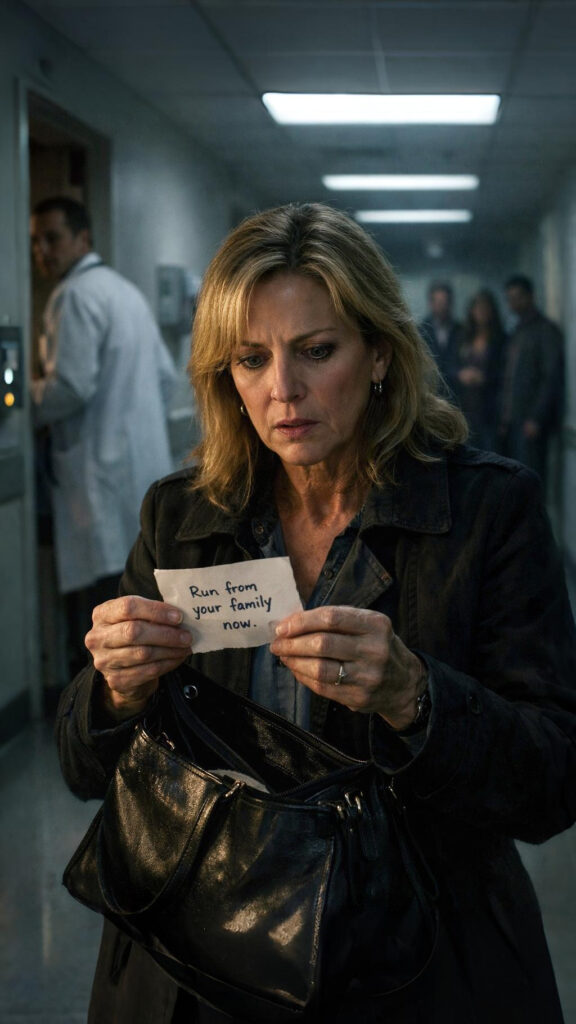
Chapter 1 — The Secret Note
The clinic smelled of antiseptic and wilted flowers. I had been there before, always for routine checkups, but that afternoon felt different the moment I entered the waiting room. The receptionist avoided my eyes. The nurse who took my pressure trembled slightly when she wrapped the cuff around my arm.
When Dr. Harris called my name, his voice cracked.
He was usually calm, confident, even a little cold. But that day, his eyes darted toward the door before meeting mine. He gestured for me to sit down, closing the blinds halfway as if afraid of someone watching.
He asked questions I didn’t understand—too many questions about my family, my living situation, who usually accompanied me to appointments.
Then he went silent. He kept writing, line after line, while pretending to update my medical file. His pen scratched against the paper for longer than it should have.
When I reached for my purse to leave, he slipped something between the test results—quickly, discreetly. Our eyes met for a second. There was a warning there, unspoken and trembling.
I didn’t open the paper until I got home.
It was a short note, written in his hurried handwriting:
“Run from your family now.”
I reread it several times, thinking it was a mistake. Maybe he meant someone else. Maybe he was under stress. But no—my name was on the top of the test results, my handwriting on the signature line. It was meant for me.
At dinner that evening, I couldn’t stop glancing at my husband and daughter. They laughed about something on TV, utterly ordinary, yet their laughter felt rehearsed. When I mentioned that Dr. Harris seemed nervous, my husband’s fork paused midair.
“What do you mean nervous?” he asked, not looking at me.
“Just… different,” I said. “He didn’t even give me my prescription directly.”
He shrugged, forcing a smile. “Doctors are overworked. You worry too much.”
But later that night, as I went to take my medication, I noticed something odd—the pills in my bottle were slightly different. The shape, the color, not quite the same as last month’s. My daughter had refilled them for me that morning, she said.
I held the note in one hand, the bottle in the other, trying to make sense of both.
What did he mean run? Was it about this?
The next day, I tried to call the clinic, but the receptionist said Dr. Harris wasn’t available. “He’s on emergency leave,” she explained, though her voice faltered like someone reading from a script.
Emergency leave.
By noon, I found myself rechecking every detail of my day. The mail that arrived already opened. The car keys missing from the counter. My husband’s sudden insistence that I stay home and rest.
It was as if the walls of my own house had begun to lean closer.
That night, I dreamt of the doctor’s face—his lips pressed together, eyes darting behind me, as though someone else was in the room. I woke with the sheet twisted around my legs and the faint taste of metal on my tongue.
I wanted to believe it was just anxiety. I wanted to believe my family loved me as much as I loved them.
But the note wouldn’t let me.
By morning, I hid it under the lining of my purse. If it was nonsense, fine. But if it wasn’t… then I needed proof that someone else had seen what I hadn’t yet dared to name.
The house felt too quiet that day. Every sound—footsteps in the hallway, the hum of the refrigerator—seemed deliberate, as if announcing itself to me. My daughter’s smile lingered too long, her questions too specific.
“Feeling better today, Mom?” she asked.
“Yes,” I lied, clutching the bag where the note was hidden.
I could still feel the paper’s weight like a heartbeat.
That evening, while they slept, I took my coat and went outside just for air. The stars looked dimmer than usual, blurred by clouds. My breath came out shaky.
I realized I hadn’t felt truly alone in weeks—not even in my own mind.
Whatever reason the doctor had for writing those words, I was starting to understand. Not fully, not yet. But enough to know one thing:
Something was wrong in that house.
And for the first time, I began to fear what the people closest to me were capable of hiding.
Chapter 2 — The Shadows at Home
The morning after I found the note, everything seemed slightly off—as if the world had tilted a few degrees during the night. The house looked the same, but I couldn’t stop noticing details that never bothered me before. The doors that were always half open now stayed shut. The curtains were drawn tighter. Even the clock on the kitchen wall ticked louder, its rhythm like a pulse that didn’t belong to the room.
My husband sat at the table reading the newspaper. He didn’t usually do that. He never cared much for the news. When I asked about it, he smiled and said he was “catching up on things.” But the pages barely moved. I could see his eyes fixed on me above the fold.
“Sleep well?” he asked.
“Not really.”
“Strange dreams again?”
“Something like that.”
He nodded, too quickly, then went back to staring at words he clearly wasn’t reading.
I poured coffee and felt his gaze follow me. My hands trembled just enough for the cup to clink against the saucer. He smiled again, too patient, too knowing.
When my daughter came down for breakfast, she wore perfume—strong, artificial, the kind that covers other smells. She kissed my cheek and lingered for a moment. “You should take your pills before we eat, Mom.”
“I’ll take them later.”
Her expression changed—only for a second, but it was there. Tightness around her mouth, something close to irritation. “Doctor’s orders, remember?”
I nodded, pretending to agree, but my stomach tightened.
After they both left for work, I sat alone in the kitchen, staring at the bottle on the counter. I turned it over slowly, counting the pills, memorizing their color, their edges. I didn’t know what I was looking for. Maybe a reason not to be afraid. Maybe the courage to admit I already was.
I went to my room and opened my laptop. The clinic’s website still listed Dr. Harris as active. No emergency leave. No statement. No mention of him at all, actually—his profile had vanished completely. It was like he’d never worked there.
I searched his name. Nothing.
I started trembling.
At noon, my sister called, but before I could pick up, my husband’s voice echoed from the hallway. “Don’t tire yourself with phone calls,” he said. “You need rest.”
He was home early. Too early.
He smiled again, that same rehearsed curve of his mouth. “I thought we could have lunch together. You’ve been so quiet lately.”
“I just haven’t been sleeping,” I said, forcing calm.
“Well,” he replied, setting a hand on my shoulder, “it’s good I’m here to take care of you.”
That touch lingered a moment too long.
The rest of the day passed in slow motion. Every sound felt magnified—the running faucet, the creak of the stairs, the rustle of fabric when someone walked behind me. By dusk, I realized I had barely spoken. I was afraid of what my voice might reveal.
When night came, I pretended to take my medicine, slipping the pill beneath my tongue, then hiding it inside a folded napkin. I flushed it down the toilet later, my heart hammering as I watched it swirl away.
That’s when I noticed my reflection in the bathroom mirror—eyes wide, mouth slightly open. I didn’t recognize that face. It looked like someone who had seen the truth and couldn’t unsee it.
The note was still in my purse, crumpled now from being handled too much. “Run from your family now.”
Those words no longer felt like paranoia. They felt like instructions.
The next morning, my daughter mentioned the doctor again, casually. “By the way, Mom, Dr. Harris called yesterday,” she said, stirring her tea. “He wanted to know if you were feeling better.”
I froze. “He did?”
“Yes,” she said, smiling thinly. “I told him you’re in good hands.”
There was no way she could have spoken to him. He had disappeared.
“Did he say anything else?” I asked, my voice smaller than I wanted it to be.
She shrugged. “Just to keep taking your medication. Every dose matters.”
I smiled back, but I could feel the air leaving the room.
After she left, I opened the back door and stepped into the garden. The wind was colder than usual. I looked at the windows from outside—two silhouettes inside, moving slowly, one after another.
They were searching for something.
Maybe for me. Maybe for the note.
I stood there for a long time, watching through the glass. When my husband turned his head toward the window, I ducked behind the hedge. My hands were shaking so violently I had to press them against my knees.
I didn’t go back inside until nightfall.
The moment I stepped into the hallway, I knew they had been in my room. The drawers weren’t how I’d left them. The perfume bottle on my dresser was turned slightly to the left. My purse, the one with the note, had been moved—emptied and refilled.
I wanted to scream. Instead, I smiled when my husband asked, “Rough day?”
“Yes,” I said. “I think I just need some rest.”
He touched my shoulder again. “Good idea. You’ll feel better soon.”
As I lay in bed, I felt the mattress dip slightly beside me. His hand rested gently on my arm. His breathing was steady. Mine wasn’t.
In the dark, I could almost hear Dr. Harris’s voice, faint and distant. Run from your family now.
It wasn’t just fear anymore. It was certainty.
Something was happening inside this house—something quiet, deliberate, and dangerous. And I was beginning to understand that the note wasn’t just a warning.
It was a countdown.
Chapter 3 — The Hidden Truth
I woke up before dawn, my pulse already racing. The house was silent, wrapped in that fragile stillness before the world begins to move again. But it wasn’t peace—it was a silence that listened back.
I stayed in bed for a few minutes, pretending to sleep. My husband’s alarm would go off soon. My daughter would come downstairs. The routine would play out as always. But now, every familiar movement felt rehearsed, choreographed, like a performance staged just for me.
When he finally left for work, I watched from the window as his car disappeared down the street. Only then did I breathe properly.
That morning, I made a plan.
I would go to the pharmacy myself. I’d ask about my medication, about the changes I’d noticed—the shape, the color, the dosage. If there was something off, I’d know.
At least, that’s what I told myself.
The pharmacist, a young man with kind eyes, scanned the label and frowned. “This prescription doesn’t match our database,” he said quietly. “Are you sure it’s from Dr. Harris?”
My throat closed.
“Yes,” I whispered. “He’s been my doctor for years.”
He tapped the computer again. “I’m sorry, ma’am. There’s no Dr. Harris registered under that clinic anymore. The code on this label—it’s not even from our system.”
I thanked him, though I don’t remember how I managed to speak. I walked out into the cold, the world spinning slightly around me. The street seemed longer, the sky lower. Every step home felt like walking deeper into something I couldn’t yet name.
When I reached the house, my daughter’s car was already there. She wasn’t supposed to be home.
I slipped quietly through the back door. Voices drifted from the kitchen—hers and my husband’s. I stopped, pressing my back to the wall.
“She’s starting to ask questions again,” my daughter said.
“She won’t get far,” he answered. “Just keep her calm until next week. By then, everything will be finalized.”
Finalized.
My heart pounded so hard I thought they might hear it.
My daughter sighed. “She still doesn’t know about the papers, right?”
“No. She thinks she’s signing something for the insurance. Just keep it that way.”
I couldn’t breathe. I staggered backward into the hallway, clutching the wall for balance. My mind raced—papers, signatures, false prescriptions. A pattern began to take shape, one too dark to look at directly.
They were planning something. Something involving me.
I went upstairs, every step careful, controlled. In my room, I opened the drawer where I kept my documents. The envelope with my insurance forms was missing. So was my bank folder.
They had taken everything.
The sound of footsteps came from downstairs. I quickly replaced the drawer and sat on the edge of the bed, pretending to read when my daughter appeared in the doorway.
“Mom,” she said sweetly, “you didn’t answer when I called. Everything okay?”
“I’m fine,” I said, smiling faintly. “Just tired.”
She came closer, eyes scanning the room like a detective pretending to be affectionate. “You shouldn’t overthink things. Dad and I only want what’s best for you.”
“I know,” I replied. “I’m lucky to have you.”
Her smile widened, but her eyes didn’t.
After she left, I locked the door and sat in the dark. My reflection in the mirror stared back at me—older, smaller, but not weak. Not anymore.
That night, I packed a small bag: the note, my ID, and the spare cash hidden behind a framed photo. I left the light on, so they’d think I was asleep.
At midnight, I heard their voices again. This time, outside my door.
“She took her pills?” my husband asked.
“Yes,” my daughter said. “I watched her.”
I held my breath until their footsteps faded. The moment the house quieted, I slipped out the window into the freezing air. My bare hands burned as I climbed down the trellis. My knees hit the ground hard, but I didn’t stop.
The street was empty, wet from rain. I didn’t know where to go, only that I couldn’t stay.
I reached the clinic by dawn. The lights were off, the door locked. But there—taped to the glass—was a note. A single line written in the same hurried handwriting as before:
“Trust no one who calls you family.”
My knees went weak. I looked around, searching for someone, anyone, but the street was deserted. The morning sun broke over the buildings, cold and pale.
I turned the corner and saw a man waiting near a parked car. A familiar silhouette. Dr. Harris.
He looked thinner, older, his face drawn tight with exhaustion. When he saw me, relief washed over him.
“You came,” he said. “Thank God.”
I couldn’t speak.
“I tried to contact you,” he continued, voice low. “They erased everything—my records, my license. I found out what they were doing too late.”
“What are they doing?” I asked, barely whispering.
He looked at me with something like sorrow. “They’ve been using your name. Your medical identity, your insurance. Everything.”
My mind flashed to the missing papers, the fake prescription, the way my daughter had smiled while insisting I take the pills.
Dr. Harris leaned closer. “They’re planning to declare you unfit to manage your own affairs. Once you sign the new forms, they’ll control everything—your money, your house, your life.”
For a moment, I couldn’t breathe.
He handed me an envelope. “Inside is proof. Keep it hidden. Don’t go back home tonight. I’ll find you tomorrow.”
He looked over his shoulder nervously. “Someone’s been following me.”
Before I could reply, he got into his car and drove away.
I stood there on the sidewalk, the envelope trembling in my hands, the city waking up around me.
For the first time, I understood what the note had meant all along. It wasn’t paranoia. It wasn’t confusion.
It was survival.
And the people I had loved the most were the ones I now had to escape.
Chapter 4 — The Escape
The sky had turned gray by the time I reached the bus station. Morning light, dull and uncertain, spilled across the cracked pavement. People moved past me without faces—blurs of motion and noise, all of them going somewhere safe, somewhere ordinary.
I had nowhere to go.
The envelope trembled in my hands, still unopened. I could feel the edges of the papers inside, sharp and thin, like blades waiting to cut through everything I had believed about my life.
A voice echoed through the station speakers, announcing departures. I didn’t even know which bus to take. All I knew was that I couldn’t be found.
I bought a ticket to the next town without thinking. My hands shook as I handed over the cash. The clerk smiled politely, unaware of how the world had already fallen apart behind my calm face.
When I sat down on the bus, I pressed my bag to my chest and stared out the window. The city blurred by—streets I knew, corners that once felt like home. Each one felt foreign now, contaminated by memory.
Halfway through the ride, I opened the envelope.
Inside were photocopies—medical records, insurance claims, bank statements. All with my name. But the signatures weren’t mine. They had transferred policies, redirected payments, even forged consent forms for treatments I never received. My husband’s handwriting stared back at me from the margins. My daughter’s too.
There was also a final page, a scanned document labeled Petition for Guardianship. My breath hitched. They were trying to prove I was mentally unfit.
I folded the papers carefully, though my hands wanted to tear them apart. My throat ached from holding in the scream.
At the bottom of the stack, there was a small note in Dr. Harris’s handwriting: Go to Havenfield. Room 12. Tell them I sent you.
Havenfield. I had never heard of it. But it was an instruction, and right now, following instructions was all that kept me steady.
By the time I arrived, the rain had begun. Havenfield turned out to be a small inn near the edge of the next town—old wood, peeling paint, the kind of place people stayed when they didn’t want to be remembered.
The woman at the desk looked up from her ledger. “Room 12?”
I nodded. “Dr. Harris told me—”
Her eyes softened. “Yes. He called earlier. Said you’d be arriving today.”
Relief flooded me so suddenly that my knees almost gave out.
The room was small, simple—a single bed, a nightstand, and a window overlooking the empty street. I sat down and finally let myself breathe. The rain against the glass sounded like applause, soft and steady.
For the first time in days, I felt safe.
But safety is fragile.
That night, I woke to the sound of a car engine outside. Headlights swept across the window, slicing through the darkness. I froze. Another light flickered—a phone screen, someone checking messages.
I crept to the window and peeked through the curtain. A familiar car sat across the street. My husband’s.
He had found me.
My heart thudded in my throat. I reached for the lamp but stopped midway, afraid to cast a shadow. I crouched by the bed, holding my breath as the car door opened.
Then silence.
Minutes passed, each one heavier than the last. Finally, footsteps on gravel—approaching the entrance of the inn.
I grabbed my bag, the envelope, my coat. My hands shook so violently I dropped the keys twice before I could lock the door.
A knock echoed down the hallway. Someone asking the clerk a question. A man’s voice, calm and polite.
I slipped out the window, into the rain. My shoes sank into mud. My coat soaked instantly. I didn’t look back.
I ran through alleys, across dark streets, until my lungs burned. I stopped only when I reached the train tracks, empty and glistening under the rain.
I leaned against a post, gasping. The envelope was still in my hand.
The note, the papers, everything that proved what they had done—it all felt heavier now. Proof meant nothing if I didn’t survive to show it.
I could hear the faint hum of a car engine in the distance. Headlights again. Searching.
I crossed the tracks and ducked into the woods beyond them. The rain was colder here, the air raw with pine and earth. Branches scraped against my arms as I pushed through.
At some point, I fell. The papers spilled into the mud, white pages turning dark. I crawled to gather them, sobbing quietly, my breath coming in sharp bursts.
Somewhere far off, a dog barked.
I pressed the papers to my chest and whispered to the darkness, “Please, not like this.”
A light flickered ahead—a cabin, faintly glowing through the rain. I stumbled toward it, half-blind, half-frozen.
When I reached the door, it opened before I could knock.
A man stood there, flashlight in hand. Dr. Harris.
“You shouldn’t have left the inn,” he said, pulling me inside. His voice trembled. “They’re closer than you think.”
I sank into a chair, my whole body shaking. “They found me.”
“I know,” he said, locking the door. “They’ve been tracking your phone. I disabled mine days ago.”
He set the flashlight down, and for a moment, the world went quiet except for the sound of rain on the roof.
“They want control of everything you own,” he said softly. “But it’s worse than that now. They’ve filed false medical reports claiming you’re unstable. They’ll use them to have you committed.”
The room spun. “They can’t.”
“They can if you go back.”
I stared at him. “What do I do?”
He hesitated, then handed me a new envelope. “There’s a contact in the city—someone in legal aid who can protect you. But you have to disappear for a while. No calls, no letters.”
His eyes flicked toward the window, shadows moving beyond the glass. “Go now, before they find this place.”
I clutched the envelope, the rain still dripping from my sleeves. My reflection in the dark window looked nothing like the woman I had been a week ago.
“I don’t even know who I am anymore,” I whispered.
Dr. Harris met my gaze. “You’re someone they couldn’t break. That’s who you are.”
I turned toward the door, heart pounding. The rain outside had become a curtain, hiding everything beyond it. I stepped into it anyway, clutching the envelope like a heartbeat.
Behind me, the cabin light went out.
And ahead of me, only the storm waited—wild, endless, and free.
Chapter 5 — The Reckoning
I didn’t stop walking until the sky began to pale. My shoes were heavy with mud, my hands numb from gripping the envelope. I had crossed miles without knowing where I was going—only that I couldn’t let them find me again.
When the rain finally eased, I reached a gas station on the edge of the highway. The fluorescent lights hummed weakly, the world around them washed in gray. I went inside, dripping and exhausted, and asked for directions to the city. The clerk barely looked up. “Next bus leaves in an hour,” he said.
I bought a ticket and sat near the window, hugging my coat close. The envelope pressed against my ribs, the papers inside already damp, their ink threatening to blur. It felt like my life—fragile, dissolving at the edges, yet still legible if I held on long enough.
When the bus arrived, I climbed aboard and sat near the back. A few passengers murmured to each other in low voices. I stared out at the road as the landscape rolled past—fields, billboards, towns I didn’t recognize. Each one looked like it belonged to someone else’s life.
By the time I reached the city, it was evening again. The streets glowed with wet reflections, headlights sliding across puddles like liquid glass. I followed the address Dr. Harris had written, my feet aching, my breath shallow.
It led me to an old office building near the courthouse. The sign outside read Civic Legal Aid Foundation. Inside, the air smelled of paper and stale coffee. A woman behind the desk looked up when I entered.
“Can I help you?”
I hesitated, clutching the envelope. “Dr. Harris sent me.”
Her expression changed immediately. “Come with me.”
She led me down a narrow hallway into a small office filled with folders and old computers. A man sat behind the desk, his glasses slipping down his nose. “You must be her,” he said quietly. “He told us you might come.”
He gestured for me to sit. “You have something for me?”
I handed him the envelope. He opened it carefully, scanning the documents one by one. The silence stretched, broken only by the sound of paper turning. When he finally looked up, his face was pale.
“This is worse than he said,” he murmured. “They forged not just financial records—medical evaluations, too. According to these, you’ve been diagnosed with early-onset dementia. You’ve been declared legally incompetent.”
The words hit like a physical blow.
“That’s impossible,” I whispered. “I’m not—”
“I know,” he said gently. “But they filed it already. It’s pending approval in court next week. If you hadn’t come now, they would’ve taken control of everything.”
I felt the room tilt slightly. “They were going to erase me.”
He nodded slowly. “But we can stop them. You have evidence—Dr. Harris’s testimony, these falsified forms. We’ll present them before the judge.”
A flicker of hope sparked, weak but real.
“Will I have to see them?” I asked.
“Yes,” he said. “But not as their victim—as their accuser.”
The next few days blurred into motion. Statements, signatures, copies. Every form felt like a step toward reclaiming something I hadn’t realized I’d lost.
When the day of the hearing came, I barely recognized myself in the courthouse mirror. My hair was neat, my hands steady. I had slept only a few hours, but the exhaustion was laced with purpose.
Inside the courtroom, my husband and daughter were already seated. They looked startled when they saw me—alive, composed, holding the folder they thought they had destroyed.
My daughter was the first to speak. “Mom, what are you doing here?”
I didn’t answer. I looked straight ahead, at the judge.
The lawyer beside me presented the evidence, his voice calm but firm. He detailed the false prescriptions, the forged documents, the missing funds. Each piece unfolded like a thread being pulled from a tangled knot.
My husband interrupted once, his tone sharp. “She’s confused. That doctor filled her head with nonsense—”
The lawyer placed one last page on the table. “This is Dr. Harris’s statement. He risked his career to expose the fraud.”
The judge leaned forward, scanning it. My husband’s voice broke mid-sentence. My daughter’s hands shook as she tried to whisper something to him, but it was too late.
For the first time in months, I let myself look at them—not with fear, but clarity. The faces I once trusted now seemed like masks worn too long.
When it was my turn to speak, I stood. My knees trembled, but my voice didn’t.
“I spent my life believing that love and loyalty were the same thing,” I said quietly. “I gave everything I had to people who thought that made me weak. But today, I learned something different. Love without respect is just control. And I won’t be controlled anymore.”
The judge nodded, his expression unreadable. “You’ve been through something extraordinary, Mrs. Collins. The court recognizes the fraud committed against you. Guardianship petition denied. Assets to be restored under legal supervision.”
It was over.
The sound of the gavel echoed like thunder. My husband dropped his head. My daughter began to cry, softly, without tears.
I walked out before they could speak to me.
Outside, the sky was clear for the first time in days. The air smelled of rain and possibility. I stood on the courthouse steps, closing my eyes, feeling the wind move against my face.
For the first time, I wasn’t running.
Dr. Harris met me at the bottom of the stairs. His eyes were tired, but he smiled. “You did it.”
“No,” I said. “We did.”
He nodded. “What will you do now?”
I looked past him, toward the street where people hurried by, their lives intact, untouched by the weight of survival.
“I’ll start again,” I said. “But this time, for me.”
As I walked away, the city lights flickered to life one by one, glowing against the darkening sky. I didn’t look back.
The storm had finally passed.
And in its quiet wake, I had found myself again.