Chapter 1 — The Message That Crossed the Line
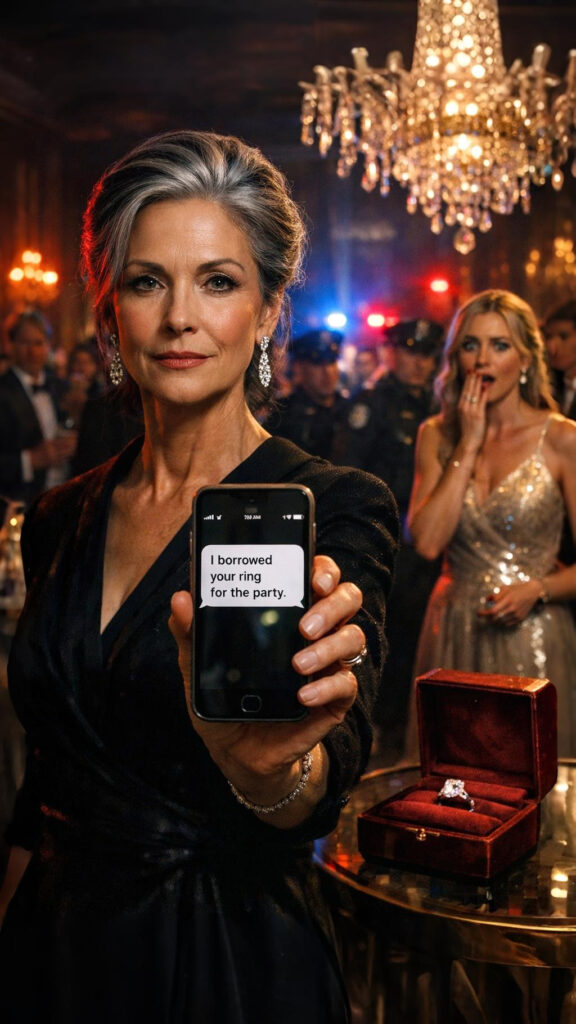
The notification came at 8:42 p.m. My phone buzzed once, lighting up the corner of the room where I had been reading. A short message, no greeting, no hesitation—just confidence disguised as politeness:
“I borrowed your ring for the party.”
Borrowed.
The word sat there, innocent to most eyes, but to mine it burned like acid. That ring wasn’t costume jewelry. It wasn’t something one could “borrow” the way you borrow sugar or a dress.
I stared at the screen for a long moment, my heartbeat slowing rather than racing. The kind of calm that only arrives when disappointment is too old to hurt.
For years, I had allowed small things to pass. A borrowed scarf never returned. My favorite china taken “for a family dinner.” The bottle of perfume she had once called “too expensive for someone her age” — later appearing on her dresser when I visited.
Each time, I smiled. Each time, I told myself it’s not worth the fight.
But this message…
This was different.
The pink diamond ring was the only thing I had kept after selling most of my late husband’s assets. A rare stone, purchased in an impulsive act of love three decades ago, when we still believed in forever. It had survived recessions, betrayals, funerals — and, somehow, me.
Now, in a single message, it was treated like a prop.
I could picture her at that moment — my daughter-in-law — her manicured fingers tapping away, her lips pursed in satisfaction. She knew I’d see it. She knew I wouldn’t stop her.
Because I never did.
For years, she’d learned that my silence meant permission. That my patience was weakness. That being “family” meant taking without asking.
But something in me shifted that night. Perhaps it was the quiet of the house, or the memory of how my husband’s eyes had glistened when he placed that ring on my hand. Or maybe it was the exhaustion — of being good, polite, forgiving.
I reread the message once more. The phrasing was deliberate. No question mark. No apology. Just a declaration.
I borrowed your ring for the party.
A small laugh escaped me, but it wasn’t amusement. It was disbelief at how predictable she’d become — and how foolish I’d been to let it reach this point.
My phone slipped from my hand and landed softly on the couch. I stared at the window, where the streetlights bled through the curtains, and for the first time in a long while, I didn’t feel powerless.
I felt… alert.
The kind of alert that comes when you realize the war has already started, and you were the only one pretending it hadn’t.
My mind began to work quickly, mechanically. I knew the details by heart — the insurance documents, the valuation papers, the photos taken when I renewed the policy two years ago. Everything was in a folder in my study. Everything was verifiable.
For a moment, I considered calling my son. He was at that same party, probably smiling beside her, unaware or unwilling to care. But then I remembered the last time we spoke — his voice flat, tired, saying, “Mom, you always make things bigger than they are.”
No. I wouldn’t call him.
He had chosen to live in the world she built, not mine.
The clock ticked toward nine. Outside, laughter floated from the neighbor’s yard, the sound of normal lives continuing elsewhere. I rose from the couch, every movement deliberate, and walked toward my study. The folder was right where I’d left it — top drawer, marked Personal — Legal.
As I opened it, a strange calm filled me. My hands didn’t shake. My breathing was steady. There was no rage, no tears. Just a steady certainty — a cold recognition that this would be the last time anyone mistook my silence for surrender.
The phone rang once as I picked it up again, but I ignored it. I scrolled through my contacts and stopped at a familiar name.
When he answered, his voice was crisp, professional.
“Mrs. Langford? Good evening.”
“I’d like to report a theft,” I said quietly. “The pink diamond ring — the one insured for three million.”
There was a brief pause on the line. “Understood. Do you know who took it?”
“Yes,” I replied. “I know exactly who did.”
I hung up and sat down, the weight of the moment settling over me like a new kind of peace.
She had crossed the line.
And I, for the first time, had decided not to step back.
In the quiet that followed, I thought of her — laughing, posing for photos, her hand glittering under chandelier light.
And I wondered how long it would take before the knock came at her door.
Chapter 2 — The Hidden Weight of the Pink Diamond
The ring had not always been mine. It was a promise before it became a possession.
Thirty-two years ago, my husband, Richard, placed it on my hand under a rain of pink petals at a small gallery in Florence. The jeweler had called it “a living stone”, because under certain lights, it seemed to pulse — as though the diamond had a heartbeat of its own.
We had no fortune then. He sold an old car and borrowed money from his brother to buy it. “It’s not for now,” he told me. “It’s for later, when the world tries to make you forget who you are.”
At the time, I thought he meant aging. I didn’t know he was leaving me an anchor — or a weapon.
The ring became a quiet symbol between us. I wore it to every event where people tried to underestimate me. When I taught, I would rest my hand on the desk just so the sunlight touched it, and it would sparkle faintly — a reminder that I belonged to more than the life I’d settled for.
After Richard died, the ring was all that remained of his defiance. Everything else — the house, the car, the savings — vanished into the machinery of grief, debt, and survival. But I never sold it. Never pawned it. Never even loaned it.
When my son married, I remember her — my future daughter-in-law — staring at my hand during the ceremony. Her smile was sweet, practiced. “What a beautiful ring,” she said later. “Must be priceless.”
“It is,” I’d replied. “But not for the reasons you think.”
I should have seen it then. The way her eyes lingered not on me, but on the jewel. Desire coated in charm.
Over the years, she would make little jokes about it. “One day, that’ll be in our family safe,” or “You should let me wear it just once, so it gets used to my hand.” She said it with laughter, but her laughter had edges.
I always dismissed it as youth, vanity, playfulness. I mistook her hunger for admiration. I didn’t realize it was hunger for ownership.
Now, sitting in the dim light of my study, I saw the chain of small permissions that had led us here. I had taught her that taking was safe, that kindness was a door left open. Every smile I gave her, every compromise, had been an unspoken invitation.
And that ring — that impossible, fragile symbol — was never just about money.
It was about history. It was about everything I had refused to surrender when the world tried to strip me bare.
When Richard’s illness consumed our savings, I’d kept that ring hidden in a small velvet pouch, behind the medicine cabinet. Once, he found me staring at it while he rested in bed.
“Promise me,” he whispered, “if they ever make you small, wear it. Remember that you were never meant to beg.”
I had promised. And I had kept it.
Until now.
The irony was unbearable. That she — someone who never knew struggle, who had married into comfort — would wear it not out of love, but out of vanity. A piece of me displayed like a trophy.
I pictured her standing in front of her mirror, turning her hand to catch the light. Maybe she imagined herself photographed, envied, adored. Maybe she even thought of me — that frail woman she believed too harmless to resist her.
The phone was still in my hand. I replayed the lawyer’s words, his calm assurance that the report had been filed. That the police were on their way.
Part of me hesitated — a small, trembling part that still wanted peace. But peace, I had learned, cannot exist in the same house as humiliation.
I rose, walked to my dresser, and opened the old wooden box where the ring used to rest. The indentation in the velvet was still there — a small hollow, the ghost of what belonged. I ran my fingertip over it, as though I could still feel its warmth.
The memory of Richard’s voice returned, soft but certain: “If they ever make you small…”
I had become small. Not by fate, but by habit.
By letting others take pieces of me until nothing felt worth defending.
The ring wasn’t just a diamond. It was the measure of my endurance — and tonight, it had been stolen not just from my drawer, but from my identity.
When I finally looked up, my reflection stared back from the window — pale, older, but not defeated. Behind me, the house was quiet, filled with the echo of years spent keeping peace.
For the first time, I wondered what Richard would say if he could see me now — not the soft wife who avoided conflict, but the woman who called the police on her own family.
I thought he might smile. Not proudly, but knowingly.
The kind of smile that says, you finally remembered who you are.
Outside, I could hear faint music drifting from somewhere distant — the party, maybe. I imagined her laughter, the sound of champagne glasses, the false brightness of celebration.
And somewhere amid that noise, a ticking clock, counting down the last few minutes before the world shifted.
Before she learned that the pink diamond she flaunted wasn’t a prize.
It was a warning.
Chapter 3 — Silence, Proof, and a Single Phone Call
I didn’t sleep that night. Not because of guilt, but because the silence felt different — alive, almost electric. Every shadow in the room seemed to breathe with the weight of what was coming.
I sat at my desk, the documents spread before me like a map of my own past. Insurance appraisals, photographs, certificates of authenticity. Each page a fragment of the life I had built — carefully, lawfully, quietly.
For years, I had kept these papers not for vanity, but for protection. The ring had drawn attention more than once, and Richard had insisted we keep it insured. “Not for us,” he said, “for the day someone tries to take what’s ours.”
He had been right.
The file was complete — timestamped, notarized, irrefutable. Proof that the ring was not merely expensive, but unmistakably mine.
I placed the papers neatly into a leather envelope and rested my hand on top of it, as if to anchor myself. My reflection in the window stared back: composed, unreadable. It was the same expression I used to wear when teaching — calm above the surface, calculation beneath.
The phone buzzed again. Messages. I didn’t open them, but I could see the previews light up the screen.
From my son: “Mom, please tell me this isn’t true.”
From her: “You didn’t have to make a scene. It’s just a ring.”
Just a ring.
I almost laughed.
For her, everything was “just.” Just a ring. Just a mistake. Just a misunderstanding. She had mastered the art of shrinking consequences with words.
But I was done living in her vocabulary.
The night air was cool when I opened the window slightly. Somewhere, a dog barked. I could faintly hear sirens far away, echoing through the city streets. The thought made my pulse steady — not from satisfaction, but from inevitability.
I checked the time. 10:26 p.m.
The lawyer had said he’d file the report immediately. The local authorities would verify ownership, cross-reference the appraisal number, and act accordingly.
It would not take long.
Still, I wanted to hear confirmation from him directly — not as reassurance, but as closure. I picked up the phone again and dialed his number.
“Mrs. Langford,” he answered quickly. “Everything’s in motion. The report has been validated. The police are already coordinating with your insurer.”
“Will they go tonight?”
“Yes. They’re required to act immediately due to the value. It’s classified as a high-profile theft.”
There was a pause. Then, his voice softened. “Are you sure you want this to go forward? It might create tension within the family.”
“Tension already exists,” I said quietly. “It’s just been disguised as politeness.”
He said nothing more. Neither did I.
After I hung up, I leaned back in the chair and closed my eyes. The memory of her voice returned — light, careless, the way she always spoke when she thought she had won. “I borrowed your ring for the party.”
Borrowed.
Even now, the word made something inside me tighten.
Borrowing implies intention to return. She had no such intention. I knew it in my bones. To her, the ring was proof of her triumph — a symbol that even my memories could be worn as decoration.
But she had underestimated me.
For years, she’d seen an old woman who gave too much, forgave too easily, and complained too little. What she didn’t see was the part of me Richard had sharpened — the part that knew when to remain silent, and when to strike.
Silence can be louder than fury.
At 11:02, I heard another vibration. My son again. I let it ring. Then another — a call this time. I didn’t answer. He would call until panic replaced arrogance. Until realization dawned.
I rose from the desk, pacing slowly through the house. My footsteps echoed softly against the wooden floors. The photographs on the walls followed me with patient eyes — Richard holding our newborn son, our first home, a garden that once bloomed under my care.
So much had been built, and so much had been quietly taken. Not through theft, but through erosion — one small act of disregard at a time.
This moment wasn’t about revenge. It was about reclamation.
I sat on the couch again, the folder beside me, and waited.
Every minute stretched longer than the last. The city’s noises came and went: engines, wind, the hum of life continuing outside my still house.
Then, a distant sound cut through the calm — faint but distinct. Sirens. Closer now. Not the wild kind of emergency, but measured, deliberate.
I didn’t move. I didn’t need to.
In my mind, I could see it unfolding — the grand entrance hall of her rented venue, chandeliers glimmering, laughter filling the room. Then, the sudden intrusion of blue lights slicing through the night. Officers stepping through the door, calm but authoritative.
Someone would ask, “What’s going on?”
Someone else would whisper, “They’re here for her.”
And she — perfectly dressed, manicured, radiant — would freeze.
I could almost see her face. The confusion turning into disbelief, then indignation. “There must be some mistake,” she’d say, her voice quivering just enough to sound innocent.
But there would be no mistake.
The pink diamond would gleam under the light, and its value would no longer be vanity — it would be evidence.
My phone rang once more. I didn’t need to check who it was. I knew.
I let it ring until it stopped.
In the silence that followed, I felt no triumph, no vindictive joy — only clarity.
For years, I had lived afraid of breaking the fragile balance of family. Tonight, I understood that the balance had never been real. It was built on the assumption that I would never fight back.
Now, that illusion was gone.
And in its place, there was only the truth — quiet, sharp, and irreversible.
The kind of truth that could no longer be borrowed.
Chapter 4 — The Party Interrupted
The photographs appeared online before dawn — shaky, bright with flash, each one capturing the exact second the celebration curdled into panic. A blur of sequins, startled faces, the unmistakable shine of uniformed officers cutting through the golden light of chandeliers.
I didn’t need to see them to imagine it. I had seen that kind of room too many times — one of those rented spaces where laughter is practiced, where every smile carries calculation. I could picture her there, radiant and composed, believing herself untouchable.
Until the first officer spoke her name.
That was the moment the illusion must have cracked.
I sat at the kitchen table with my tea growing cold, the glow of my phone screen lighting the small circle of calm around me. The news was traveling fast — socialite questioned at private event, high-value jewelry under investigation, no comments from family sources.
Each headline sounded polite, detached, almost gentle. None of them captured what the silence in that room must have felt like.
The ring, my ring, had stolen the night.
Witnesses said she tried to laugh at first. “This is ridiculous,” she’d told them, the reporters quoted. “It’s my mother-in-law’s ring. She lent it to me for the evening.”
But then came the paperwork. The insurance records. The notarized documents with my name printed over and over again in black ink. Proof more dazzling than the diamond itself.
I could almost hear her voice faltering as realization crept in. The photographs showed her lowering her hand, the ring still flashing under the lights. One officer, tall and expressionless, held out a velvet-lined case. She hesitated before placing it inside.
That was the moment she understood this wasn’t a misunderstanding.
This was accountability.
By the time my son called, his voice was hoarse, shaken by embarrassment more than fear. “Mom, what have you done?”
“I’ve done what should have been done years ago,” I said quietly.
He started to argue, but his words stumbled into excuses. “You could have called us first. We could’ve talked it through.”
“We never talk it through,” I reminded him. “You talk over me, and she decides what’s reasonable. That’s not conversation. That’s control.”
There was silence on the other end, the kind that stretches so far it starts to tremble.
“She’s humiliated,” he finally said.
“So was I,” I replied, my voice steady. “Only no one noticed when it was me.”
I hung up before he could say anything else.
The morning sun began to push through the curtains, pale and indifferent. In the light, the house looked different — larger somehow. The air seemed to move again, no longer heavy with restraint.
I walked through each room slowly, touching the furniture, the framed photographs, the details that had become invisible from repetition. Each object had its history, its quiet claim to my life.
When I reached the living room, I stopped by the glass cabinet where the ring had once rested in its case. The shelf was empty now, but I didn’t feel its absence.
It wasn’t the diamond that had defined me — it was the courage it represented.
Later that afternoon, there was a knock at the door. Not forceful, not urgent — just a polite rhythm. When I opened it, a young officer stood there, his expression respectful but firm. He carried a small sealed envelope.
“Mrs. Langford,” he said, “this was recovered from the evidence inventory. The item is secure. You’ll be contacted for further proceedings.”
I thanked him, and he nodded, glancing briefly around the hallway, perhaps expecting anger or tears. I offered neither.
When he left, I placed the envelope on the table without opening it. The seal would remain untouched until the time came to present it again — clean, lawful, undeniable.
By evening, the phone had stopped ringing. Friends didn’t know what to say. My son had gone quiet. I imagined their dinner table that night — her sitting there, eyes red, voice sharp, pretending to be the victim. He, silent and ashamed, wondering which side of the story the world would believe.
But this wasn’t about sides anymore. It was about truth.
As the day faded, I stepped outside into the garden. The air smelled faintly of rain, the soil damp and rich beneath my shoes. I hadn’t been out there in weeks. The roses had bloomed wildly in my neglect — unpruned, imperfect, alive.
I watched them for a long time, their petals trembling with wind, and realized how much I had missed simple things.
The chaos of that night had ended, but something inside me had just begun to steady itself. For the first time in years, I felt no need to explain myself to anyone.
Let them whisper. Let them twist the story into whatever version helps them sleep.
I know what really happened.
I know what it took to dial that number and stay calm. To sit in silence while the world shifted. To reclaim something that was never truly about gold or gem — but about dignity.
As night fell again, I turned off the lights one by one, the house settling around me. The quiet no longer felt hollow. It felt earned.
And somewhere, perhaps in a box in an evidence room, a pink diamond rested — gleaming not as a symbol of wealth or beauty, but of something far rarer.
Resolution.
Chapter 5 — After the Sirens: Power Reclaimed
The silence after scandal is never truly silent. It hums — low, steady, like the faint vibration left behind by thunder.
For days, that sound followed me. Not in the air, but in the way people spoke to me. Carefully. Cautiously. As if my voice now carried authority it hadn’t before.
The neighbors avoided direct questions. Some sent flowers, others brought casseroles — offerings disguised as curiosity. I accepted them all with polite detachment. Kindness, after all, was easier to give than truth.
I spent the first morning reading. The newspaper laid it out in two short columns: Heirloom Dispute Leads to Public Incident — Family Denies Wrongdoing. No names were printed, but anyone familiar with our circle would know. That was enough.
I didn’t need her name in print. I only needed the truth to breathe, even if it did so quietly.
My son visited on the third day. He came alone. He looked older, or maybe just tired — the kind of exhaustion that comes from realizing the ground beneath your life has shifted.
He didn’t speak right away. He stood in the doorway, holding a paper bag, unsure whether to sit.
“I brought you groceries,” he said finally.
I nodded. “Thank you.”
He placed them on the counter, glancing at the familiar furniture, the framed photographs that used to make him smile. They didn’t seem to comfort him now.
“Mom,” he began, his voice cautious, “you’ve made things… complicated.”
I looked at him — the boy who once ran through this house barefoot, the man who now stood before me like a stranger. “No,” I said softly. “She did.”
He sighed, rubbing the back of his neck. “The police… they released her after questioning. But the story’s everywhere. People are talking.”
“Let them.”
He frowned. “Don’t you care what they’ll think?”
“I stopped caring when you both stopped listening.”
The words settled between us like dust. He didn’t answer. He didn’t have to.
We sat in silence for a while. I poured tea for both of us, out of habit more than warmth. He took it, his hands trembling slightly, his wedding band glinting in the afternoon light.
“She’s embarrassed,” he said eventually. “She feels attacked.”
“She should feel accountable,” I replied.
“She says you overreacted.”
I smiled faintly. “She would.”
The conversation ended there, quietly — no shouting, no reconciliation. Just two people who finally understood they lived on different sides of the same truth.
When he left, I watched from the window as his car disappeared down the street. The house was quiet again, but this time it didn’t feel lonely.
It felt intact.
Later, I received a call from the insurance representative. The formalities were complete; the ring was confirmed recovered and stored for safekeeping. I could retrieve it whenever I wished.
But I didn’t. Not yet.
The idea of wearing it again felt unnecessary. The diamond had already done its job — not as jewelry, but as revelation.
That night, I sat in the garden with the lights off. The moon hung low, gentle against the horizon. I thought of Richard, of that day in Florence, of how he had said the ring would remind me who I was.
It had. But not in the way he imagined.
It reminded me that love, in its truest form, doesn’t demand silence. It demands presence — the kind that stands tall even when the world expects you to bow.
A breeze rustled through the roses. The scent carried memories — birthdays, anniversaries, quiet dinners that had once filled this house with laughter. But those moments no longer ached. They simply existed, folded neatly into time.
When the mail arrived the next morning, an envelope from my lawyer rested on top. Inside was a single line: Case dismissed. Property confirmed. No further action required.
It was done.
For a long moment, I stared at that line — so simple, so final. Then I placed the letter in the drawer beside the others, a silent archive of every boundary I’d learned to draw too late.
I made breakfast slowly, savoring the routine. The smell of coffee filled the kitchen, the kind of domestic calm that used to feel ordinary. Now it felt like luxury.
The phone stayed quiet that day. No apologies came. No explanations. Only distance — and I welcomed it.
By evening, I opened the window again and let the air drift through. The world outside carried on as it always did — cars passing, children shouting, someone mowing a lawn. But to me, everything sounded different, sharper, real.
I realized something then. I had spent years mistaking peace for quiet, love for approval, forgiveness for surrender. But true peace, I found, was not the absence of conflict. It was the presence of self-respect.
The kind that could sit in silence and still feel whole.
Before bed, I took the small velvet case from the drawer and placed it on the table. I didn’t open it. I didn’t need to.
It was enough to know it was there.
Proof that I had chosen myself — and that, at last, choosing myself was no longer a crime.
As the lights dimmed, I whispered to the stillness of the house, to the memory of a promise made decades ago.
“I remembered, Richard,” I said softly. “I remembered.”
And for the first time in years, I slept without fear of being taken from.