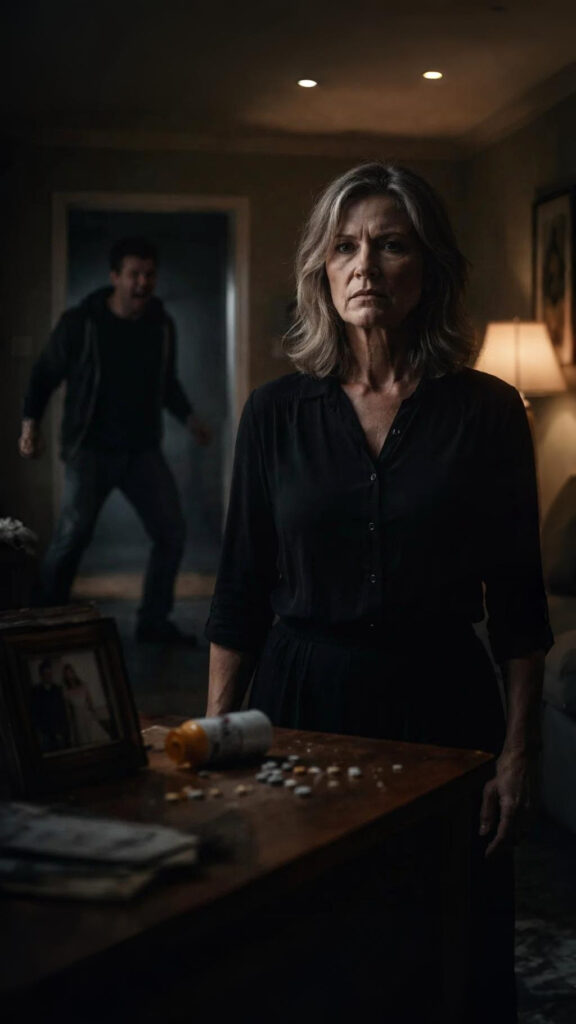
Chapter 1 — The Weight of Silence
When the priest said the final words at the cemetery, the sound of the earth hitting the coffin echoed like a verdict. My husband had been gone for only a week, but time already felt stretched and hollow, as if the air itself refused to move. People spoke to me in whispers, offering sympathy that sounded like routine. I nodded, thanked them, and watched as faces disappeared into cars and umbrellas, leaving me alone beside the grave that would never answer me again.
The house didn’t feel like a home anymore. His coat still hung on the back of the chair. His coffee cup remained in the sink, a faint ring of dried liquid around the edge. I kept meaning to wash it, but every morning I found myself standing there, holding it, as though I could feel the warmth of his hands through the porcelain. The silence was unbearable, yet I couldn’t bring myself to fill it.
My son, Daniel, visited me every other day at first. He looked at me with eyes too tired for his age. “You should eat something,” he said once, setting down a container of soup that he must have bought on his way. His voice cracked halfway through the sentence.
“I will,” I replied, though neither of us believed it.
He stayed for a few minutes, pacing the kitchen, opening drawers, closing them again without reason. I told myself he was grieving too. Losing his father had shaken him, perhaps even more than me.
But grief has different shapes. Mine was heavy and quiet; his, restless and sharp.
Nights were the worst. I would wake up expecting to hear my husband’s slow breathing beside me, only to find an empty pillow. The loneliness was a sound of its own, constant and low, humming through the walls. Sometimes, I thought I heard footsteps in the hallway—Daniel, perhaps, coming to check on me—but when I turned on the light, there was no one. Just shadows pretending to be company.
A month passed. I began to notice Daniel’s calls became shorter. Sometimes he wouldn’t answer at all. When he did, his tone was distant, distracted.
“Everything okay, sweetheart?” I asked once.
“Yeah. Just… tired. Don’t worry, Mom.”
But I did worry. I heard something in his voice—a tremor, a kind of echo I couldn’t place.
One afternoon, I went to his apartment unannounced. The blinds were closed. He took a long time to open the door. When he did, his face startled me. His beard was untrimmed, his eyes red-rimmed, as if he hadn’t slept for days.
“Mom, you shouldn’t be here,” he said, blocking the entrance with his body.
“I was worried. You didn’t answer your phone.”
He forced a laugh. “Just been busy. You know how it is.”
But there was nothing busy about that apartment. The air smelled stale. Empty bottles on the counter. A mess of papers on the table—letters, bills, something crumpled that he quickly covered with his hand.
I didn’t ask. I told myself he needed space.
On the way home, the winter air bit at my cheeks, but I barely felt it. My thoughts circled like vultures around the same question: How do you help someone who refuses to be helped?
In the evenings, I sat by the window and watched the streetlights flicker on, one by one, like a slow awakening. I told myself Daniel was just grieving in his own way. But a mother’s heart knows when grief becomes something else—something darker, something dangerous.
Still, I held onto denial.
When he stopped showing up entirely, I filled the space with chores. I cleaned the house from top to bottom, reorganized the cabinets, sorted old photographs into albums. Anything to keep from thinking.
Then one night, I found myself talking to my husband’s photograph. “I don’t know how to reach him,” I whispered. “You always knew what to say when he shut down. I can’t do it alone.”
The picture said nothing, of course. But for a brief second, I thought I saw warmth behind that frozen smile. It was enough to keep me going.
The next morning, Daniel called. His voice sounded calm—too calm. “I’m coming over tonight, Mom,” he said.
A small relief filled me. Maybe he was ready to talk, to open up.
“Good,” I said softly. “I’ll make dinner.”
He paused. “Don’t go to any trouble.”
I didn’t know what that meant, not then. I thought he was just being polite. But later, when I looked back, those words would echo through me with a weight I couldn’t have understood at the time.
That evening, I lit a candle for my husband before setting the table for two. The flame flickered and bent, as if uneasy. I didn’t yet know that the quiet house, the one I had longed to feel alive again, would soon become the stage for something far more terrifying than loneliness.
And that my mourning—for my husband, for my old life—was only the beginning.
Chapter 2 — The Fracture Beneath the Surface
Daniel arrived just after sunset. The sky still held a faint trace of blue, like something refusing to give in to the dark. I had prepared dinner—roasted chicken, mashed potatoes, a plate of sliced tomatoes he used to love when he was little. The candlelight trembled on the table, throwing soft shadows across his face as he sat down.
He didn’t touch the food. His hands were restless, fingers drumming against the wood. His eyes kept darting toward the window, the floor, the corners of the room, as if something invisible might emerge from them at any moment.
“You’re quiet,” I said. “Are you feeling any better?”
He looked up slowly. “Better?” He gave a short, hollow laugh. “There’s no better, Mom. Not for me.”
I froze. His voice had an edge I’d never heard before—low, certain, as though he were speaking from some place deep and unreachable.
“Everyone’s lying,” he continued. “You, Dad… the doctors, the neighbors. You all pretended everything was fine.”
“Daniel, please—”
He pushed the plate away, the fork clattering against the table. “You don’t understand what they’ve done. What you’ve done.”
There was nothing to answer. His words didn’t feel directed at me but at something beyond me, something I couldn’t see. I wanted to reach for his hand, but he pulled it back before I could. His eyes were shining with anger—or fear—it was hard to tell which.
After he left that night, the silence in the house felt different. He hadn’t raised his voice. He hadn’t been violent. But something in his tone, in the way he looked at me before walking out, unsettled every piece of me.
For the first time since my husband’s death, I was afraid of my own son.
The next days blurred. I called him. He didn’t answer. I sent messages that went unread. I visited his apartment again, but this time he didn’t open the door. I waited in the hallway, listening. I could hear faint movements inside—footsteps, drawers opening and closing—but no response to my knocks.
Through the door, I said softly, “Daniel, I just want to see you. Please. I’m not here to judge you.”
A long silence followed. Then, from the other side, his voice came quiet and strange. “You shouldn’t be here, Mom. It’s not safe.”
“Safe? Safe from what?”
He didn’t reply. Only the sound of a lock sliding into place.
That night I couldn’t sleep. Every sound in the house made me flinch—the creak of the pipes, the ticking of the old clock in the hallway. I began to realize that my grief had masked something deeper, something I had refused to name: Daniel’s mind was slipping away, and I didn’t know how to stop it.
I found an old notebook of his from college. Inside, his handwriting had become erratic toward the last pages. Phrases repeated again and again: “They’re watching me.” “I have to protect her.” “The house isn’t safe.”
I sat on the edge of my bed, reading those words under the pale light of the lamp, and felt a cold understanding settle in my chest. My son wasn’t just lost in sorrow. He was fighting a darkness I couldn’t see.
Two nights later, the phone rang at 2 a.m.
“Mom,” he whispered. His breathing was uneven. “Don’t go near the windows. Don’t let them see you.”
My heart started pounding. “Daniel, what are you talking about? Who’s outside?”
“They’ve been watching since the funeral. I know you think I’m crazy, but it’s real. You need to listen to me.”
“Please, honey, you’re scaring me.”
“I’m coming over,” he said. “I’ll fix everything.”
Before I could answer, the line went dead.
The drive from his apartment to my house was less than fifteen minutes. I sat in the dark living room, staring at the door, listening for the sound of his car. But when the headlights finally swept across the curtains, something in me twisted. I wasn’t sure I wanted to open that door.
Still, I did.
He stepped inside, eyes wild, clothes wrinkled, jaw clenched as if he hadn’t eaten or slept in days. He held nothing in his hands, but the energy around him felt sharp, electric.
“You’re not safe here,” he said. “They followed me. I heard them outside.”
“Daniel, no one’s following you. You need rest. You need help.”
“Help?” He smiled, but it wasn’t a smile I recognized. “You still think this is about me, don’t you? You think I’m sick. You think I’m like Dad.”
His words stopped me. “What do you mean, like Dad?”
He stared at me for a long time, then looked toward the hallway where my husband’s study used to be. “You think I didn’t know what really happened?”
My throat tightened. “Daniel, your father was ill. You know that.”
“Was he?” he whispered. “Or was that what you wanted me to believe?”
The room felt smaller suddenly, as though the walls were leaning in. I could smell rain on his clothes, metallic and cold. He was trembling—not from fear, but from something that looked like rage trying to disguise itself as purpose.
“Daniel,” I said quietly, “I think we should go to the hospital tomorrow. Just to talk to someone. Please, for me.”
He laughed under his breath. “You’ll see soon enough. I’m the only one who can protect you.”
He turned toward the window, staring into the dark. I could see the faint reflection of his face in the glass—pale, drawn, eyes darting at shadows that weren’t there.
I stayed silent. I didn’t know what else to say that wouldn’t break something already hanging by a thread.
When he finally left, it was without another word. I locked the door behind him and pressed my back against it, feeling my heartbeat race against the wood.
The next morning, I found muddy footprints on the porch and cigarette ashes near the window. He had come back during the night.
I realized then that something had shifted beyond my control. My son was not the same boy who used to leave me flowers on Mother’s Day. Something had taken him, hollowed him, filled the empty spaces with fear and fury.
And deep down, I knew—whatever storm had begun in his mind, it was only getting closer.
Chapter 3 — The Night of the Storm
The wind began to rise before sunset. The trees bent and whispered like conspirators outside my window, their branches tapping against the glass as if trying to warn me. I had checked the locks twice already, yet something inside me refused to settle. Every sound felt too loud, too near.
Daniel hadn’t called in three days. I told myself I’d wait one more before reaching out again, but that lie dissolved as soon as the first thunder rolled through the sky. Storms always made him uneasy. Even as a child, he would crawl into our bed and whisper, Make it stop, Mom. Make it stop.
I picked up the phone and dialed. Straight to voicemail. Again. Then once more.
By the fifth attempt, I wasn’t dialing out of hope—I was dialing to fill the silence.
I made tea I wouldn’t drink. Rearranged the same stack of letters on the table. Opened and closed the curtains. When lightning finally flashed through the room, it illuminated my husband’s photograph on the shelf—his steady eyes watching me, as if he already knew what was coming.
At nine-thirty, headlights swept across the living room wall.
I froze.
They stayed there a moment before flickering out. A car door slammed. Footsteps on the porch.
A knock.
“Mom, it’s me.”
His voice was calm, almost tender. Too tender.
I hesitated, my hand on the doorknob. Rain drummed on the roof above us, steady and relentless. I unlocked it slowly, opening just enough to see his face in the dim porch light. His hair was wet, his eyes wild but gleaming with something—relief, maybe, or something close enough to mimic it.
“Daniel,” I whispered. “You’re soaked.”
He stepped inside without asking. Water pooled beneath his shoes. He wasn’t carrying an umbrella, or anything else. Just himself, trembling, but not from the cold.
“They’re outside,” he said. “I saw them again.”
“There’s no one out there.”
“You don’t believe me.”
“I believe you’re scared,” I said carefully. “But I promise you, no one’s coming.”
He began pacing, running his hands through his hair. “You don’t understand, Mom. They’re watching. They want to take you like they took Dad.”
My stomach dropped. “Daniel, please—your father died of heart failure. We talked about this—”
“Stop lying!”
The shout cracked the air like another bolt of thunder. He slammed his fist against the wall, hard enough to make a picture frame tilt. Then silence again, except for the rain and his unsteady breathing.
He looked at me, his expression shifting, melting into something softer but infinitely more dangerous. “I’m sorry,” he murmured. “I didn’t mean to yell. You just—you make me scared when you don’t believe me.”
“I do believe you,” I said, though my voice was shaking. “But you need help. We can go together, tomorrow. Talk to someone.”
He shook his head violently. “No hospitals. That’s what they want. They’ll use that to take you away.”
His words tangled in my mind, pulling at pieces of memory I didn’t want to revisit—the way my husband had grown paranoid near the end, insisting people were listening through the walls, that the neighbors were recording his voice. The same tone, the same hollow conviction.
Lightning flashed again, followed by thunder so close it rattled the windows. The lights flickered once, twice, and went out.
Darkness swallowed the room.
I reached for a candle on the counter, my hands trembling so badly the match broke. I tried another. Then another.
When the flame finally caught, it revealed Daniel standing too close. His face glowed in the flickering light, eyes wide, lips parted in a strange, frozen smile.
“See?” he whispered. “They cut the power. They know I’m here.”
“It’s the storm,” I said softly. “Just the storm.”
He tilted his head, listening to something I couldn’t hear. Then he moved toward the window, pulled the curtain aside, and peered into the night.
“Stay away from there,” I said.
He didn’t move.
“Daniel, please.”
When he finally turned, his voice had changed. Lower, calmer, but far more chilling. “I won’t let them hurt you. Even if you don’t understand.”
Something in the way he said it made every nerve in my body tighten.
“Daniel,” I whispered, “you’re scaring me.”
He blinked slowly, as though coming back from some distant place. “I’d never hurt you,” he said. “You know that, right?”
“I know,” I answered, because it was the only thing that might keep him from unraveling further.
Outside, the rain grew heavier, slamming against the roof in sheets. I could barely hear my own heartbeat.
Then a sudden crash—something shattering in the kitchen. Daniel spun toward the sound, eyes wide. “They’re inside!”
“No, it’s just—”
He ran before I could finish, disappearing into the dark. I heard drawers opening, the metallic clang of utensils hitting the floor. Then his voice again, louder now, trembling with fury.
“Get out! Leave her alone!”
I followed, candle trembling in my hand. He stood by the counter, clutching the largest kitchen knife we owned.
My voice broke. “Daniel, put it down.”
He looked at me as if seeing me for the first time. “Don’t come closer.”
“I’m not,” I said. “It’s okay, sweetheart. Just… please.”
The wind howled through a crack in the window. The flame flickered wildly, stretching shadows across his face. For a heartbeat, I saw both my son and a stranger standing there, trapped in the same body.
Then, just as suddenly as it began, something in him shifted again. The tension drained from his shoulders. He dropped the knife, letting it clatter onto the tiles.
He stared at it, confused, as though it had appeared from nowhere.
“I don’t know what’s happening to me,” he said, his voice barely audible.
I set the candle down and took a cautious step forward. “It’s all right,” I whispered. “We’ll get through this. I promise.”
He sank to the floor, burying his face in his hands. I knelt beside him, though my entire body was shaking.
Outside, the storm began to fade. The thunder moved farther away, the rain softening into a steady rhythm.
But even as the calm returned, I knew nothing inside the house had truly quieted. The storm had only changed shape.
That night, I sat beside my son until dawn, afraid to sleep, afraid to move, afraid to believe that the worst was over.
Because deep down, I already knew—whatever broke in him that night had reached the point of no return.
Chapter 4 — The Edge of Fear
Morning came with a strange quiet, too still for what had happened the night before. The air felt heavier, as if the walls themselves had been holding their breath. Daniel was still asleep on the couch, his face pale, his fingers twitching slightly as if arguing with dreams. The knife was gone—I had hidden it in the pantry while he wasn’t looking.
For a moment, I allowed myself to believe it was over. That the storm, both outside and inside him, had finally passed.
But peace never lasts long when it’s built on fear.
I made coffee, though I didn’t drink any. The bitter smell filled the kitchen, familiar but strangely hollow. Every sound—the hum of the fridge, the click of the heating pipes—felt too sharp, too loud. I kept glancing toward the living room to make sure he was still breathing.
When he finally stirred, he looked at me with the blankness of someone waking up in a stranger’s home. “How long have I been here?”
“Since last night,” I said softly. “You came during the storm.”
He rubbed his face. “I don’t remember much.”
“That’s okay.”
But it wasn’t okay. Nothing about this was.
I wanted to tell him how terrified I’d been, how close he’d come to doing something irreversible. Yet the words stuck in my throat. I didn’t want to shame him, or push him further into whatever pit he was sliding toward.
Instead, I said, “Why don’t we go see Dr. Harris tomorrow? You liked him, remember? He’s kind.”
Daniel frowned. “You called him?”
“Not yet,” I lied. “I just thought—”
He stood up suddenly. “Don’t call anyone, Mom. Promise me.”
The air changed again, that same electric charge as before.
“Daniel,” I began carefully, “he just wants to help.”
“Help,” he repeated, laughing bitterly. “That’s what they said about Dad, too. And what did help do? It killed him.”
I wanted to argue, to remind him that his father’s death wasn’t anyone’s fault. But he was already pacing, running a hand through his hair. “You’re not listening. You never listen.”
His words hit harder than he meant them to. Maybe because they were true in ways I didn’t want to admit.
I had spent years pretending not to see the cracks forming in both of them. My husband’s quiet withdrawal, the strange notebooks, the muttered conversations with people who weren’t there. And later, Daniel’s quick temper, the sleepless nights, the same haunted look behind his eyes. I told myself it was just stress. That love could fix anything if I tried hard enough.
But love is not medicine.
By afternoon, Daniel seemed calmer. He even helped me fix the curtain rod the wind had knocked loose. There was a strange sweetness in that moment—brief, fragile, almost like before.
He looked at me, smiling faintly. “You remember when Dad tried to fix the roof and fell through it?”
I laughed, though my chest tightened at the memory. “I thought he’d broken every bone in his body.”
“He didn’t stop laughing,” Daniel said quietly. “Even when you yelled at him.”
I nodded. “That was your father.”
The silence that followed wasn’t uncomfortable. For a while, it felt like we were two people remembering the same man instead of two strangers orbiting around grief.
Then the phone rang.
Daniel’s smile vanished.
I went to answer, but he was faster. He picked it up, listened for two seconds, then slammed it down.
“Who was that?” I asked.
He didn’t answer. His eyes darted to the window again. “They found the number.”
“Daniel, please—there’s no they.”
He moved toward the door. “I need to make sure.”
“Make sure of what?”
“That they haven’t followed me here.”
I blocked his way. “You can’t go out there. You haven’t eaten, you haven’t slept—”
He brushed past me. “I’ll be fine.”
I wanted to reach for him, to stop him, but I couldn’t move. My body betrayed me, rooted by fear. The door slammed, and I was left in silence again—one that no storm could match.
For hours, I paced the same few steps between the kitchen and the front door. Every car that passed made my heart jolt. I tried calling him again and again. No answer.
By midnight, I gave up and sat by the window. The moon was pale, thin, a ghostly sliver cutting through the dark. I thought about calling the police, but what would I say? My son is sick but won’t admit it? My son scares me but I still love him?
At some point, I must have dozed off.
The sound that woke me wasn’t loud—it was a whisper against the back door, something soft brushing against the glass. I turned, half-dreaming, expecting to see the curtains moving. But it wasn’t the wind.
It was Daniel.
He was standing outside, barefoot, staring through the window. His clothes were wet again, his hair plastered to his forehead.
I opened the door before thinking. “Daniel! Where have you—”
“Shh,” he said, pressing a finger to his lips. “You have to be quiet. They’re near.”
“Who?”
He didn’t answer. He stepped inside, dripping water across the floor. In his hand was something metallic. I felt my breath catch before realizing—it was just his father’s old flashlight.
“Daniel, please, you need to rest. Come sit down.”
He didn’t move. His eyes were searching the shadows, scanning every corner of the room. “You locked the windows?”
“Yes.”
“And the basement door?”
“Yes.”
“Good.”
He began checking each lock himself anyway. Every click echoed like a countdown.
At one point, he turned toward me and whispered, “You think I’m crazy.”
My throat tightened. “No, I think you’re afraid.”
He looked at me for a long time, then said, almost tenderly, “That’s why I have to protect you. Even if you don’t believe me.”
He stayed up all night, sitting by the window with the flashlight, watching the dark yard. I stayed on the couch, pretending to sleep, my body rigid with exhaustion.
When dawn finally came, his eyes were still open.
He looked different. Detached. Calm, in a way that made the calm itself feel dangerous.
I realized then that I couldn’t keep pretending this would fix itself. Something inside him had crossed a line that love could no longer pull back.
I also realized something else—if I didn’t act soon, I might not live long enough to help him.
Chapter 5 — The Breaking Point
By morning, I could barely keep my hands from shaking. The house was drenched in the pale gray light of dawn, quiet except for the faint creaks of settling wood. Daniel was still at the window, the flashlight dead in his lap, his eyes hollow from a night without sleep.
He didn’t look at me when I entered. He didn’t even blink.
“Daniel,” I said softly. “Please. Let me make you breakfast.”
He didn’t answer. His gaze stayed fixed on the yard. I followed it, but there was nothing there—only the fence, the maple tree, the grass still glistening with dew.
When I touched his shoulder, he flinched like I’d burned him.
“Don’t,” he whispered. “They’ll see.”
“No one is watching us.”
He turned then, his eyes fever-bright. “You don’t understand, Mom. They already have.”
I stepped back. Something about the way he said it, slow and certain, sent a tremor through me. His voice was calm, but his body—his body was all tension, every muscle wired and ready.
“You need to rest,” I said, keeping my voice steady. “Come lie down for a while.”
“I can’t,” he murmured. “If I sleep, they’ll get in. You think I don’t know what they did to Dad, but I do. He saw them too.”
His words dug into me like glass. “Your father was sick, Daniel. He was never—”
He stood abruptly, cutting me off. “Stop saying that! He wasn’t sick! You’re the one who wanted people to think he was!”
The words hit hard. For a moment, the room seemed to tilt.
“I did what I could to help him,” I said. “I loved him.”
Daniel’s expression softened just a little. “I know you did. And I know you love me. That’s why you need to listen now.”
He stepped closer, lowering his voice. “They’ve been in the house before. I’ve heard them move things. Whispering through the vents. I checked the attic—it’s not safe.”
I swallowed hard. “You went into the attic?”
He nodded. “Last night. While you were asleep.”
The thought made my stomach turn. “Daniel, you can’t keep doing this to yourself. You’re scaring me.”
His jaw clenched. “I’m scaring you because you don’t believe me. But when you finally see, it’ll be too late.”
He started pacing again, muttering under his breath. I couldn’t catch all the words, only fragments—watching, recording, safe nowhere.
I realized then that I was out of my depth. Love couldn’t fix this. Reason couldn’t reach him.
I had to get help.
While he checked the windows again, I slipped into the kitchen. I picked up the phone as quietly as I could, dialing Dr. Harris’s number with trembling fingers.
It rang once. Twice.
Then Daniel’s voice came from behind me. “Who are you calling?”
My heart nearly stopped.
I turned slowly. “Just the pharmacy,” I lied. “For my medication.”
He took a step closer. His eyes narrowed. “You don’t take medication.”
I forced a small laugh. “I do now. The doctor prescribed something for my sleep.”
He stared for a long moment before nodding. “Good. You need to sleep. I’ll watch the house.”
When he left the room, I finished the call in a whisper, explaining everything as quickly as I could. Dr. Harris’s assistant promised to send someone, but it might take hours. I hung up before Daniel could notice.
The rest of the morning stretched endlessly. He wouldn’t let me out of his sight for long. Each time I went to another room, he followed a few minutes later, pretending to check the locks or close a curtain.
By noon, he was muttering again—angry now, pacing faster, rubbing his temples as if trying to erase something inside his head.
“I can’t hear them anymore,” he said suddenly. “That’s not good.”
“What do you mean?”
“It means they’ve changed how they’re listening.”
I tried to smile, tried to stay calm. “Maybe that’s a good thing. Maybe they’re gone.”
He stopped pacing. Looked at me with a kind of pity. “You really don’t see it, do you? They’ve already taken everything. Dad, the house, me. And now they’re coming for you.”
His voice cracked on the last word. For a second, I saw my son—the real Daniel, frightened and desperate for help. Then the moment vanished.
“I won’t let them have you,” he said.
I wanted to tell him that no one was coming, that he was safe, that I loved him. But before I could, he moved toward the window again, eyes narrowing. “They’re here.”
I followed his gaze—still nothing. Just the street, the empty air.
“Daniel—”
He turned to me, shaking his head. “Get in the bedroom. Lock the door. Don’t come out.”
“Daniel, please, there’s no one out there—”
He raised his hand, not to strike, but in warning. “Do what I say.”
My body acted before my mind could argue. I stepped into the bedroom and turned the lock. My heart thudded in my ears.
Through the door, I could hear him moving—fast, erratic. Furniture scraping. The back door opening. His voice shouting something I couldn’t make out.
Then silence.
A silence so deep it pressed against my chest.
I stayed there for what felt like hours, afraid to move, afraid to breathe. Every sound of the house felt alive—the ticking clock, the faint hum of the refrigerator, the whisper of wind against the windowpane.
When I finally gathered the courage to unlock the door, the living room was empty. The front door hung slightly open.
Rain had started again, light and steady, leaving muddy footprints across the floor that led outside.
Daniel was gone.
I stood there, staring at the open door, the weight of the quiet pressing down until I could hardly breathe. The only thought that managed to form was simple, and it hollowed me completely.
If I didn’t find him soon, I might lose him forever—
or worse, he might lose himself completely.