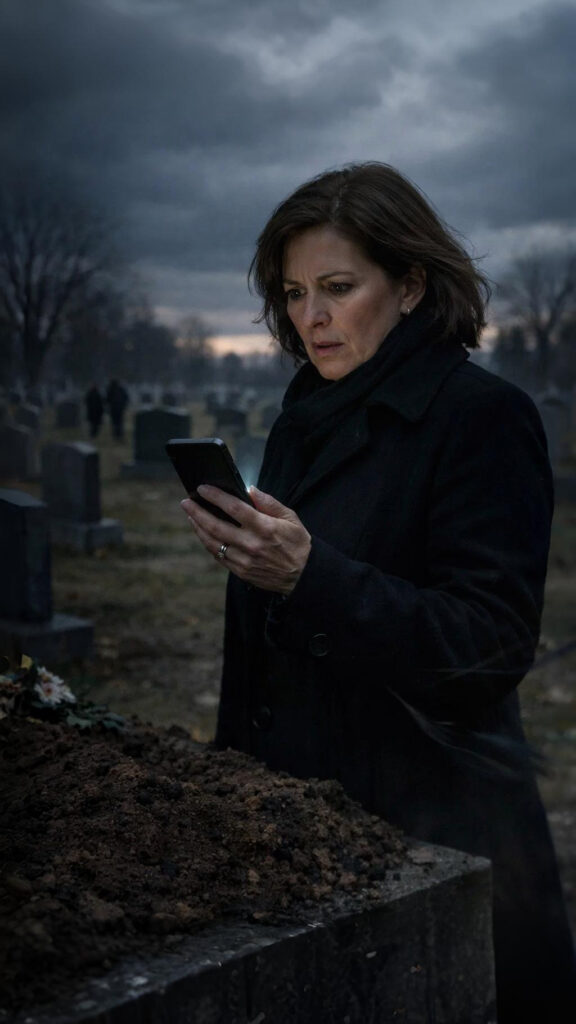
Chapter 1 – The Funeral Message
The rain began before dawn, a thin whisper against the windows that grew heavier as the hearse rolled through the iron gates.
I stood beneath my black umbrella, watching the coffin descend, the sound of wet soil muffled under the priest’s voice. The world around me seemed blurred—umbrellas like dark wings, faces hidden behind veils and pity. My husband was gone. At least, that’s what everyone believed.
I didn’t cry. Not because I was strong, but because something in me refused to accept the stillness of it all.
Thomas had always been larger than life—loud laughter, impossible ideas, hands that could fix anything. Now that man lay silent, a box between roots and rain.
As people began to leave, I remained near the grave. The ground was soaked, my shoes sinking slightly into the mud. I was about to turn away when my phone vibrated inside my purse. I thought it was my son, maybe asking if I was all right. But the screen showed an unknown number.
The message was short.
“I’m alive. I’m not in the coffin.”
My breath caught. For a moment I thought my eyes had tricked me, that grief had already begun to play cruel games with my mind. But the words didn’t vanish. They stared back, solid, undeniable.
I looked around. Only a few gravediggers remained, distant figures under the mist. My hand trembled as I typed a reply.
“Who are you?”
The answer came almost immediately.
“I can’t say. They are watching us. Don’t trust the children.”
I froze. The children?
A chill crept up my spine despite the coat around my shoulders. My daughter, Emily, was still at the gate, talking to the funeral director. My son, David, stood beside the car, glancing impatiently at his watch. They looked normal, exhausted, sad. But the message pulsed on the screen like a warning.
Don’t trust them.
I wanted to delete it. Pretend it hadn’t appeared. But instead, I saved the number. Instinct told me that erasing it would be a mistake.
That night, the house felt wrong. The furniture seemed arranged differently, as if someone had been walking through the rooms while I was gone. Thomas’s study door was locked—David had said he needed to “organize Father’s documents.” He’d taken the key. I didn’t question him then. Now, I wished I had.
Emily brought me tea before bed. Her smile was thin, polite.
“Try to rest, Mom,” she said softly. “You look pale.”
“I’m fine,” I lied.
When she left, I turned the phone over and over in my hands, the glow of the screen faint in the dark room. The number was still there. No name. Just that impossible message.
Could someone be pretending? Playing some cruel trick to make me doubt reality? Or… was Thomas truly alive?
I closed my eyes and saw him in his coffin—face pale, lips still, that strange scar near his temple. The undertaker said it came from the accident. But I remembered seeing that same scar months earlier, when he fell off the ladder fixing the roof. Why mention it as new?
I opened my eyes again, heart pounding.
The phone lit up once more.
“Be careful. They lied about how I died.”
I sat up straight, every sound in the house suddenly sharper. The ticking of the clock, the wind brushing the curtains, the faint creak of a floorboard outside my door.
Someone was there.
I waited, barely breathing, until the shadow moved past the crack under the door—slow, deliberate. Emily? David? I couldn’t tell.
Morning came grey and heavy. At breakfast, both children behaved as if nothing had happened. They spoke about the will, the house, the accounts. David mentioned that some assets might need to be “transferred quickly” before paperwork got complicated.
I stirred my coffee, pretending to listen. Inside, I replayed the message over and over. Don’t trust the children.
When David left for the bank, I tried the study door again. Locked. Emily had gone out to buy groceries, leaving me alone. I found an old hairpin and forced the keyhole. It opened with a quiet click.
The room smelled faintly of tobacco and old paper. Thomas’s desk was cluttered with files. Most were empty. But inside one drawer, hidden beneath a pile of receipts, was a photograph.
Thomas. Standing beside an unfamiliar man. The date printed on the back—three days before the supposed accident.
My pulse quickened. The message wasn’t just a cruel joke. Someone wanted me to find this.
That evening, another text arrived.
“They think I’m dead. Play along. Don’t ask questions yet.”
I stared at the words until they blurred. Outside, the rain returned, steady and unending. Somewhere in the distance, a door slammed.
I felt it then—the first crack in the world I thought I knew. My husband’s death wasn’t an ending. It was the beginning of something far darker.
And the warning echoed in my mind, again and again.
Don’t trust the children.
Chapter 2 – The Children’s Shadows
The next morning, sunlight spilled across the curtains, but it felt wrong, too bright for a house that should have been mourning. I woke before dawn, the phone still on the nightstand, the messages glowing faintly in my mind. “Don’t trust the children.”
I kept hearing that line in my husband’s voice. Calm. Certain. As if he knew them better than I ever could.
At breakfast, Emily hummed as she buttered her toast. Her movements were mechanical, careful, like an actress repeating lines she’d rehearsed a hundred times. David sat across from her, tapping his phone, pretending not to notice how quiet I was.
“Mother,” he said without looking up, “I’ll be meeting with the lawyer today. Father’s estate needs some signatures. I’ll handle everything—you don’t have to worry.”
I wanted to ask why the rush, but my voice felt stuck behind my ribs. I only nodded.
Emily smiled faintly, too faintly. “It’s better this way, Mom. You shouldn’t deal with stress. Let David manage things for a while.”
Their eyes didn’t meet mine when they spoke. That told me more than words could.
When they left, silence returned like a thick fog. I stood in the hallway, staring at the family portraits. Thomas’s smile in those photos seemed to mock the emptiness of the house. In one of them, he held David as a boy, both of them laughing, arms covered in paint from fixing the porch. I touched the frame. There was dust along the edge—except near the corner, where someone had recently moved it.
Behind the photo, folded neatly, was a small envelope. No name. No seal. Inside, a single line typed on a slip of paper:
“They’re lying about the will.”
My knees weakened. The room tilted slightly.
I sat down, clutching the envelope. Someone had been inside this house after the funeral. Someone who wanted me to know.
The hours crawled. I cleaned the same table twice, rearranged the same stack of letters. But I couldn’t shake the feeling that I was being watched. Every sound—a creak, a whisper, a car outside—felt loaded with meaning.
That evening, David returned with a briefcase and a smile too polished to be genuine.
“Everything’s under control,” he said. “The lawyer’s preparing the documents. We’ll finalize things by next week.”
“What documents?” I asked.
He hesitated, then laughed softly. “Just routine procedures. You wouldn’t understand the legal language.”
“I’d like to see them anyway.”
He looked at me for a long moment, eyes narrowing slightly. “You’re tired, Mother. You should rest.”
He placed his hand over mine, but there was no warmth in it.
When he left the room, I followed quietly, my feet soft against the carpet. He entered Thomas’s study, the same room I’d broken into the night before. I stopped near the door, listening. Papers rustled, drawers opened, a zipper closed.
I peered through the small crack—he was burning something in the fireplace.
Pages curled, edges blackened, words dissolved into smoke.
I backed away before he could sense me. The faint smell of burning paper followed me down the hallway.
Later, when Emily returned, she found me sitting by the window, the same envelope resting on my lap.
“Mom, what’s that?”
“Nothing important,” I said.
She studied me carefully, her head tilted just slightly. Then she leaned closer. “You’ve been acting strange. Are you taking your medication?”
I blinked. “What medication?”
“The antidepressants. Dad said you had them—remember?”
Her tone was sweet, but underneath it was something cold. She wasn’t asking. She was reminding me of a version of myself that never existed.
That night, sleep refused to come. I walked through the halls, the wooden floor groaning under my feet. At Thomas’s old desk, I noticed the faint outline of a missing key. The lock on the bottom drawer had been broken recently—the metal bent. I reached inside and found a single USB drive wrapped in tissue.
It had no label, only a small scratch that looked like the letter “T.”
I took it upstairs, plugged it into my old laptop, and waited. The screen flickered before showing a single folder: “Proof.”
Inside were scanned documents—bank statements, property transfers, insurance papers. All signed by Thomas. Or someone pretending to be him.
The most recent one was dated the day after his death certificate was issued.
My throat tightened.
A faint sound echoed downstairs. A door opening. Then closing softly.
I turned off the light, heart pounding. Through the crack in my bedroom door, a figure moved—tall, slow, deliberate. A phone glowed in their hand.
Emily’s voice whispered faintly from the hallway. “She’s still awake. Yes… I’ll handle it.”
I didn’t breathe until she was gone.
The next morning, they both acted normal again, cheerful even. Emily brought me flowers. David suggested we take a short trip to “clear our minds.”
I agreed, smiling as if I believed them.
But the phone buzzed in my pocket—another message from the same unknown number.
“Don’t go anywhere with them. They’re planning something. Check the account ending in 74.”
I waited until they left for town before opening the laptop again. I found the statement and saw the transfer—fifty thousand dollars withdrawn three days before the funeral. The signature was mine. Or rather, a perfect copy of it.
Outside, a car door slammed. I jumped. Emily’s voice called out, bright and careless.
“Mom! We forgot your scarf!”
I hid the laptop under the cushion and forced a smile when she entered.
She held out the scarf, but her eyes scanned the room like a searchlight.
For the first time, I saw it clearly—the same cold intelligence that once belonged to her father. But twisted, sharpened.
When she left, I locked the door.
The phone buzzed again.
“They know you found the drive. Destroy it. And remember, not everything you see is real.”
I stared at the words until my reflection blurred on the screen.
Outside, the rain began again, steady and familiar. Somewhere deep inside, fear shifted into resolve.
If Thomas was truly alive, I would find him.
And if my children were hiding something… then I would uncover every secret they buried, one by one.
Chapter 3 – The Silent Investigation
I began to move like a stranger inside my own house, careful with every sound, every drawer that opened, every whisper of a step on the wooden floor. My children still came and went as if nothing had changed, but I could feel the air between us tighten each day. Their voices too calm, their eyes too rehearsed.
After the discovery of the USB drive, I no longer saw the walls as safety—they were screens, keeping me inside whatever story they had written. I had to learn to act. Pretend. Smile.
When David asked if I’d slept better, I said yes.
When Emily offered tea, I took it, pretending not to see her watch until I drank.
But the truth lived now in small, hidden moments.
I waited until they left the house. Then I unlocked the drawer again, this time using gloves. The USB drive was gone.
I froze, staring at the empty space, my pulse rising so fast it made my vision blur. They knew.
I sat down and forced myself to breathe. I couldn’t panic. Not yet. I still had the photograph—the one of Thomas and the unknown man, taken three days before his supposed death. I placed it under the floorboard near my bed, wrapped in plastic, along with the strange envelope I’d found behind the picture frame.
By afternoon, the house filled again with their footsteps, their practiced smiles. Emily asked if I wanted to visit the cemetery that evening.
“It might help you let go,” she said softly.
Her tone made it sound like an order wrapped in kindness.
“I’ll think about it,” I replied.
She nodded, eyes lingering a second too long.
That night, I waited until both doors closed upstairs, until silence settled again. I turned off every light, took my coat, and left through the back door. The rain had stopped; the air smelled of damp earth. The cemetery was less than a mile away.
Each step felt heavier than the last. I walked past the gate, the same one I had crossed during the funeral. The soil at Thomas’s grave was still fresh, darker than the rest. I knelt down, brushing my fingers over the name engraved in stone.
“Where are you?” I whispered.
My phone vibrated in my pocket. Unknown number. No message, just a single missed call.
I called back. It didn’t ring. No tone, no connection—just silence. Then a voice.
“Don’t speak,” it said. “You’re being watched. Go home now.”
The line went dead.
I turned quickly, heart hammering. A car was parked by the corner of the road, headlights off. The shape of someone inside. Watching.
I ran.
When I reached home, both David and Emily were in the living room, as if waiting. Emily stood by the window, phone in hand. David sat calmly, smiling.
“Out for a walk, Mother?” he asked.
His tone was too light, too casual.
“I needed air,” I said. “I couldn’t sleep.”
He nodded slowly. “Understandable. But you should be careful. It’s dangerous to go out alone at night.”
He let the words hang, heavy with meaning.
Emily said nothing. She only looked at me, eyes steady, face unreadable.
When I went upstairs, I locked the door. My hands shook. I checked under the bed—the photograph and envelope were gone.
They had searched my room.
I felt a strange calm settle over me then, cold and sharp. Fear had done its part; now it was time for calculation. I needed proof—something that couldn’t be erased, burned, or stolen.
The next morning, I went to the library in town. I told Emily I was going to church. She smiled and didn’t question it.
At the library, I used one of the old computers. The clerk didn’t even look up when I logged into the internet. I searched the name of the lawyer David had mentioned. His office didn’t exist. No record, no registration. Nothing.
But the name appeared linked to a construction company—one Thomas had worked with years ago. My husband’s signature was on several archived contracts. I printed everything.
When I returned home, David was waiting by the door.
“Church closed early?” he asked.
I smiled faintly. “Yes, the priest was ill.”
He nodded but didn’t move. His gaze slid to my handbag. “You’re carrying quite a lot of papers.”
“Old letters,” I said quickly. “From your father.”
He let me pass, but I could feel his eyes on my back.
That night, I hid the papers inside the lining of my coat.
Around midnight, another message arrived.
“You’re close. Meet me where the accident happened. Tomorrow. 6 PM.”
I stared at the screen, heart racing. The place where Thomas’s car had been found—an old road near the quarry. The police said the vehicle went off the curve, caught fire instantly. They said he died on impact.
But I remembered something else: no one was allowed to see the body. David said it was “too burned.”
The next evening, I drove there. The sky hung low, heavy with storm. The road was deserted, half-eaten by weeds. I parked near the tree line and waited.
At first, there was nothing. Only the wind. Then a figure emerged from the shadows—hooded, moving carefully. My breath caught.
“Thomas?” I whispered.
The figure stopped. Lifted a gloved hand.
“Not here,” a man’s voice said. Not my husband’s. But close. “They can trace phones. He’s alive, but not safe. Your children made a deal. The accident wasn’t an accident.”
“Who are you?”
No answer. He turned, disappearing into the dark as headlights appeared behind me—a car approaching fast.
I jumped into my vehicle and drove off before the other car could stop. My hands trembled on the wheel.
When I reached home, the lights were on. Emily was waiting by the door.
“You went out again,” she said quietly.
Her voice wasn’t angry—it was almost tender. But her eyes were wrong.
“Where?” she asked.
I hesitated. “Just for a drive.”
She smiled. “You should rest. You’ve been seeing things that aren’t there.”
Her hand brushed my arm. A motherly gesture. A warning in disguise.
That night, as thunder cracked across the sky, I realized the truth wasn’t just buried—it was being hunted.
And I was next on the list.
Chapter 4 – The Hidden Deal
I woke before dawn, my pulse still caught in the echo of the dream. A car sliding off the road. Flames behind glass. A voice calling my name from somewhere deep beneath the sound of rain.
When I opened my eyes, the house was quiet. Too quiet.
I walked down the hallway, careful not to make the floorboards creak. Emily’s door was closed. David’s room was empty, the bed neatly made, no sign that he had slept at all. His suitcase was gone.
On the kitchen counter, a single cup of coffee waited—still warm, steam rising faintly.
A note beside it.
Back in a few days. Don’t worry. Everything’s under control.
No signature.
I stood there for a long time, reading it over and over. The handwriting was David’s, but something about the way he formed the letters looked different. Too careful, almost printed.
My phone buzzed on the table. Unknown number again.
“He’s not gone. They moved him. Check the old storage house near the quarry.”
I didn’t answer. My fingers hovered over the screen.
I could almost feel Emily’s eyes on me even though she wasn’t there. The walls of the house had ears. I slipped the phone into my pocket, grabbed my coat, and left before she woke.
The morning fog was thick, clinging to the ground like smoke. The road curved sharply toward the hills, the same path Thomas used to drive when he went to “meet clients.” Now I knew that word could mean anything.
The storage house stood at the edge of the quarry, hidden by overgrown grass and rusted machinery. The padlock was old, covered in mud. I pushed the door—it gave way too easily.
Inside, the smell hit first: damp, metal, oil. Dust motes floated in the weak light. There was a desk, an overturned chair, and boxes stacked to the ceiling.
I opened the first one—papers, contracts, bank ledgers, some signed by Thomas, some by other names I didn’t recognize. The second box held photographs. Men in suits. My husband standing with them. David beside him in one of them, younger, smiling proudly.
My breath caught.
In the corner of the room, an old coat hung from a nail. It was Thomas’s—faded brown with the tear on the sleeve I’d mended years ago. Inside the pocket, a phone. Dead battery. I slipped it into my bag.
Then I heard footsteps.
I froze, the air tightening around me. The door creaked.
“Mom?”
Emily’s voice. Soft. Uncertain.
I stepped back, gripping the edge of the desk. “What are you doing here?”
“I could ask you the same,” she said, stepping inside. “You’ve been sneaking out, following messages from strangers. You think Dad’s alive. Don’t you realize how dangerous that sounds?”
Her tone trembled between pity and accusation.
“Who told you I was here?” I asked.
“You did.” She lifted her phone, showing the tracker app. “For your safety, remember? You agreed to it months ago.”
I hadn’t. But maybe David had installed it himself.
“Emily,” I said quietly, “if you know something—if David—”
She cut me off. “Stop blaming us. Dad’s death was an accident.”
I stared at her. “Then why are there papers with his name dated after the accident? Why were they hiding money?”
For a moment, her face hardened. Then she smiled—a slow, weary smile. “You shouldn’t have seen that.”
Before I could move, another car pulled up outside. Doors slammed. Voices—two men.
“Emily?” one called. “Everything fine?”
She turned toward the sound, then back to me. “Go home, Mom. Please. Forget this.”
But the men stepped inside before I could leave. They weren’t strangers. I recognized one of them from the photograph with Thomas—the same cold eyes, the same expensive watch.
He looked at me and smiled politely. “Mrs. Hale. I’m glad you’re here.”
I stepped back, heart pounding. “Who are you?”
“A friend of your husband’s,” he said. “We worked together on a project. Before the accident.”
His gaze lingered on the open boxes. “I see you’ve found some of our old business records.”
“Business?” I repeated.
He nodded. “Thomas was involved in an investment partnership. Unfortunately, after his death, there were… complications. But your son has been very helpful resolving them.”
My throat tightened. “My son?”
“Yes. David understands the value of discretion.”
Emily looked down. She wouldn’t meet my eyes.
“I think you should go,” the man said gently. “It’s not safe here. These documents are confidential.”
He reached for the boxes. I stepped forward instinctively. “They belong to my husband.”
His smile didn’t fade. “Not anymore.”
He turned to Emily. “Take your mother home.”
I let her guide me outside, my mind spinning, the fog swallowing the road as we walked.
In the car, Emily gripped the steering wheel so tightly her knuckles went white. “You shouldn’t have come here, Mom. You don’t understand how deep this goes.”
“Then tell me,” I said. “Tell me the truth.”
She didn’t answer.
Back at the house, she went straight upstairs. I stood in the hallway, staring at the empty space where family used to mean safety.
Later, when night fell, I took out the dead phone from Thomas’s coat. Plugged it into an old charger. Waited.
The screen flickered. One message appeared.
From: T. Hale
Date: one week after the funeral
If you’re reading this, it means they found me again. Trust no one—especially David. The deal was never about money.
The battery died before I could open anything else.
I sat there in the dark, holding the phone, listening to the wind rattle the windows. The truth was no longer a question of life or death. It was a transaction.
And somewhere, my husband was still part of it.
Chapter 5 – The Revelation at Dawn
The night stretched long, heavy with the sound of wind scraping against the shutters. I sat on the edge of the bed with Thomas’s phone in my hand, its dead screen reflecting the faint light from the hallway. His last message burned inside me: Trust no one—especially David. The deal was never about money.
I didn’t sleep. Each time I closed my eyes, I saw that storage house again—the man with the polite smile, the papers vanishing into his hands, Emily’s trembling voice when she said you don’t understand how deep this goes.
By morning, the decision had already formed. I had lived too long being the silent one in a house of whispers. If Thomas was alive, or even if he wasn’t, I needed to uncover what they had done in his name.
The sun hadn’t risen yet when I left. The streets were empty, wet from the night’s rain. I drove without a destination, only following the instinct that something—someone—was still watching.
At a gas station on the edge of town, I parked and walked into the small diner beside it. The smell of coffee and old wood steadied me. I sat near the back, the phone charging beside my cup.
When it finally blinked to life, new messages appeared—unsent drafts saved in the phone’s memory. Each one written by Thomas, never delivered.
“They forced me into it. The company isn’t real. The investors are laundering money through us. David helped them. I recorded everything.”
“If something happens to me, the truth is on the drive I hid at the quarry. Tell no one.”
The drive. The one they had stolen.
A wave of nausea rolled through me. Somewhere in that device was the reason for all of it—the fake death, the men at the storage house, my children’s fear.
I looked out the window. A silver car had pulled into the lot. Black-tinted windows. No license plate on the front.
I unplugged the phone, left cash on the table, and walked out the back door.
The air outside was sharp, biting. I crossed the alley, moving fast, turning corners until the car was out of sight. My pulse wouldn’t slow.
I reached a small park, empty except for the pigeons pecking at the wet grass. Sitting on a bench, I tried to breathe, to think.
Then the phone rang. Unknown number.
I answered. “Thomas?”
A pause. Then the same male voice I had heard before—the one who’d met me near the quarry.
“You shouldn’t have gone to the diner,” he said. “They followed you.”
“Who are you?”
“A friend. I worked with your husband before he disappeared. He trusted me to protect the evidence.”
My grip tightened. “The drive?”
“Yes. They took the original, but there’s a copy. Meet me before they find you.”
“Where?”
He hesitated. “The old lighthouse, tonight. Bring no one.”
The line went dead.
I sat there, the world narrowing to the sound of the wind through the trees.
When I returned home later, Emily was waiting in the kitchen. Her calm smile barely hid the exhaustion on her face.
“You’ve been gone for hours,” she said softly. “We were worried.”
“We?” I asked.
“David called. He’s on his way back.”
Her hand rested on the counter beside a small cup of tea. “Drink something. You look pale.”
I glanced at the cup but didn’t touch it. “You’ve been busy,” I said.
She froze. “What do you mean?”
“I went through your father’s phone.”
Her expression didn’t change, but her fingers tightened around the rim of the cup. “You shouldn’t have done that.”
“Neither should you,” I said. “Whatever you and your brother are part of—it’s going to end.”
Her voice broke slightly. “You don’t understand, Mom. We didn’t have a choice.”
“Everyone has a choice.”
She shook her head. “Not when they hold everything you love over you.”
For the first time, I saw something human in her—fear, regret, maybe even guilt.
“Who are they?” I asked.
Before she could answer, the front door opened. David stepped inside, expression unreadable. He kissed his sister on the cheek, then looked at me.
“We need to talk,” he said.
I didn’t move.
He placed a folder on the table. “You’ve made things complicated. The men who visited yesterday—they don’t like complications.”
“I saw the photos,” I said. “You were part of it long before Dad died.”
His jaw tightened. “Dad didn’t die,” he said finally. “Not exactly.”
The words hung between us like static.
“What do you mean?”
David looked at Emily, then back at me. “They faked the crash to make him disappear. He agreed to it. He thought it would protect us.”
“Protect us from what?”
“From the same people you met at the quarry.”
He sighed, running a hand through his hair. “But something went wrong. He tried to expose them. They came after him. We’ve been paying ever since.”
My mind raced, fragments of the past weeks colliding—the message at the funeral, the hidden money, the forged signatures.
“He’s alive?” I whispered.
David didn’t answer.
Emily turned away, her shoulders trembling. “He was. We think they caught him.”
The room swayed.
I leaned against the table, breath shallow. “You should have told me.”
“We couldn’t,” David said. “If they knew you were aware, they would have taken you too.”
Outside, thunder rolled in the distance. The storm was returning.
I looked at them—my children, liars, protectors, victims—and felt a strange mixture of anger and pity.
“I’m going to the lighthouse,” I said.
David’s head snapped up. “No. You can’t. That’s exactly what they want.”
“Then they’ll find I’m not the woman they expect.”
Neither of them stopped me as I walked out. The rain had started again, steady and cold. The road stretched ahead, winding toward the cliffs.
Somewhere out there, the truth waited—alive or dead.
And I was ready to meet it.