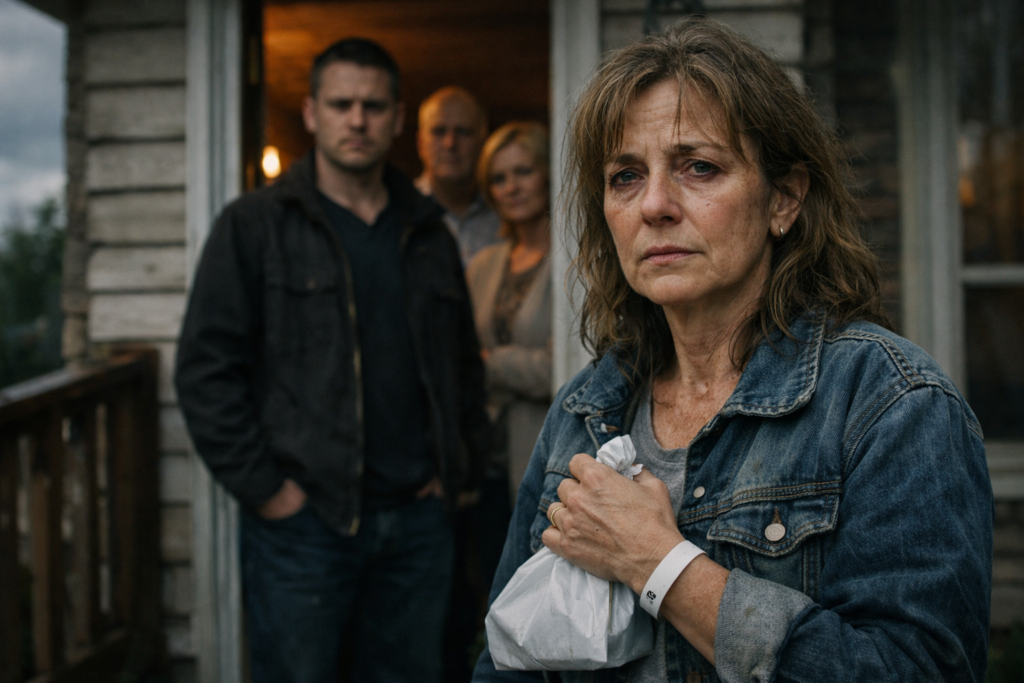
Chapter 1 — The Return That Wasn’t Home
When I stepped out of the hospital gates, the air felt different. Too bright, too clean, as if the world had kept turning while I was suspended somewhere between pain and anesthesia. A month. Almost a month since I had last seen my home, the only place I’d ever truly built with my own hands.
The taxi stopped in front of the old iron gate. My hands trembled as I reached for the latch, the sound of metal scraping metal, a familiar echo that should have felt comforting. But even before I crossed the threshold, something inside me whispered that something wasn’t right.
The curtains were new. Pale beige, not the ones I’d chosen. There were flower pots by the window, too many of them, and none were mine. I froze on the sidewalk, clutching the hospital discharge papers against my chest like a shield.
Then I heard laughter.
It came from inside—young voices, unfamiliar. A woman’s tone, too comfortable for a visitor.
When I finally pushed the gate open, the smell hit me. Perfume, food, life. My life, but not mine anymore.
I stood there for a moment, waiting for my son’s face to appear, waiting for that first look of surprise and joy. Instead, he came to the door with the expression of someone facing an inconvenience.
“Mom,” he said flatly, not even stepping aside. “You shouldn’t be here.”
For a second, I thought I hadn’t heard him right.
“I live here,” I managed to say. “Where else would I go?”
Behind him, a woman appeared—his wife. And then, behind her, another couple. Her parents. They were carrying plates, glasses, moving as if they owned every inch of the place.
My son didn’t look at me when he spoke again.
“It’s not yours anymore.”
I felt something collapse quietly inside my chest.
He continued, as if reciting a rehearsed line. “I gave the house to them while you were in the hospital. You’ll stay somewhere else for now. Don’t come in.”
The words fell like stones.
No explanation. No apology. Just an order.
I wanted to ask how, why, when. But the way he avoided my eyes told me he’d already answered those questions for himself long ago.
The woman—his wife—stood beside him with her arms crossed, watching me as one might watch a stray animal wandering too close to the porch.
I took a step forward, but he moved into the doorway, blocking me.
“Don’t make this harder, Mom.”
That was the moment I realized.
Not the hospital, not the pain, not even the loneliness of long nights hooked to machines—none of that had truly broken me until that instant. Until I saw my own son guarding the door of my home as if I were the intruder.
I remember the silence more than the words. The air between us was thick, alive, vibrating with all the things I wanted to say but couldn’t.
Then, behind me, a neighbor’s curtain moved. Eyes watching. The humiliation spread through me like fever.
I straightened my shoulders. The discharge papers slipped from my hand, carried away by a soft breeze that didn’t care about dignity or ownership.
For the first time in my life, I had nowhere to go.
He closed the door slowly, as if sealing something final. The click of the lock was soft but definitive.
I stood outside for what felt like an hour. Maybe more. Watching the house that had once held birthdays, fights, laughter, prayers. The walls seemed indifferent now, as if they too had forgotten me.
A part of me wanted to scream. To pound on the door until someone called the police. To demand what was mine.
But another part—older, quieter—just wanted to breathe.
So I walked away. Each step heavier than the last, as if the street itself was pulling at my feet, trying to remind me that I belonged nowhere.
At the end of the block, I turned back once. The light in the kitchen window flickered, and for a second I saw a shadow move—someone washing dishes, someone humming. A stranger living the life I’d built.
The sky was the same gray I remembered from the day my husband died.
Maybe that’s what endings look like, I thought. Not with a storm, but with a lock turning quietly in a familiar door.
I didn’t cry until I reached the bus stop. The kind of crying that doesn’t make sound, just steals the air.
People passed without looking. I was invisible again.
But beneath the ache, something colder began to stir—a pulse, faint but real. Not anger yet. Not strength. Just the first breath of a woman who had nothing left to lose.
And that, I would later understand, was the beginning of everything.
Chapter 2 — The Price of a Lifetime
The first night after everything collapsed, I slept sitting on a bench near the bus station. Not because I had nowhere else to go—but because I couldn’t yet face the idea of knocking on someone’s door and explaining why I was suddenly homeless. The air was damp. My hospital wristband still clung to my skin. Every time I looked at it, I felt branded, as if the world could see my failure written there.
The next morning, I went to the community center where Mrs. Alvarez volunteered. She’d known me for years, since my son was still in school, back when he used to run down the hallways barefoot, shouting that he’d be rich one day.
When she saw me standing at the door with a plastic hospital bag and swollen eyes, she didn’t ask questions. Just motioned me inside.
“You can rest here a while,” she said softly. “Coffee’s in the kitchen.”
The warmth of the cup in my hands almost broke me. I hadn’t realized how cold I’d become.
While I sat there, something in me began replaying the years that had led to this. Not as memories, but as scenes, sharp and heavy, pressing against my ribs.
I saw myself at thirty, working double shifts at the garment factory, stitching dresses that would sell for more than my weekly pay. My fingers bled through the fabric, but every drop meant another tile, another brick, another step toward that house. The house that was supposed to keep my family safe.
I saw myself at forty-two, when my husband’s heart failed in the middle of a night that smelled like rain. I remember holding his hand until it went cold, promising him I’d keep the family together. I kept that promise for as long as I could.
I saw the years after that—my son’s college, his wedding, the endless gifts, the money I shouldn’t have given. “Just a little more, Mom. We’ll pay you back.” Always the same sentence, always followed by silence.
That house had been my proof of worth. My reward for years of hunger and exhaustion. When the bank finally handed me the last payment receipt, I’d cried in the middle of the street, hugging it like a newborn. And now… all of it had vanished with a single signature I hadn’t even known existed.
The cruelest part wasn’t losing the walls or the furniture. It was realizing that the boy who once called me his hero had grown into a man capable of pretending I never existed.
I spent that entire afternoon sitting by the window of the center, watching people pass. Families carrying groceries, couples arguing, children dragging their backpacks home. I used to be part of that rhythm. Now, I was a pause between other people’s lives.
At sunset, I found a small room to rent near the old train line. It was cheap because the walls trembled every time a train passed, but at least it had a door that opened with my own key. That small metallic sound felt like a heartbeat.
The room smelled of damp plaster and loneliness. I placed my bag on the floor and sat on the bed. It sank beneath me, too soft, too unfamiliar.
That night, I went through my wallet. Three old photos, a few coins, a folded receipt from the pharmacy. And one picture of my son, taken when he was nine, holding the puppy we’d rescued. His smile back then could light the world.
I kept staring at that photo until my eyes blurred. What had I done wrong? How had love turned into entitlement so slowly that I hadn’t noticed?
It’s strange how the mind protects you from seeing what’s in front of you. All those years, the signs were there. The way he spoke to me, the way his wife rolled her eyes whenever I gave advice. The way they always said, “It’s just a house, Mom,” as if they were already rehearsing the theft.
But I’d been proud of them. Proud enough to ignore the chill behind their smiles.
The next morning, I went to the municipal office to ask about the deed. The clerk, a young man who smelled faintly of cologne and indifference, typed my name into his computer. He looked at the screen for a long moment, then at me.
“Ownership transferred last month,” he said. “Signed and notarized by your son.”
My throat tightened. “Without my consent?”
He shrugged. “It’s legal if you added him to the title. Did you?”
I remembered the day I’d done it. His wedding was coming up. He’d said it would make things easier—just a formality, he’d told me. And I’d believed him.
Walking back to the rented room, the noise of the city felt distant, like a film playing behind glass. Every sound—honking cars, people laughing, dogs barking—seemed to belong to another world.
At the bakery, I spent my last coins on a piece of bread and a cup of tea. The woman behind the counter smiled politely, but her eyes slipped past me, already on the next customer.
That night, I didn’t eat. I just sat by the window, watching the moon slip behind the buildings. The trains came and went, shaking the walls, but I didn’t move.
Somewhere deep inside, beyond the hurt, beyond the confusion, I felt something forming.
Not revenge. Not yet. Just a question.
How could a mother disappear from her own story without anyone noticing?
And then another thought followed it, darker and quieter—
Maybe she doesn’t disappear. Maybe she learns to rewrite the story herself.
I pressed the photo of my son against my chest, feeling its edges dig into my skin, as if reminding me that pain could be sharp and real.
Tomorrow, I promised myself, I would stop crying. Tomorrow, I would start remembering not just what I’d lost, but everything I’d built before they took it.
Because no one steals a lifetime.
They only borrow its silence.
Chapter 3 — The Quiet After the Storm
The days that followed blurred together, like raindrops sliding down a fogged window. I woke up every morning before sunrise, not because I had anywhere to be, but because sleep had become a stranger. The train would roar past at dawn, rattling the thin glass of the window, shaking the small table where my cup of tea sat cooling. That sound, once annoying, began to feel like a reminder that something was still moving in the world, even if it wasn’t me.
I started walking early, before the streets filled. I passed my old neighborhood sometimes, keeping to the opposite sidewalk, my head lowered. The house stood there as it always had—same garden, same blue gate—but now the laughter that spilled from it wasn’t mine. A balloon once hung from the porch for someone’s birthday. It had faded by the next week, its string tangled around the railing like a forgotten thought.
Once, my son’s wife saw me standing across the street. She froze, gripping the grocery bag tighter. For a brief second, our eyes met. There was no guilt in hers. Just discomfort, the kind you feel when something from the past interrupts your new, polished life. She turned away quickly.
That night, I wrote her name on a scrap of paper and then tore it in half. It wasn’t anger; it was an act of erasure. I needed space in my mind for silence.
At the community center, Mrs. Alvarez tried to make me talk.
“You can’t stay quiet forever,” she said, sitting beside me on the bench. “Silence can rot the heart.”
“I’m not rotting,” I said softly. “I’m listening.”
She didn’t ask what I was listening for.
The truth was, silence had become a companion. It helped me sort the noise of betrayal from the voice that was still mine. Each quiet hour felt like stitching something back together, though I didn’t yet know what.
I started keeping a notebook. Not for plans or revenge—at least not consciously. Just pieces of memory, fragments of who I’d been before everything unraveled. I wrote down the sound of my husband’s laugh, the recipe for the soup my son used to beg for, the smell of the house when it rained. It was my way of reclaiming what couldn’t be signed away.
Sometimes, at night, I spoke to my husband as if he were still there.
“They took it all, Luis,” I whispered. “Even the curtains.”
But in the silence that followed, I always heard the same answer inside me: They can’t take you if you stop giving yourself away.
I began noticing small things again—the way sunlight caught dust in the air, the smell of bread from the bakery down the street, the sound of children running past the window. Life kept offering moments, even to those it had wounded.
One evening, I passed by the bank where I used to pay my mortgage. I stood outside for a long while, staring at the reflection in the glass. An old woman looked back at me, thinner, smaller, but her eyes… her eyes were awake.
That night, I made a decision.
No more waiting for apologies that would never come. No more hoping someone would realize what they’d done. I would build again—not a house, but a boundary. A place no one could enter without my permission.
The next day, I went to the social office and asked about my rights. The young clerk looked surprised at how much I already knew. I had spent nights reading legal guides, scribbling notes, circling phrases. Words like “fraudulent transfer,” “elder exploitation,” “revocation of deed.”
He asked if I wanted to file a claim.
“Not yet,” I said. “First, I need to remember exactly what I’ve lost.”
He frowned, not understanding. But I did. I wasn’t ready to fight until I could feel every wound without flinching.
Weeks passed. My body healed faster than I expected, but my hands still trembled when I thought about that locked door. Sometimes, I dreamed of it—my son standing there, saying those words again: It’s not yours anymore.
In those dreams, I didn’t cry. I just turned and walked away.
One morning, I woke up before dawn, heart pounding, the echo of those words still in my ears. And for the first time, I laughed. It wasn’t joy—it was something fiercer, something that sounded like survival.
Later that day, I went to the market and bought a single flower, a white lily. I took it to the train tracks and laid it there, not as mourning, but as an offering to whatever strength had kept me alive this long.
Standing there, the wind pulling at my coat, I realized I didn’t hate my son. Hatred was still a form of attachment. What I felt was emptier, quieter—freedom disguised as loss.
That afternoon, Mrs. Alvarez found me sitting outside the center again.
“You look different,” she said.
“I am,” I answered. “I stopped waiting to be saved.”
She smiled sadly. “So what now?”
I looked at the horizon, where the last train of the day was crossing. “Now,” I said, “I start remembering who built that house in the first place.”
Because before the house, before the betrayal, before the silence—there had been a woman who survived everything once already.
And she was still here, breathing, listening, waiting for her next step.
Not forgiveness. Not vengeance.
Just clarity.
The kind that comes when a storm finally passes, and what’s left standing is only what was meant to last.
Chapter 4 — The Quiet Retaliation
The morning I decided to act was so ordinary that no one could have guessed it would change anything. The sky was a pale, forgettable gray. The street vendors were shouting over the traffic, and my tea had gone cold before I even noticed. But something inside me had settled into a new stillness, the kind that comes not from peace but from a decision.
I had spent weeks in silence, learning it, mastering it. Silence had become my weapon—sharp, invisible, patient.
I went to the library, carrying my old notebook, and sat at one of the back tables near the window. The same notebook where I’d written recipes, memories, pieces of my life, now held another kind of story. Dates. Names. Numbers. Copies of receipts. I had begun collecting them one by one. Every transfer, every bank payment, every document that proved the house had once been mine and mine alone.
The librarian, a kind woman with silver hair, helped me print public records. I didn’t tell her the full story. I just said I needed them for “a matter of inheritance.” She didn’t ask more.
When I returned to my small rented room, I laid everything on the table. The papers looked fragile, yet together they had weight—years of my work, my savings, my sweat in ink and signatures.
I traced the edges of one page with my finger. My name, written there in bold letters, felt like a whisper from another life.
That night, I didn’t sleep. I reread every document, every line, until the words began to blur into something more than legal proof—they were pieces of dignity, stitched back into place.
The next morning, I called my son. It was the first time I had heard his voice since the day he locked the door.
“Mom?” His tone was cautious.
“I need to pick up some old things,” I said simply. “Don’t worry. I won’t stay long.”
He hesitated. “It’s not a good time. Maybe next week—”
“It will be today,” I interrupted. My voice didn’t rise, but something in it made him fall silent.
When I arrived, the gate was open. The in-laws were sitting in the garden, sipping coffee. The same chairs I had once polished every spring. My son appeared at the doorway, eyes darting toward them as if unsure how to behave in front of witnesses.
“Mom, we talked about this,” he began. “You can’t just—”
“I won’t be long,” I said, walking past him.
The living room smelled the same. The curtains, the ones I hadn’t chosen, swayed gently with the wind. I could feel my pulse in my throat, but my steps were steady.
I went straight to the cabinet near the dining table. My wedding photo was still there, tucked behind a vase of artificial flowers. They hadn’t thrown it away. That was something.
As I reached for it, my daughter-in-law appeared, arms crossed. “We were going to put that in storage,” she said.
“Don’t bother,” I replied. “It belongs to me.”
I turned back to my son. He looked uneasy, shifting his weight. “Why are you really here?”
I met his gaze for the first time. “To remind you,” I said, “that everything you see—every brick, every chair—was built with my hands. You may have the papers, but you don’t have the story.”
He opened his mouth to respond, but I wasn’t interested in his excuses. I placed the folder of documents on the table, neatly, deliberately.
“This,” I said, tapping it, “is proof of what you took. And one week from now, I’ll make sure everyone knows it.”
His face drained of color. “What are you talking about?”
“Neighbors, friends, church, community. They’ll know how you treated the woman who gave you everything. I won’t shout. I won’t beg. I’ll just tell the truth.”
For the first time, he looked small.
The in-laws exchanged glances. One of them muttered something about misunderstanding, but I didn’t even look their way.
“I’m not asking for the house back,” I said quietly. “I just want you to understand what it cost to take it.”
Then I picked up the photo and left.
Outside, the air felt cleaner. The gray sky had shifted into a pale blue, soft and wide. I walked slowly, my heart steady.
That evening, I called Mrs. Alvarez. She answered on the first ring.
“I did it,” I said simply.
“What did you do?”
“I gave them silence. The kind that makes people hear themselves.”
She laughed softly, though I could hear the tears beneath it. “That’s the cruelest kind of justice.”
I didn’t answer. I was watching the sunset through the cracked glass of my window, thinking of how peace can sound like revenge if you’ve been quiet long enough.
Over the next days, the whispers began. I didn’t have to say much. People saw me, asked, and I told them just one sentence:
“My son gave my house away while I was in the hospital.”
No anger. No bitterness. Just the fact, delivered like a stone dropped into still water. The ripples took care of the rest.
Soon, I heard from Mrs. Alvarez that the neighbors were talking. The church committee, too. The story spread not because I shouted it, but because injustice has its own echo.
One week later, my son came to see me. I wasn’t surprised.
He stood in the doorway of my small room, the same way he had once stood at the door of the house—only now, he was the one who looked like he didn’t belong.
“Mom,” he said quietly, “people are talking.”
“They’re listening,” I corrected.
He hesitated, then took a deep breath. “I didn’t mean to hurt you.”
“Yes,” I said. “You did.”
He looked down, ashamed. “What do you want from me?”
“Nothing,” I replied. “That’s what terrifies you.”
For a long moment, he didn’t move. Then he turned and left, shoulders slumped.
When the door closed behind him, I felt something shift inside me—not triumph, not joy, but balance.
Sometimes silence speaks louder than anger.
That week, I slept through the night for the first time since the hospital. The trains still passed, the walls still trembled, but this time, the sound didn’t bother me. It felt like applause.
Soft, distant, but real.
Chapter 5 — The House That Spoke for Itself
The rumors spread faster than I ever intended. I hadn’t said much—just enough to let the truth breathe—but truth, once set loose, grows legs of its own. It crosses fences, slips under doors, whispers through cracks.
By the end of that week, everyone knew.
I didn’t need to raise my voice. The story retold itself in the mouths of others, reshaped by outrage, polished by disbelief. The woman abandoned by her son. The house stolen while she was fighting for her life. The ingratitude that no one wanted to believe possible, yet everyone did.
I heard fragments of it in the bakery, in the market, even at the bus stop.
“Did you hear what he did to his mother?”
“A house! Can you imagine?”
“God forgive him, but I never liked that woman he married.”
I didn’t add or correct anything. I just listened. Each retelling made it less my pain and more their lesson.
My son stopped answering calls. His wife quit her job at the local shop. The in-laws—so proud, so polished—started avoiding eye contact when they passed me on the street. Shame has a smell, sharp and bitter. I could feel it before I saw them.
One morning, I received a letter. Folded neatly, left under my door. No name, but I recognized the handwriting. My son’s.
“Mom,” it began, “please stop. You’re destroying us.”
I read it once. Then again, slower this time.
Destroying? The word lingered. I hadn’t destroyed anything. I had only refused to hide what was already broken.
That afternoon, Mrs. Alvarez came by with a basket of bread.
“You’ve shaken them,” she said, half proud, half afraid.
“I didn’t want to,” I replied. “But sometimes the truth has a taste of vengeance, even when you speak it softly.”
She nodded, setting the basket on the table. “What will you do now?”
“I’ll wait,” I said. “Let them hear their own echoes.”
Days passed. The whispers became heavier. A cousin of his called to say people at church were questioning his morality. His wife’s parents had been excluded from a neighborhood association. The humiliation was spreading like spilled ink, unstoppable once it touched the paper.
I didn’t rejoice. There was no satisfaction in watching them crumble, only a strange calm—like watching a storm dismantle what it built.
But one evening, there was a knock at my door.
When I opened it, my son stood there, eyes hollow, shoulders sagging. Behind him, I could see the weight of sleepless nights, of whispers that no apology could silence.
“Can I come in?” he asked.
I hesitated, then stepped aside.
He looked around the small room, his gaze lingering on the cracks in the ceiling, the modest furniture, the single vase on the windowsill.
“You shouldn’t be living like this,” he murmured.
“Like what?”
“Alone. In a place like this.”
I smiled faintly. “I’ve been alone for a long time, Daniel. This place just made it visible.”
He rubbed his face with both hands. “I was stupid. I thought… I don’t even know what I thought. They told me it would be temporary. That we’d help you later. But everything got complicated.”
“It’s strange,” I said softly. “How easily people call theft ‘complicated.’”
He winced. “I’m sorry.”
I believed he meant it. But regret doesn’t rebuild what betrayal burns.
“I can’t give the house back,” he continued, his voice breaking. “It’s legally theirs now. But I want to make things right somehow.”
“You can’t,” I said. “Not with money. Not with guilt. Some debts stay unpaid so you never forget why they existed.”
He lowered his head. For the first time, I saw not the man who betrayed me, but the child who once clung to my hand when thunder scared him.
“I miss you,” he whispered.
“I know.”
He looked up, desperate. “What do you want me to do?”
“Learn,” I said. “And live with what you’ve learned.”
We sat in silence for a while. The sound of the train came faintly through the walls, its rhythm steady, like a heartbeat refusing to stop.
When he left, he paused at the door. “Do you hate me?”
I thought about it. The question deserved honesty.
“No,” I said. “I outgrew hate.”
He nodded slowly and stepped into the hallway, his figure shrinking as he walked away.
After he was gone, I sat by the window. The city was quiet, the lights flickering like old memories refusing to fade. I realized then that I had done nothing extraordinary—no revenge, no plan, no weapon. Just truth and patience. And somehow, that had been enough.
The next morning, I went back to the neighborhood. Not to confront anyone, not even to see the house. I just wanted to walk past it one last time as a visitor.
The gate was closed, the garden unkempt, the flowers drooping. There was a “For Sale” sign nailed to the fence.
I stopped. For a moment, I didn’t breathe.
Then I smiled.
The house that once betrayed me was now rejecting them too.
As I turned away, the sun slipped through the clouds, catching on the windows like a silent farewell. I didn’t look back again.
That night, when I returned to my small room, I opened the window and let the cold air fill the space. I felt lighter—not because justice had been served, but because I no longer needed it.
Forgiveness hadn’t come. But freedom had.
And freedom, I realized, is quieter than revenge. It doesn’t roar. It exhales.
I closed my eyes and whispered into the darkness, not to my son, not to the past, but to the woman who had survived it all.
“You made it,” I said.
And for the first time in months, I believed it.