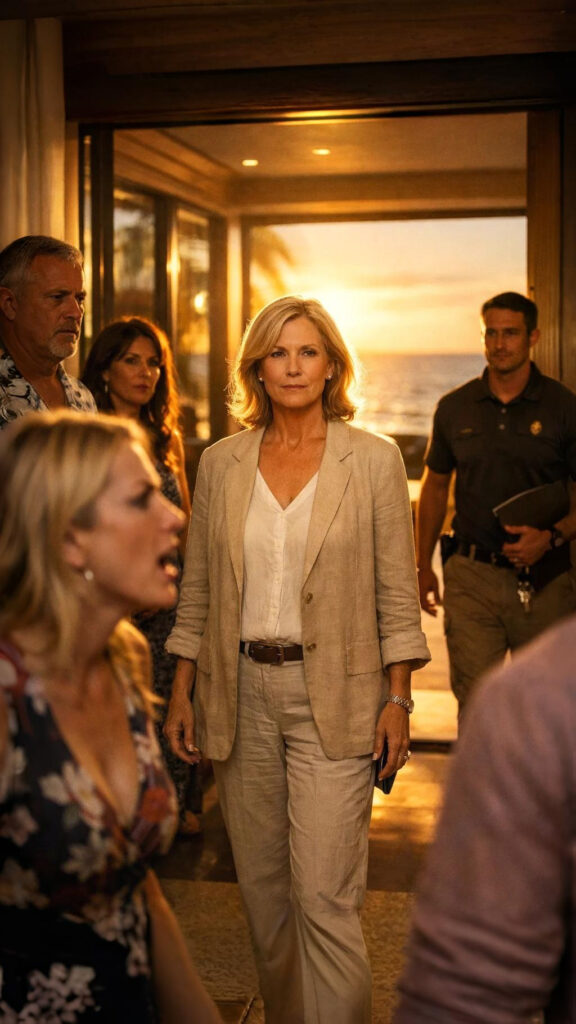
Chapter 1 — The Door That Wasn’t Mine Anymore
I arrived at the beach house just after noon.
The sun was bright, too honest for what waited behind that door.
I had driven for hours with the windows down, salt already in the air, rehearsing nothing at all. This place had always been where my shoulders dropped on their own. Where silence felt earned. Where I reminded myself that I was more than what the family needed from me.
I parked in my usual spot.
The one I had paid for when the road was still gravel.
For a moment, everything felt normal.
Then I heard laughter.
Not the soft kind that drifts.
The loud, careless kind that claims space.
Children screaming.
Music thumping through walls that once echoed only waves.
The clatter of plates, the scrape of chairs being dragged across my floor.
My floor.
I stood there longer than necessary, keys warm in my hand, telling myself it was fine. Maybe they’d arrived early. Maybe my son hadn’t told me yet. Maybe there was still room.
I unlocked the door.
The smell hit first. Fried food. Sweet drinks. Someone else’s perfume clinging to the air like ownership.
The living room was full.
Not busy.
Occupied.
My daughter-in-law was sprawled on the couch, feet tucked beneath her, phone in hand. Her sister sat cross-legged on the rug. An uncle I barely recognized leaned against the bookshelf I had built with my husband decades ago. Coolers lined the wall where family photos used to hang.
No one looked surprised to see me.
They looked annoyed.
She was the first to speak.
Her voice carried easily, sharp and casual, the way cruelty often is when it doesn’t expect consequences.
“Why did that old leech show up here?”
The room went quiet in the way people go quiet when they want to see how bad it will get.
She didn’t lower her voice.
Didn’t pretend it was a joke.
She glanced around at her family, then back at me, lips curling as if I’d tracked sand inside on purpose.
“No room for you,” she added. “We’re full.”
I felt something tighten in my chest. Not shock. Not even pain.
Recognition.
I had seen this look before. In small ways. In delayed replies. In sighs when I spoke too long. In how my presence had slowly become an inconvenience instead of a given.
Still, hearing it out loud changed the weight of the room.
I looked at my son.
He wasn’t sitting. He hovered near the kitchen, eyes on the counter, hands busy with nothing. His silence landed harder than her words.
I waited.
He didn’t say my name.
Didn’t say hers, either.
The children stared at me openly now. One of them whispered something and giggled.
I set my bag down gently.
“It’s okay, dear,” I said, smiling.
The smile surprised even me.
I heard a few exhales, relieved. The tension broke, just enough for them to relax back into their comfort. She rolled her eyes, already bored, victory assumed.
“Good,” she said. “Because honestly, we need space. You understand, right?”
I nodded.
Of course I understood.
I understood that the house I had bought with thirty years of savings had somehow become a favor they were granting me.
I understood that the keys in my hand meant less than the audacity in hers.
I understood that no one in that room expected me to do anything but retreat quietly.
I picked my bag back up.
“I’ll just get some air,” I said.
Outside, the ocean hadn’t changed.
The wind still moved the palms the way it always had. The horizon didn’t care who felt entitled to what.
I sat on the steps and listened to the laughter start again inside.
Louder this time.
They were already celebrating my absence.
I thought about the first summer here. About painting these walls myself. About the nights my husband and I slept on the floor before we could afford furniture. About how this place had been meant as a refuge. A promise to myself that one day, I would rest.
I stayed there for a long time.
Long enough for the sun to shift.
Long enough for anger to cool into something clearer.
When I stood, my hands were steady.
I didn’t knock again.
I didn’t announce myself.
I simply watched through the open window as my daughter-in-law poured drinks into glasses she hadn’t bought, laughing in a house she hadn’t earned, confident in a power she believed was permanent.
She didn’t see me.
But I saw her.
And for the first time since that door opened, I wasn’t wondering where I would go.
I was thinking about what belonged to me.
Chapter 2 — What That House Cost Me
I didn’t go far.
Just down the beach, past the rocks where the sand turns darker and the noise thins out. I sat on a piece of driftwood, shoes in my hand, feet buried where the water reached and retreated like it couldn’t decide if I mattered.
The house stayed in view.
Bright. Loud. Alive with people who believed it had always been theirs.
I closed my eyes, and the years came back without asking.
Not memories in order.
Moments. Weights. Numbers.
I was twenty-six when I started saving for that place.
Twenty-six, working two jobs, saying no to vacations, to dresses I liked, to dinners out. Every envelope had a purpose. Every coin felt like a brick for something solid in a life that hadn’t been easy even then.
My husband used to joke that one day we’d sit by the ocean and finally sleep late.
“We’ll earn our tired,” he said.
We never did it together.
He died twelve years before the house was finished.
Cancer doesn’t care about plans or savings accounts.
I finished it anyway.
Because quitting would have meant admitting that the years we struggled were just years lost, instead of steps toward something better.
I built it slowly.
One room at a time.
One summer at a time.
I paid for permits.
For repairs after storms.
For taxes that rose every year like a test of commitment.
I kept the receipts.
I always kept the receipts.
When my son married, they came here on their honeymoon weekend because they couldn’t afford a trip.
I cooked. I cleaned. I slept on the couch without being asked.
When their first child was born, they needed help.
“I’ll just stay a few weeks,” I said.
It became months.
I bought groceries.
Paid the electric bill.
Watched the baby so they could rest, work, breathe.
When money was tight, they called me.
When it wasn’t, they forgot.
I didn’t complain. I thought that was love.
On the beach, I watched my daughter-in-law step onto the deck, drink in hand. She leaned on the railing like it was hers by right. Someone said something that made her laugh loudly, head thrown back, careless and free.
I wondered how many nights she’d slept here without me.
How many mornings she’d woken up thinking this place was simply part of her life, not the result of someone else’s.
My phone buzzed.
A message from my son.
“Mom, don’t take it personally. You know how she jokes. We’ll talk later.”
Later.
That word had swallowed years of my life.
I typed nothing back.
Instead, I opened my banking app.
Transfers.
Automatic payments.
Standing orders I had set up so long ago I barely remembered doing it.
The numbers stared back at me.
Monthly support.
School fees.
Insurance premiums in my name for cars I didn’t drive.
I added them up slowly.
Over the last eight years alone, I had given them more than most people make in a decade.
Not loans.
Gifts.
Because family doesn’t keep score, I had told myself.
But someone always does.
The tide crept higher, soaking the hem of my pants. I didn’t move.
I thought about how easily she had called me a leech.
How naturally the word had come to her.
As if dependence only ran one way.
When I finally stood, my legs ached, but my head felt clear.
I walked back toward the house, not to go inside.
Just close enough to hear.
Music.
Laughter.
A man shouting that the grill was ready.
My daughter-in-law’s voice floated out again, sharp with excitement.
“Tomorrow we’ll invite more people,” she said. “This place is perfect.”
This place.
I unlocked my car and sat behind the wheel without starting it.
For the first time, I let myself imagine something dangerous.
What would happen if I stopped?
Not yelling.
Not confronting.
Just… stopping.
No more quiet payments.
No more safety net they didn’t even acknowledge.
The idea didn’t scare me.
It steadied me.
I drove away as the sun began to set, the house shrinking in the mirror. They didn’t notice. No one waved. No one called out.
That was fine.
I wasn’t leaving.
I was repositioning.
And somewhere between the road and the darkening sky, I understood something that would change everything that followed.
They believed the house was theirs.
But belief is fragile.
Ownership is not.
Chapter 3 — The Smile That Meant Goodbye
I didn’t go home.
I checked into a small motel on the edge of town, the kind that smells faintly of detergent and old air-conditioning. The room was clean enough. Quiet enough. That mattered.
I sat on the bed with my purse in my lap and didn’t turn on the TV.
Silence first.
Always silence first.
My phone vibrated again.
Another message from my son.
“She’s stressed. You know how she gets when the whole family is around. Don’t make this bigger than it is.”
I read it twice.
Then once more, slowly.
I wondered how many times I had been asked not to make things bigger. How often my hurt had been framed as inconvenience. How easily the responsibility to keep peace had always landed on me.
I placed the phone face down.
The room felt strangely light.
I opened my laptop.
Not with anger.
With precision.
Years ago, when my husband was still alive, he had insisted on organizing everything. Documents labeled. Folders dated. Copies of copies.
“People forget,” he used to say. “Paper doesn’t.”
I had laughed back then.
Now, I silently thanked him.
The deed to the beach house was exactly where it should be.
My name alone.
I scrolled through bank statements next.
Transfers highlighted. Notes attached. Years mapped out in numbers that told a story no one else wanted to hear.
I didn’t cancel anything yet.
Not a single payment.
That was important.
You don’t pull the ground out from under someone while they’re still dancing on it.
You wait until they’re confident they won’t fall.
The next morning, I drove back to the house.
I didn’t announce myself.
I didn’t knock.
I walked in carrying fresh bread and fruit, like I always had.
The noise paused for half a second when they saw me.
Then resumed.
My daughter-in-law looked up from the table, eyes narrowing just slightly.
“Oh,” she said. “You’re back.”
“Yes,” I replied, calm. “I thought I’d help with breakfast.”
She hesitated, clearly recalculating.
“Well,” she said after a moment, shrugging, “if you don’t mind staying out of the way.”
I smiled.
The same smile from the day before.
The one that told them nothing.
I moved quietly around the kitchen, pouring coffee, setting plates, listening. They talked freely now, assuming my presence meant submission. That my silence meant acceptance.
I learned things.
About plans to stay all summer.
About inviting friends.
About how expensive beachfront rentals had become.
“She’s lucky to have this place,” her sister said. “Honestly, at her age, what does she even need it for?”
My hand paused on a cup.
Just for a moment.
Then I continued pouring.
My son wouldn’t meet my eyes.
That afternoon, my daughter-in-law cornered me near the hallway.
“We’re thinking of repainting,” she said, tapping on the wall. “Something brighter. More modern.”
She said it casually.
Like a suggestion.
Like permission wasn’t even part of the conversation.
“That won’t be necessary,” I replied.
Her eyebrows lifted.
“Oh? Why not?”
I looked at her fully then.
Not with anger.
With clarity.
“Because I won’t allow changes without my approval.”
She laughed, short and sharp.
“You’re serious?”
“Yes.”
The word landed heavier than I expected.
Her smile faded.
“Well,” she said slowly, “we’ll see.”
That evening, my son finally spoke.
“Mom,” he said, pulling me aside. “You’re making things awkward.”
I tilted my head.
“For whom?”
He sighed. “You know what I mean.”
I did.
“I think,” I said gently, “that you’ve confused my kindness with consent.”
He frowned, like the sentence was written in a language he didn’t speak.
Before he could respond, his wife called him.
Dinner was ready.
I ate quietly.
Listened more.
Noted everything.
That night, back at the motel, I made my first move.
I logged into my bank account and canceled one payment.
Just one.
The smallest one.
The kind that wouldn’t be noticed immediately.
I closed the laptop and lay back on the bed, staring at the ceiling.
I didn’t feel guilty.
I felt… aligned.
The next morning, my daughter-in-law complained loudly about a declined card at the grocery store.
“It must be the bank,” she snapped. “They’re always messing things up.”
I sipped my coffee.
Smiled.
And said nothing.
Not yet.
Some lessons take time to settle.
And I was done rushing.
Chapter 4 — The First Real No
The change didn’t announce itself.
It never does.
It crept in quietly, like humidity before a storm, sticking to everything until discomfort became impossible to ignore.
By the third day, the house felt different.
Still loud.
Still crowded.
But sharper.
The fridge was emptier than expected. The air-conditioning shut off twice in one afternoon. Someone complained about the Wi-Fi lagging, voices raised like accusations aimed at the walls.
I watched from the corner of the room, book unopened in my lap.
Listening.
My daughter-in-law stood at the counter, phone pressed hard against her ear.
“No, that’s impossible,” she said. “Try again.”
A pause.
Her jaw tightened.
“Well, fix it.”
She hung up and slammed the phone down.
“This is ridiculous,” she muttered. “Everything keeps declining.”
Her sister looked up from the table. “Did you hit your limit?”
“I don’t have a limit,” she snapped. “Someone messed something up.”
My son shifted in his chair.
He glanced at me, then away.
The look was quick.
But it was the first time I saw uncertainty there.
Later that afternoon, he followed me outside.
The ocean was calmer that day, deceptively gentle.
“Mom,” he said, lowering his voice. “Did you change something?”
I didn’t answer immediately.
I let the question breathe between us.
“I changed many things over the years,” I said finally. “What exactly are you asking about?”
He rubbed the back of his neck, a habit from childhood when he didn’t know how to admit fear.
“The card,” he said. “The account. Some payments didn’t go through.”
I nodded once.
“Yes.”
“That’s… not like you.”
I met his eyes.
“I know.”
Silence stretched.
He waited for an explanation.
For justification.
For apology.
I offered none.
“Well?” he pressed. “Was it a mistake?”
“No.”
The word sat between us, heavy and unfamiliar.
He blinked.
“You can’t just—”
“I can,” I said calmly. “And I did.”
His voice dropped. “But we rely on that.”
I tilted my head.
“Rely,” I repeated. “Or expect?”
He looked past me, toward the house, where laughter erupted again, brittle this time.
“You’re punishing us,” he said.
I considered that.
“No,” I replied. “I’m stopping.”
The distinction mattered.
He opened his mouth, then closed it. He didn’t know how to argue with something that wasn’t loud.
That evening, the tone inside shifted again.
My daughter-in-law didn’t smile at dinner.
Didn’t joke.
Didn’t pour wine as freely.
She watched me instead.
Carefully.
As if trying to locate the moment control had slipped through her fingers.
After the dishes, she cornered me in the hallway.
Her voice was sweet.
Too sweet.
“There seems to be a problem with the accounts,” she said. “You probably need to call the bank.”
I met her gaze.
“I already did.”
Her smile faltered. Just a crack.
“And?”
“And everything is exactly as it should be.”
She folded her arms.
“Well, that’s inconvenient,” she said. “With everyone here.”
I nodded.
“I imagine it is.”
She waited.
I waited longer.
Finally, she laughed, sharp and forced.
“Come on,” she said. “You don’t expect us to cover everything ourselves, do you?”
I thought of her words from the first day.
Old leech.
No room for you.
I smiled again.
The same one.
“I only help people who make room for me,” I said softly.
The echo landed.
Her face changed completely this time.
Anger flashed first. Then disbelief. Then something closer to fear.
“You’re doing this on purpose.”
“Yes.”
There it was.
The truth, spoken plainly.
She stepped back as if struck.
That night, doors closed harder than usual. Voices hissed behind walls. My name surfaced in fragments, always followed by silence when I passed.
I slept well anyway.
Better than I had in years.
The next morning, a knock came at my door.
My son stood there, eyes tired, voice tense.
“She’s saying you’re confused,” he said. “That you’re not thinking clearly.”
I looked past him, at the hallway that no longer felt like mine.
“I’m thinking very clearly,” I replied.
“She wants to talk about… options,” he continued. “Maybe getting someone to help manage things.”
“Like what?”
He hesitated.
“A professional. Just in case.”
Just in case I needed to be handled.
I smiled again.
But this time, there was no warmth in it.
“I think,” I said, “it’s time I stopped pretending this is my house only when it’s convenient for you.”
He swallowed.
I closed the door gently.
Behind it, my phone was already in my hand.
Some calls can’t wait.
And some wars don’t start with shouting.
They start with one quiet, irreversible no.
Chapter 5 — The Storm Behind the Smile
The lawyer’s office smelled of paper and sea air.
You could hear the gulls outside, circling above the pier as if they’d been waiting for my decision, too.
He was a quiet man, gray hair, patient eyes. The kind who had seen too many families unravel over greed and guilt. He didn’t look surprised when I told him everything.
Not one bit.
He nodded slowly as I spoke, pen resting against his notebook.
When I finished, he asked only one question.
“Do you want to keep the house or let them have it?”
“Keep it,” I said.
My voice didn’t shake.
He smiled, just a little. “Then let’s make it clear that it’s yours.”
We went through the papers—proof of ownership, banking records, transactions that traced a lifetime of giving. He said I had enough to make anyone listen, even the ones who’d stopped pretending to care.
By the time I walked out, the ocean looked different.
Not peaceful.
Powerful.
When I returned to the beach house that afternoon, their cars were still parked outside. Music again. Laughter. But this time, I didn’t pause at the door.
I walked in.
The sound cut off instantly.
My daughter-in-law froze mid-sentence, her sister’s fork halfway to her mouth. My son stood at the sink, pretending to be busy.
“Oh, you’re back,” she said, smiling too wide. “We thought you went home.”
“I did,” I said, setting my bag down. “To take care of some things.”
She glanced at my son, confused. “Like what?”
I pulled an envelope from my purse and placed it on the counter.
“Like this,” I said.
She hesitated before picking it up. Her eyes flicked across the letterhead. The law firm’s name was printed in neat, dark ink.
Her voice tightened. “What is this?”
“Notice of ownership,” I said. “And a request for immediate vacancy.”
The room went still.
“You’re joking,” she said, laughing nervously. “You can’t—”
“I can,” I interrupted, calm. “And I have.”
My son’s voice finally cracked through the silence. “Mom, you’re overreacting.”
“No,” I said. “I’m correcting.”
He opened his mouth again, but the words never came. He knew. Deep down, he had always known this day would come.
“I’ll give you until tomorrow evening,” I added. “After that, I’ll have the locks changed.”
My daughter-in-law’s face went pale, then flushed with heat. “You wouldn’t dare.”
“I would,” I said simply. “And I will.”
I turned and walked out before they could answer.
The sky was turning gray, the kind of gray that warns of rain before it arrives. I sat on the porch steps, watching the tide crawl closer, and felt the air shift.
Inside, they were arguing now. Loud, panicked whispers that rose and fell like the wind.
I didn’t listen closely. I didn’t need to.
By evening, the shouting had stopped.
Doors slammed. Cars started. Then silence again.
When I stepped inside, the house smelled of salt and cleaning products. They’d taken most of their things. Not all. A sweater left on a chair. A half-empty bottle of wine on the counter. A child’s toy near the stairs.
The kind of things people forget when they leave in anger.
I stood in the center of the living room, letting the quiet spread.
For the first time in a long while, it didn’t feel like an empty house.
It felt like mine.
The next morning, I woke before sunrise. Made coffee. Opened the windows. Let the air move freely again.
The ocean outside was calm.
Almost forgiving.
A car pulled up hours later.
My son. Alone this time.
He didn’t knock. Just stood at the doorway, eyes tired.
“Mom,” he said softly. “You really went through with it.”
“Yes.”
He looked around, taking in the emptiness. “She’s furious.”
“I’m sure she is.”
He ran a hand through his hair. “She says you’ve lost it.”
I smiled faintly. “If losing it means remembering what’s mine, then yes, I suppose I have.”
He looked at me, searching for something—an apology, a weakness, a trace of the mother who always gave in.
He didn’t find it.
“I didn’t want it to end like this,” he said quietly.
“It hasn’t ended,” I replied. “It’s only begun without pretending.”
He nodded slowly, stepped back, and left.
When the sound of his car faded, I sat by the window and watched the tide climb higher, foaming against the rocks.
The horizon glowed, a faint promise of light breaking through clouds.
Somewhere in that steady rhythm, between the waves and the wind, I realized something simple.
Peace doesn’t come from being left alone.
It comes from choosing to stop letting people take pieces of you.
And for the first time in years, I was whole again.