Chapter 1 — The Public Exclusion
The photo appeared on my phone while I was stirring soup. A notification, a small sound, harmless at first. Then the words: “The family that matters.”
Her mother in the middle, my son beside her, their smiles perfectly aligned. My daughter-in-law had written the caption in gold letters, and the comments beneath were a parade of hearts and congratulations.
I stared at it for a long time. My reflection trembled faintly in the screen—hair unkempt, apron stained, eyes too tired for vanity. The kitchen light flickered.
It took me ten minutes to type two words: Good luck.
I didn’t add a period. The absence of one made it sound softer, maybe even kind. But I meant it as a farewell, a warning disguised as blessing.
When I pressed “post,” something inside me settled. Not peace, exactly—just the quiet that comes after a storm, when you’re too exhausted to keep pretending you don’t feel the cold.
The comment sat there for an hour before my son appeared.
He burst through the door like a man escaping fire. His face was white, his voice broken between disbelief and panic.
“Mom—what did you do?!”
I turned off the stove and let the spoon rest.
“What do you mean?”
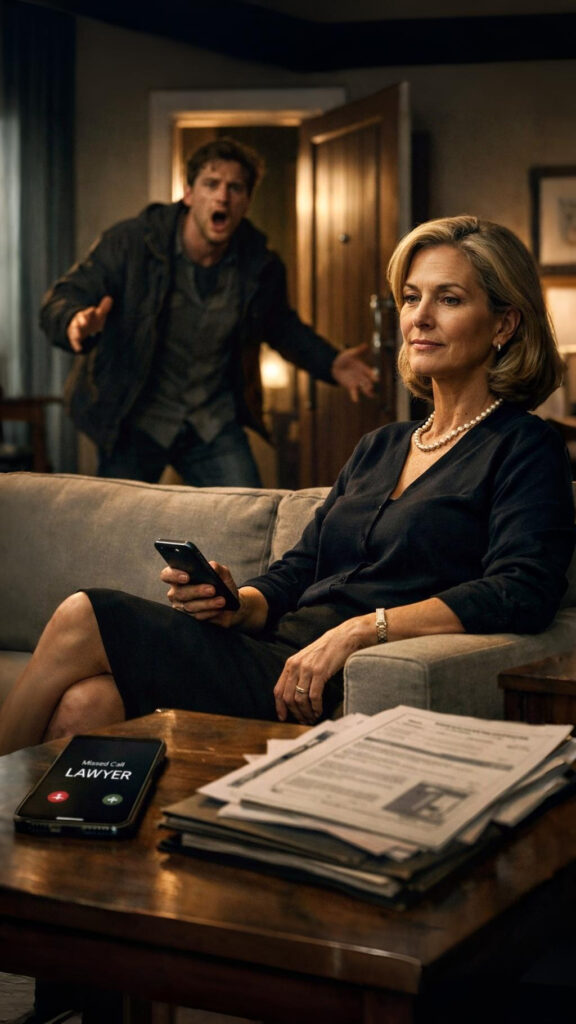
“The lawyer called me! The house—he said there’s been a change—”
He stopped, realizing something that his mind couldn’t yet accept.
“Please tell me you didn’t…”
But I said nothing. Silence has a way of filling a room faster than smoke.
He looked around as if the walls might give him answers. The same walls I painted after my husband died. The same walls that kept him warm through college, through heartbreak, through every time he came running back to me.
Now, he stood in the same place, a stranger in his own childhood.
I walked to the window and looked out at the garden. The roses had grown tall, some leaning against the fence like old women sharing secrets. I remembered planting them the week after my husband’s funeral—something to make the silence bloom.
Back then, my son had helped me dig the holes, dirt under his nails, sweat on his forehead, smiling. He said, “One day I’ll make sure you never have to lift a finger again.”
Promises age faster than people.
When he met her, I was happy. I thought, finally, he’ll be loved by someone new. I didn’t notice how her smile sharpened whenever she looked at me, or how my son started saying “we” instead of “I.”
Then the dinners became rarer. The calls, shorter. Invitations to birthdays arrived late, sometimes not at all.
And when I did go, she’d hand me disposable plates. Always disposable.
The caption on that photo was just the last push of a long, slow erasure.
“The family that matters.”
Not me. Not the woman who sold her wedding ring to pay his tuition. Not the one who signed the papers when his first business failed. Just her and her mother, perfectly framed in good lighting.
I could have cried. I didn’t. Tears are a luxury you lose when people mistake your kindness for weakness.
He stood behind me, still waiting for my answer, still hoping I’d deny whatever he feared.
“Mom,” he said again, quieter this time. “What did you do?”
I turned to him, met his eyes, and smiled just enough to confuse him.
“I did what you should have done years ago, son. I remembered who built this house.”
He blinked, as if the words were a foreign language.
I walked past him, slow and deliberate, like someone leaving a confession booth. The smell of soup filled the air, rich and familiar. I ladled a small bowl for myself and sat at the table.
He didn’t move. His hands shook.
“You can eat if you like,” I said. “It’s still your favorite.”
But he didn’t.
He stood there, pale and silent, with the weight of something he didn’t yet understand pressing down on him. Outside, a car passed, and the house creaked as if exhaling after holding its breath too long.
I took a spoonful of soup, savoring the warmth.
For the first time in years, it tasted like freedom.
Chapter 2 — The Weight of All She Gave
He didn’t come back that night. I expected that.
Men like my son don’t know how to face quiet consequences. They need noise, explanations, someone else to blame.
The house was still. I moved through it as if walking inside a memory, touching the backs of chairs, the edges of photographs, the grooves of a life that had belonged entirely to others.
In the living room, the old clock ticked past midnight. It was the same clock his father had fixed dozens of times, tightening the screws, adjusting the pendulum, proud of keeping something working even when money was scarce.
Now it kept time only for me.
I thought about all the years that had folded into that house—the endless cooking, the nights awake waiting for a call, the mornings spent ironing shirts for a son too busy to remember a thank-you.
I remembered the mortgage papers, the ones my husband and I signed twenty-seven years ago with trembling hands. We were so young then, so terrified of debt, but we wanted a place where our child could grow without the noise of the city.
He was five. He used to draw with crayons on the floor while I planned the next month’s meals around the numbers on a wrinkled notepad.
That’s how every sacrifice began: quietly, without an audience.
When my husband fell sick, the hospital trips swallowed our savings. I sold his tools, then my jewelry, then the car. My son was in college at the time, chasing his degree, chasing a dream he said would repay everything.
He didn’t know I took the night shifts cleaning offices downtown. I’d come home at sunrise, hands raw, knees aching, but proud because he was still studying.
He never saw the envelopes marked Past Due. I hid them under the mattress. I hid everything—pain, fear, exhaustion—because mothers are told that love means silence.
The first time he brought her home, she smiled too wide. “It’s such a quaint house,” she said, dragging the word like it was covered in dust.
I laughed politely, though something inside me tightened. She smelled of perfume and confidence, both expensive.
Later, when they married, I paid for the catering. They said they’d pay me back when things “stabilized.” Things never did.
The day I gave them the keys to the guesthouse, I said, “Stay here until you can afford your own place.”
That was six years ago.
At first, it was temporary. Then it became convenient.
And convenience, I learned, can rot love faster than resentment.
I cooked for them. Watered their plants when they traveled. Babysat their dog. Paid their electric bill twice when they “forgot.”
Each time, they promised it wouldn’t happen again.
It always did.
Sometimes I’d hear laughter from their side of the house—dinners with friends, music spilling through the walls—and I’d stay in my room, reading the same page of an old book over and over, too proud to interrupt.
Then came the day her mother moved in for “a short recovery.”
She never left.
Suddenly, my kitchen became theirs. My groceries, their convenience. My house, their inheritance in progress.
I’d find lipstick-stained cups left in the sink, perfume bottles on the bathroom counter.
Once, she said, “You should be grateful, you’re never alone here.”
Grateful.
The word stuck in my throat like a stone.
One afternoon, I overheard them talking on the porch. My son’s voice low, hers sharp.
“She’ll have to understand,” she said. “This place will be ours soon anyway.”
And he didn’t answer.
That silence broke something inside me that no insult ever could.
It wasn’t anger that came after. It was clarity.
The kind that burns quietly, like a candle left in a dark church.
That night, I went to the old cabinet in my room and pulled out the folder labeled Property Documents. The deed still had my husband’s name. Mine too.
I read it three times before setting it on the table.
The next morning, I called the lawyer.
His voice was calm, almost relieved to hear from me. “Mrs. Hale, we’ve discussed this before. You still hold full ownership. You can make any changes you wish.”
“Yes,” I said. “I wish to make some changes.”
It took weeks to finalize. Not that I minded. Each signature felt like reclaiming breath I’d lent away for decades.
When it was done, I walked to the window and looked out at the same garden, the same roses, and whispered, “We did it, Henry.”
Henry—my late husband—would’ve smiled. He always said people show their true hearts when they think the papers are already signed.
So when my daughter-in-law posted that photo—The family that matters—she had no idea the walls behind her no longer belonged to them.
The house, the land, everything—they were already secured in my new arrangement.
My lawyer had called her husband, my son, earlier that afternoon. Told him, formally, that his name had been removed from all future rights of inheritance, that the property was legally transferred to a trust in my name, to be managed by me alone.
So when he came running into my kitchen, pale and shaking, it wasn’t just shock.
It was realization.
He finally understood that love without respect cannot inherit anything—not even a home.
And yet, even with all that weight lifted, I felt something else that night. Not triumph. Not bitterness.
Just a strange, deep exhaustion.
Because giving everything away—your time, your years, your strength—is one kind of loss.
But learning to keep what’s yours… that’s a whole new kind of loneliness.
Chapter 3 — The Cold Decision
The next morning, the house felt too quiet. Even the clock seemed hesitant to tick.
I poured myself coffee and watched the steam rise and fade. The mug trembled slightly in my hand—not from guilt, but from years of habit. Mothers learn to tremble when their children are upset, even when they’re wrong.
Outside, the garden looked untouched by what had happened. Dew on the grass. Sunlight slanting through the trees. The roses leaning toward the window as if curious.
My son’s car wasn’t there. Neither was hers.
For the first time in years, I had breakfast alone. Real breakfast, not the scraps left after everyone else had eaten. Toast, butter, two eggs. I even used the good china—the set my husband bought for our twentieth anniversary. The one she said was “too old-fashioned” to use.
The fork clinked against the plate. The sound echoed in the emptiness, like proof that the house finally belonged to silence again.
Around noon, my phone rang. His name flashed on the screen. I let it ring. Then again. And again.
By the fourth time, I answered.
“Mom,” he said. His voice was tired, almost pleading. “We need to talk.”
“We are talking,” I replied.
“Face to face.”
I looked at the clock. “Not today.”
“Why are you doing this?”
“Doing what?”
“You know what! Changing the documents, locking us out like we’re strangers!”
“You’ve been strangers for a long time,” I said quietly.
He went silent. I could hear his breathing, shallow, quick.
“Is she there?” I asked.
“She’s… upset.”
“I’m sure she is.”
“Mom, please. We can fix this.”
“No,” I said. “You can’t fix what you don’t see as broken.”
He sighed, frustrated. “You’re being cruel.”
I almost laughed. “Cruel? After all these years, that’s the word you choose?”
He tried again, but I hung up before the sentence could take shape.
The phone rang twice more that afternoon. Then it stopped.
I went about the day quietly, watering the plants, dusting the shelves, folding clothes I hadn’t worn in months. Each small act felt deliberate, sacred. A life reassembled piece by piece.
At dusk, I found myself standing before my husband’s photograph. His smile was still there, soft and knowing, as if he’d seen this all coming.
“I think I did what you would’ve done,” I whispered. “No more giving everything away.”
The evening light stretched across the floor, golden and slow. I sat down on the old armchair and felt the creak beneath me, the sound of wood remembering.
Later, there was a knock at the door. Persistent, sharp.
When I opened it, my daughter-in-law stood there. Her makeup was perfect, though her eyes betrayed a sleepless night.
“We need to talk,” she said.
I stepped aside but didn’t invite her in. “Talk here.”
She crossed her arms. “You’ve embarrassed us. Do you understand what people are saying online?”
I smiled faintly. “I don’t read comments.”
“You made a fool of your son!”
“He made that choice himself.”
Her tone hardened. “You think this is strength? You’re destroying your family over pride.”
“Pride?” I repeated softly. “No. This is peace.”
She looked past me into the living room, eyes darting over the furniture, the framed pictures, the little details she used to mock. “You can’t just erase us from your life.”
“I didn’t erase you,” I said. “You walked out of it long ago.”
Her lips tightened. “You’ll regret this, you know. When you’re alone. When no one comes to visit.”
I almost thanked her for the warning. But instead, I said, “I’ve lived alone before. It doesn’t scare me.”
She hesitated, waiting for me to bend, to apologize, to open the door wider. I didn’t move.
Finally, she turned and walked back to the car, her heels clicking against the pavement like punctuation marks at the end of a story.
When the door closed, the silence returned—deep, steady, complete.
I leaned against the wall and exhaled. My body was trembling again, but this time it wasn’t weakness. It was release.
That night, I slept with the windows open. The wind moved through the curtains like a whisper, the scent of the garden drifting in. Somewhere far off, thunder rolled across the hills.
For the first time in years, I didn’t dream about losing anything.
I dreamed of standing in the middle of my house, the air warm, the light soft, and the feeling—not of victory—but of quiet certainty.
The kind that comes when you stop waiting for love to look like gratitude.
When you finally decide that peace, even if cold, is still yours to keep.
Chapter 4 — The Quiet Revelation
A week passed before I heard from the lawyer again. His voice, steady and composed, came through the receiver as if nothing unusual had happened. But something in his tone had changed—an undercurrent of respect that hadn’t been there before.
“Mrs. Hale,” he said, “I just wanted to confirm you received the official copy of the deed.”
“I did,” I replied. “Thank you.”
He hesitated. “Your son called our office several times. I thought you should know. He asked if there was any possibility of reversing the transfer.”
“And what did you tell him?”
“That there isn’t.”
“Good.”
After I hung up, I sat by the window with the envelope on my lap. The papers were inside, neatly folded, heavy with authority. I didn’t need to open them again—I knew what they said. The house was mine. Completely. Legally. Finally.
Outside, the neighborhood went about its life. Cars passing, children shouting in the distance, a dog barking behind the fence. All of it felt distant, like sound underwater.
The phone remained silent for the rest of the day. They had stopped trying. I thought that would bring relief, but it left an odd stillness instead. Freedom can feel like emptiness at first.
That evening, I found a letter slipped under my door. No envelope, just folded paper, my name written in my son’s handwriting.
Mom, please. Let’s talk. I’m sorry about everything. I didn’t mean to hurt you. We’ll come by tomorrow to explain.
No apology ever starts with “we.”
I set the paper aside. The words didn’t sting—they slid over me like rain over glass. Still, I kept the letter, not for sentiment, but as proof of what regret looks like when it comes too late.
The next morning, I woke early. The house was cool, the air heavy with the scent of wet soil. I brewed coffee and sat outside. The sky was pale, the kind of color that promises nothing but clarity.
I was halfway through my cup when their car stopped in the driveway. They didn’t expect me to be waiting.
My son stepped out first, hands shoved into his pockets, avoiding my eyes. She followed, wearing sunglasses though the sun hadn’t yet appeared.
“Mom,” he said carefully. “Can we come in?”
I shook my head. “Say what you came to say.”
He looked at her, then back at me. “We overreacted. We said things we shouldn’t have. She didn’t mean the post the way it sounded.”
I smiled faintly. “The family that matters, wasn’t it?”
She shifted her weight, lips tightening. “It was just a caption. You’re taking it too seriously.”
“I took it exactly as you meant it.”
He stepped closer. “We’re trying to make peace.”
“Peace,” I repeated, letting the word rest on my tongue. “Peace for whom?”
“For all of us,” he said quickly. “For the family.”
I looked at him long enough for the silence to settle. “Family begins with respect. Everything else is decoration.”
He sighed, shoulders slumping. “So that’s it? You won’t even listen?”
“I’ve been listening for years,” I said. “But now, for once, I get to answer.”
She spoke then, her voice sharp. “You’re punishing us for nothing. You should be grateful we took care of you!”
I turned my gaze toward her. “Took care of me?”
“Yes! We let you stay here, we—”
My laugh cut her off, low and calm. “You let me stay in my own house?”
The words hung between us like smoke. My son’s face fell, his mouth half-open, as if realizing the absurdity of everything he’d believed.
“I worked my whole life for this place,” I said softly. “I fed you here. Raised you here. Paid for every wall, every window. And you both decided it was yours because I didn’t protest loudly enough.”
He looked at me then—really looked—and for the first time, I saw shame behind his eyes.
“Mom,” he whispered, “we didn’t mean to take advantage of you.”
“I know,” I said. “That’s what makes it worse.”
The air shifted. The wind carried the faint smell of roses from the garden, sweet but distant.
She muttered something under her breath, then reached for his arm. “Let’s go. This is pointless.”
He hesitated. “I just wanted to make things right.”
“You can,” I said. “By leaving them wrong for once. Let them stay broken. Some things should never be fixed.”
He nodded slowly, understanding and hurt mixing on his face. Then they turned and left.
The car backed down the driveway, the sound of tires crunching gravel fading into nothing.
When they were gone, I walked back inside. The sunlight poured across the floor, touching everything I owned—every chair, every book, every quiet space.
I realized then that for the first time in my adult life, no one had a claim on my peace.
Not a husband, not a son, not a daughter-in-law, not a memory.
Just me.
That night, I slept with the deed on the nightstand, the lamp still on. I didn’t read it. I didn’t need to.
I just wanted the light to touch it—proof that what was once taken for granted now belonged, unmistakably, to me.
And when I closed my eyes, I didn’t dream of their faces, or the past, or what forgiveness might look like.
I dreamed of doors staying closed. Of rooms filled with quiet.
Of freedom that no one could rename as loneliness.
Chapter 5 — The Fall of the Chosen Family
It took less than a month for their perfect image to crack.
At first, it was subtle. Fewer posts. No matching smiles. Her captions grew shorter, emptier, and then stopped altogether. The silence between their pictures said more than words ever could.
People always believe what they see online, but truth has its own way of leaking through the seams.
I heard the whispers at the market. The way the cashier, who used to serve her first, leaned closer to me now, lowering her voice to gossip. “Did you see? They sold their car. Must be trouble with the bank.”
I didn’t ask. I just nodded, as if such things had nothing to do with me.
Later, one of the neighbors mentioned that her mother—the one from the photo—had moved out. “Too much tension in that house,” she said. “They’re fighting about money, apparently.”
Money.
It always comes down to that.
That night, as I sat near the window, I saw his car parked in front of their small rented place across town. The lights were off. Only the glow of his phone reflected against the windshield. He stayed there for a long time, not moving, not going inside.
I didn’t wave. I didn’t open the curtain wider. I just watched, quietly, and then let the darkness reclaim him.
Days passed, and I returned to my routines. Morning coffee, garden, evening tea. I started walking again—something I hadn’t done in years. The air felt different now, sharper, clearer.
One morning, I saw her at the grocery store. Alone this time. Her face was thinner, the confidence chipped away. She caught my eye for a second, then quickly turned down another aisle. I almost pitied her. Almost.
Later that same week, my son came by. He didn’t knock. The doorbell rang twice, cautious.
When I opened it, he stood there holding a small cardboard box. His shoulders were hunched, his eyes hollow.
“Hi, Mom,” he said quietly.
“Hello.”
“Can I come in?”
I hesitated, then stepped aside.
He placed the box on the table. “It’s your things. The ones you left at the guesthouse.”
“I didn’t leave anything,” I said.
He rubbed the back of his neck. “I know. I just… wanted an excuse to come.”
We sat across from each other. The same kitchen. The same chairs. Everything familiar, but rearranged by time.
“She left,” he said finally. “Took her things yesterday.”
“I see.”
“She said she couldn’t live like this. Said I ruined her life.”
“And did you?”
He looked at me, startled. “I don’t know anymore.”
I poured two cups of tea. One for him, one for me. The sound of liquid filling the cups was the only noise in the room.
“I didn’t want this,” he said after a while. “I thought I was building a future. Instead, everything fell apart.”
“Sometimes it needs to fall apart,” I said. “Otherwise, you’d never see what was built on lies.”
He nodded slowly, his hands wrapped around the warm cup like it was the last thing keeping him steady.
“I miss Dad,” he whispered.
I smiled faintly. “He’d have told you to be careful who you let sit at your table.”
A shadow of a laugh escaped him, short and broken. “He probably would’ve.”
He looked around the room, eyes softening on the photographs, the plants, the clock. “You’ve kept everything the same.”
“I had to,” I said. “It’s how I remember where I started.”
He stayed a little longer, talking about small things—work, the rent, the silence in his apartment. Each word felt like a step toward something fragile but real.
When he finally stood to leave, I followed him to the door.
“Mom,” he said, hesitating. “Do you hate me?”
I looked at him for a long time. The boy I raised was still there, buried under mistakes and pride. “No,” I said softly. “I just stopped waiting for you to love me right.”
His eyes shimmered, but he didn’t cry. He nodded, then turned away.
After he left, I walked to the garden. The roses had started blooming again, bright and unapologetic. I trimmed the dead stems, humming to myself.
By the time the sun began to set, the air was filled with their scent—sweet, stubborn, alive.
The next day, I saw the post.
Her account, once filled with filters and parties, had a single new photo: an empty table, a caption that said “Some families are temporary.”
The irony almost made me smile.
I closed the app and set the phone aside. The sound of the clock filled the room again, steady and calm.
For the first time, I realized the silence didn’t scare me anymore.
It was home.
Not the walls, not the papers with my name, not the garden or the photographs—just this quiet, this steady pulse of peace I’d fought to reclaim.
The so-called “family that mattered” had collapsed under the weight of their own arrogance.
And I—forgotten, underestimated, erased—had become what they never imagined I could be.
The only one still standing.