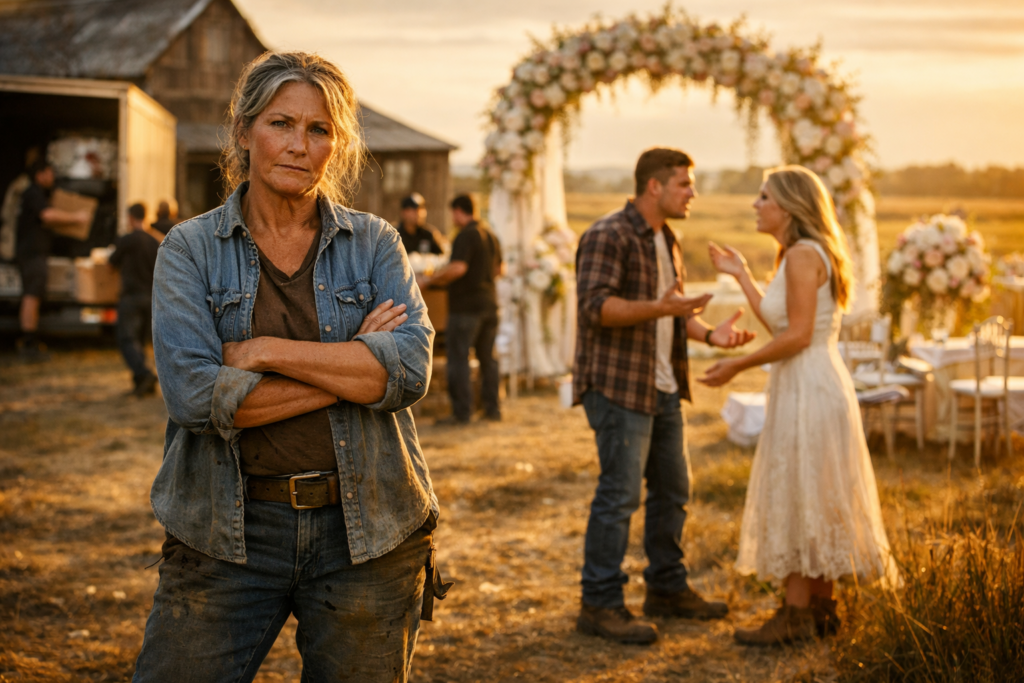
Chapter 1 – The Life Bound to the Land
For forty years, the rhythm of my days was measured by the sound of the wind moving through the wheat. Morning light used to crawl slowly across the kitchen table, spilling over unpaid bills, seed catalogs, and the same chipped mug that had been mine since my husband died. Everything in that house had a layer of memory on it—dust mixed with devotion.
I worked the land like a prayer. Rain or drought, I was out there, mending fences, driving the tractor, patching roofs, burying animals when they fell, planting again when they shouldn’t have grown. I learned to fix engines from a manual, to balance ledgers on the back of grocery receipts, to sleep through the ache in my shoulders. When the crops failed, I sold jewelry, furniture, my wedding dress. When they grew, I saved every penny for the next storm.
People used to say I was married to the soil. Maybe I was. It was the only partner that ever stayed.
My son grew up watching me scrape life out of the dirt. He saw me counting coins at the kitchen counter, stretching leftovers into meals. He promised once that he’d never leave me to do it alone. But promises made by children tend to dissolve in the wind before they ever reach adulthood.
When he was small, he used to run through the cornfields yelling, This is ours, Mama! This is all ours!
I used to laugh. Back then, “ours” meant togetherness. It meant he was part of something sacred.
Years blurred. The laughter stopped echoing through the fields. The farm changed, and so did he.
By the time he came back with his wife, the fences were new, the barn had been repainted, but the ground still carried the same scars. I had worked it alone for so long that I stopped expecting anyone to notice. The farm didn’t feel like home to them—it felt like potential.
Sometimes I would find her standing on the porch, looking out over the land with a calculating smile.
“It’s such a beautiful property,” she’d say, her voice too casual, too rehearsed. “You’ve done a lot with it, haven’t you?”
I’d nod, but inside I’d hear the unspoken question: How much longer will it be yours?
They started to visit more often after that. Talking about “future plans,” about “modernizing,” about how “things could run more efficiently.” I listened in silence, my hands tightening around a cup of coffee that had long gone cold. They talked as if I were some caretaker left behind by time, not the woman who had built every inch of that place.
One evening, while I was cleaning the kitchen, I overheard them laughing on the porch.
“She’s so stubborn,” my daughter-in-law said.
“She’ll come around,” he replied. “It’s our property, after all. It’ll all be ours soon enough.”
The word “ours” struck me differently that night. It no longer meant togetherness. It meant possession. It meant erasure.
I went to bed early, pretending I hadn’t heard. But the sentence kept scratching at the back of my mind.
Our property.
The same soil I had bled for. The same house I had kept warm when there wasn’t enough wood for both of us to eat and heat. The same fields that had carried my husband’s coffin through the rain.
It wasn’t just a claim they were making—it was a rewriting of history. And I was being edited out.
Some nights, when sleep wouldn’t come, I’d sit on the porch with a blanket over my knees and look out at the silhouette of the barn. The land never betrayed me. It gave back what I put in, even when it hurt me. My son didn’t understand that kind of loyalty. He thought owning was the same as belonging.
I remember the morning the first frost hit that year. The ground glittered like glass, fragile but beautiful. I stood there for a long time, watching the sunlight break over the field. My breath came out in clouds. The silence felt heavy, filled with things I would never say aloud.
This was my life’s work—forty years written in sweat, calluses, and the smell of soil after rain.
Every furrow in the earth carried my name. Every fencepost marked a boundary I had built with my own hands.
And yet, I could already feel them circling—my son and his wife—claiming, measuring, dreaming aloud about futures that didn’t include me.
I wasn’t ready to fight yet. Not openly. But something inside me had begun to stir.
A quiet awareness. A thin thread of steel tightening where there had once been only fatigue.
I didn’t know it then, but that was the beginning of the end.
The day I realized that love, unprotected, turns into entitlement.
And that sometimes, the hardest thing isn’t losing what you own—
It’s watching others pretend they built it.
Chapter 2 – The Quiet Theft
It began with small things.
A suggestion here, a correction there. Words dressed as kindness.
“You shouldn’t overwork yourself,” my daughter-in-law would say, smiling while taking pictures of the fields with her phone. “We can help with the management. You’ve done enough.”
I had heard that tone before — polite, polished, but hollow. The kind that conceals intent.
They started calling the farm “our place” in conversations with friends. I’d be standing a few feet away, hands still dirty from feeding the horses, when I’d hear it float through the air — our farm, our land, our property.
At first, I told myself it was a slip of the tongue. People talk loosely. They mean no harm.
But one afternoon, my son stood beside the barn, arm wrapped around his wife’s shoulder, and said with perfect ease, “When we remodel this space for the wedding, it’s going to look incredible.”
I turned slowly. “Remodel?”
He smiled, oblivious to the chill in my voice. “You know, just some improvements. The company we’re hiring will handle everything.”
“The company you’re hiring?”
He nodded, distracted. “It’ll be good for everyone. Family event. Brings life back to the place.”
Life, I thought, has never left this place. Only gratitude did.
That night, I found their plans on the kitchen counter — printed schedules, floral arrangements, catering lists, a full budget. They had even chosen the area near the oak tree where my husband and I buried our dog thirty years ago. The words ‘Ceremony Spot’ were written over it in bright red ink.
My hands trembled. Not from age — from disbelief.
They had taken my silence for permission. My love for weakness.
I sat at the table until dawn, staring at those papers, reading the same lines again and again. I remembered every year I had spent out there — harvesting alone, fixing what broke, refusing to sell when debt collectors came knocking.
No one called it ours then.
When my son came by the next morning, he spoke as if nothing had happened.
“You’ll love the setup. We’ll invite the neighbors too. People will finally see how beautiful your farm is.”
My farm. The way he said it — as though I were an afterthought.
I asked him when he planned to tell me about it.
He blinked. “Tell you? Mom, it’s all family. You don’t have to stress about these things.”
He patted my shoulder and left before I could answer.
His car disappeared down the road, dust rising behind him. The sound faded, but the words didn’t.
I walked out to the field, where frost still clung to the grass. The oak tree loomed in the distance — strong, patient, older than all of us. I had always trusted that tree to keep secrets. That morning, I whispered one to it.
“I think they’re stealing from me, and they don’t even know it.”
The branches moved slightly, though the air was still. I took it as agreement.
Days passed in a haze of false courtesy. They visited often now, bringing flowers, talking about guest lists, asking for measurements of the barn. I watched them take photos, send messages, laugh. They never asked if it was all right.
One afternoon, my daughter-in-law walked through the kitchen wearing that same polite smile.
“You know, once the wedding’s over, we could really turn this place into something special. Maybe a venue? It’s such a waste to keep it just for family.”
Her words were syruped with ambition.
“A waste,” I repeated softly. “That’s what you think this is?”
She hesitated, realizing too late what had slipped out. “No, I mean— it could be something more.”
More than forty years of labor. More than my husband’s hands in the soil. More than my youth spent trading comfort for survival.
I smiled. “I see.”
That night, I didn’t sleep. I sat in my small office, surrounded by old ledgers and receipts. The walls smelled of dust and engine oil. Every document had my name on it. Every acre, every barn, every fence. My handwriting marked them all.
I found the deed, folded neatly in a file labeled Personal. The paper was yellowed but intact. The ink, faded but legible. My name stood alone.
Not ours.
Mine.
I realized then that their theft wasn’t only material — it was emotional. They were taking ownership of my story, rewriting me out of it.
When you spend your life giving, people start to believe that giving is your duty. They forget it was ever a choice.
By the next morning, I had made a decision, though I didn’t yet know the shape it would take. Something inside me had hardened. Quiet, deliberate, unyielding.
I watched from the window as they arrived with boxes of decorations, stepping across the yard like tourists in a museum. They were talking about color schemes and flower arches, pointing at things I had built with hands that now trembled slightly from age.
I didn’t interrupt. I didn’t argue.
But inside, I was counting days.
Every word they spoke became a seed of determination. Every assumption, another reason to act.
When they left that afternoon, I called a number written on a flyer I’d kept for years — a local event company looking for rural spaces to rent. The man on the line sounded cheerful. He said they’d been searching for a place exactly like mine.
We arranged the date. The same date as the wedding.
As I hung up the phone, the silence of the house felt different. Not lonely — purposeful.
I walked to the window again. The fields stretched wide beneath the pale sky, waiting.
It was still my land.
For now.
And for the first time in years, I didn’t feel like the past. I felt like the storm on the horizon, calm before the break.
Chapter 3 – The Invitation That Wasn’t
It came in the mail, a thick envelope with gold edges and the faint scent of expensive perfume. I almost didn’t open it. For a moment, I thought it might be a mistake, something meant for someone who lived differently, who had time for such ceremonies. But the handwriting was my son’s.
Inside, a card: “We are honored to invite you to the celebration of our wedding, to be held at our family property.”
Our family property.
The words sat on the paper like a bruise. Not my farm, not my home — theirs.
I read it twice, maybe three times, until the lines blurred. I set the invitation down, carefully, like something fragile that could cut me. My hands were steady, but my chest wasn’t.
I didn’t cry. I had already done that long ago, when I realized my son saw me not as a mother but as an obstacle.
The next day, he came by to “share the good news.” He carried himself like a guest, not a son.
“Did you get the invitation?” he asked, setting a bottle of wine on the counter like a peace offering. “We wanted to make it official.”
I studied him. His smile was too wide, rehearsed. “Official,” I repeated. “That’s what you call it?”
He chuckled. “Mom, it’s just a party. We’re family. Everyone’s excited.”
“Family,” I said softly. “That’s what you call people who take what isn’t theirs?”
His smile faltered, just for a second. “You’re overreacting. We just want to celebrate on the farm. It’s tradition.”
“Tradition,” I said again, turning the word in my mouth like a stone. “Tradition used to mean respect.”
He sighed, already tired of the conversation. “Please don’t make this difficult. It’s one day. Just be happy for us.”
One day. As if one day could erase forty years.
When he left, I stayed by the window, watching his car disappear down the same road he used to ride his bike on as a boy. I remembered shouting for him to come home before dark, remembered his laughter echoing through the fields. I wondered when that sound had stopped meaning love.
The days that followed were quiet but charged, like the air before lightning. They came and went freely now, making plans, giving orders to contractors, marking spaces with flags and stakes. My land was turning into their stage.
I overheard my daughter-in-law speaking on the phone near the barn.
“Yes, it’s all ours now,” she said. “We’re doing everything ourselves. It’s going to be perfect.”
Perfect. The word twisted. I stood behind the open window, unseen. The wind carried her voice to me, sweet and sharp at the same time.
I looked out over the field — my field — and tried to imagine it filled with white tents, music, laughter. It felt like someone describing a funeral while smiling.
That night, I walked through the house and turned off each light slowly, one by one. The quiet was heavy but not empty. It had weight, like memory.
On the kitchen table lay the invitation again. I had left it there deliberately, like a test. The gold lettering shimmered faintly in the dark. Our family property.
I whispered to no one, “You’ll see what that means.”
The following morning, I visited the small office of the event company I had called. The man remembered me instantly.
“Ah, Mrs. Fletcher,” he said with enthusiasm. “We’re thrilled about the rental. It’s such a lovely property.”
“It is,” I said. “It has history.”
He nodded. “The date you mentioned — are you sure it’s available? It’s quite in demand.”
“I’m sure,” I replied. “It’s already reserved for something else. I just haven’t told them yet.”
He laughed, not understanding. I smiled.
The papers were signed that same afternoon. The ink on the contract gleamed wetly before drying — my signature anchoring it all. I left the office feeling lighter than I had in years.
When I returned home, the barn was already half-covered in decorations. Strings of lights hung from the rafters, and white fabric draped across beams that used to hold hay bales. My daughter-in-law was giving directions with a clipboard in hand, her tone brisk and confident.
I stood at the doorway. “You’re early,” I said.
She turned, startled. “Oh! We just wanted to get a head start before the wedding week.”
“Before the wedding week,” I repeated. “That’s good. You’ll have plenty of time to clean up.”
She laughed uncertainly. “You’re so funny.”
I didn’t smile.
They had no idea. None.
That evening, after everyone left, I sat on the porch watching the sunset melt behind the fields. The sky was streaked with orange and violet, colors too beautiful for how I felt.
It wasn’t anger anymore. It was something colder, something steady. The kind of calm that comes when the decision is already made.
I thought of my husband, how he used to say, Never let anyone walk the land who doesn’t know what it cost to keep it. I wondered what he’d think if he could see it now — his son turning legacy into spectacle.
I imagined the look on their faces when they’d arrive that morning, dressed in their best clothes, only to find the farm buzzing with strangers, tents already up, music already playing — just not for them.
That thought didn’t make me smile. But it steadied me.
The next days unfolded slowly. The preparations for their wedding grew louder, busier, more invasive. Trucks came and went, people walked across my property as if they owned it.
And in my quiet house, I waited. Every contract signed, every payment confirmed, every hour accounted for.
The invitation stayed on my nightstand, unopened again, the gold edges curling slightly under the lamp’s heat. It wasn’t an invitation anymore. It was evidence.
They thought they were the hosts. They thought they were the center.
But the farm was still mine.
And I was still here.
I closed my eyes that night with a strange kind of peace, like the stillness before a storm that knows exactly where to strike.
Chapter 4 – The Quiet Retaliation
The morning of the wedding dawned soft and gold, the kind of day the sky reserves for beginnings. I stood by the window, watching the mist lift from the fields like a curtain rising on a stage. The farm looked peaceful—too peaceful for what was coming.
The house was silent except for the ticking clock and the hum of the refrigerator. On the table lay my copy of the rental contract, folded neatly beside a cup of coffee that had long gone cold. I traced the paper with my fingertips. My name shimmered faintly in the morning light, sharp and clear. It was proof.
Outside, I could already hear distant engines—the first wave of arrivals. Vans filled with decorations, photographers, caterers. And somewhere down the road, my son and his bride, believing this day belonged to them.
I slipped on my old work jacket, the one with the faded patch that said “Fletcher Farms.” It smelled of rain and hay and forty years of mornings just like this one. I didn’t dress for their ceremony. I dressed for my own closure.
The first person to see me was a young man unloading boxes near the barn. He smiled politely, assuming I was part of the wedding staff.
“Morning, ma’am,” he said. “Where should we set up the sound equipment?”
I met his gaze evenly. “You should speak to your supervisor,” I replied. “This is a company rental. They’ll know.”
He hesitated, confused. But then a van rolled up with the event company’s logo plastered across its side, and he shrugged, relieved to have direction. I watched as their team began setting up tents, tables, and speakers—efficient, confident, unaware of the storm they were walking into.
An hour later, the cars began to arrive. Shiny sedans, ribbons fluttering, guests in suits and dresses stepping carefully onto the gravel path. Laughter floated through the air, bright and oblivious.
Then came my son’s car.
He stepped out, grinning, holding his bride’s hand. She looked radiant in white, every inch the picture she must have imagined. For a brief, painful second, I saw the boy he used to be—the one who brought me wildflowers and said he’d never leave the farm. But the memory vanished as quickly as it came.
They walked toward the barn, still unaware. I followed at a distance.
The moment they turned the corner, I saw it—the expression freezing on their faces, their smiles faltering. The barn wasn’t decorated for a wedding anymore. It was already transformed for a corporate event. A large banner hung from the entrance: “Congratulations, Miller Industries – Annual Partnership Gala.”
Dozens of strangers moved about purposefully, setting up catering trays, adjusting lighting, checking microphones. My son stopped dead. His bride blinked rapidly, confusion flooding her face.
“What is this?” she whispered.
He turned toward me, disbelief and fury colliding in his eyes. “Mom… what the hell is going on?”
I stepped closer, steady, calm. “It’s rented out,” I said. “An event company booked it months ago. Today, in fact.”
“Rented?” His voice cracked. “You— you can’t do that! This is our wedding day!”
I tilted my head. “Your wedding day. On my property.”
His bride’s voice rose, brittle. “You knew about this? You let us plan everything here—our guests, our setup—and you didn’t say a word?”
“I didn’t need to,” I replied. “You never asked.”
The silence that followed was heavy, almost sacred. Even the workers had stopped moving, their eyes darting between us, unsure if they should continue.
My son’s face turned red. “You’re ruining everything!”
“No,” I said softly. “I’m reclaiming something.”
He took a step forward, his fists clenched, but the event coordinator intercepted, holding up a clipboard. “Ma’am,” he said to me nervously, “we’re all set for the corporate guests. They’ll arrive soon. Should we proceed?”
I nodded. “Yes. Make sure they have everything they need.”
The coordinator turned to my son, professional and apologetic. “I’m sorry, sir, but this property is under exclusive contract today. You’ll have to clear the area.”
The words struck him like a slap. His bride started crying quietly, her mascara bleeding down her cheeks. He looked at me as if seeing a stranger.
“How could you do this?” he said.
I looked past him toward the fields, glowing in the sunlight. “I spent forty years giving,” I said. “You spent a few months taking. I suppose it was time I reminded you where the balance lies.”
He stared at me, speechless. His bride turned away, shaking her head. Guests began whispering, confusion spreading like wildfire through the crowd.
One of the event company’s sound technicians, unsure what to do, turned on soft background music—jazz drifting out into the chaos. The absurdity of it almost made me laugh.
My son tried one last time. “We’re family, Mom.”
I met his eyes. “Family asks. Family respects. You stopped being family when you started acting like an owner.”
He didn’t answer. He just walked away, the gravel crunching under his shoes. His bride followed, her dress catching in the dirt. The cars began to turn around, engines growling in protest.
By noon, the last of the wedding guests were gone. The only sounds left were laughter from the event company’s staff and the clinking of glasses as they toasted a successful setup.
I stood by the barn door, the sunlight warm on my face. For the first time in years, the air felt light. Mine.
The event coordinator approached again. “Everything’s going smoothly, Mrs. Fletcher. I hope this arrangement worked out for you.”
“It did,” I said. “More than you know.”
As the day unfolded, I watched strangers enjoy the space with genuine gratitude—something my own son had forgotten how to feel.
When evening came, and the lights glowed softly against the darkening sky, I sat alone on the porch. The music drifted from the barn, faint but pleasant. My hands rested on my lap, still, peaceful.
I thought of my son, somewhere nursing his pride, and his wife, already blaming me for their humiliation. Maybe they would never understand. Maybe that was fine.
I hadn’t done it to hurt them. I had done it to end the cycle — to draw a line no one else could cross.
The farm had always been my story. That day, I simply took back the pen.
And as the stars began to rise over the fields, I felt something I hadn’t felt in years.
Relief.
Chapter 5 – The Aftermath of Silence
The day after the wedding-that-never-was, the farm woke up quieter than I had ever heard it. The early light slid gently across the fields, touching everything but stirring nothing. Even the birds seemed cautious, as if they, too, were waiting to see what I would do next.
The event company had left before dawn. They were efficient—no trace of their party remained, only faint tire marks in the dirt and the scent of extinguished candles hanging in the cool air. The barn was empty again, stripped of banners, chairs, and voices. It looked like itself.
For the first time in months, the place breathed.
I brewed coffee the way I always did, slow and deliberate, the smell of it curling through the kitchen. My hands didn’t tremble. I sat at the table where everything had started—the same table where I’d found their wedding plans, where I’d signed the rental papers, where I’d learned to live alone.
The phone rang three times before I picked it up.
It was him.
His voice sounded hoarse, like he’d been shouting or drinking or both. “You humiliated us,” he said. No greeting. No hesitation. “Do you have any idea what people are saying?”
I looked out the window. The frost had melted. “I imagine they’re saying the truth.”
“You destroyed our wedding, Mom!”
I took a sip of coffee. “I didn’t destroy anything that wasn’t already broken.”
He went silent. I could almost hear the weight of his disbelief through the line.
Finally, he muttered, “You’ve lost your mind.”
“No,” I said quietly. “I just found my boundary.”
He hung up.
I didn’t call him back.
The next few days were strange. The farm felt lighter, but the world outside was heavy with noise—neighbors talking, whispers in the grocery store, curious looks from the mailman. Everyone knew. Small towns always know.
When I went to the market, people watched me with a mixture of awe and fear. One woman, a widow like me, stopped by the vegetable stand and said softly, “Good for you.”
That was all. But it was enough.
In the evenings, I walked through the fields. The air smelled of damp soil and wood smoke. The oak tree where they had planned to say their vows stood still, unbothered, its branches heavy with the last leaves of autumn. I touched the bark, rough and familiar.
“You’ve seen worse,” I whispered.
Sometimes I thought about the look on his face—the shock, the anger, the disbelief. It haunted me, yes, but not with regret. More like a necessary ghost, one that reminded me of what silence costs.
One night, he came back.
I heard his car before I saw him, the engine struggling up the gravel path. He didn’t knock right away; he stood on the porch for a long time. I could see his shadow through the curtains, his head bowed.
When I finally opened the door, he looked older than he had the week before. The arrogance was gone, replaced by something unsteady.
“Can I come in?” he asked.
I nodded.
He sat at the table, the same spot where his father used to sit. His hands were clasped tight, his wedding ring glinting under the lamp.
“She hasn’t spoken to me since that day,” he said quietly.
I didn’t answer.
He rubbed his face. “I know what you did wasn’t about the wedding. It was about everything else. I just… I didn’t think you’d actually do it.”
“You didn’t think I’d stand up for myself,” I corrected.
He looked at me for a long moment. “No,” he admitted. “I didn’t.”
There was a silence then, heavy but not cruel. The kind that settles between people who finally see each other for who they are.
“I worked that land for forty years,” I said softly. “Every debt paid, every storm survived. I built something so you could have choices. But I never gave you ownership over me.”
He nodded slowly, shame flickering across his face.
“I’m sorry,” he said.
It wasn’t enough, but it was real.
We sat there in the stillness, the clock ticking like a heartbeat between us. He didn’t ask for forgiveness, and I didn’t offer it. Some things don’t need to be said to be understood.
When he left, he didn’t look back. But he drove slower this time, as if the road itself demanded respect.
After he was gone, I stepped outside. The night was cool, the stars sharp and bright. The barn stood dark and quiet, a witness to everything that had happened.
I breathed in the air—clean, unclaimed.
People think revenge is loud, that it burns hot and leaves smoke. But mine was quiet. It left no flames, only space.
In that silence, I found something close to peace.
Days passed, and the farm began to hum again—small tasks, small joys. I fixed the fence, mended an old gate, planted winter seeds just to see if they’d take. The soil accepted me like an old friend.
Sometimes, when I paused to rest, I imagined the laughter of children, maybe his someday, running through the fields without knowing what had happened there. I didn’t want to curse the land with bitterness. It deserved better. So did I.
I didn’t know if he’d ever come back. I didn’t know if forgiveness would grow between us like something wild and slow. But I knew this: the farm was mine. The life was mine. And for the first time in a long time, so was the peace that came with it.
When the sun set behind the hills, painting everything gold, I sat on the porch with a cup of tea, watching the light fade. The world, it seemed, was finally learning to leave me be.
And I—at last—was learning how to stay.