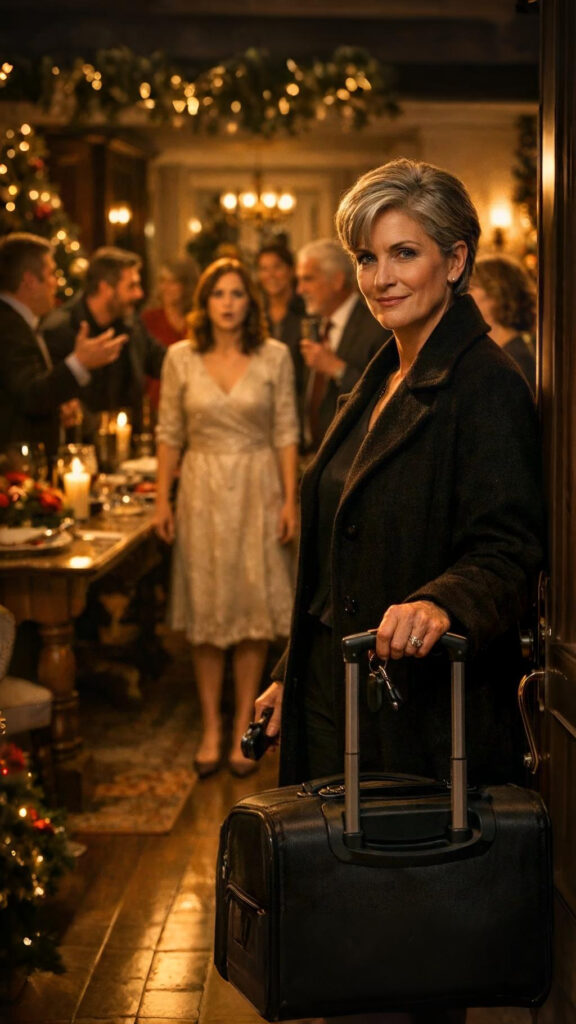
Chapter 1 — The Casual Conversation That Unmasked Everything
The kitchen smelled faintly of cinnamon and detergent. It was mid-December, and the house felt heavy with the kind of silence that lingers before the holidays—the kind where everyone pretends to be busy, but no one really wants to speak first.
Martha was wiping the counter when her daughter, Claire, came in, phone in hand, smiling at something that had nothing to do with her mother.
“Mom,” she began, half-distracted, “I just wanted to check—are you free for Christmas? We’ll be having dinner here this year.”
Martha paused. “Here?”
Claire nodded, scrolling. “Yeah, at your house. It’s just easier. Everyone likes it here. You know how Dad’s side always complains about the parking at our place. So, yeah, we’ll bring everything. You don’t need to worry.”
Martha smiled the polite, automatic smile that mothers have perfected over decades. “And who’s ‘everyone’ this time?”
Claire lifted her eyes, almost as if counting in her head. “Just a few people. Fifteen, maybe.”
Just fifteen.
Martha let the words hang for a moment. She turned to rinse the cloth, her movements slow, deliberate.
Then she said, calmly, “Perfect. Then I’m going on vacation, and you’re in charge. I’m not a babysitter, and definitely not an employee.”
The sound of water hitting the sink filled the pause that followed.
Claire’s phone slipped slightly in her hand. “What do you mean, vacation? You can’t just—Mom, everyone’s expecting—”
“Then you’ll have to explain it to them,” Martha replied. “Because this year, I’m not cooking for fifteen people. I’m not cleaning before or after. I’m not planning, reminding, decorating, or pretending. I’m done.”
She didn’t raise her voice. She didn’t need to.
Claire stared at her, blinking, as if the words were in another language.
For a moment, Martha thought of taking it back, softening it somehow, adding a smile. But no. She had been soft for too long, and it had cost her more than she cared to admit.
So she dried her hands, placed the towel neatly on the counter, and sat down.
The air between them changed.
Claire’s expression tightened, confusion blending with the faintest trace of fear. “Are you angry about something? Did someone say—”
“No,” Martha interrupted. “I’m just… tired. Not the kind of tired a nap can fix. The kind that comes from realizing you’ve been hosting other people’s comfort while forgetting your own.”
Claire laughed lightly, but it didn’t sound natural. “Mom, it’s Christmas. You love Christmas.”
“I used to,” Martha said. “Before it became a shift I didn’t apply for.”
Silence again. Outside, wind pressed against the windowpane, like it wanted to listen.
Martha had always known that her family took her for granted, but knowing it and seeing it were two different things. The moment had arrived without warning—disguised as a casual question about dinner plans—and yet it revealed everything.
Every assumption.
Every habit.
Every small way she had been reduced from mother to maid.
She thought about the last ten Christmases. The early mornings spent basting, stirring, and coordinating while everyone else slept in. The fake smiles when someone complained that the turkey was too dry or the wine too warm. The years she’d worked overtime just to afford gifts that no one remembered come January.
And the gratitude? It always came wrapped in obligation.
She had told herself it was love. It wasn’t. It was duty, painted pretty.
“Fifteen people,” she murmured again, almost to herself. “And not one of them ever asked what I wanted.”
Claire shifted her weight, uncomfortable. “Mom, you’re taking this the wrong way. I thought it would make things easier for you. You always say you like when the family comes together.”
“I like it when the family shows up,” Martha replied, “not when they move in.”
Her tone wasn’t sharp. It was flat, final.
In that instant, Claire seemed to understand that something had shifted—a balance that had quietly kept their family functioning for years had just cracked.
Martha stood, walked to the fridge, and opened it. She took out a small notebook, the kind she used for recipes, but now filled with something else: travel plans, hotel confirmations, and a list of beaches she’d been meaning to visit for decades.
Claire watched, wordless.
“I already booked the tickets,” Martha said, without looking up. “I’ll be gone for a week. Maybe two.”
Her daughter’s eyes widened. “You—you’re serious?”
“I’ve never been more serious.”
For years, Martha had swallowed her own boundaries, believing that sacrifice was love. That patience was virtue. That being needed was the same as being valued.
But now, staring at her grown daughter—who had just assumed her home, her time, and her labor were all available on command—she saw clearly: they had mistaken her endurance for agreement.
And that mistake was about to cost them.
Claire finally found her voice. “You can’t just leave me with all that! What am I supposed to tell them?”
Martha turned, meeting her daughter’s eyes with calm resolve. “Tell them the truth. Tell them your mother isn’t working Christmas anymore.”
The words landed like quiet thunder.
Martha didn’t shout, didn’t explain. She simply walked away, her slippers soft against the floor.
Upstairs, in the solitude of her room, she felt something rare bloom inside her. It wasn’t guilt or sadness.
It was space.
For the first time in years, she felt her own life stretch open again, like a door she had forgotten was there.
And downstairs, her daughter stood alone, realizing that the house didn’t just belong to her mother—
it was her mother.
And this year, she wasn’t opening it for anyone.
Chapter 2 — The Weight of Silent Years
The night after that conversation, Martha couldn’t sleep. The house, which had always felt too full during holidays, now seemed almost sacred in its stillness. She lay awake, listening to the faint hum of the refrigerator and the sigh of the wind sneaking through the window frame.
She thought about every Christmas she’d ever hosted.
The shopping lists scribbled on scraps of paper.
The smell of burnt sugar when the caramel hardened too quickly.
The panic when she realized she’d forgotten the cranberries—again.
And the faces. Always the faces.
Smiling, demanding, ungrateful faces that thanked her with empty phrases before moving on to complain about something trivial.
For years, Martha had believed she was building memories. But now, in the quiet, those memories looked more like evidence.
Evidence of devotion mistaken for duty.
Of love reduced to labor.
She remembered Claire as a child, tugging on her apron strings, wanting to help stir the cake batter. Back then, every small mess was forgiven, every spill a joy. But somewhere along the way, helping turned into expecting, and appreciation became entitlement.
Martha wondered when that shift had happened.
Maybe when her husband died.
She could still see him, sitting at the head of the table, carving the turkey with a grin that belonged to another time. His absence had created a void that she’d tried to fill with service—making everything perfect so that no one would feel the gap he left behind.
But the harder she worked, the more invisible she became.
Grief made her gentle at first. Then it made her quiet. And quietness is a dangerous kind of disguise—it teaches people to stop listening.
She thought of the countless favors she had done without being asked.
Watching the grandkids for “just a few hours” that turned into days.
Paying for Claire’s electricity bill “just this once.”
Offering her home when her daughter’s kitchen flooded, then watching that “temporary stay” stretch into six long months.
And every time, she smiled. She said it was fine. Because that’s what mothers do, right?
They make things fine.
Even when they’re not.
Martha sat up in bed and turned on the lamp. The warm light pooled around her, soft but revealing. On the nightstand sat an old photograph of her and Claire—Christmas 1997. Matching sweaters, laughter that still looked genuine. She traced her finger over their faces.
“Where did we go wrong?” she whispered.
But the photo didn’t answer.
Maybe it wasn’t wrong. Maybe it was inevitable.
When people rely on your strength for too long, they start to forget it’s voluntary.
Martha stood, walked to the dresser, and pulled out a stack of envelopes—receipts, letters, bank statements. Proof of every sacrifice she’d made. There were tuition payments she’d covered “for the kids’ sake.” Rent transfers she’d slipped into Claire’s account when her son-in-law lost his job. Birthday parties she’d funded when they said they couldn’t afford gifts.
It was all there, in ink and numbers—years of quiet giving that had rewritten the definition of love in her house.
She ran her hand over the papers, then gathered them neatly back into the drawer. She didn’t feel angry. Not anymore.
What she felt was lighter.
The next morning, she made coffee and sat by the window. Outside, frost kissed the edges of the garden. The rosebush she’d planted after her husband’s funeral stood bare, thorns catching the pale sunlight. She admired it for a long time.
Strong. Honest. Not pretending to bloom when it wasn’t the season.
Claire appeared in the doorway, hesitant. Her eyes were puffy; maybe she hadn’t slept either. “Mom, about yesterday…”
Martha didn’t look up. “Yes?”
“I didn’t mean to upset you. I just thought it would make things easier if we used your place.”
“I know what you thought,” Martha said, taking a sip of coffee. “But you didn’t think of me.”
The words hung there, soft but sharp.
Claire opened her mouth, then closed it. “We’ve always done Christmas here.”
“And that’s exactly why it’s time for that to change.”
Martha looked at her daughter then, really looked—beyond the defensive tone and the rehearsed guilt. She saw a woman who had learned convenience as an inheritance.
“Do you know,” Martha said slowly, “how many Christmases I’ve spent doing everything alone? Cooking, cleaning, decorating, pretending?”
Claire’s eyes darted to the floor. “You like doing that stuff.”
“No, Claire. I like feeling useful. That’s different.”
The silence after that was the kind that exposes things. It wasn’t angry or dramatic—it was the sound of realization settling in.
Claire finally muttered, “I didn’t know you felt that way.”
“You weren’t supposed to,” Martha replied. “I made it too easy to forget.”
They stood there, the distance between them no longer physical but something older, built out of decades of misunderstanding.
Martha didn’t expect an apology. She wasn’t sure she wanted one. What she wanted was something simpler—space to breathe without being needed, to exist without a task attached to her name.
After her daughter left the kitchen, Martha sat for a long time, staring out at the pale winter sky.
She thought about her husband again, how he used to tease her for overcooking the ham. “You’d feed the whole town if you could,” he used to say. She’d laugh, not realizing that someday she actually would—and they’d still come back hungry for more.
She smiled faintly now, a smile with edges.
The truth was, she hadn’t been living—she’d been maintaining.
Maintaining peace.
Maintaining image.
Maintaining a version of family that no longer existed.
Her trip, she realized, wasn’t just a vacation. It was her first act of rebellion.
And though she hadn’t left yet, something in her already had.
That evening, she opened her wardrobe and began to pack. The rhythmic folding of clothes felt almost ceremonial, like she was preparing an altar for the woman she used to be.
When she zipped the suitcase, a quiet satisfaction filled the room.
Downstairs, she heard Claire talking on the phone. Her tone was sharp, panicked, trying to rearrange plans, to fill the void Martha had just created.
But Martha didn’t move.
For the first time in decades, she didn’t rush to solve it. She let her daughter stumble, let her own absence echo.
She poured herself another cup of coffee, sat by the window again, and whispered under her breath—
“It’s about time.”
Chapter 3 — The Moment of Refusal
The week before Christmas unfolded with strange quiet. Normally, the house would already be bursting with noise—wrapping paper rustling, music playing too loud, the smell of cinnamon and roasting meat. But this year, there was none of that.
Martha woke up early every morning out of habit, then remembered she didn’t have to. No lists to write. No groceries to buy. No chaos waiting downstairs. It felt wrong at first—like she’d forgotten something essential. But then she would sit by the window with her coffee and realize that this, this stillness, was what she had been missing all along.
Claire called twice that week, her voice clipped, rehearsed. “Mom, I think we can handle the food if you can just prepare the desserts. Everyone expects your lemon pie.”
Martha smiled into the phone. “Then it’ll be a disappointment this year.”
“You’re really not making it?”
“No, dear. I’m really not.”
A pause, long enough for the truth to settle. “I don’t understand you lately,” Claire said.
“I know,” Martha replied softly. “That’s part of the problem.”
After hanging up, Martha walked through the living room, running her fingers over the frames on the wall—weddings, birthdays, grandchildren she hadn’t seen in months. Each photo was proof of her involvement, her permanence. Yet somehow, none of them showed her resting, smiling without exhaustion, simply being.
She stopped in front of one picture: Claire’s wedding day. Martha, in a pale blue dress, standing beside her daughter, smiling wide. She remembered that morning clearly—how she’d woken at dawn to steam the gowns, how her back had ached from arranging flowers, how she’d paid the caterer’s last-minute fee because Claire’s husband had “forgotten.”
No one ever thanked her for that.
And maybe that was the moment she stopped being seen as a person and became part of the scenery.
By Thursday, the calls turned into messages. “Mom, please. It’s not the same without you.” Followed by, “Everyone’s asking about the menu. Can you at least come to supervise?”
Supervise. The word made her laugh out loud.
As if she were some kind of house manager, summoned to ensure the show went on.
Martha closed her phone and slipped it into a drawer. She wasn’t angry anymore—just strangely detached, like she had already stepped outside their world.
That afternoon, she visited the travel agency to confirm her trip. The woman behind the counter smiled. “Two weeks in Madeira. Perfect time to go. Do you have family joining you?”
Martha hesitated, then shook her head. “No. It’s just me.”
“Good,” the woman said. “Then you’ll actually rest.”
Rest. The word tasted unfamiliar.
When she got home, she packed the last of her things: a sunhat, a paperback novel she’d been meaning to read for years, her late husband’s old camera. She placed it on top of the suitcase, tracing the leather strap with her fingertips. He would have loved this, she thought. He always said she worked too hard to stay still.
Evening came. Outside, the lights in neighboring houses flickered on, one by one, like tiny beacons of routine. Martha sat on the porch, listening to the faint sound of laughter drifting from across the street. Somewhere, a carol played.
For a fleeting moment, doubt crept in. Was she being selfish?
But then she remembered every time she’d canceled plans, postponed doctor appointments, ignored her own needs to serve everyone else’s comfort. She remembered standing in her kitchen one Christmas Eve, wrists aching, hearing her daughter say, “You missed a spot,” as she cleaned.
That memory was enough.
The next morning, Claire arrived unannounced, holding her youngest by the hand. Her expression was firm, her tone rehearsed.
“Mom, we need to talk.”
Martha gestured toward the living room. “We can talk, but I have a taxi coming in half an hour.”
Claire frowned. “You’re really leaving? Now? Everyone’s counting on you!”
“Then they’ll learn not to.”
“Mom—this isn’t fair! You can’t just abandon your family at Christmas.”
“Abandon?” Martha’s voice didn’t rise, but something in it sharpened. “Claire, I’ve given you thirty Christmases. Thirty. You’ve given me what, exactly? A guest list and a pile of dishes?”
Claire’s eyes filled with tears she didn’t seem to understand. “That’s not true.”
“Then tell me what part is.”
Her daughter looked away. The child beside her shifted uncomfortably, sensing the weight of adult words.
Martha crouched down to face her granddaughter. “You be good for your mother, alright? And remember, Christmas isn’t about who cooks—it’s about who’s kind.”
The girl nodded solemnly.
When Martha stood again, she saw something flicker in Claire’s face—not anger, but loss.
“I don’t know who you are anymore,” Claire whispered.
“I’m the same person,” Martha said. “You just stopped seeing me.”
The taxi horn sounded outside. Martha picked up her suitcase.
Claire didn’t move to hug her. Neither did Martha. But as she opened the door, she turned back and said, almost gently, “You’ll manage. You always said I taught you that.”
The ride to the airport felt surreal. Houses blurred past, glowing with decorations, people rushing through stores with wrapped boxes and laughter. She felt like a ghost moving through someone else’s tradition.
And yet—she wasn’t sad. She was free.
At the terminal, when the attendant asked if she was traveling for the holidays, Martha smiled. “No. I’m traveling for myself.”
On the plane, she looked out the window as the city lights grew smaller, the streets folding into the dark like strands of old memories.
She imagined the house she’d left behind—empty, quiet, waiting for someone else to fill it with noise and duty. She didn’t miss it.
She leaned back, closed her eyes, and let the hum of the engines drown out everything she used to be.
For the first time in years, no one needed her.
And she wasn’t afraid of that anymore.
Chapter 4 — The Silence After Departure
The hotel was quiet. Too quiet, perhaps, for someone who had lived her entire life surrounded by clattering dishes, ringing phones, and voices that called her name every few minutes. Martha stood by the balcony door, watching the waves fold themselves against the shore like an old song she didn’t know she’d missed.
The ocean didn’t need her.
And that, she realized, was the beauty of it.
She had arrived late the night before, the air thick with salt and the hum of distant nightlife. The receptionist, a young man with a kind smile, had called her Mrs. Harper as if it were a title of respect, not burden. He had carried her luggage without assuming she owed him anything.
Now, in the morning light, her room glowed with a softness she hadn’t felt in years. Pale curtains swayed, the sunlight painting shifting shapes across the bedspread. She breathed deeply and thought: This is mine. Just mine.
Downstairs, breakfast was served on a terrace overlooking the water. Martha took a seat near the edge, where the sea stretched endlessly, indifferent to human calendars and expectations.
The waiter appeared, notebook ready. “Good morning, ma’am. Would you like coffee?”
“Yes,” she said, smiling. “Strong. Black.”
He nodded and left. The simplicity of that exchange stunned her. No one asking for anything extra. No one expecting her to fix or plan or soothe.
She looked around. Families laughed, couples leaned close, strangers talked about their plans for the day. Martha sat alone and, for once, it didn’t sting. There was peace in her solitude—a quiet she’d never allowed herself to keep.
She took her coffee to the beach after breakfast. The sand was cool beneath her feet, the water curling close like it wanted to greet her but not intrude. She walked slowly, her footprints fading behind her, erased almost immediately by the tide.
It felt right.
That afternoon, she sat on a bench near the promenade, watching people pass by. Tourists, locals, children chasing gulls. She didn’t know any of them, and none of them knew her. Yet, for the first time, she didn’t feel invisible.
Back home, invisibility had meant being needed but not seen. Here, it meant freedom.
Her phone buzzed in her bag. She ignored it.
It buzzed again. And again.
Finally, she pulled it out. Thirty messages. Missed calls. Claire’s name filling the screen like an alarm she no longer had to answer.
She opened one.
“Mom, where did you go? Everyone’s here. We’re worried.”
Then another.
“You can’t just disappear like this.”
Then one that made her pause.
“Dad would be ashamed.”
Her chest tightened—but not with guilt. It was something else. A strange mix of sorrow and strength. She typed a reply, slowly, deliberately.
“Your father would have told me to rest. I’m doing that now.”
She pressed send and turned off the phone.
The wind lifted her hair. Somewhere behind her, laughter drifted from a group of teenagers playing cards in the sand. The sound didn’t bother her—it reminded her of the life that went on, the world that didn’t collapse when she stopped holding it up.
Later, she walked through a local market. Tables full of fruit, pottery, and woven bags in bright colors. A woman selling handmade jewelry stopped her.
“You’re traveling alone?” the woman asked.
“Yes.”
The woman smiled. “That’s brave.”
Martha hesitated. “Is it?”
“Of course,” the woman said. “Most people wait for permission. You didn’t.”
That night, back in her room, she poured herself a glass of wine and sat by the balcony again. The ocean glowed silver under the moonlight, restless but eternal.
She thought of Claire. Of her grandchildren. Of the years she had spent proving her worth through service. She didn’t hate them. Not even a little. But she couldn’t go back to being the person who said yes out of fear of being unloved.
Love, she had learned, should never require exhaustion as proof.
Her thoughts wandered to Christmas morning—what must be happening back home. Claire probably rushing around, the table half set, the turkey undercooked, voices rising. Maybe someone had noticed her absence not as inconvenience, but as silence too large to ignore.
She hoped so.
Martha didn’t wish for guilt. She wished for awareness.
The next day, she joined a group tour to a coastal village. As the bus wound through narrow roads and steep cliffs, she felt a kind of awe she hadn’t known in decades. She wasn’t thinking about anyone else’s comfort, anyone else’s plans. She was just there.
At one point, the guide—a young woman with sunburned cheeks—asked where everyone was from. When it was her turn, Martha said simply, “I’m from a small place where I forgot who I was.”
The group laughed softly, thinking it was a joke. But she meant it.
On the third morning, she woke to a message. This time, from her granddaughter.
“Grandma, Mom’s sad. Everyone’s fighting. I wish you were here.”
Martha’s eyes lingered on the words. They were honest, unfiltered, without manipulation.
She replied, “I miss you too, sweetheart. But sometimes, people need to learn to help themselves.”
Then she sent a photo—of the beach, the sea stretching endlessly—and added, “I’ll bring you a seashell.”
She could almost imagine the child smiling at that.
Martha spent the rest of the day walking until her legs ached. She stopped at a quiet café overlooking the cliffs and watched the waves crash with relentless rhythm.
For the first time in her life, she didn’t feel like she had to earn her peace. She just allowed it.
As evening fell, she realized she wasn’t thinking about returning home. Not yet. Maybe not even after the two weeks. She didn’t know what waited for her there—only that when she did go back, she wouldn’t fit into the same shape they had kept her in.
She’d outgrown it.
That night, as she lay in bed, she thought about the word “home.”
It wasn’t a place anymore.
It was this feeling.
The space she had reclaimed inside herself.
Quiet. Whole. Untouched.
And somewhere between waking and dreaming, Martha whispered into the darkness—
“I wasn’t running away. I was finally walking toward myself.”
Chapter 5 — The Echo of Home
By the time Martha returned, the decorations were gone.
Tinsel still clung to the corners of the porch like forgotten cobwebs, but the lights were dark, the air stripped of that heavy sweetness that had always followed Christmas. The house looked smaller than she remembered—quieter, too, though she couldn’t tell if it was the house or her.
She set her suitcase down in the hallway and waited for something to stir inside her. Regret. Relief. Anything. But all she felt was calm, the kind that doesn’t rush to fill silence.
Dust had settled on the console table. A few unopened envelopes waited where she’d left them. She walked through the rooms slowly, her steps soft, deliberate. The air smelled faintly of pine and absence.
When she reached the kitchen, she saw it: a note stuck to the refrigerator. Claire’s handwriting, neat but strained.
“Mom, we didn’t mean to upset you. Christmas wasn’t the same without you. I think we all realized some things. Please call when you’re ready. Love, Claire.”
Martha read it twice, then folded it neatly and placed it inside a drawer.
Not yet.
She poured herself a glass of water and leaned against the counter. The hum of the refrigerator filled the room. For once, she didn’t feel like a servant standing in her own kitchen. She felt like a guest—welcome, peaceful, untethered.
Later, she went to the backyard. The rosebush stood bare, its thorns sharp against the winter air. She touched one of the branches gently and smiled. It had survived the frost, quiet but alive. She understood that language now—the resilience of stillness, the dignity of waiting for the right season to bloom again.
Her phone vibrated in her pocket. This time, she answered.
“Mom?”
Claire’s voice was tentative, soft.
“Yes, dear.”
“You’re back.”
“I am.”
“I thought you might stay longer.”
“I thought so too.”
A pause stretched between them. It wasn’t tense, just unfamiliar.
“Christmas was a disaster,” Claire said finally. “The turkey burned, the kids fought, and your grandson asked why I looked so tired.”
Martha chuckled quietly. “Sounds like a normal Christmas to me.”
“Not without you. We… we realized how much you do.”
Martha took a slow breath. “You realized how much I did,” she corrected gently. “I’m not doing it anymore.”
“I know.”
The tone in her daughter’s voice had shifted—no longer defensive, no longer pleading. Just human.
“I’m sorry, Mom,” Claire whispered. “For assuming. For making everything your responsibility.”
Martha closed her eyes. The apology landed softly, like snow.
“Thank you,” she said. “That means something.”
“Will you come for dinner this weekend? Nothing big. Just us.”
“Maybe,” Martha said. “But only if I can bring dessert from the bakery instead of baking it myself.”
Claire laughed, the sound fragile but real. “Deal.”
After the call, Martha sat at the table and let the quiet wrap around her like a shawl. There had been a time when she feared silence—because silence left room for thought. Now, she welcomed it.
In the days that followed, she moved slowly through the routines she’d once performed automatically. Watering plants. Folding laundry. Opening windows just to feel the cold brush her skin. She was relearning the rhythm of her own life, one quiet act at a time.
One afternoon, while sweeping the porch, she saw her neighbor, Mr. Ellis, wave from across the street.
“Back from paradise?” he called out.
She smiled. “Something like that.”
He laughed. “You look ten years younger.”
“Maybe I left the years there,” she replied.
When he walked away, Martha looked up at the sky—wide, gray, endless. She thought about all the places she’d never seen, the small adventures she had postponed because someone else’s needs always came first.
No more.
The following morning, she visited a travel agency again. The same young woman recognized her.
“Back already? How was the trip?”
“Perfect,” Martha said. “I’d like to plan another one.”
“Anywhere special?”
“Anywhere quiet.”
The woman smiled knowingly. “I think I can help with that.”
On the way home, Martha passed a café she had never entered before. She stopped, went in, ordered tea, and sat by the window. The world outside moved briskly—cars, people, errands—but inside, time stretched. She didn’t check her phone. She didn’t hurry.
When she returned home, she found an envelope slipped under her door. Inside was a drawing—crayon colors spilling across the page. A stick figure with gray hair and a smile, standing beside a child holding a seashell.
Her granddaughter’s handwriting read:
“Grandma, I love you. I have your shell.”
Martha placed the drawing on the refrigerator. For the first time in years, her kitchen didn’t feel like a workplace. It felt like part of her story again—messy, soft, real.
That evening, as the sun dipped behind the rooftops, she sat on the porch with a blanket around her shoulders. The air was cold but gentle, the kind of cold that reminded you you’re still alive.
Somewhere inside the house, the phone rang again. She didn’t rush to answer it. Maybe she would later. Maybe she wouldn’t.
She tilted her head back, watching the first stars appear, faint and hesitant, as if testing their own courage.
And for a long moment, Martha simply existed—no titles, no tasks, no expectations.
Just herself.
A woman who had finally learned that peace doesn’t arrive with applause.
It comes quietly,
like a home she built again
inside her own name.