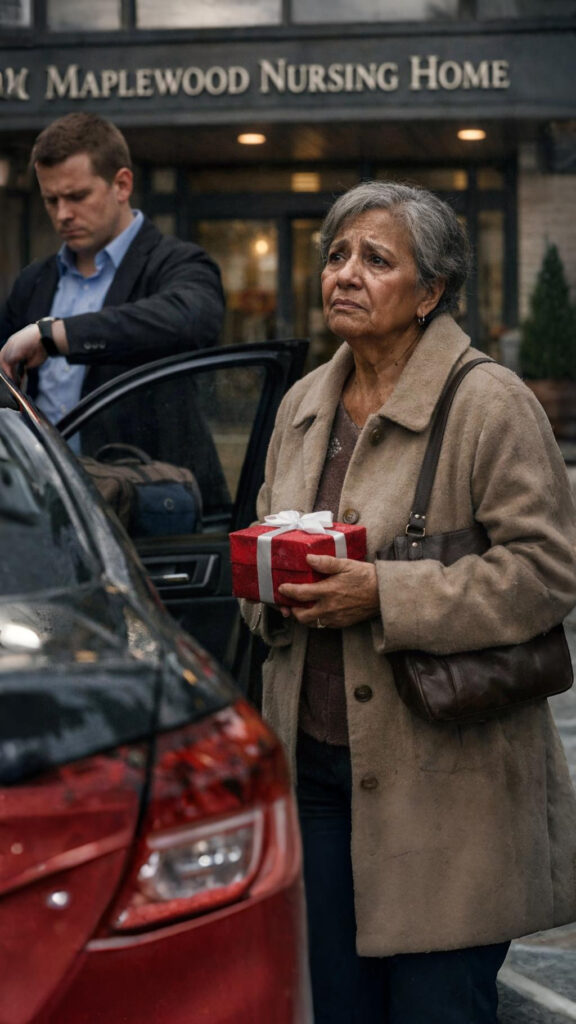
Chapter 1 – The Birthday He Forgot
I was still holding the paper plate when he said it.
Not yelling.
Not even annoyed.
Just calm. Detached.
As if he were discussing the weather.
“You’ll be more comfortable there, Mom. It’s already arranged.”
The word there echoed louder than anything else.
I had baked my own birthday cake that morning.
A small one. Vanilla, because it was cheaper and easier on my stomach.
Seventy candles felt ridiculous, so I used just one.
I didn’t even get to light it.
I remember asking, quietly, carefully, as if tone alone could change reality.
“Just for a few weeks?”
He didn’t look at me.
“No. This is permanent.”
That was the moment something cracked inside my chest.
Not loudly.
Not all at once.
Slowly.
The nursing home smelled like disinfectant and boiled vegetables.
A place designed to erase time.
Where days melt into each other and birthdays are just another checkbox on a clipboard.
They wheeled me in while my son signed papers.
So many papers.
I noticed how fast his pen moved.
How practiced.
How relieved.
A nurse leaned toward me and smiled with professional kindness.
“You’re lucky. Your family really cares.”
I almost laughed.
Almost.
When my son finally turned to me, he hugged me with one arm.
His phone still in his other hand.
“Don’t make this harder than it has to be,” he whispered.
As if I were the problem.
I watched him walk away down the hallway.
No looking back.
No pause at the door.
Just gone.
That night, the staff brought me a cupcake.
Chocolate. Store-bought.
A single candle already melted into wax.
“Happy birthday,” the nurse said gently.
I thanked her.
She meant well.
But when the lights went out, I cried into my pillow so no one would hear.
Not because I was old.
Not because I was sick.
But because my own son had decided I was finished.
I replayed the moment over and over.
The calm voice.
The word permanent.
The way my birthday had turned into an administrative task.
Lying there, staring at the ceiling tiles, I wondered how love could dissolve so completely without leaving a trace.
I wondered when I had stopped being a mother and started being a burden.
And somewhere between the beeping monitors and the distant coughs of strangers, a terrible thought settled in:
If this is how my life ends,
then everything I gave meant nothing.
I didn’t know it yet.
But that night was not the end.
It was only the moment I was erased.
Chapter 2 – What I Gave
The mornings in the nursing home had a sound of their own.
Soft slippers. The metallic rattle of breakfast carts.
The slow hum of a television that no one was really watching.
I used to wake up before sunrise at home. Old habits.
Coffee first, then the garden, then the quiet satisfaction of doing things before anyone else stirred.
Here, I woke because the hallway light bled through the cracks under the door.
It was always on. Always too bright.
I had time. Too much of it.
And with time came remembering.
I thought about every bill I paid for my son when he was starting out—
the rent he couldn’t afford, the loan I co-signed, the car insurance I covered “just for a few months.”
I remembered skipping my own medication once because he needed money for a security deposit.
I told myself it was love.
When his wife wanted a bigger wedding than they could pay for, I took money from my savings.
Fifteen thousand dollars I had planned to use for house repairs.
The roof could wait, I said.
Love couldn’t.
When their first child came, I moved closer to help.
Babysat every weekend. Cooked meals, folded laundry, stayed up through fevers.
They said I was a blessing.
Then, slowly, I became an obligation.
The gratitude faded. The requests didn’t.
They learned that I never said no.
I can still hear his voice on the phone.
“Mom, it’s just until next month.”
Then, “Mom, you wouldn’t want us to lose the house, would you?”
I would smile and say, “Of course not.”
Because mothers don’t count what they give.
They just keep giving.
In the nursing home, the other residents told their stories over instant coffee and faded photographs.
I kept mine to myself.
I didn’t want pity. I wanted understanding—something rarer, quieter.
A young nurse named Clara sometimes lingered in my room.
She was gentle, curious, too kind for a place like that.
She asked once, “Do you get many visitors?”
I smiled. “My son is busy. Important job.”
It sounded better than the truth.
When she left, I opened the drawer beside my bed.
Inside were the letters I had written to him but never sent.
Little pieces of my pride I couldn’t bring myself to mail.
You forgot my birthday.
You left me without asking if I wanted to go.
Do you ever think about what I gave up so you could have more?
I tore one of the letters that night. Then another.
But the words clung to me even as the paper disappeared.
What no one tells you is that betrayal from your own child doesn’t feel like anger.
It feels like confusion—like you misplaced something vital and can’t remember where.
I thought about all the years I’d worked extra shifts at the library,
how I saved coins in a jar to buy him his first guitar,
how I lied to friends saying he was too busy to visit when he simply didn’t want to.
The mind is cruel in its precision.
It remembers the smallest details, the exact weight of the keys I gave him the day he moved out,
the way he hugged me like someone ending a duty rather than beginning a life.
Every kindness replayed itself now as a wound.
Every sacrifice, a foolish investment.
One afternoon, I sat near the window, watching the rain smear the glass.
A nurse walked by humming softly, and for a second I imagined it was my mother’s voice.
I wanted to tell her I understood her now—how hard it must’ve been to keep giving without being seen.
Clara came in, holding a tray.
“Soup today,” she said, setting it down.
Her kindness almost hurt.
“Clara,” I said quietly, “have you ever realized too late that you gave everything to the wrong people?”
She paused, then answered carefully. “Yes. But sometimes giving isn’t about them. It’s about who we are.”
I didn’t respond.
I just stared at the steam rising from the bowl, thinking how easy it is to confuse love with surrender.
Later that night, as the halls quieted, I took a small notebook from under my pillow.
On the first page, I wrote a single line:
He took everything I gave—and then left me on my birthday.
I didn’t know why I wrote it.
Maybe because I needed proof that it happened.
Or maybe because somewhere deep inside, I already felt something shifting.
The pain wasn’t fading.
But it was beginning to take shape.
And shapes, unlike wounds, can be built into something new.
Chapter 3 – The Quiet Between Tears
The nights were always the hardest.
That stillness after the nurses finished their rounds, when all that remained were the distant coughs, the shuffle of slippers, the low hum of machines keeping other people alive.
It was then that my thoughts turned sharp.
They sliced through the silence.
Sometimes, I caught myself whispering his name—my son’s name—like a habit I couldn’t quit.
It tasted strange in my mouth now, too familiar and too foreign at once.
I wondered if he ever thought of me before sleeping.
If his children asked where Grandma went.
What he told them.
Probably that I was fine.
That I liked it there.
That it was my choice.
It’s easier to live with cruelty when you disguise it as kindness.
One night, the rain pressed against the window like soft fingers.
I sat awake, the small lamp glowing on my nightstand, a faint circle of yellow in the dark.
I had been crying earlier. Quietly, so no one would come.
There is a kind of crying that doesn’t make noise—
just breathing that trembles, shoulders that remember every ache at once.
And in that silence, something began to change.
It wasn’t forgiveness.
Not yet.
But it was the first time the pain didn’t feel endless.
It felt like a message, though I didn’t understand it.
I took a long breath and stared at my reflection in the window.
The glass blurred my face, mixing it with the storm outside.
Old, yes.
But still here.
Still breathing.
I whispered to that faint, ghostly image:
“You’re still you.”
For weeks, I had been shrinking inside myself,
making my pain smaller so others wouldn’t notice it.
That night, I stopped doing that.
I began to let myself feel the whole thing—the betrayal, the humiliation, the exhaustion.
It burned, but it also woke something up.
The next morning, Clara came in and noticed my eyes.
“You didn’t sleep again,” she said softly.
“I was thinking,” I replied.
“About what?”
“About everything I never said.”
She smiled, as if she understood.
Maybe she did.
After breakfast, I stayed in the garden area.
It wasn’t really a garden—just a square of concrete with a few stubborn flowers and a single wooden bench.
But it was the only place where the air felt like air.
I sat there for hours, letting the sun warm my hands.
Memories drifted in and out, not as punishments but as reminders.
My husband’s laughter, long gone.
The day my son was born, red-faced and furious at the world.
The nights I stayed awake, counting his breaths in the dark.
I had loved him with every version of myself—
the young woman, the mother, the widow.
And now, there was one more version left.
The woman who had been left behind but hadn’t disappeared.
I didn’t tell anyone, but that day I stopped crying.
Not because the sadness was gone,
but because I realized it no longer owned me.
The sadness was part of me now, like a scar that no longer hurts when touched.
Later, when I returned to my room, the phone on my bedside table caught my eye.
It hadn’t rung in weeks.
But I didn’t reach for it.
Instead, I opened my notebook again and wrote:
He left me where he thought I’d fade away.
But I’m still here.
And I’m beginning to remember who I was before everything I gave away.
That line stayed with me for days.
Each morning, I repeated it silently while brushing my hair, folding my blanket, watching the light change through the window.
It became a quiet vow.
Not revenge. Not even anger anymore.
Just a decision to start existing for myself again.
One evening, while others were watching television, I stayed by the window.
The sun was setting, and the light painted everything gold for a moment—the floor, my hands, the edge of my cup.
I thought of how endings can look beautiful when you stop expecting them to hurt.
And then I realized something simple, almost absurdly simple:
He had taken me out of my house, yes.
But he hadn’t taken me out of my life.
I still had that.
And for the first time, that felt like enough to begin something new.
Chapter 4 – The Day Everything Turned
It began like any other morning.
The same faint music leaking from someone’s television down the hall,
the smell of oatmeal and disinfectant,
the nurse calling names that no one always heard.
But there was a letter on my tray that day.
A plain white envelope with my name typed neatly on the front.
No return address.
For a moment, I thought it might be from him—my son.
That flicker of old hope still lived somewhere under the scar.
But it wasn’t his handwriting.
It was from the state lottery office.
I blinked, confused, certain it was some mistake.
I hadn’t played in months, maybe a year.
I opened it slowly, half-expecting it to be a scam.
And then I saw the numbers.
The ones I always played.
The ones I’d chosen years ago—birthdays, anniversaries, dates that meant something.
They matched.
All of them.
At first, I didn’t believe it.
I laughed. Out loud.
The nurse passing by stopped, startled.
“Are you alright, Mrs. Evans?”
I held up the letter with shaking hands. “I think— I think I just won the lottery.”
She smiled politely, the way people do when humoring old women.
But later, when the phone calls started, when the papers came, when the officials confirmed it,
no one doubted anymore.
I had won.
Millions.
Enough to buy back every piece of my life.
The first night after the confirmation, I didn’t sleep.
Not because of excitement.
Because of silence.
I stared at the ceiling, feeling the weight of something shift inside me.
All those years of being small, apologetic, invisible.
Gone in a single twist of luck.
The next morning, I asked to use the facility’s phone.
The director herself came to my room, smiling too brightly.
“Mrs. Evans, I heard the news! We’re thrilled for you. Such a blessing.”
A blessing. Yes.
But also a reckoning.
I nodded politely.
“I’ll be leaving soon,” I said.
Her smile flickered. “Oh—well, of course. We’ll help with the arrangements.”
That afternoon, I called my lawyer.
An old acquaintance from my husband’s days—someone I trusted.
“Harold,” I said, “I need to make a few changes.”
He hesitated. “Changes?”
“To my will. To my accounts. To everything.”
He didn’t ask why. Maybe he already knew.
That evening, as the sun bled through the window, I called the phone company and changed my number.
A clean slate.
I didn’t want to hear his voice.
Not his apologies, not his excuses, not his careful, practiced concern.
When the paperwork arrived, I sat at the small table in my room and read every word carefully.
The pen felt heavy in my hand.
But when I signed my name, my hand was steady.
I left nothing to my son.
Not a cent.
Not a single heirloom.
Instead, I created a scholarship fund for nurses like Clara.
For women who cared, truly cared, in a world that rarely thanked them.
When I told her, she tried to refuse.
“Mrs. Evans, that’s too much. I couldn’t—”
“You can,” I interrupted.
“And you will.”
She cried. I didn’t.
For the first time in a long while, I felt something close to peace.
That night, I packed my few belongings.
A framed photograph of my husband,
a worn cardigan,
the small notebook filled with words I had written to survive.
The director came to see me off.
“Will you be staying with family?” she asked gently.
I smiled. “No. I don’t have family.”
Her face softened, pity blooming behind her eyes.
But she was wrong.
I wasn’t alone.
I had myself.
And I had my freedom.
The taxi arrived just as the sun began to rise.
The air outside was cool, alive.
As we drove away, I didn’t look back at the nursing home.
Not once.
Through the window, I saw the world unfold—
streets waking, shops opening, people rushing to places that mattered.
And for the first time in years,
I was one of them again.
I thought of the irony of it all—
how the moment I stopped being useful was when life decided to reward me.
I didn’t owe explanations.
I didn’t owe forgiveness.
I owed myself a new beginning.
As the taxi turned onto the main road,
I whispered quietly, almost like a prayer:
“You thought you ended my story.
But you only gave me a better one to start.”
And with that, I let the past stay where it belonged—
behind me, dissolving in the rearview mirror.
Chapter 5 – When They Came Back
The call came two weeks after the newspaper printed the story.
They always print it when it’s someone unexpected—
the quiet, invisible woman who suddenly isn’t so invisible anymore.
I had moved into a small house by the lake.
White curtains, wooden floors, light that filled the mornings like forgiveness.
The silence was no longer cruel; it was clean.
I was making tea when the phone rang.
An unfamiliar number.
I knew before answering.
“Mom?”
That voice.
Cautious. Measured.
The same tone he used when asking for favors he pretended were small.
I didn’t speak right away.
I just let the moment stretch, let him feel the weight of his own word—Mom.
“I heard about the lottery,” he said, his voice softer now. “I wanted to say congratulations.”
A pause. Too long.
I could almost hear his thoughts rearranging themselves,
trying to find the right words to reach the version of me he used to know.
“I didn’t mean for things to—”
I cut him off. “You didn’t mean for me to leave quietly, did you?”
Silence.
Then a nervous laugh. “Mom, come on. It’s not like that. You know how much we—”
“No,” I said gently. “I don’t.”
He went quiet again, caught between shame and strategy.
I could picture him sitting at his expensive kitchen table,
hand around his coffee mug, looking at his wife for help.
I waited. I’d learned that silence can be sharper than shouting.
Finally, he sighed. “The kids miss you.”
I smiled without meaning to. “Do they?”
“Of course. They keep asking when you’ll come visit.”
“How sweet,” I said. “I hope you tell them I’m happy. I hope you tell them I’m safe.”
He didn’t answer.
And in that absence, I heard everything he wasn’t saying.
They thought I’d crawl back.
They thought money would make me generous again, the way guilt never did.
But I had already decided—my life, my rules.
That evening, as the sky folded into pink and orange, I sat on the porch and watched the water shift with the wind.
The air was filled with that quiet hum of summer insects, the kind of sound that tells you you’re alive.
Clara had come to visit earlier that week.
She brought flowers, her uniform replaced by a simple blue dress.
She looked different—free.
“I wanted to see how you were settling in,” she said, handing me the bouquet.
I placed them in a glass jar on the table. “It feels strange,” I admitted. “Having space that’s mine again.”
“You earned it,” she said simply.
Her words lingered long after she left.
I had earned it. Every inch of this quiet, every breath of this peace.
A few days later, there was a knock at my door.
I opened it to find my son standing there.
He looked older—
not in years, but in something else.
A kind of decay that comes from pride and regret fighting for the same space.
He tried to smile. “Can we talk?”
I stepped aside. Not out of kindness, but curiosity.
He walked in carefully, like he was entering a museum of things he’d broken.
“I didn’t come for money,” he began.
I raised an eyebrow. “Then what for?”
“For… us. For what’s left.”
He sat across from me, eyes darting toward the lake outside.
“I made mistakes. I thought I was doing what was best. You seemed so—tired. I thought you’d be happier there.”
I studied him.
The lies had softened over time, but they were still lies.
“You thought I’d disappear quietly,” I said. “That was the real plan, wasn’t it?”
He looked down.
The silence between us filled the room like fog.
“I can’t change what happened,” he said finally.
“No,” I agreed. “You can’t.”
I stood, walked to the window, let the light fall across my face.
Behind me, he shifted, waiting for a verdict.
“I don’t hate you,” I said at last. “But I don’t trust you either.”
He exhaled, almost relieved.
“Maybe we can start again,” he offered.
I turned back to him.
“Maybe you can,” I said softly. “I already have.”
He didn’t know what to do with that.
He just nodded, stood up, and left.
When the door closed, I felt something unexpected—
not triumph, not vengeance.
Just clarity.
He had come for forgiveness, maybe even for money,
but I had given him something better—
the truth.
Later that night, as the moon painted silver lines on the water,
I wrote in my notebook again:
They came back when they thought I was useful again.
But love isn’t a door they get to knock on whenever it suits them.
I closed the book, feeling its quiet weight in my hands.
It wasn’t anger anymore that kept me company.
It was freedom.
And it was enough.