Chapter 1 — The Night I Found Her
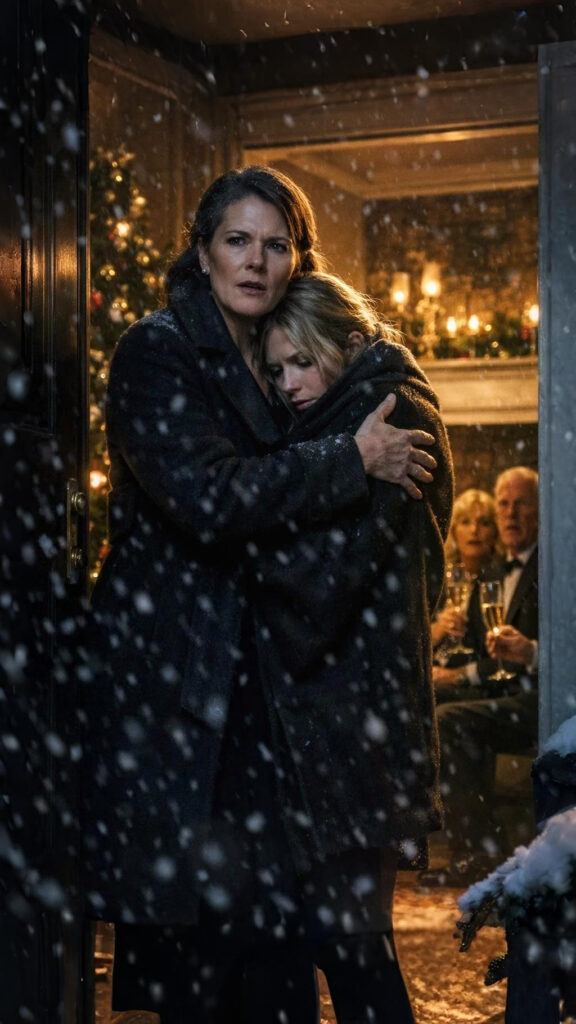
Snow was falling in slow, uncertain spirals, covering the quiet neighborhood in a silver hush. The kind of stillness that belongs only to Christmas Eve—where every lighted window promises warmth, laughter, and love.
But not all houses keep their promises.
When I stepped out of the taxi, the air sliced through my coat like a blade. My fingers trembled as I clutched the small gift bag I’d brought—just a scarf and a photo frame. I hadn’t told anyone I was coming. I wanted it to be a surprise. After all, Christmas was for family.
Then I saw her.
At first, I thought it was a shadow by the porch. But the shadow moved, and the weak light from the streetlamp touched her face. My daughter. Sitting on the front steps, her knees drawn to her chest, her hair tangled, her breath visible in the freezing air. No coat. No blanket. Just a thin sweater and eyes that looked empty.
“Anna?” I whispered.
She blinked, as if unsure I was real.
“Mom?” Her voice cracked like something frozen and breaking.
I rushed to her, dropping the gift bag into the snow. Her skin was ice beneath my hands. I pulled off my coat and wrapped it around her shoulders. She was shivering so violently that her words came in broken fragments.
“They… they told me to leave.”
Inside, through the window, I could see silhouettes moving—figures laughing, clinking glasses. The glow of the fire flickered across polished wine glasses and ornaments. A woman in a red dress lifted her flute of champagne. A man in a sweater adjusted a speaker. The sound of carols leaked faintly through the glass, muffled and cruelly cheerful.
“They’re celebrating,” I murmured. “While you’re out here freezing?”
Anna nodded. Her lips were blue. “I tried to help in the kitchen, but his mother said I was in the way. Then she said there wasn’t enough room for everyone. I thought she was joking… but she told me to wait outside until they were done eating.”
The words hit me like a slap. My breath caught somewhere between disbelief and fury.
I looked back at the window again—my son-in-law’s family, perfectly comfortable, perfectly unaware. How long had she been sitting here? How long had they ignored her?
I stood and helped her to her feet. “You’re coming with me.”
She hesitated. “I don’t want to make a scene.”
I met her eyes. “They made the scene, darling. You just lived it.”
For a moment, she said nothing. Then she leaned into me, exhausted, broken, but still my little girl. I guided her toward the door, feeling the weight of the night pressing against my spine.
The doorknob was warm to the touch—so close to heat, yet it had been denied to her. I could hear laughter, the kind that only grows louder when it knows it’s safe from consequence.
“Mom, please…” she whispered, clutching my sleeve. “Don’t.”
But I had already made up my mind.
When I pushed the door open, a sudden silence rippled through the room. Every face turned toward us. A few eyes widened. Someone dropped a fork. The fire crackled, filling the pause that followed.
And in that moment—half fury, half heartbreak—I held my daughter tighter, shielding her from the stares.
All the years I had taught her to be patient, to be kind, to endure—that training dissolved in an instant. I saw her suffering, and behind it, every time I’d told myself not to interfere. Every time I’d trusted that others would love her as fiercely as I did.
They never did.
One of the guests, a woman with perfect hair and too much perfume, forced a smile. “Oh, we didn’t expect guests.”
“No,” I said, my voice low but clear. “I can see that.”
The son-in-law stepped forward, his expression pale. “We were just—”
“Laughing,” I interrupted. “While she sat outside in the snow.”
He looked down. The woman in red cleared her throat. Someone turned the music off. The air grew thick with discomfort.
Anna tugged my arm. “Let’s just go, please.”
But I didn’t move. I looked around the room—at the decorations, the plates of food, the expensive wine. Every sign of abundance, every proof of comfort that had been denied to her.
Then I spoke six words that cut through the silence like glass.
“Not all families deserve their blessings.”
No one dared to respond.
I walked her out, my arm still around her, leaving behind the warmth, the lights, the pretense. The snow kept falling, erasing our footprints as fast as we made them.
And for the first time that night, I didn’t feel the cold.
Chapter 2 — The House of Warmth and Shadows
The car heater struggled to catch up with the winter night. My hands, still trembling, gripped the wheel while Anna sat beside me wrapped in my coat. Her hair clung to her damp face, and every few seconds she let out a shuddering breath that fogged the window.
Neither of us spoke for a long time. The silence between us was dense, filled with words neither dared to release yet. Outside, Christmas lights blurred into streaks of red and gold as we drove away from the house that had chosen cruelty over compassion.
When we finally reached my small home at the edge of town, she hesitated before stepping out. Maybe she feared another cold doorstep, another door that wouldn’t open for her.
“Come in,” I said softly. “This is your home too.”
The warmth inside was modest but real. A single string of lights flickered above the window, and the faint smell of cinnamon lingered from the cookies I’d baked earlier, just in case I spent the night alone. The old armchair near the fireplace seemed to sigh when she sat down, as if welcoming her back to something forgotten.
I draped a blanket over her shoulders. “You should’ve told me things were this bad.”
She looked at the flames instead of me. “It wasn’t always. At first, they treated me well. But once the wedding was over, everything changed. His mother said I didn’t fit in. His sisters stopped talking to me unless they wanted something cleaned or cooked.”
Her voice broke, and she pressed her hands against her eyes. “I thought if I tried harder, they’d like me. That maybe if I made myself small enough, quiet enough…”
I knelt beside her. “You don’t need to disappear for anyone’s comfort.”
She gave a weak smile that didn’t last. “He said the same thing once. Before he started pretending not to hear them.”
The fire popped, throwing sparks upward. The sound filled the silence that followed.
In that fragile light, I saw the girl she used to be—the one who used to dance barefoot on summer nights, who believed kindness could fix everything. Somewhere along the way, that belief had been used against her.
I reached out, brushing a strand of hair from her face. “They don’t get to decide your worth, Anna. You understand that?”
She nodded, but I could tell she didn’t believe it yet.
Later, after she’d gone to bed, I stayed by the fire with a cup of tea that had already gone cold. My thoughts returned to the scene I’d left behind—the perfect decorations, the laughter that had turned to stunned silence when I spoke. I wondered if they’d gone back to celebrating after we left, or if my words still echoed in that polished room like smoke that wouldn’t fade.
I thought about those six words again. Not all families deserve their blessings.
It wasn’t anger that had made me say it. It was clarity. For years I had watched good people break themselves trying to earn love from those incapable of giving it. My daughter had done the same. And I had taught her to—by example, by silence, by forgiving too easily.
That realization stung deeper than the cold.
When I finally rose from the chair, I checked on her. She was asleep, curled on her side beneath the thick blanket, her face softened, her breathing steady. For the first time in a long time, she looked safe.
I turned off the lights, leaving only the glow from the fireplace dancing across the walls. The house was quiet again, but it no longer felt empty.
Outside, the snow continued to fall, gentle now, almost forgiving.
I knew this peace wouldn’t last. People like the ones we left behind don’t give up easily. There would be calls, messages, maybe even a visit. They’d want to control the story, to make her doubt herself, to turn her strength into guilt.
But this time, they’d have to go through me.
As I lay in bed later, I replayed the evening from the beginning—the drive, the shock of seeing her outside, the silence of that rich, heartless room. And somewhere between memory and exhaustion, I made a quiet promise.
She would never stand in the cold again.
The snow whispered against the window as if it had heard me. Each gust of wind seemed to agree.
By morning, the world outside would be covered in white—clean, untouched, hiding every trace of where we’d been.
And maybe, I thought, that was how healing began. Not with warmth or forgiveness, but with the courage to walk away and let the snow fall over everything that no longer deserved a place in your heart.
Chapter 3 — The Morning After the Snow
The next morning arrived slow and pale, wrapped in silence. The snow outside had buried everything—the road, the fences, even the memory of last night. From the window, the world looked untouched, as if nothing cruel had ever happened in it.
Anna was still asleep when I made coffee. The smell filled the small kitchen, warm and steady, like a promise that the day would be gentler than the one before. Her coat hung by the door, still damp from melted snow, a reminder of where I’d found her.
When she finally appeared, her face was softer, but her eyes carried the same shadow. She sat at the table without speaking. I poured her a cup. She wrapped her hands around it, holding it as if to borrow its heat.
“Did you sleep?” I asked.
She nodded. “Better than I thought I would.”
I smiled. “That’s something.”
But I could tell her thoughts were still trapped in that other house—where laughter had turned to silence, and silence to shame. I let her sit with it for a while. Some wounds needed quiet more than words.
After breakfast, she helped me clear the snow from the porch. The cold air bit at our cheeks, but the movement felt good, real, grounding. She worked in silence, focused, as if each shovel of snow was a small act of taking her life back.
When we paused to rest, she looked toward the road, where the snow was still untouched. “Do you think they’ll call?”
“Yes,” I said. “They will.”
She didn’t ask the next question out loud, but I heard it anyway—What will we do when they do?
I answered it with a look. “We don’t owe them anything.”
Her breath clouded the air. She nodded, though her hands trembled again.
We went inside. The phone rang just as I was hanging our coats. She froze. The sound was sharp, intrusive, like something that didn’t belong in this quiet morning.
I walked over and picked it up before she could.
“Hello?”
A voice—smooth, controlled, the kind of tone people use when they’re pretending not to be angry. It was her husband. He wanted to “talk.” He wanted to “clear up misunderstandings.” He said his family hadn’t meant for things to “look that way.”
I let him speak until his words started looping, the way guilt does when it can’t find a place to rest. Then I interrupted him.
“She was outside, without a coat, while you sat by the fire. There’s nothing to clear up.”
He stammered, searching for something to make it sound less cruel. I could hear glasses clinking in the background, faint voices—so they were still together, still celebrating.
“Tell her I’m sorry,” he said finally. “Tell her to come home. It’s Christmas.”
“She is home,” I said, and hung up.
When I turned, Anna was standing in the hallway, watching me.
“What did he say?”
“Nothing worth repeating.”
She didn’t push. Instead, she came to stand beside me, looking out the window at the snow again. For the first time since last night, I saw something new in her posture—not just pain, but resolve.
The day passed slowly. We cooked a simple meal, watched the fire burn low. She told me stories I’d never heard before—about small humiliations, little cruelties that had built up like frost. How she’d started apologizing for things she hadn’t done, just to keep the peace. How she’d stopped calling me because she didn’t want me to worry.
Each confession was a thaw.
By evening, she was quiet again. I thought she’d fallen asleep in the armchair, but when I looked closer, I saw she was awake, staring into the fire.
“I used to think love meant staying,” she said softly. “No matter how bad it got.”
“It doesn’t,” I replied. “Sometimes it means leaving before you forget who you are.”
She nodded, tears gathering at the corners of her eyes. “I feel like I’ve forgotten already.”
I leaned forward and touched her hand. “Then we’ll help you remember.”
Outside, the snow began again—gentle, steady, endless.
We sat there for a long time, not speaking, listening to the quiet rhythm of it falling against the window. Somewhere in that silence, something fragile but necessary began to form.
It wasn’t forgiveness, not yet. It wasn’t even peace. It was just the faint, trembling outline of beginning again.
Before going to bed, she placed the small photo frame I’d brought as a gift on the mantel. It still held the picture of her as a child, laughing on a summer day, sunlight caught in her hair.
“I think I’ll keep it here,” she said. “For now.”
I nodded. “A reminder.”
She smiled faintly. “Of what?”
“That warmth doesn’t always come from fire,” I said.
And as the night deepened, I realized that maybe, just maybe, this was the first Christmas that truly meant something—not for what was lost, but for what was finally found.
Chapter 4 — The Return of Voices
The next few days passed in a strange kind of calm. Morning light slipped through the curtains each day, soft and unhurried, as though time itself wanted to move gently around us. The world outside remained buried under white, muffled and slow. Inside, we moved like people learning to breathe again.
Anna started to help with small things—folding laundry, watering plants, stirring soup while humming under her breath. Her hands shook at first, but each day the tremor faded a little. The silence between us began to feel less like grief and more like healing.
Then, on the fourth morning, the calm cracked.
The phone rang again.
This time, I didn’t rush to answer. I let it ring once, twice, three times. Anna’s eyes followed the sound. She didn’t ask who it was. We both knew.
When I picked up, I didn’t speak right away. A man’s voice—her husband again—poured through the line, urgent and polished, the tone of someone rehearsing regret.
“Please,” he said, “I need to see her. Things got out of hand that night. My mother shouldn’t have said what she said. It wasn’t supposed to go that far.”
I waited. His excuses filled the air like static.
“She won’t talk to me,” he added. “She blocked my number. I just need to explain.”
I finally said, “You don’t explain cruelty. You stop repeating it.”
He sighed, frustrated. “You’ve turned her against me.”
“No,” I replied. “You did that yourself.”
Before he could say more, I hung up.
Anna was standing in the doorway, pale but steady. “He’s not giving up, is he?”
“No. But neither are we.”
She walked over, sat at the table, and stared at the window. “He’ll come here.”
“Then let him find a door that doesn’t open.”
That night, I heard her moving in her room long after I’d gone to bed—packing and unpacking, pacing. When I knocked softly, she said, “I’m fine, Mom,” but her voice trembled around the lie.
I sat by the fire until dawn. I knew what fear does—it makes you think you can’t survive on your own. It teaches you to mistake control for love. I had lived through that once myself, years ago, though I’d buried the memory so deep it only stirred when I saw her face in the snow.
The next morning, I found her sitting by the window, a letter in her hands. She didn’t hide it when I came closer.
“I wrote to him,” she said quietly. “Not to forgive him. Just to tell him it’s over. That I won’t come back. That there’s nothing to talk about anymore.”
Her fingers trembled as she folded the paper. “I needed to write it for me.”
I nodded. “You don’t have to send it.”
“I will,” she said. “Because if I don’t, he’ll keep waiting. And part of me will keep waiting too.”
We went to the post office together. The sky was heavy with clouds, and the snow had turned to slush beneath our boots. She dropped the letter into the box, her breath catching as it fell. For a moment, she just stood there, her hand resting on the metal as though she were letting go of something invisible.
When we returned home, she seemed lighter. Not happy, but emptied of something that had been poisoning her for too long.
That afternoon, we made tea and sat by the fire again. She spoke about small things—movies she wanted to see, books she’d never finished, the garden she wanted to plant when spring came. The future slipped into her sentences without her realizing it.
At one point, she turned to me and said, “You shouldn’t have had to see me like that. Out there in the snow.”
“I’m glad I did,” I said softly. “It reminded me what love is supposed to look like.”
She smiled faintly. “I don’t know if I believe in love anymore.”
“Then start with believing in peace,” I said. “Love can come later.”
The days lengthened. Calls came and went, each one shorter, more desperate, until they finally stopped. The silence that followed was different this time—cleaner, earned.
One evening, as we watched the sunset paint the snow in shades of gold and pink, Anna said, “I think I want to go back to school. Finish what I started before I got married.”
I turned to her, surprised but proud. “You should.”
“I’m scared,” she admitted.
“Good,” I said. “It means you’re alive.”
She laughed, the sound unfamiliar but beautiful.
Later that night, I stood by her door, listening to her hum softly as she packed away the last traces of her old life—a wedding photo, a necklace, letters she no longer needed to reread. The firelight flickered against the hallway walls, warm and forgiving.
And for the first time since that Christmas Eve, I realized something simple and profound: sometimes rescue doesn’t happen in a moment of heroism. Sometimes it happens slowly, in the quiet, in the small acts of choosing yourself again and again.
Outside, the snow had stopped. The moonlight fell across the yard, untouched, pure, like a clean page waiting for the next chapter.
And I knew that when the morning came, she would begin to write it.
Chapter 5 — The Doorbell in Spring
The snow melted slowly that year. Weeks passed before the grass dared to show its color again, timid patches of green breaking through the white. The air smelled of thawing earth, of something waking up after a long, aching sleep.
Anna had changed with the season. Her hair was lighter now, trimmed short just above her shoulders, and she’d stopped wearing the heavy coats that once swallowed her whole. She laughed more. Not often, but when she did, it sounded less like someone remembering joy and more like someone rediscovering it.
She had enrolled in evening classes at the community college. The first day she went, I watched from the porch as she walked down the street with her books in hand, her head high, her steps uncertain but determined. I didn’t call out. I just watched until she turned the corner and disappeared.
That night, she came home exhausted but glowing.
“I forgot what it feels like to be curious,” she said, kicking off her shoes. “To learn something new just because I want to.”
“You remember now,” I told her.
“I think I’m starting to.”
Life began to collect small, quiet moments of normalcy again—shared breakfasts, the hum of the kettle, her papers spread across the kitchen table. Some days she’d come home with stories about her classmates; other days she’d fall silent halfway through dinner, lost in thoughts she didn’t share. But even those silences were different. They no longer felt like hiding.
Then, one afternoon in early April, the doorbell rang.
I was in the garden, kneeling by the soil, my hands deep in dirt. I didn’t hear it the first time. But when it rang again, sharp and urgent, I looked up. The sound sliced through the calm like the snap of a frozen branch.
I wiped my hands on my apron and walked to the door.
Through the window, I saw him.
Older than I remembered from that night, though not by much. His posture was stiff, his jaw tight, his eyes tired. He held his hat in both hands—a gesture too rehearsed to be sincere.
When I opened the door, the air between us carried the heavy scent of rain.
“Mrs. Hall,” he said, his voice careful, polite. “I just want to talk.”
“About what?”
“About Anna.”
“She has nothing left to say to you.”
He nodded, as if expecting that. “Please. Just tell her I’m here. I came alone. I just want to make things right.”
I almost laughed. “You can’t fix what you chose to break.”
He looked past me into the hallway, his gaze flickering toward the stairs. “I miss her,” he whispered. “I made mistakes.”
“Mistakes,” I repeated softly, the word tasting bitter. “Leaving someone in the snow isn’t a mistake. It’s a decision.”
His eyes dropped. “She won’t answer my letters.”
“She burned them,” I said before I could stop myself. It wasn’t true—she hadn’t, not yet—but part of me wanted it to be.
He looked wounded, but it didn’t move me. I’d seen too much of what his kind of regret looked like: sudden, loud, and useless.
Behind me, I heard footsteps on the stairs.
“Mom?” Anna’s voice was steady, though I could feel the tremor beneath it. When she reached the doorway, her face paled but her shoulders stayed straight.
He looked at her like a man seeing a ghost. “Anna.”
She didn’t respond. She stepped forward, not close, but enough for him to see her clearly—the new haircut, the calm in her eyes, the quiet dignity that no longer asked for his approval.
“I came to apologize,” he began, his voice cracking. “To explain—”
“There’s nothing left to explain,” she said. “You did what you did, and I believed I deserved it. I don’t anymore.”
He flinched, and for a moment, I saw the flicker of the same boyish charm that must have fooled her once. “I just thought maybe—”
“You thought wrong,” she said.
Silence fell heavy between them. He opened his mouth again, but she raised her hand, stopping him.
“I don’t hate you,” she said. “I just don’t need you to be sorry. That’s not my burden anymore.”
The rain had started then, soft at first, then harder, a curtain of water blurring the street.
He stood there for a moment longer, as if waiting for something to shift, some door to open that would never open again. Then he nodded once, turned, and walked away into the rain.
When he was gone, Anna exhaled. Her knees trembled, but she didn’t fall.
I closed the door quietly.
She leaned her forehead against it, eyes shut. “It’s over,” she whispered.
“Yes,” I said. “It is.”
Later, we sat by the window and watched the rain wash the last of the snow from the garden. The earth was dark, rich, ready. Anna placed her hand against the glass.
“I think I’ll plant something tomorrow,” she said. “Something that grows fast. Something alive.”
“Good,” I said. “Let it remind you how roots don’t care about storms.”
That night, as the rain softened into silence, I realized how far we’d both come. There was no grand ending, no sudden burst of happiness—just two women sitting in a quiet house that had finally become a home.
Sometimes peace doesn’t arrive with light. Sometimes it comes like rain—soft, relentless, cleansing everything it touches until what’s left is only what deserves to remain.
And in that gentle stillness, I knew spring had finally begun.