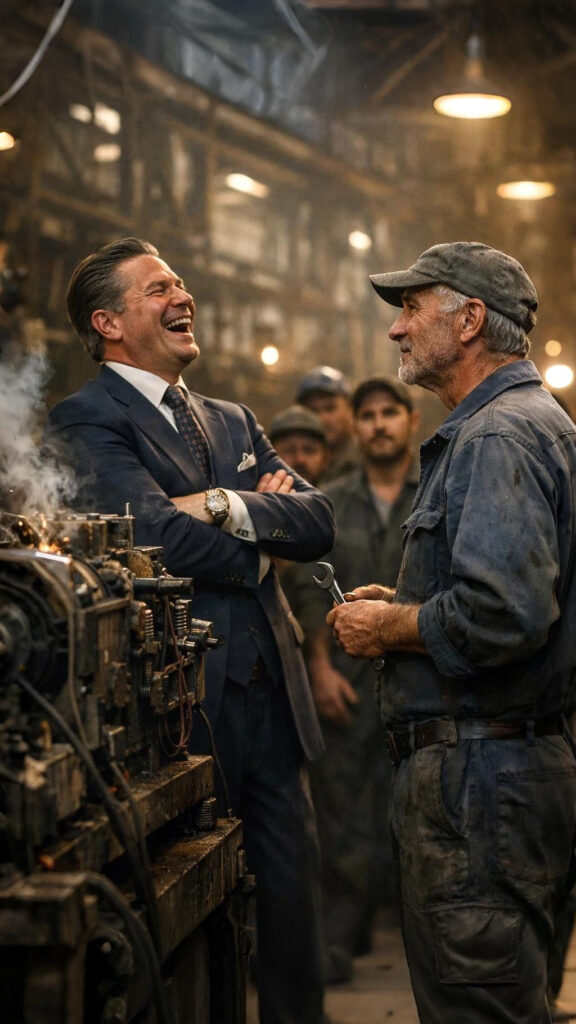
Chapter 1 — Topic 1: The Public Humiliation and the Absurd Bet
“Move. You’re in the way.”
The words landed without warning.
Dry. Sharp. Final.
They were thrown in front of everyone, in the middle of the factory floor, where machines hummed and men suddenly pretended not to hear.
No name was used.
It didn’t need one.
The owner of the factory stood there with his jacket open and his watch visible, irritation stamped across his face as if the delay itself were a personal insult. He hated interruptions. Even more, he hated being seen while things went wrong.
He gestured with his hand, impatient, as if shooing away something that shouldn’t exist there in the first place.
The man in the gray uniform stepped aside immediately.
Head down.
No argument.
No reaction.
He was used to that.
The factory owner was known for his temper.
Fifty-eight years old.
Self-made.
Respected in boardrooms and feared on the production line.
He believed the factory was an extension of his will. If something failed, it wasn’t a system problem. It was always someone else’s incompetence.
That morning, nothing was working the way it should.
A production line had stopped unexpectedly.
Dead silence where noise should have been.
Every idle second burned money, and he could almost hear it.
Engineers hovered nearby, whispering to each other. Supervisors checked their phones, avoiding eye contact. No one had answers yet, and that made him angrier than the failure itself.
He scanned the room, searching for a target.
His eyes landed again on the man in gray.
The janitor.
Always there.
Always invisible.
Pushing his cart, wiping oil stains, changing trash bags that nobody noticed until they overflowed.
The owner scoffed.
“Unbelievable,” he muttered, loud enough for others to hear.
“This place is full of useless people.”
A few nervous laughs followed.
Not because it was funny.
Because silence felt dangerous.
The janitor stayed still, holding his mop like an anchor. His shoulders were relaxed in a way that came only from long habit. He had learned, over the years, that reacting only made things worse.
He had learned to wait.
The owner turned back to the group of managers and engineers, his voice rising now, feeding on the attention.
“You all have degrees. Experience. Titles.”
He paused, letting the words sink in.
“And yet my factory is stopped.”
No one answered.
His gaze drifted again, this time with a hint of mockery.
Then he laughed.
A short, dismissive laugh that cut through the tension.
“I’ll tell you what,” he said, raising his voice so everyone could hear.
“I’ll give one million dollars to anyone who fixes this in two minutes.”
More laughter. Louder this time.
He spread his arms, enjoying the moment.
“One million,” he repeated, smiling.
“As if any of you could.”
Eyes darted around. Some people shook their heads. Others forced smiles. Everyone knew the offer was not real. It wasn’t meant to be.
It was a humiliation disguised as confidence.
The owner’s eyes flicked once more to the janitor, lingering just long enough to make the message clear.
Especially you.
The janitor said nothing.
He lowered his gaze, adjusted his grip on the mop, and took a slow step back.
No one noticed the way his eyes moved briefly toward the silent machine.
No one noticed how he stopped breathing for just a second, as if something had clicked into place.
To them, he was still just the man who cleaned floors.
To the owner, the bet was already over.
Chapter 2 — Topic 2: The Imminent Collapse and the Hidden Desperation
The laughter faded faster than it had come.
What remained was the sound of machines that should have been running, but weren’t.
A silence that carried weight.
The kind that made numbers echo in the minds of people who understood what stoppage really meant.
The owner turned away, already bored with his own joke. To him, the matter was settled. The problem was complex. Time was short. Failure was inevitable.
He walked toward the glass-walled office overlooking the factory floor, motioning for the senior staff to follow.
Inside, the door closed softly.
Outside, tension stayed.
On the factory floor, supervisors exchanged uneasy looks. Engineers crouched beside the halted machine, opening panels, checking readings they had already checked twice.
Nothing changed.
One of the younger engineers swallowed hard.
“If we don’t restart in the next twenty minutes,” he said quietly, “the batch is ruined.”
No one answered him.
Another voice followed, lower, strained.
“And if the batch is ruined, the contract is gone.”
They all knew which contract.
The largest one of the year.
The one that had kept investors calm.
The one that was already being audited because of recent inconsistencies in output reports.
The truth was simple, and terrifying.
This wasn’t just a technical failure.
The stoppage had exposed something deeper.
A misalignment between reported numbers and actual production.
A discrepancy small enough to hide for months, but loud enough to scream now that the line was dead.
In the glass office above, the mood had shifted.
The owner stood by the window, arms crossed, jaw tight. He no longer smiled.
“Tell me this is fixable,” he said, without turning around.
A manager cleared his throat.
“The machine can be restarted,” he began carefully.
“But the timing—”
“Don’t explain timing to me,” the owner snapped.
Another executive stepped forward, voice cautious.
“If the auditors arrive before we resume production… they’ll ask why the output reports don’t match today’s halt.”
Silence followed.
The owner’s fingers tightened against his arm.
“So?” he said. “We’ve handled audits before.”
“Yes,” the executive replied.
“But not with a live failure exposing the gap.”
That was the word no one liked.
Gap.
It meant questions.
It meant delays.
It meant consequences that money alone couldn’t immediately erase.
Down on the factory floor, the janitor pushed his cart slowly along the wall.
He wasn’t trying to listen.
But sound traveled.
He heard fragments.
“Two minutes.”
“One million.”
“Audit.”
He stopped near the silent machine, pretending to wipe a stain that had already been cleaned.
No one paid attention.
Engineers argued in low voices now. One blamed a sensor. Another blamed software. A third suggested restarting the system entirely, which would erase temporary data.
That suggestion was shut down immediately.
“If we reboot, we lose the logs,” someone said.
“And if we lose the logs during an audit…”
No one finished the sentence.
The janitor straightened slightly.
Logs.
He looked at the machine again. Not at the exterior, but at a specific panel on the side. A place most people ignored because it was rarely relevant.
Rarely.
Above, in the office, the owner finally turned around.
“This is getting ridiculous,” he said.
“I offered a million dollars and got nothing but excuses.”
A nervous laugh tried to form. It failed.
“We need time,” a manager said.
“Time is exactly what we don’t have,” the owner replied.
His voice lowered, sharp with something close to fear.
“If this stops the shipment, the board will tear us apart.”
No one disagreed.
Outside the glass, the factory waited.
The janitor placed his mop back into the cart.
Slowly.
Deliberately.
He glanced once more at the machine.
And this time, he didn’t look away.
Chapter 3 — Topic 3: The Invisible Man Who Understood What No One Else Did
He had learned, long ago, how to be unseen.
Not by hiding.
By belonging too much to the background.
The gray uniform helped. So did the cart, the mop, the quiet way he moved through spaces that others crossed loudly. People stopped noticing him the same way they stopped noticing walls.
He preferred it that way.
Standing a few steps from the silent machine, he didn’t rush. He didn’t touch anything yet. He simply observed, as if listening to a language others had forgotten how to hear.
The engineers were still arguing.
“It has to be the sensor,” one insisted.
“No, the software update messed with the timing,” another replied.
“This doesn’t make sense,” a third muttered, rubbing his face.
The janitor lowered himself slightly, pretending to adjust the wheel of his cart.
His eyes traced the machine’s body, following lines of metal and access points most people had never opened. He knew where they led. He knew what lived behind them.
Because this wasn’t the first time he had seen this kind of silence.
Years ago, machines like this had been his responsibility. Not to clean around them, but to design the logic that kept them alive. To predict what would fail when pressure met shortcuts.
He had learned patterns then.
He still saw them now.
The stop hadn’t been random.
It had been precise.
Too precise.
He noticed the blinking indicator near the side panel. Not red. Not green. An in-between state that suggested hesitation rather than error.
A pause.
Someone had told the system to wait.
He straightened slowly.
Across the floor, a supervisor glanced at him, then looked away just as quickly. The janitor’s presence registered only as movement, not meaning.
That was fine.
He remembered the laughter from earlier.
The million-dollar joke.
The way the owner’s eyes had lingered on him, not with curiosity, but with dismissal.
He didn’t feel anger.
He felt something colder.
Focus.
He rolled his cart a little closer. No one stopped him. No one ever did.
One of the engineers sighed loudly.
“We’re running out of time,” he said.
“If we don’t restart soon, the auditors will walk in on a dead line.”
Auditors.
The word echoed again.
The janitor’s jaw tightened almost imperceptibly.
He looked at the machine’s internal clock display, visible only if you knew where to stand. It was still running. Counting.
The system hadn’t crashed.
It was waiting for reconciliation.
Numbers didn’t match.
So the machine refused to lie.
He exhaled slowly.
In the office above, voices rose.
“We can’t explain this gap,” someone said.
“We don’t have to explain it,” the owner replied sharply.
“We just need the line running.”
That was the mistake.
The janitor had heard that logic before. In different buildings. With different names on the doors. It always led to the same ending.
On the factory floor, someone kicked the base of the machine in frustration.
“Come on,” the man muttered. “Just start.”
The janitor stepped back half a pace.
He understood now.
The problem wasn’t mechanical.
It wasn’t software.
It wasn’t even timing.
It was accounting logic embedded into the system, designed to halt production when reported output exceeded verified throughput.
A safeguard.
A rare one.
An expensive one.
Someone had activated it years ago, probably without fully understanding the implications.
And now, with the numbers stretched thin and the audit looming, the machine had done exactly what it was meant to do.
Protect the truth.
The janitor rested both hands on the handle of his cart.
He could fix this.
Not by forcing the system.
Not by erasing logs.
But by reconciling the discrepancy in real time, feeding the machine what it needed to release the hold.
Two minutes would be enough.
Maybe less.
Around him, panic thickened. People checked watches. Someone ran toward the office stairs, desperate to update the owner.
The janitor remained still.
Invisible.
Silent.
Thinking.
He knew what would happen next.
He knew the ridicule that would come before permission.
But he also knew something else.
If no one acted, the factory wouldn’t just stop.
It would be exposed.
And that, finally, mattered more than pride.
He took one step forward.
Then stopped.
Not yet.
He waited for the right moment.
The moment when silence would demand an answer.
Chapter 4 — Topic 4: The Improbable Interruption
The silence finally broke.
Not with an answer.
With frustration.
A supervisor slammed his palm against a metal railing.
“This is insane,” he said. “We’re standing here arguing while the clock keeps running.”
As if on cue, footsteps echoed from the stairs.
The owner returned to the factory floor.
His expression had changed. The confidence was gone, replaced by impatience sharpened into something dangerous. He didn’t look at the machine first. He looked at the people.
“Well?” he asked.
One word.
Heavy.
No one spoke.
Engineers avoided his eyes. Managers shifted their weight. Someone cleared his throat and immediately regretted it.
The owner laughed again, but this time there was no humor in it.
“Amazing,” he said. “Absolutely amazing.”
He pointed toward the machine.
“Isn’t this supposed to be state-of-the-art?”
Then toward the group.
“And you’re the best money can buy?”
A few people smiled weakly. Most didn’t.
The janitor stood near the edge of the group, hands resting calmly on his cart. He hadn’t moved since the owner arrived.
The owner noticed him.
Of course he did.
“You,” he said, snapping his fingers once.
“Why are you still here?”
The janitor lifted his head slightly.
“I’m working,” he replied quietly.
A few people exchanged glances. The answer was polite. Too polite.
The owner scoffed.
“Working,” he repeated.
He turned to the others.
“Do you hear this?”
A couple of nervous laughs followed. Again.
The janitor didn’t react.
The owner stepped closer, his voice rising as the tension demanded a release.
“Let me ask you something,” he said.
“You wouldn’t happen to know how to fix multimillion-dollar machinery, would you?”
More laughter. Louder this time. Safer.
The janitor hesitated.
Not because he was unsure.
Because he understood the cost of speaking.
Then he said it.
“I think I can help.”
The words didn’t travel far.
They didn’t need to.
Silence swallowed them.
Someone snorted. Another person laughed openly now, unable to stop it. A supervisor shook his head, smiling in disbelief.
The owner stared at him for a moment, as if trying to decide whether he had heard correctly.
Then he laughed.
A real laugh this time. Sharp and mocking.
“This is perfect,” he said.
“Absolutely perfect.”
He turned to the crowd, spreading his arms again.
“Ladies and gentlemen,” he announced,
“our janitor thinks he can save the factory.”
Laughter rolled through the room. Some people laughed because they found it funny. Others because they didn’t know what else to do.
The janitor remained still.
“I don’t need to save it,” he said.
“I just need access.”
That made the laughter louder.
The owner wiped a tear from the corner of his eye.
“You hear that?” he said.
“Access.”
He leaned closer, lowering his voice.
“To what? The mop closet?”
More laughter.
The janitor didn’t raise his voice.
Didn’t defend himself.
“I need the side panel opened,” he said.
“And permission to input a reconciliation override.”
That word landed differently.
A few engineers stopped smiling.
“Override?” one of them muttered.
“That’s not—”
The owner cut him off with a raised hand.
“Oh, no,” he said.
“Let him finish.”
He looked directly at the janitor now.
“Tell me,” the owner said slowly.
“How exactly would you fix what my entire team couldn’t?”
The janitor met his gaze.
“By aligning the production logs with the internal throughput counters,” he said.
“The machine is waiting because the numbers don’t match.”
A hush crept in. Not complete silence. But close.
One engineer frowned.
“That safeguard was deprecated,” he said.
“It shouldn’t—”
“It was never removed,” the janitor replied.
“Just hidden.”
The owner blinked.
Then smiled again.
“Well,” he said, straightening up,
“This just keeps getting better.”
He turned to the group.
“You know what?” he said.
“Let’s enjoy this.”
He looked back at the janitor.
“I’ll allow it,” he said.
“Two minutes. Just like I promised.”
The janitor nodded once.
“But,” the owner added, his smile sharpening,
“when this fails, I want everyone to remember who wasted our time.”
The janitor stepped toward the machine.
The laughter faded again.
This time, it didn’t come back.
Chapter 5 — Topic 5: The Proof No One Could Deny
The owner stepped back, folding his arms.
“Two minutes,” he said again, louder now.
“Not a second more.”
Someone glanced at the clock mounted high on the wall.
The red digits glowed like a warning.
The janitor didn’t look at it.
He crouched beside the machine, setting his cart aside with care, as if the noise of metal wheels might disturb his concentration. His movements were economical. No rush. No hesitation.
That alone drew attention.
One engineer leaned toward another.
“He’s not even nervous,” he whispered.
The janitor reached for the side panel the engineers had ignored all morning. His fingers moved confidently along the edge, pressing at a point that wasn’t marked, wasn’t obvious.
The panel released with a soft click.
A few heads lifted.
“That latch was disabled,” someone murmured.
“No,” another replied quietly. “It was concealed.”
The owner’s smile thinned.
Inside the panel, a small interface lit up. Old. Unassuming. Designed for people who knew exactly what they were looking for.
The janitor did.
He tapped the screen once.
Paused.
Then again.
Numbers appeared. Not production speed. Not temperature.
Logs.
Raw throughput counts, time-stamped and uncompromising.
A murmur spread.
“That’s not accessible from the main console,” an engineer said, stepping closer despite himself.
“It’s not supposed to be,” the janitor replied, still calm.
“It’s a safeguard.”
He spoke as he worked, not to impress, but because silence felt unnecessary now.
“When reported output exceeds verified throughput,” he continued,
“the system pauses to prevent false reconciliation.”
Someone swallowed hard.
“That was only meant for—”
“For audits,” the janitor finished. “Yes.”
The owner shifted his weight.
“How do you know this?” he demanded.
The janitor didn’t answer.
He entered a sequence of commands, slow enough to follow, precise enough to be unmistakable. His hands never shook.
On the main display, the blinking indicator changed.
Yellow.
Then steady.
One minute had passed.
The janitor leaned closer to the screen, eyes narrowing.
“There,” he said softly.
He adjusted a single value. Not erased.
Aligned.
The machine responded immediately.
A low hum began, barely noticeable at first.
Then another sound joined it.
Then another.
Belts tightened. Lights flickered. The long-dead line stirred like something waking from sleep.
Someone gasped.
“No way,” an engineer whispered.
The hum grew louder. Familiar. Alive.
The red digits on the wall clock ticked past one minute and thirty seconds.
The conveyor belt moved.
Then the first unit rolled forward.
Silence crashed down over the factory floor.
No laughter.
No whispers.
Only the sound of production resuming.
The janitor stood and closed the side panel, securing it with the same hidden latch.
Done.
He wiped his hands on a cloth, as if finishing any other task.
The owner stared at the machine, then at the display, then back at the janitor.
His mouth opened.
Closed.
“What did you just do?” he asked.
“I reconciled the discrepancy,” the janitor replied.
“In real time. The system no longer needs to pause.”
One of the engineers rushed to the main console, scrolling rapidly.
“The logs are intact,” he said, disbelief in his voice.
“And the numbers match.”
Another checked the time.
“One minute and forty-eight seconds,” he said.
No one laughed.
The owner stepped forward slowly.
“That safeguard,” he said, choosing his words now,
“was proprietary. Hardly anyone even remembers it exists.”
The janitor met his gaze.
“I remember,” he said.
The owner looked around.
At his managers.
At his engineers.
At the machine that was running again.
Then back at the man in gray.
“How?” he asked again, quieter this time.
The janitor hesitated.
Not long.
“I helped design systems like this,” he said.
“Before.”
The word hung in the air.
Before.
The clock kept running.
The factory kept moving.
And for the first time that day, the owner felt something he wasn’t used to feeling.
He wasn’t in control anymore.