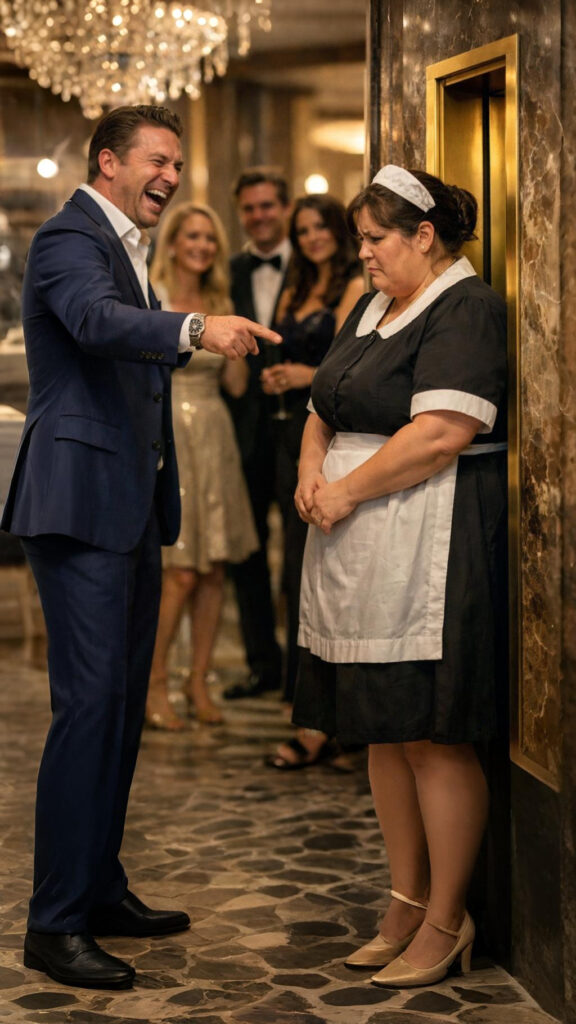
Chapter 1 — The Door and the Laugh
“Step aside. You’re blocking the way.”
The words were thrown without hesitation, loud enough to cut through the murmur of the room.
No name was used. None was needed.
She stopped immediately.
Her hands tightened around the thin folder she was holding, the one she had been told to deliver upstairs. She took half a step back, eyes lowered, making space as she had done countless times before.
People like her always did.
The man didn’t slow down. He didn’t even look at her face. To him, she was part of the building, like the walls or the glass doors—something to pass through, not something to acknowledge.
He was in his early forties, impeccably dressed, surrounded by people who mirrored his pace and his confidence. A self-made millionaire, they liked to say. Owner. Visionary. Untouchable.
He enjoyed being seen.
That afternoon, the lobby was crowded for a reason. Investors, partners, assistants, a photographer near the entrance. The atmosphere buzzed with importance, and he fed on it.
When he stopped, it wasn’t because of her.
It was because someone laughed behind him.
He turned, already smiling, already ready to perform. His eyes landed on her again, still standing near the door she had stepped away from.
The glass door.
Tall. Heavy. Marked with restricted access signage.
An idea crossed his mind, sudden and playful, born from boredom more than malice. But cruelty often wore boredom well.
He pointed at the door.
“You know,” he said, voice amused, loud enough for everyone to hear, “I’ve been thinking about commitment lately.”
A few people chuckled, unsure where this was going.
He looked at her properly for the first time.
Not with curiosity. With entertainment.
“If you walk through that door,” he continued, smiling wider, “I’ll marry you.”
The silence lasted less than a second.
Then the laughter exploded.
Someone covered their mouth. Someone else shook their head in disbelief. A phone was discreetly raised.
She didn’t laugh.
She stood still, confusion flickering across her face before settling into something quieter. Something controlled.
He watched her reaction closely, enjoying the imbalance. He expected embarrassment. Maybe anger. Definitely retreat.
“That door isn’t for staff,” he added lightly. “Didn’t think you’d want to break the rules for a joke.”
More laughter.
The proposal wasn’t romantic.
It wasn’t serious.
It wasn’t meant to be accepted.
It was a public reminder of where he stood—and where she didn’t.
She swallowed.
“I was just delivering documents,” she said softly.
Her voice barely carried, but it was steady.
He raised an eyebrow, amused that she had spoken at all.
“Well,” he replied, spreading his hands, “consider this an upgrade to your day.”
A pause.
“If you pass through that door,” he repeated, slower now, savoring it, “I’ll marry you.”
Someone whispered, “She won’t.”
Someone else muttered, “She knows better.”
She did know better.
She knew her place in rooms like this. She knew what laughter like that meant. She knew how quickly dignity could be crushed when people decided it didn’t belong to you.
And still, her eyes moved to the door.
Just for a moment.
The laughter grew louder when they noticed.
“Go on,” he encouraged. “Unless you’re afraid.”
That word landed heavier than the others.
Afraid.
She had been afraid before. Of eviction notices. Of hospital bills. Of nights when silence meant bad news.
This wasn’t fear.
This was choice.
Her fingers loosened around the folder. She placed it carefully on the reception desk, aligning it as if the world weren’t watching.
Then she turned toward the door.
The room shifted.
Not enough to stop her, but enough to notice.
“Hey,” someone said, half-laughing, half-warning. “She’s actually—”
The door was heavier than it looked.
She pushed.
The sound of the hinge echoed, sharp and unmistakable.
The laughter faltered.
She stepped through.
Just one step.
Nothing dramatic.
No announcement.
The door closed behind her with a soft click.
For a brief second, no one spoke.
Then the room erupted again, louder than before.
He laughed the hardest.
“Unbelievable,” he said, shaking his head. “Guess I’ll start shopping for rings.”
The joke was over.
To him, it ended there.
He turned away, already distracted, already forgetting the face of the woman who had walked through a door she was never meant to touch.
What he didn’t notice was the way her expression changed on the other side of the glass.
Not proud.
Not triumphant.
Focused.
And very aware that something irreversible had just begun.
Chapter 2 — When No One Was Watching
The door closed behind her, and the sound was softer than she expected.
No applause.
No consequences.
Just a corridor that smelled of polished wood and quiet authority.
She stood there for a second longer than necessary, not because she was afraid, but because she understood something important.
On this side of the door, no one was laughing.
She adjusted her posture, straightened her shoulders, and walked forward as if she belonged there. Not hurried. Not hesitant.
Belonging, she had learned, was often performed before it was granted.
The hallway led to a smaller office, rarely used, reserved for legal overflow and archived matters. She knew this because she had memorized the building long before that afternoon. Every shortcut. Every schedule gap. Every moment when power wasn’t paying attention.
She had worked in places like this for years.
Always nearby.
Never included.
Her official role changed often—assistant, temp, external support—but it always meant the same thing. Invisible labor. Silent presence. Access without authority.
People spoke freely around her.
They always assumed she didn’t understand.
Inside the office, she closed the door and exhaled for the first time.
Not relief.
Preparation.
She opened the folder she had been carrying. Inside were copies, not originals. That had been intentional. The originals were already where they needed to be.
Her phone vibrated once.
A message.
No name. Just a number she knew by heart.
“Did he do it?”
She typed back without hesitation.
“Yes.”
A pause.
Then another vibration.
“Then it’s confirmed.”
She sat down, placing the folder on the desk, her movements precise. Anyone watching would have assumed she was just another employee doing a task she barely understood.
In reality, she was checking timelines.
The wager had been public.
The words had been clear.
And most importantly, there had been witnesses.
She knew better than to expect immediate consequences.
Men like him forgot promises the moment they stopped being entertained by them.
Outside, the laughter was already fading. The lobby would return to normal. Meetings would resume. His life would continue untouched.
For now.
She left the office ten minutes later, using a different exit, one no cameras covered directly. By the time she stepped back into the street, the building behind her had already erased the moment.
She didn’t.
Her apartment that night was quiet. Small. Clean in a way that suggested discipline rather than comfort.
She placed her keys down, removed her shoes, and sat at the table by the window. From there, she could see the city lights and the movement of people who believed they knew where they were going.
She opened her laptop.
The screen lit her face, revealing details no one in the lobby had noticed. The calm focus. The absence of resentment. The patience that came from long calculation, not submission.
Files filled the screen.
Legal frameworks.
Contract law precedents.
Public commitment clauses.
She worked methodically, not obsessively. This wasn’t revenge. It was structure.
At some point, her phone rang.
She answered on the second ring.
“You shouldn’t underestimate how easily he’ll dismiss this,” a man’s voice said on the other end. Older. Cautious.
“I’m not,” she replied. “That’s why I won’t remind him.”
A brief silence.
“You’re sure about this?”
She looked at the screen again, at the timestamp from earlier that afternoon. The clip had already been sent to three secure locations.
Witnesses mattered.
But records mattered more.
“I’m sure,” she said. “He needs time to forget.”
The call ended.
Days passed.
Then weeks.
The building continued its routines. She continued hers. Different job. Different badge. Same city.
Occasionally, she saw him on screens. Business magazines. Interviews. Engagement rumors that went nowhere.
Each time, she noted the date.
Each time, she waited.
Three months later, he stood on a stage at a charity event, smiling confidently as he spoke about integrity, commitment, and the importance of honoring one’s word.
She watched the livestream from her apartment.
Not angry.
Not amused.
Certain.
Because while he spoke about values, she had been quietly aligning timelines, jurisdictions, and obligations. Preparing not an accusation, but an inevitability.
The door had been the joke.
Time would be the consequence.
And when he finally remembered that afternoon—when the laughter froze on his face—he would understand that the moment he thought was harmless had never belonged to him at all.
Chapter 3 — The Door That Changed Everything
The city was waking up when he first saw her again.
Not in person, not yet—on a screen.
Her name appeared where he least expected it, buried in a document his assistant had marked for review. The name meant nothing to him at first. Familiar, maybe. Ordinary. One of those names you forget the moment you hear them.
But when he saw the photo attached, his hand froze over the mouse.
Her.
The woman from the lobby.
The one who had stepped through the door.
For a moment, he just stared. The memory felt distant, almost amusing. He remembered the laughter, the absurd promise, the ease with which the crowd had followed his tone. It had been nothing, a passing humiliation—an anecdote at best.
Yet here she was again, attached to a corporate file that shouldn’t even have reached his desk.
A small consultancy, recently contracted through one of his subsidiaries.
Specializing in compliance, documentation, and due diligence.
Her name listed as director.
He frowned.
“Who signed this?” he asked without looking up.
His assistant hesitated. “You did, sir. Last quarter.”
He blinked, confused. “That’s not possible.”
“It was part of the regional audit package. You approved it remotely.”
He leaned back, scanning the contract again. The signature was his. The initials were his. The date matched a week when he had been traveling.
He remembered nothing.
That afternoon replayed itself in fragments. Her face. The door. The sound of laughter echoing against glass. His own voice saying words he couldn’t recall in full, but that others surely could.
He told himself it was coincidence.
He told himself he didn’t believe in ghosts.
Across the city, she was already awake.
She had been for hours.
The documents she had sent were moving through channels she had built piece by piece, not through revenge but through precision. Every form, every clause, every timestamp existed for a reason.
And at the center of all of it was the contract no one else remembered—a recording, yes, but also a statement of intent. Spoken in public. Witnessed. Broadcast live for a few minutes before the cameras turned away.
A promise.
Unilateral, explicit, and traceable.
She hadn’t needed to exaggerate anything. The law was patient.
So was she.
She walked through the small apartment, light spilling in through half-open blinds, reflecting off the folders stacked neatly on her table. Each one marked with a single letter. Each one a step toward completion.
When her phone rang, she didn’t answer immediately. She let it ring twice, three times, before lifting it.
“You’ve reached her,” she said calmly.
“He’s seen it,” a voice replied. “We’re certain.”
“Then the clock starts today.”
He tried to dismiss it.
He told his team to cut ties with the consultancy, to find another provider, to clean up the paperwork quietly.
But the contract wasn’t easy to remove. It was tied to others—audits, legal checks, upcoming tenders. Removing it would expose gaps, trigger scrutiny, invite questions.
She had designed it that way.
He didn’t know that yet.
At dinner that night, he mentioned her name casually to an acquaintance, expecting laughter. Instead, he received silence.
“Her?” the man said, lowering his glass. “She’s working with the Ministry now, isn’t she? On ethics reforms?”
He laughed. “That’s ridiculous.”
“Maybe,” the man said, shrugging. “But she’s been in meetings your company will need clearance for.”
He didn’t sleep well after that.
By morning, three of his departments reported delays in pending contracts. Technical verifications. Missing authorizations. Every one of them linked—somehow—to her office.
Coincidence stopped being comforting.
He ordered a private inquiry.
The report that came back a week later wasn’t long, but it was enough.
Her qualifications were genuine. Her expertise, undeniable. Her new consulting firm was legitimate, respected, growing fast. And yes, she had passed through his building months earlier, working as an administrative contractor under a different name.
He read the final line twice.
“Known to operate with remarkable discretion and strategic foresight.”
He closed the folder slowly.
That afternoon, he found himself standing in the same lobby, staring at the same glass door.
The same threshold he had once turned into a joke.
He looked at his reflection, and for the first time, saw something uncertain in it.
Something he couldn’t define.
“She can’t mean to…,” he whispered, but the sentence died before it formed.
Because somewhere deep inside, he already knew that what he had called a joke was no longer his to define.
She watched the footage later that night. A live feed from the lobby camera, archived and downloaded legally through her new credentials.
He stood there longer than she expected.
Not angry. Not proud.
Lost.
She watched him turn, walk away, disappear from the frame.
She didn’t smile.
She didn’t need to.
The door had been a symbol that day.
A line he thought he had drawn.
He never realized it was the one she had stepped over—and that on the other side, the world had already begun to change.
Chapter 4 — The Silence That Followed
He began to notice it in small ways first.
The silences.
Not the kind that filled rooms when words were unnecessary, but the kind that arrived when people didn’t know what to say in front of him anymore.
A shift in tone.
A glance that lingered too long.
Meetings that used to start with laughter now started with caution.
He couldn’t explain why.
Every time he entered a room, voices softened. His name was still spoken with respect, but it sounded rehearsed now, cautious—as if everyone had agreed not to provoke something they couldn’t control.
At first, he blamed paranoia.
Then, he blamed fatigue.
But the silence kept spreading.
He tried to work through it, drowning himself in schedules and numbers, convincing himself that control was a habit, not a feeling. Yet every report he opened seemed to carry her name in the footnotes.
Always small.
Always formal.
Always there.
She wasn’t attacking him.
She was reminding him.
And somehow that was worse.
He called his assistant one morning. “I want every document with her signature reviewed,” he said.
The assistant hesitated. “Sir, we can’t—those are under government oversight now.”
He stared at her. “Since when?”
“Since last month. It was part of the new transparency framework.”
He didn’t respond. He didn’t need to.
The irony was too sharp to swallow.
Across town, she stood in front of a mirror that hadn’t known luxury. The reflection was unremarkable—hair tied back, plain blouse, calm expression—but it carried something stronger than beauty.
Certainty.
She didn’t crave the image of revenge. She despised that word. It implied anger, emotion, chaos. What she built was none of those things.
It was order.
Every step she had taken since the day he laughed had been deliberate, designed to expose how fragile his authority was when faced with structure instead of sentiment.
The system had always protected men like him because they understood how to manipulate visibility.
She had simply learned to operate in silence.
Her mentor once told her that true power never announces itself—it just rearranges the room. That was what she was doing now, one document at a time.
When the meeting request arrived in her inbox—a request signed by his company’s legal division—she almost smiled.
Almost.
The subject line read: Clarification Meeting: Contractual Misunderstanding.
She knew the word misunderstanding was corporate language for panic.
He arrived early. He wanted to control the space before she entered it, to remind himself who he was.
The conference room was spotless, the skyline sharp against the glass walls.
He waited in silence.
When she walked in, there was no hesitation, no dramatics. She greeted him with the same calm professionalism she had used months ago when delivering documents to people who never remembered her name.
“Mr. Hale,” she said.
He stood. “Miss Rowan.”
Her tone didn’t waver. “Mrs.,” she corrected softly. “Legally.”
He blinked. “What?”
“Legally,” she repeated, sliding a file across the table. “You may not recall, but your statement was made publicly, witnessed by no fewer than eleven individuals and recorded by two separate outlets. You confirmed intent in front of an audience, and you never retracted it. Under certain jurisdictions, that qualifies as an implied binding declaration.”
He stared at her, confused at first, then amused. “You can’t be serious.”
She met his eyes. “I rarely am.”
He laughed once. It sounded forced. “So what do you want? Money? Position? Some kind of—”
“Respect,” she said quietly.
The word landed harder than any accusation could.
He frowned. “You think this is how you get it?”
“No,” she said. “This is how I prove you never had it.”
For a moment, he said nothing. The silence stretched thin, sharp as glass.
He wanted to tell her she was exaggerating. That no one would believe her. That words spoken in jest couldn’t hold weight.
But deep down, he already knew she wasn’t bluffing.
She didn’t move like someone chasing attention.
She moved like someone who had already won.
When she spoke again, her tone was clinical. “You’ll receive documentation within seventy-two hours. It isn’t personal. It’s procedural.”
He wanted to respond, but the air had already shifted.
His authority didn’t fill the room anymore.
Her presence did.
As she gathered her papers, he caught a glimpse of something inside the folder—an official seal, government-issued, clean and unmistakable.
He didn’t ask to see it.
He didn’t have to.
That night, the silence returned.
But this time it wasn’t the silence of rooms or people. It was internal.
The sound of a mind trying to recall exactly when control had slipped through its fingers.
He poured himself a drink and stared at the skyline until the lights blurred.
She had crossed a door once, and he had laughed.
Now she was opening another—one that no laughter could close.
For the first time in years, he couldn’t predict what would happen next.
And that uncertainty, more than fear, was what froze him.
Chapter 5 — The Months of Quiet Collapse
Winter came early that year.
The city’s edges froze before the air did, a slow, silent transformation that went mostly unnoticed—except by those who had something to lose.
He was one of them.
At first, it was subtle. Calls went unanswered a little longer. Meetings were postponed with polite excuses. Projects he’d once commanded into existence now stalled, requiring “additional approval.”
Nothing dramatic.
Just friction.
Just the kind of stillness that builds before things break.
He thought it was temporary.
He always believed in control—the ability to fix, to buy, to dominate until the universe obeyed.
But this time, the silence didn’t yield.
Every attempt to fix things led him back to her.
Not directly. She didn’t call. She didn’t threaten. She didn’t even seem interested in him anymore. But her name surfaced everywhere like a watermark beneath his failures.
An approval notice here.
A compliance clause there.
Every path he tried to clear had her initials etched somewhere along the way.
He stopped sleeping through the night.
He would wake up at three in the morning, replaying every version of that afternoon—the laughter, the crowd, the sentence that had sounded harmless until it wasn’t. He would hear his own voice, careless and arrogant, echoing against the glass walls:
“If you walk through that door, I’ll marry you.”
The memory burned differently now.
It wasn’t just embarrassment.
It was recognition.
Because she had walked through that door. And somehow, in the months that followed, she had rewritten the rules of the world he thought he owned.
She didn’t celebrate any of it.
Her apartment remained unchanged—minimal, precise, practical. She still cooked the same meals, still worked through dawn, still refused interviews. The world around her had begun to whisper, of course—speculation about the woman who had built a company from nowhere, who had appeared in government documents without explanation, who seemed to understand legal architecture better than the men who wrote it.
She ignored all of it.
Her work wasn’t about spectacle. It was about structure.
And quietly, she was restructuring everything.
The consulting firm that bore her name now handled oversight for three of the largest urban contracts in the region. Her team was small, mostly women, mostly invisible, all competent enough to make entire corporations nervous.
She had turned invisibility into an advantage.
Into armor.
One evening, as she reviewed documents by lamplight, a message arrived—short, cautious.
“Are you satisfied now?”
She didn’t respond immediately.
When she finally did, it was only two words:
“Not yet.”
He began losing investors next.
They didn’t vanish; they drifted. Conversations became colder, offers vaguer. He could feel them pulling away before they even admitted it. They had sensed the shift before he had—something intangible, the slow erosion of reputation.
People didn’t trust him the same way anymore.
In private meetings, he caught the flicker of curiosity in their eyes when her name came up. A silent question. A quiet doubt. As if they knew something he didn’t—or worse, knew exactly what he had done and were waiting for him to acknowledge it.
He hated that feeling.
The powerlessness.
The invisibility he’d once mocked in others now returned as punishment.
One night, he drove past her new office.
He told himself it was coincidence, that he was simply taking the long way home. But he slowed when he saw the lights still on. Through the glass, he could see her silhouette—calm, focused, unmoved by the hour. Papers spread around her like evidence of a plan he couldn’t decipher.
He didn’t get out of the car.
He just watched.
For too long.
Then, without realizing it, he smiled.
Because some part of him—some fractured, fading corner of pride—still admired what she’d done.
The precision.
The patience.
The inevitability.
She had beaten him not by shouting, but by enduring.
And that realization hurt more than any defeat could.
She looked up once, sensing movement outside.
Through the reflection in the window, she caught a glimpse of headlights, a familiar shape of a car.
She knew he’d come eventually.
Men like him always did—drawn not by guilt, but by disbelief that the world could continue without them.
She didn’t move.
Didn’t wave.
Didn’t acknowledge.
Instead, she turned back to her work, signing another approval that would quietly finalize the acquisition of a subsidiary he no longer controlled.
Her signature was steady.
Her breathing calm.
When the engine outside finally faded into the distance, she allowed herself a moment to sit back, closing her eyes.
Not triumph.
Not vengeance.
Just peace.
He had laughed once when she crossed a door.
Now, he was the one frozen before it—too afraid to step through, too late to undo the consequences.
Winter deepened.
The city kept moving.
And in the space between silence and justice, she stayed exactly where she belonged—on the other side of the door, waiting for spring.