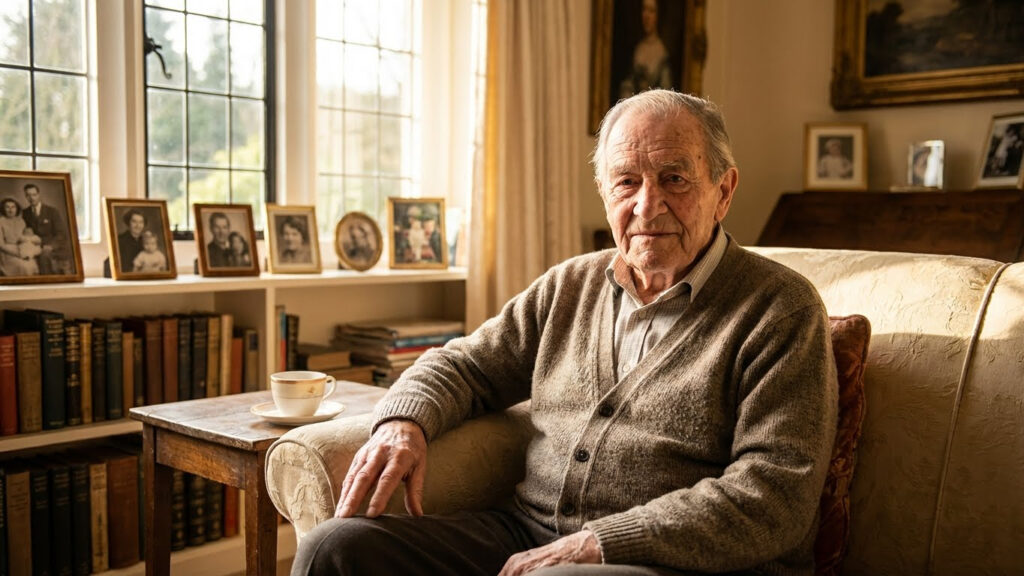
My name is Harold Whitman. I am seventy-two years old now, and when I look back, I can see with unsettling clarity who I was when everything began, long before the silences, long before the distance settled quietly into the rooms of my life. I was not a cruel man, nor an absent one by intention. I was, above all, a man convinced that his worth was measured by how much weight he could carry without letting it show. I grew up believing that stability was love, that responsibility was affection, and that endurance was the purest form of devotion a man could offer. I learned early that praise came when you worked harder, stayed longer, complained less. Over time, that lesson didn’t just guide me, it became me. I didn’t wake up one day deciding to trade moments for hours or presence for productivity. It happened gradually, almost politely, as life often does when it takes something from you. At first, work was simply what I did. Then it became what I was. Somewhere along the way, it stopped being a part of my life and turned into the structure holding everything else in place.
When I married and later became a father, that structure felt not only necessary but noble. I told myself that providing was the highest form of care, that security mattered more than availability, that consistency in income could make up for inconsistency in presence. I carried that belief with quiet pride. I was dependable. I was needed. People counted on me. There was comfort in that role, a sense of control in a world that otherwise felt uncertain. I liked being the one who didn’t falter, who stayed late, who took on more when others stepped back. It made me feel essential, and feeling essential is a powerful thing. It convinces you that whatever you’re sacrificing must be worth it, even when you never stop to name exactly what that sacrifice is.
I remember thinking, often without words, that this phase would pass. That there would be a time later when things slowed down, when the effort I was putting in would translate into freedom, into calm, into time that could be reclaimed. I believed time was something you could store away, like money, something that accrued quietly in the background while you focused on more urgent matters. That belief made everything feel temporary, even when years were passing. Missed evenings felt like exceptions. Absence felt justified. There was always a reason, always a deadline, always a sense that this was what a responsible man was supposed to do. I wasn’t chasing luxury or excess. I was chasing adequacy, the reassurance that I was doing enough, being enough, holding everything together.
What I didn’t understand then was how identity hardens when it goes unquestioned. Each time I chose work without hesitation, the choice became easier the next time. Each time I told myself that this was necessary, that story gained authority. I began to see the world through a single lens: obligations first, everything else later. And later always felt close enough to ignore. I wasn’t running from my family, at least not consciously. I was running toward a version of myself I believed they needed. A man who was steady, reliable, unshakeable. A man who never said no to responsibility. I didn’t see that in becoming that man, I was quietly stepping away from being present. I thought I was building something solid, something that would stand the test of time. I didn’t realize that some things don’t erode loudly. They fade slowly, through neglect that feels harmless in the moment.
Looking back now, I can see that who I was at the beginning mattered more than I knew. That man, so certain of his priorities, so confident in his reasoning, laid the groundwork for everything that followed. Not through a single decision, but through a way of seeing the world that left little room for pause or doubt. I was convinced that love could wait, that connection would remain intact simply because it existed once. I didn’t yet understand that presence is not preserved by intention, only by action, and that the habits you form in the name of responsibility eventually define what your life becomes. At seventy-two, I can say this without anger or drama, only with clarity: the man I was when it all began believed he had time. That belief shaped every choice that followed, and by the time I questioned it, the years had already decided for me.
Chapter 2 — The Silent Promise I Made to My Family
I never gathered them in the living room to say it out loud, never sat across the table and explained what kind of life I was about to build around us, but the promise existed all the same, solid and unquestioned in my mind. It formed quietly, the way assumptions do, shaped by habit and reinforced by repetition, until it felt less like a choice and more like a duty I had always carried. The promise was simple in wording, though vast in consequence: everything I did from that point on would be for them. Those words became my internal compass. They justified early mornings and late nights, missed calls and postponed plans, the constant sense of being needed elsewhere. I believed that as long as my intentions were pure, the outcome would take care of itself. Love, I assumed, was self-sustaining. It didn’t need constant attention. It only needed proof that I was trying.
At first, the promise felt generous. It gave me purpose beyond myself and anchored my identity in something larger than ambition. Whenever exhaustion crept in, I reminded myself who it was for. Whenever doubt appeared, I silenced it with the same reasoning. This isn’t about me. This is about them. That phrase carried enormous power. It made sacrifice feel virtuous and absence feel temporary. I didn’t consider how one-sided the promise was, how it asked nothing of me emotionally while demanding everything in terms of time. I wasn’t promising to listen more, to be there more, to share myself more. I was promising results. Stability. Protection. A future that looked good on paper. In my mind, those things were interchangeable with care.
What I didn’t notice then was that no one had asked me to make that promise in the way I did. My family never demanded perfection or constant provision. They never set the terms I was living by. I created them myself, drawing from a narrow understanding of what responsibility looked like, one I had inherited without questioning. The promise wasn’t negotiated, it was assumed, and because it lived entirely inside me, it never faced resistance. There was no one to point out its imbalance, no moment where I had to explain why time together was always deferred. It felt natural to prioritize what could be measured over what could only be felt. Money had numbers. Work had outcomes. Presence was vague, easy to postpone, easy to underestimate.
As the years went on, that promise hardened into expectation. I expected myself to endure, to keep going, to absorb stress without complaint. I expected my family to understand without explanation. Understanding became something I relied on without checking if it was still there. I told myself that gratitude would follow, that one day they would look back and see the effort, the consistency, the long hours as evidence of love. I imagined a future conversation where everything would make sense in retrospect. In that imagined future, the sacrifices would be acknowledged, the absences forgiven, the distance erased by recognition. I lived toward that imagined moment, confident it would arrive simply because I meant well.
But promises that are never spoken aloud have a way of drifting. They don’t bind anyone but the person who believes in them. While I was fulfilling my side of an agreement no one else had signed, life was unfolding in quieter, less visible ways around me. Moments were happening without my presence, routines forming that didn’t include me, connections deepening elsewhere. I didn’t see these as warnings. I saw them as the natural order of things, proof that everything was functioning smoothly. If nothing was breaking, I assumed nothing was wrong. That assumption became another layer of protection, shielding me from questions I didn’t want to ask.
Looking back now, I understand that the promise I made was incomplete. It focused entirely on outcomes and ignored experience. It valued safety over closeness, endurance over intimacy. I promised to give them everything, but I never examined what everything truly meant. I didn’t realize that by defining love solely through provision, I was narrowing it, stripping it of the one thing it cannot survive without: presence. At the time, the promise felt honorable. It gave my life direction and justified my choices. But it also set the course for a pattern that would repeat itself for decades, quietly shaping the distance I would only notice much later, when the words “for you” no longer had anyone waiting on the other side.
Chapter 3 — When Absence Began to Feel Normal
There was no single moment when my absence announced itself as a problem. It didn’t arrive loudly or demand attention. It settled in gradually, the way background noise does, until you stop noticing it altogether. In the beginning, every missed moment came with an explanation, and every explanation felt reasonable. A late meeting here, an urgent call there, a project that couldn’t wait, a responsibility that had to be handled now rather than later. Each time, I told myself it was temporary. Each time, I believed it. The dangerous thing about repetition is not that it exhausts you, but that it reassures you. When nothing collapses immediately, you start to trust the pattern.
At first, I felt the pull of what I was missing. I remember checking the clock during dinners I wasn’t at, picturing the table, the voices, the ordinary conversations unfolding without me. That awareness brought a faint discomfort, but it was always dulled by the same thought: this is necessary. Over time, that discomfort softened. The images became less vivid. The moments I wasn’t part of stopped feeling like interruptions in my life and started feeling like events happening elsewhere, parallel to my own. I didn’t feel excluded. I felt occupied. And being occupied felt productive, purposeful, even virtuous.
The family adjusted without ceremony. Schedules shifted. Plans were made with flexibility, assuming I might not be there. No one complained. No one demanded explanations. Their understanding, which I once appreciated, became the quiet permission I didn’t realize I was using. When people stop expecting you, it doesn’t feel like rejection at first. It feels like efficiency. Things move smoothly. There are fewer conflicts, fewer negotiations, fewer moments where you have to choose. I mistook that smoothness for harmony. I didn’t see that it was, in fact, distance learning how to operate politely.
I began to narrate my life in a way that made sense only to me. I told myself that presence wasn’t about physical location, that intention mattered more than attendance. I was there in spirit, I thought. I cared. I worried. I planned. I carried them with me mentally, even when I wasn’t physically beside them. That mental presence felt sufficient because it cost me nothing extra. It didn’t require me to leave early, to say no, to disrupt the rhythm I had built around work. It allowed me to feel connected without changing my behavior, and that illusion was incredibly comfortable.
What made it even easier was the absence of immediate consequences. Birthdays passed and were celebrated anyway. Meals were eaten. Life continued. Children grow whether you are there or not. Partners adapt. Homes remain standing. Nothing in my external world signaled that something essential was being lost. The loss was happening in smaller units, too subtle to register: shared jokes I didn’t hear, routines I didn’t learn, emotional shorthand I never developed. These are not things you notice disappearing. They simply fail to form. And you cannot miss what you never fully had.
Gradually, absence stopped requiring justification. It became part of the structure of our lives, an unspoken assumption rather than a deviation. I stopped apologizing and started explaining less. Not because I didn’t care, but because caring had become abstract. I was investing my energy where I could see tangible results, where effort translated into outcomes I could measure and control. Relationships don’t offer that kind of feedback. They require presence without guarantee, attention without immediate return. I wasn’t avoiding that consciously. I was just more comfortable elsewhere.
Looking back now, I understand that this was the most deceptive phase. Nothing was wrong enough to provoke change. There were no arguments, no ultimatums, no dramatic scenes to force reflection. Everything appeared functional. And because it did, I assumed it was healthy. I didn’t realize that what feels normal is not always what is right, and that comfort can be a warning sign when it dulls your awareness. Absence became normal because I allowed it to, because I benefited from its convenience, and because I believed, without question, that time would eventually make room for everything I was postponing. By the time I noticed how deeply that normality had set in, it was no longer something I could simply undo.
Chapter 4 — The Illusion of Being a Good Husband and Father
Because nothing seemed broken, I began to believe I was doing well. That belief didn’t come from reflection or dialogue, but from comparison. I looked at men who struggled to provide, whose households were unstable, whose lives felt chaotic, and I reassured myself that my path was the responsible one. Bills were paid. Needs were met. There was no crisis demanding attention. In my mind, that absence of crisis became evidence of success. I equated order with health and assumed that emotional closeness was something that naturally followed once the foundation was secure. I told myself I was being patient, that I was building something lasting, and that patience would be rewarded with understanding.
I measured my role through outcomes rather than experiences. I asked whether my family was safe, not whether they felt connected. I asked whether they lacked anything materially, not whether they missed me. These were easier questions to answer because they relied on visible proof. Numbers, schedules, achievements, routines that ran smoothly even when I wasn’t there. I convinced myself that consistency mattered more than presence, that showing up reliably in one domain compensated for absence in another. It felt logical, even compassionate, to prioritize what I could guarantee over what felt uncertain and fragile.
When doubts surfaced, they were quiet and easily dismissed. A fleeting thought during a late drive home, a vague sense of distance when I walked into a room and conversations paused before resuming. I noticed these things, but I framed them as normal, inevitable side effects of adulthood. Everyone gets busy. Everyone makes sacrifices. I wasn’t unique in that. I was simply doing what was required. That narrative protected me from discomfort. It allowed me to maintain a positive image of myself without examining the gaps between intention and impact. I didn’t question whether being a good provider automatically made me a good presence. I assumed it did.
What I failed to see was how my absence reshaped expectations. Over time, my role narrowed. I became the one who worked, who handled responsibilities, who was consulted for decisions but not always included in daily life. Emotional closeness doesn’t disappear abruptly. It thins. It stretches. It adapts around what is available. My family learned how to function without my consistent involvement, and I interpreted that adaptation as independence rather than distance. I took their resilience as proof that everything was fine, not realizing that resilience often forms in response to absence, not because of harmony.
I also misunderstood silence. The lack of complaint felt like approval. No one accused me. No one demanded change. That quiet reinforced my belief that I was fulfilling my role adequately. I didn’t consider that people often stop asking when they stop expecting. I didn’t notice how conversations stayed practical, how emotional exchanges became brief, how shared moments were fewer not because of conflict, but because of habit. I was present enough to feel included, absent enough to avoid responsibility for emotional depth. It was an arrangement I never consciously chose, but one I benefited from nonetheless.
In my own mind, I remained central. I imagined myself as the pillar holding everything up, unaware that the structure had quietly redistributed its weight. I believed my family saw me the way I saw myself: reliable, committed, essential. I didn’t realize that presence is what makes someone feel essential, not effort carried out elsewhere. Love expressed at a distance slowly changes shape. It becomes abstract, assumed, less felt. And because no one announced that change, I didn’t register it as loss.
Now, looking back, I can see how convincing the illusion was. I wasn’t neglectful in the obvious ways. I wasn’t cruel, inattentive, or dismissive when I was there. I simply wasn’t there enough for those moments to accumulate into closeness. I thought I was succeeding because I was fulfilling the role I had defined for myself. I never stopped to ask whether that role was enough, or whether being a good husband and father required something that couldn’t be deferred, outsourced, or justified later. At the time, the illusion was comforting. It allowed me to move forward without friction. Only much later did I understand that comfort, in this case, was not a reward. It was a warning I didn’t know how to hear.
Chapter 5 — The Small Choices That Repeated for Decades
What defined the years that followed was not a single decisive moment, but a pattern so quiet it almost felt harmless. The days blurred into one another, marked by decisions that barely registered as decisions at all. Each choice was small, defensible, easy to explain. Stay a little longer. Finish this first. Handle it tomorrow. There was always another opportunity coming, another weekend, another evening that seemed less urgent than the task in front of me. I didn’t experience these moments as losses. I experienced them as postponements, and postponements carry the comforting illusion that nothing is being taken away, only delayed.
I told myself I was being practical. Life demanded compromises, and this was mine. If I missed a dinner, there would be another. If I skipped a school event, there would be more. If I arrived late, at least I arrived. These thoughts didn’t come with guilt at first. They came with reassurance. I was still involved. I was still connected. I was simply prioritizing what couldn’t wait. And work, by its nature, always presented itself as something that could not wait. Deadlines have a way of sounding final. People, on the other hand, are patient. Or at least they seem to be.
Each time I chose work, the cost felt negligible. One moment here, one conversation there. Nothing dramatic enough to force reflection. The danger was precisely in how reasonable everything appeared. I wasn’t choosing against my family, I told myself. I was choosing stability. I was choosing security. I was choosing responsibility. Those words softened the edges of the truth and allowed me to continue without examining the accumulation of absences that were quietly defining my role. It never felt like neglect because neglect suggests intent, and my intent was always framed as care.
Over the years, those small choices began to shape expectations, including my own. I expected to be needed elsewhere. I expected interruptions. I expected that family time would adjust around my availability rather than the other way around. That expectation didn’t feel selfish. It felt earned. After all, I was carrying a heavy load. I had proven myself dependable. Dependability became my identity, and identities resist change. Once you are known as the one who always handles things, stepping back feels like failure. Saying no feels like betrayal, even when no one is asking you to sacrifice yourself that way.
What I didn’t see was how repetition dulls significance. The first time you say “not tonight,” it carries weight. The tenth time, it becomes a pattern. The hundredth time, it becomes invisible. By then, no one reacts strongly enough to alert you. Life simply reorganizes itself around your absence. I mistook that reorganization for maturity, for independence, for proof that everything was fine. I didn’t understand that what was being lost wasn’t events or milestones, but familiarity. The easy knowledge of each other that only comes from shared time. The kind of closeness that doesn’t require updates because it is continuously maintained.
There were moments when awareness flickered. A look held a second too long. A pause before a response. A sense that I was slightly out of step with conversations that had a history I wasn’t fully part of. But those moments were uncomfortable, and discomfort is easy to silence when you have a ready-made justification. I would tell myself that this was the cost of being responsible, that every life involves trade-offs, and that I was making the right ones. I didn’t question whether the trade-offs were evenly balanced or whether the currency I was spending could ever be earned back.
Looking back now, it’s clear that the tragedy wasn’t in any single choice, but in their accumulation. Hundreds of small decisions, each one insignificant on its own, slowly formed a life where presence was optional and postponement was permanent. I wasn’t reckless. I wasn’t indifferent. I was consistent, and consistency, when left unexamined, can be as destructive as neglect. At the time, these choices felt like proof of my commitment. Now, at seventy-two, I understand that they were shaping a future where commitment existed mostly in memory, and connection had been thinned by years of believing that later was a guarantee rather than a risk.
Chapter 6 — The Phrase That Justified Everything: “It Was for You”
At some point, without conscious intention, all those small choices found a single sentence to hide behind. It became my reflex, my internal defense, the explanation that required no further examination. Whenever doubt surfaced, whenever a quiet discomfort suggested that something was being missed, I returned to it automatically. It was for you. The phrase felt unassailable. It wrapped my decisions in virtue and transformed sacrifice into proof of love. As long as I could say those words, even silently, I didn’t have to sit with the consequences of my absence. They gave my choices moral weight and relieved me of the need to look any deeper.
I repeated that sentence often, sometimes out loud, more often in my own mind. It accompanied long hours and missed calls, softened the sharp edges of disappointment when plans changed yet again. It allowed me to believe that intention could stand in for presence, that motivation could substitute for experience. I wasn’t choosing myself, I insisted. I was choosing them. That distinction mattered to me, because it preserved the image I had of who I was: a man who put his family first, even when it didn’t look that way on the surface. The phrase worked because it sounded selfless, and selflessness rarely gets questioned.
Over time, “it was for you” became less of an explanation and more of a shield. It prevented conversations I wasn’t ready to have, both with others and with myself. If my absence was an act of devotion, then any feeling of loss had to be secondary, almost inappropriate. If I was doing this out of love, then the cost couldn’t be too high. That logic was comforting, but it was also deeply flawed. Love that cannot tolerate discomfort becomes rigid. It stops adapting. And rigidity, in relationships, creates distance long before it creates conflict.
I never asked whether my family experienced my choices the way I framed them. I assumed alignment. I assumed that my reasoning was obvious, that my intentions were felt even when I wasn’t there to express them. I didn’t realize that explanations you repeat to yourself lose their power once they stop being shared. Over the years, my family heard the phrase less and less, not because I stopped believing it, but because it no longer needed to be spoken. It was understood, I thought. But understanding, when unexamined, slowly turns into resignation.
The phrase also allowed me to avoid a harder truth: that work didn’t only provide justification, it provided refuge. It was a space where expectations were clear, where effort was recognized, where presence translated directly into results. At work, I knew how to succeed. At home, success was quieter, less measurable, harder to define. Being needed professionally felt concrete. Being needed emotionally required a kind of availability I had grown unused to. “It was for you” kept me from acknowledging how comfortable I had become in that imbalance.
As the years passed, the phrase lost its immediacy. It became something I referenced in retrospect rather than in real time. When I thought about what I had missed, I reassured myself that it had been necessary, that it had built something meaningful. I imagined my family viewing those sacrifices with gratitude, seeing the bigger picture I had carried for so long. I didn’t see that the phrase had stopped functioning as reassurance for anyone but me. It no longer bridged the gap between intention and experience. It merely explained why the gap existed.
Now, looking back, I understand that “it was for you” was both sincere and insufficient. It explained why I chose the way I did, but it didn’t undo what those choices cost. Intentions don’t age the same way experiences do. Experiences accumulate. They create shared memories, emotional shortcuts, a sense of belonging that grows quietly through repetition. My intentions remained frozen in time, unchanged, while life continued without my full participation. The phrase that once justified everything eventually became a reminder of how easily love can be translated into logic, and how dangerous it is to believe that logic can replace presence.
Chapter 7 — The Day Work Ended, but the Silence Didn’t
I had imagined the end of my working life many times, always as a kind of arrival. There would be relief, I thought, maybe even celebration. The long stretch of effort would finally resolve into something tangible: time. I believed retirement would feel like a door opening, a release from decades of obligation, a moment when everything I had postponed would finally step forward to meet me. Instead, it arrived quietly, without ceremony, like a chapter ending mid-sentence. One week I was still needed, still scheduled, still moving at a pace that gave my days shape. The next, I wasn’t. The structure that had justified so much of my absence dissolved almost overnight, and with it went the constant sense of urgency that had filled my life for so long.
At first, the stillness felt earned. I told myself I should enjoy it, that this was the reward I had been working toward. There were mornings without alarms, afternoons without deadlines, evenings that stretched without interruption. I finally had what I had always claimed to be building toward. And yet, something felt strangely unfinished. The time I had imagined reclaiming did not arrive in the form I expected. It didn’t feel like opportunity. It felt like exposure. Without work to absorb my attention, the quiet grew louder. The hours expanded, and in that expansion, I became aware of how little I knew about where I fit now.
I expected to step back into a life that had been waiting patiently. Instead, I found that life had adjusted in my absence and no longer required my constant presence to function. Routines existed that didn’t include me. Conversations flowed with a familiarity that I wasn’t fully part of. People were polite, kind, accommodating, but there was an unmistakable sense that I was entering spaces already in motion rather than anchoring them. No one was unwelcoming. That was the hardest part. There was no rejection to argue against, no conflict to resolve. Just a subtle distance that couldn’t be crossed by availability alone.
The realization came slowly, then all at once. I had built my identity around being needed, around solving problems, around carrying responsibility. When that role ended, I assumed another would naturally take its place. I didn’t consider that roles in relationships aren’t assigned automatically. They’re earned through presence, through repetition, through shared experience. Work had given me instant relevance every day. At home, relevance depended on a history I had only partially lived. I had imagined retirement as a return. Instead, it felt like arriving late to something that had already moved on.
There was a moment, quiet and unremarkable on the surface, that marked the point I could no longer ignore. I remember sitting at home on a weekday afternoon, realizing there was no one expecting me anywhere. No call to make, no task that required my attention, no place where my absence would be noticed if I stayed where I was. It wasn’t loneliness in the dramatic sense. It was something more unsettling: invisibility. I had spent decades believing my absence was temporary, justified by a future that would restore balance. That future had arrived, and there was nothing to restore.
I began to understand then that time doesn’t wait in reserve. It moves forward, reshaping everything it touches. While I was postponing presence, relationships were adapting. Bonds had been maintained in my absence, but they had also been redefined. The urgency I once felt about work had not transferred itself to connection. You cannot suddenly demand closeness simply because you are available. Availability is only meaningful when it has been consistent. I had assumed that love, once established, was permanent. I didn’t realize how much of it depends on maintenance.
Looking back, I can see that retirement wasn’t the point where things ended. It was the moment the illusion finally collapsed. The illusion that I was indispensable. The illusion that intention could outlast experience. The illusion that there would always be time later to become present. When work ended, it didn’t create the distance. It revealed it. It showed me, without accusation or drama, what decades of postponed presence had quietly built. By the time I understood that, there was no way to go back to the earlier chapters and make different choices. The deadline I had always believed was flexible had arrived without warning, and it didn’t care how good my reasons had been.
Chapter 8 — When I Realized the Bonds Had Weakened
After the structure of work fell away, I expected closeness to fill the space it left behind. I assumed that availability alone would be enough, that by simply being there more often, I would naturally step back into the center of my family’s lives. What I didn’t anticipate was how unfamiliar that center had become. The first signs were subtle, easy to dismiss if I had wanted to. Conversations stayed practical, focused on logistics rather than feelings. Updates were delivered efficiently, like summaries given to someone who had missed earlier meetings. I noticed that stories began in the middle, without the context that shared history usually provides. I smiled, nodded, listened, but often felt as though I was receiving information rather than participating in a living exchange.
The distance was not hostile. That, more than anything, made it difficult to confront. There were no raised voices, no accusations, no obvious resentment. Everyone was polite, considerate, even accommodating of my newfound availability. But politeness is not intimacy. It is what replaces intimacy when familiarity has thinned. I began to sense that my presence, once irregular, was now being carefully integrated rather than naturally assumed. Plans were made, but not necessarily around me. Invitations felt thoughtful, not instinctive. I wasn’t excluded; I was included deliberately, which is a very different thing.
I realized then how much I had relied on the idea that bonds, once formed, remain strong by default. I believed that love had inertia, that it carried itself forward even in the absence of reinforcement. What I was facing now was proof that this belief was incomplete. Relationships, I learned too late, don’t weaken dramatically. They loosen. They stretch quietly, adjusting to what is available. And once they have adapted to less, they do not immediately return to more simply because you decide to show up.
I noticed it in the smallest details. The way opinions were shared cautiously, as if my input was optional rather than expected. The way decisions had already been discussed before I heard about them. The way laughter sometimes erupted around memories I didn’t recognize. These moments were not meant to hurt me, but they did. Not sharply, not all at once, but persistently, like a reminder I couldn’t silence. I began to understand that while I had been building a future for my family, they had been building a present without me.
There was a moment of painful clarity when I realized that my children had learned who to go to first for comfort, for advice, for everyday reassurance, and it was no longer me. They had not rejected me; they had adapted. That distinction mattered, because adaptation does not reverse easily. Trust, familiarity, emotional reflexes are shaped by repetition, not intention. I could not ask to be the first call simply because I was now free. That position had been earned by years of consistent presence, years I had spent elsewhere.
I also began to see how my partner had learned to carry emotional weight alone. Independence had replaced expectation. Needs had been simplified, not because they were smaller, but because it was easier to manage them without disappointment. I mistook that strength for contentment for far too long. Now I saw it for what it was: a quiet accommodation to absence. When you stop relying on someone, you stop resenting them, but you also stop needing them in the same way. That realization was heavier than any accusation could have been.
The hardest part was recognizing that this weakening was not recent. It had been happening slowly, over years, while I was reassuring myself that everything was fine. The distance I felt now was simply the accumulated result of patterns I had normalized. I wanted to bridge it quickly, to make up for lost time with enthusiasm and availability. But closeness does not respond to urgency. It responds to consistency, and consistency requires time I no longer had in abundance.
I understood then that I was facing the true cost of my choices, not in dramatic confrontation, but in subtle exclusion from the emotional core of the people I loved most. The bonds were not broken, but they were no longer tight. They did not pull me in automatically. They allowed me near, but not all the way in. That realization settled heavily, because it revealed something I had avoided for decades: presence is not something you can reclaim all at once. And the longer you delay it, the more carefully you will have to approach what once felt like home.
Chapter 9 — Understanding the Real Cost, Too Late
Once I saw the weakening of those bonds, I couldn’t unsee it. Awareness has a way of rearranging the past, of casting old decisions in a new light that makes them impossible to justify in the same way. What I began to understand, slowly and painfully, was that the cost of my choices had never been abstract. It had simply been deferred, accumulating quietly while I was busy measuring success in safer terms. The price was not paid in money or status or exhaustion. It was paid in missed familiarity, in emotional fluency that never fully developed, in a closeness that should have grown naturally but instead thinned with time.
I started replaying moments I had once dismissed as insignificant. The evenings when I arrived after conversations had already run their course. The times I nodded through stories without realizing I lacked the context to truly understand them. The way I offered solutions when what was needed was shared presence. None of these moments had felt catastrophic at the time. They felt minor, forgettable. But together, they formed a pattern that explained the distance I was now experiencing. I saw clearly that relationships are not built through grand gestures or future intentions, but through ordinary, repeated availability. And I had traded too much of that availability for a version of responsibility that no longer made sense.
What hurt most was realizing that no one had taken anything from me. There was no villain in this story, no external force that had stolen my place. I had stepped away willingly, convinced I was doing the right thing. The consequences were not punishment. They were simply the natural outcome of how I had arranged my life. That understanding removed any sense of injustice, but it replaced it with something heavier: ownership. I could not blame circumstances or expectations. I had made choices, repeatedly, calmly, confidently, believing there would be time later to correct whatever imbalance they created.
I thought often about the phrase that had guided me for so long, the belief that I was giving everything. I realized then how incomplete that idea had been. I had given effort, endurance, reliability. I had given security. But I had withheld myself in ways I didn’t recognize at the time. I withheld curiosity about the inner lives of the people closest to me. I withheld availability when nothing urgent was at stake except connection. I withheld shared boredom, shared silence, shared presence. These are not dramatic forms of love, but they are the ones that create intimacy. Without them, relationships survive, but they do not deepen.
There were things I wanted to say once this understanding settled in, words that formed too late to be useful. Apologies that felt insufficient because they addressed awareness, not history. Regret is not loud when it arrives this way. It is quiet, almost respectful. It doesn’t shout or demand. It simply sits with you, accompanying each new realization, each moment where you see clearly what cannot be changed. I understood then that the past was not waiting for reinterpretation. It was complete. And no amount of clarity could alter what had already shaped itself around my absence.
I also came to see that time does not distribute its lessons evenly. Some truths reveal themselves when correction is still possible. Others wait until all that remains is understanding. I had assumed that insight would arrive early enough to be useful, that awareness naturally precedes consequence. That assumption was another form of arrogance. In reality, understanding often arrives precisely when it can no longer alter outcomes. It arrives to teach, not to rescue.
As I sat with this realization, I felt a deep, steady grief, not for what I had lost materially, but for what had never fully existed. The version of closeness I had imagined as inevitable had depended on a presence I never consistently offered. I had assumed love would fill in the gaps left by responsibility. Instead, responsibility had quietly crowded love out of the spaces where it needed time to grow. This was the true cost, not dramatic, not explosive, but enduring. A knowledge that settles into you and stays, reminding you that some things cannot be compensated for later, no matter how sincere your intentions were at the time.
By the time I understood all of this, I was no longer looking for redemption. I was looking for honesty. The kind that does not soften the truth or offer comfort where none exists. I had spent decades believing I was building something permanent. What I learned, too late, was that permanence in relationships is not created by what you provide, but by how often you are there when nothing else is required of you.
Chapter 10 — The Truth That Remains
There is no moment, even now, where everything suddenly resolves. No conversation that restores what was thinned, no realization so powerful that it reweaves decades of distance into something whole again. What remains instead is a kind of clarity that offers no comfort, only accuracy. I did not lose my family in a dramatic way. Nothing was taken from me abruptly. What I lost was accumulated, quietly, through years of believing that what mattered most could be deferred without consequence. And once that understanding settled in, I saw that there would be no redemption arc waiting at the end of this story.
I once believed that awareness itself carried a kind of power, that seeing the truth clearly would naturally lead to healing. That belief was another extension of the same thinking that guided my life for so long: effort produces results, insight fixes problems, intention repairs damage. But relationships do not obey those rules. They are not systems you can correct once you understand the error. They are shaped by time, and time does not reverse simply because you wish it would. I can acknowledge everything now, name every mistake, trace every consequence back to its origin, and still be left with the same reality. Understanding does not grant a second draft.
The hardest part of this truth is not the loss itself, but the permanence of it. I did not realize what I had until it was gone, and that knowledge does not fade with acceptance. It stays. It follows you into quiet mornings and long evenings. It sits with you when there is no longer anything to fix, only something to carry. I see now that my life did not collapse. It concluded a certain way, shaped by consistency rather than catastrophe. And consistency, once it has done its work, does not apologize.
I used to imagine regret as something loud and dramatic, filled with self-reproach and visible sorrow. But what I experience now is quieter than that. It is a steady awareness, almost calm, that accompanies every memory. I remember moments not for what they were, but for what they could have been if I had shown up differently. That is the weight that remains. Not guilt that demands punishment, but recognition that arrives when it can no longer alter the outcome.
There are things I can still do, of course. I can be kind. I can listen. I can be present in the ways that are still available to me. But I no longer confuse those actions with restoration. They are not bridges back to what was lost. They are acknowledgments of what is. I do not tell myself that everything will be fine, that closeness will naturally return now that I understand. That would be another comforting lie, and I have lived long enough inside those. What I have now is honesty, and honesty does not promise relief.
I see clearly that the life I lived made sense only because I believed time was generous. I believed it waited. I believed it could be reorganized later around better priorities once the urgent work was done. What I know now is that time does not wait for clarity. It does not pause for reflection. It moves forward, shaping outcomes whether you are paying attention or not. By the time clarity arrives, time has already made its decisions.
If there is one truth that remains, stripped of explanation and justification, it is this: providing does not replace presence. It never did. It never will. I gave them everything I knew how to give at the time, but I withheld the one thing that could not be substituted or repaid later. I gave them security, but I did not give them myself. And that absence, once fully understood, cannot be reframed into something noble or necessary. It can only be acknowledged.
I do not share this with the expectation of forgiveness, either from them or from myself. Forgiveness suggests closure, and some truths do not close. They remain open, not as wounds, but as reminders. I live with the understanding that my choices made sense to me when I made them, and that they still led me here. Both things can be true at once. Meaning does not protect you from consequence.
What remains now is not hope for reversal, but the quiet permanence of knowing. Knowing that love requires time, not someday, not later, but while it is still being formed. Knowing that absence, even when justified, still counts as absence. And knowing that some lessons are not meant to save the one who learns them, but to stand as a warning, long after there is nothing left to recover.