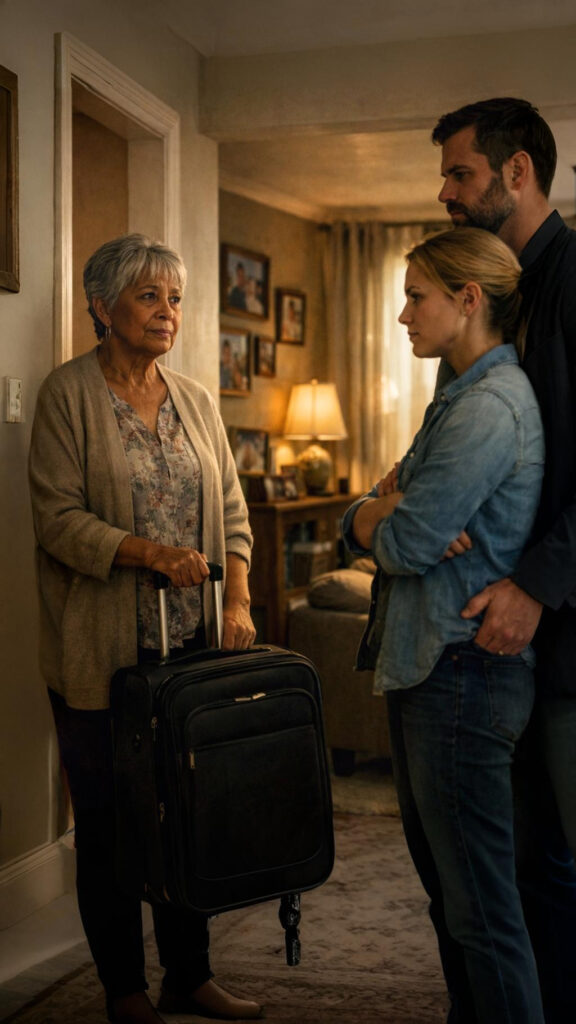
Chapter 1 — The Day I Was Told to Leave
I was sixty-two years old when my own daughter stood in front of me, arms crossed, eyes avoiding mine, and repeated her husband’s words as if they were gospel.
She didn’t even try to soften them.
“We can’t keep extra mouths to feed anymore.”
The sentence didn’t sound real at first.
It hovered in the air between us, heavy and ugly, like something that shouldn’t exist inside a family home.
I remember blinking.
Once.
Twice.
As if my eyes were the problem.
I asked her to repeat it.
She sighed, already tired of me, already impatient, and said it again—this time faster, sharper, like she wanted it over with.
“Mark says it’s not working. We need space. Financially and… emotionally.”
Mark.
Always Mark.
The man who had moved into my house with two suitcases and a smile.
The man who used to call me “Mom” when he needed something.
I looked around the kitchen while she spoke.
The same kitchen where I had cooked for them.
The same table where I had paid bills so they wouldn’t argue.
The same walls I had repainted with my own hands when they couldn’t afford to.
My bag was already by the door.
That was the part that hurt the most.
They had decided before I ever spoke.
“You can stay with a friend,” she added, finally meeting my eyes.
“Just for a while.”
I laughed then.
Not because it was funny.
Because something inside me cracked, and laughter was the only sound that came out.
“A while?” I said.
“This is my home.”
Her face hardened.
“It was.”
Mark didn’t come into the room.
He stayed in the bedroom, door closed, like a king who didn’t need to witness the exile he ordered.
But I could hear him.
The television.
The volume too loud.
Deliberate.
I picked up my coat slowly, as if moving carefully might slow time itself.
My hands were shaking, and I hated that she noticed.
She stepped aside to let me pass.
No hug.
No apology.
No tears.
At the door, I turned back once more.
“I raised you,” I said quietly.
“I didn’t raise you to do this.”
She looked away again.
“Please don’t make this harder.”
Harder.
As if it wasn’t already breaking me in half.
When I stepped outside, the cold hit my face like punishment.
I stood there for a moment, bag in hand, listening to the door lock behind me.
Click.
That sound followed me down the steps.
Followed me to the sidewalk.
Followed me into the silence where my life had just been rearranged without my consent.
I didn’t cry right away.
I walked.
Past the street where my grandchildren played.
Past the corner store where everyone knew my name.
Past the version of myself who still believed family meant safety.
Only when I sat on a bus bench, my bag between my feet, did the tears come.
Quiet ones.
Ashamed ones.
I kept hearing her voice.
“Extra mouths to feed.”
As if I were a burden.
As if decades of love could be reduced to calories and cost.
I didn’t know then that this moment—this humiliation—would become the first stone in a path they never expected me to walk.
But that day, all I knew was this:
My daughter had chosen her husband.
And she had chosen to leave me with nothing but a bag, a memory, and a wound that had just begun to bleed.
Chapter 2 — Everything I Had Given
For weeks after she threw me out, I kept going over the same memories.
Not the recent ones—those were too raw—but the ones that proved, at least to me, that I hadn’t deserved it.
It’s strange how the mind protects itself.
When you lose everything, it starts replaying the moments when you gave everything.
As if reminding you that you once mattered might soften the emptiness left behind.
I remembered the first apartment she rented, years ago.
It was falling apart—peeling paint, broken heater, one dim bulb that buzzed like a mosquito.
I paid the deposit without her asking.
She said she’d pay me back after the wedding.
She never did.
I didn’t care then.
I remembered the honeymoon fund that mysteriously “came up short.”
Mark had lost his job right before they left.
Of course I stepped in.
What mother wants her daughter’s first days of marriage clouded by debt?
So I paid.
When they decided to buy their house, the down payment came from my savings account.
I withdrew it quietly, smiling as they signed the papers, pretending not to notice that my own retirement had just become a little smaller.
I told myself it was worth it.
That’s what mothers do, right?
We sacrifice so our children can stand taller, live easier, dream bigger.
I used to cook dinner for them every Sunday.
Mark would sit at the table, scrolling through his phone while I served the food.
He’d look up occasionally, smile without warmth, and say, “You didn’t have to go through all this trouble.”
I’d laugh.
I liked the trouble.
The trouble meant I was part of something.
Once, when their youngest got sick, I stayed up all night so they could sleep.
I held that feverish little body against my chest until the sun came up.
Mark thanked me with a text message.
A single line: “Appreciate the help.”
The thing about being useful is that people start to love you for your usefulness, not your presence.
And when your usefulness ends, so does their affection.
I didn’t see it then.
Not clearly.
But looking back, I realize the warning signs were always there.
The quiet sighs when I entered the room.
The glances they exchanged when I offered advice.
The way Mark started calling me “your mother” instead of “Mom.”
Small things.
Tiny fractures that only show their size after everything shatters.
After I left, I stayed with an old friend, Clara.
She lived in a tiny flat that smelled like cinnamon and laundry detergent.
She didn’t ask questions, just made tea and handed me a blanket.
One evening, as we sat watching the rain blur the city lights, she said,
“You’ve always been too generous for your own good.”
I smiled faintly.
“It’s not generosity if it costs you everything, is it?”
She didn’t answer.
She didn’t need to.
Every day, I replayed the moments that had built that ungrateful home brick by brick.
The Christmas gifts I’d bought when they were too broke.
The hospital bills I’d paid after Mark’s surgery.
The loans I’d covered because I couldn’t stand to see them struggle.
Each memory felt like evidence in a trial where I was both victim and witness.
Sometimes I’d wake up angry.
Sometimes I’d wake up numb.
Mostly, I woke up tired.
But the anger started to take shape, slow and deliberate, like a seed cracking underground.
Not loud yet.
Not dangerous.
Just alive.
One morning, I went through my old bank statements.
Page after page of proof.
Transfers. Withdrawals. Notes that read for Anna or for house payment.
Tens of thousands over the years.
Gone.
I realized then how invisible my sacrifices had been.
How easily they had turned me from a mother into a resource.
And when resources run dry, people move on.
That night, I lay awake staring at the ceiling of Clara’s guest room.
It wasn’t self-pity anymore.
It was calculation.
I started thinking about value—how easily people assign it, how cruelly they take it away.
Mark believed I had none left to give.
He’d said it with those five words, spoken through my daughter’s mouth.
“Extra mouths to feed.”
I whispered them again into the dark.
Let them roll around in my head until they lost meaning.
Until they became something else entirely.
Fuel.
They didn’t know it yet, but they had given me a gift.
Not kindness.
Not love.
But clarity.
And clarity, I was beginning to understand, was far more powerful than forgiveness.
The next morning, I went to the bank.
The same one where I had once withdrawn money for them.
This time, it was for me.
The teller greeted me by name.
“Mrs. Davis, it’s been a while.”
“Yes,” I said.
“But I think I’m finally ready to start again.”
She smiled politely, unaware that beneath my calm expression something was quietly rebuilding itself—brick by deliberate brick.
What I didn’t know then was that those quiet steps—organizing, saving, planning—were already leading me toward the day when I’d stop being the woman they discarded…
…and become the one who would own the ground beneath their feet.
Chapter 3 — The Quiet Fall and the Spark of Awakening
The first few months after leaving my daughter’s house felt like walking through fog.
I could hear the world moving around me—cars, laughter, life—but it all seemed to belong to someone else.
Someone who hadn’t been erased from her own family.
Clara kept insisting that I rest, that time would heal everything.
Time, I learned, doesn’t heal.
It exposes.
I’d wake up before sunrise, when the city was still half asleep, and sit by the small kitchen window with a cup of instant coffee.
The street below smelled of rain and exhaust.
It reminded me of the mornings when I used to drive Anna’s kids to school while she “caught up on sleep.”
I had loved those rides.
Now, thinking about them felt like pressing on a bruise.
For a while, I tried to make myself small.
Invisible.
I didn’t want to be a burden again.
I cooked for Clara, cleaned her apartment, pretended I didn’t notice the pity in her eyes when she told me to relax.
But inside, something was shifting.
Grief has layers, and beneath the soft ache there was something harder.
A restlessness I couldn’t name yet.
One afternoon, as I was grocery shopping, I ran into one of Anna’s old neighbors.
A cheerful woman named June, who used to drop by on Sundays for dessert.
“Oh, Mrs. Davis! Haven’t seen you in ages! How’s Anna? How are the kids?”
I froze for half a second before answering.
“They’re fine,” I said.
Then she added, with a laugh, “You must miss living so close to them!”
I smiled politely and walked away.
The moment I turned the corner, I felt my throat close up.
Miss them?
I missed myself—the version of me who used to believe kindness always came back around.
That night, I lay awake and realized something simple, almost stupidly simple:
They had taken everything from me except my ability to rebuild.
I started writing lists.
Not of groceries or chores, but of everything I had ever wanted and never allowed myself to have.
A small apartment of my own.
A car that wasn’t falling apart.
A savings account that didn’t exist only to rescue someone else’s dream.
The next morning, I opened my laptop and started looking for work.
Anything.
I hadn’t been in an office in decades, but numbers and discipline never left me.
Within two weeks, I had a part-time bookkeeping job at a small property agency.
It was tedious at first—endless spreadsheets, bills, and rent ledgers—but the rhythm of it calmed me.
I liked the order.
The predictability.
Every number meant something.
Every transaction left a trail.
Money, I learned, always tells the truth about people.
My boss, Mr. Harris, was kind but distant.
He didn’t ask about my life, and I didn’t offer.
I arrived early, stayed late, and watched as money flowed in and out of places I could only dream of owning.
One day, while filing a stack of property records, I noticed something familiar.
An address.
My daughter’s building.
I froze.
It felt like the universe had dropped a stone right into the still water of my life.
They were tenants of one of the properties managed by our office.
I stared at the document, at the landlord’s name, at the renewal dates.
Three months left on their lease.
Something inside me straightened.
Not in anger—anger had burned itself out long ago—but in clarity.
This was the first moment since that night at the door when I felt choice.
For months, life had been happening to me.
Now, for the first time, I saw a door open in the fog.
That evening, Clara found me sitting at the table, surrounded by papers.
She raised an eyebrow. “You look… determined.”
“I am,” I said simply.
“About what?”
“About not being at the mercy of anyone ever again.”
She nodded slowly, studying me.
There was no pity in her eyes that night—only recognition.
Over the next few weeks, I learned everything I could about property investments.
Late nights with online seminars, notes scribbled in cheap notebooks, endless cups of coffee.
Mr. Harris noticed my interest and started giving me more responsibilities—market analyses, tenant reports, contract reviews.
He said I had a good head for numbers.
I didn’t tell him I’d spent my whole life managing everyone else’s.
When I got my first paycheck, I didn’t spend a cent.
Not on clothes.
Not on takeout.
Not even on the perfume I’d been eyeing in the shop window.
Every dollar went into savings.
I thought about my daughter sometimes—how she must have felt after I left, if she ever regretted it.
Then I’d remember the sound of the door locking behind me and stop wondering.
One morning, Mr. Harris mentioned he was looking to sell a few small properties—older buildings in need of renovation, priced low for quick turnover.
I asked for details.
He handed me a file.
I flipped through it, my pulse steady until I saw it again.
That address.
Their building.
My heart didn’t race.
My hands didn’t tremble.
It was as if all the noise in the world went quiet, waiting for my decision.
“Would you consider letting an employee make a private offer?” I asked.
He looked surprised but intrigued.
“Depends on the offer.”
“I’ll have one for you tomorrow,” I said.
That night, I stared at my reflection in the bathroom mirror.
For the first time in a long while, I didn’t look like someone’s mother, or someone’s burden.
I looked like someone capable of taking back what had been taken.
It wasn’t revenge—not yet.
It was restoration.
A rebuilding of the invisible architecture inside me.
When I finally turned off the light, I whispered to the empty room,
“They thought they buried me. They didn’t realize I was the seed.”
And in that quiet moment, I felt something I hadn’t in months—power.
Not loud, not cruel.
Just mine.
Chapter 4 — The Turning of the Key
When I made the offer, I expected resistance.
After all, who would take a sixty-two-year-old woman with modest savings seriously in a business full of loud men with quick smiles and expensive watches?
But numbers don’t care about who you are.
They only care about what adds up.
Mr. Harris called me into his office a week later.
He held the file like it was something delicate.
“I didn’t think you were serious,” he said.
“I was,” I answered. “And I still am.”
He leaned back, studying me the way people do when they sense something they can’t quite name.
“What do you plan to do with it?”
“Run it better,” I said simply.
And maybe, I thought, teach a lesson that no family dinner ever could.
He nodded. “The owner accepted. The papers are ready whenever you are.”
It was anticlimactic, the way big moments often are.
No thunder, no applause—just a quiet click of a pen on paper and the sound of my own signature claiming what once belonged to someone else.
Three months after being thrown out, I owned the building where my daughter lived.
Their home was mine now.
The irony was almost too much to swallow.
I sat in the notary’s office, staring at the deed, and laughed under my breath.
A sound soft and bitter, like coffee left too long on the stove.
Clara was waiting for me outside.
She hugged me before I could say anything.
“So?”
“So,” I said, “it’s done.”
“And how do you feel?”
I thought for a moment.
“Like I finally turned the key that locks them out of my heart.”
She didn’t reply. She just squeezed my hand, and we stood there in silence, two women who had seen too much of what people call love.
The first time I visited the property as its new owner, I didn’t announce myself.
I wanted to see it the way it truly was—without the masks people put on when they know they’re being watched.
The paint was chipped, the hallway smelled faintly of damp wood, and somewhere a child was crying behind a door.
When I reached their floor, I paused outside their apartment.
Number 3B.
The same number I used to write on gift tags, on Christmas cards, on envelopes filled with money “just to help.”
I didn’t knock.
I didn’t need to see their faces yet.
I wasn’t ready for her voice, for whatever version of guilt or defiance she had built to defend herself.
Instead, I went back downstairs and met with the building manager.
“How are the tenants?” I asked casually.
He shrugged. “Most are fine. One couple in 3B is always late on rent, though. They promise to catch up but never do.”
Of course.
Even then, still depending on someone’s mercy.
“How late?” I asked.
“Two months.”
I smiled faintly. “That won’t do.”
When the time came to issue the renewal notices, I did it personally.
Each tenant received a polite letter—updates on maintenance, contact details, and new terms.
Every unit’s rent increased modestly.
Except one.
3B tripled.
It wasn’t cruelty.
It was correction.
A balancing of scales that had been uneven for too long.
The morning the letters went out, I sat at my small kitchen table, coffee steaming beside me, and waited.
Not for an apology—those never come.
I was waiting for the sound of realization.
For the moment when comfort turns into consequence.
It didn’t take long.
By afternoon, my phone rang.
A number I hadn’t seen in months.
Anna.
I let it ring twice before answering.
“Hello?”
Her voice cracked. “Mom?”
It had been a long time since she’d used that word.
“Yes.”
“I—I think there’s been some mistake. Our rent renewal just came, and it says the new landlord—” She stopped. I could hear the disbelief in the silence that followed.
“It’s you?”
“It is.”
“Mom, you can’t be serious! We can’t afford—”
“Then perhaps it’s time to find a place that fits your budget,” I said, my tone calm, almost kind.
“Please, we have the kids—Mark just started a new job—this isn’t fair!”
Fair.
That word again.
The one people use only when fairness no longer benefits them.
I took a slow breath. “Fairness, my dear, would have been letting your mother stay under her own roof without being treated like an inconvenience.”
She went quiet.
I could almost hear the tears forming, the guilt she’d kept buried.
“I didn’t want to kick you out,” she whispered. “Mark said—”
“I know what Mark said,” I interrupted softly. “And you agreed.”
There it was.
The truth, simple and sharp.
“I’m not doing this to hurt you,” I continued. “I’m doing it because you need to understand the cost of what you called love.”
She sniffled. “You’re punishing us.”
“No,” I said. “I’m setting the rent to its real value.”
She didn’t respond.
Eventually, she hung up.
I sat there for a long time, staring at the silent phone, feeling neither victory nor regret.
Just stillness.
The kind that comes when a storm has finally passed, leaving behind a strange, clean air.
That night, Clara poured us both a glass of wine.
“To justice,” she said, raising her glass.
“To balance,” I corrected.
But later, alone, I found myself walking to the window, staring at the dark city, and whispering something softer.
“To myself,” I said quietly. “To finally choosing myself.”
The next morning, I received an envelope slid under my door.
No return address.
Inside was a check.
Three months’ rent, full amount.
And a short note written in Anna’s familiar handwriting:
We’ll move out by the end of the month. I hope one day you can forgive me.
I folded the paper and set it aside.
Forgiveness wasn’t the goal.
Freedom was.
As I watched the sun rise over the city, a strange calm settled in my chest.
I had built them a life once.
Now I had reclaimed my own.
The balance, at last, had been restored.
Chapter 5 — The Reckoning and What Came After
When they moved out, I didn’t go to see it happen.
I didn’t want to watch boxes being dragged down the hallway or hear the heavy footsteps of a family learning what loss feels like.
Some things are better left unseen.
The sound of departure is sometimes louder than the act itself.
Clara said I should at least go by afterward, make sure they hadn’t left the place in ruins.
I waited three days.
Then I went.
The apartment was smaller than I remembered.
Stripped bare, it looked more like a confession than a home.
The walls were pale, marked by years of pictures that once hung proudly.
The kitchen smelled faintly of lemon cleaner and regret.
On the counter, a single envelope waited with my name on it.
Inside was a key and another note in Anna’s handwriting.
I don’t expect forgiveness. But I hope one day you’ll think of us without anger.
The words trembled, even on paper.
I set it aside and walked through the rooms.
The echo of my own footsteps followed me.
This was where I had once poured coffee every morning, where I had held my grandchildren when they were still small enough to fit in my arms.
I remembered Anna laughing, flour on her cheeks, Mark calling from the living room.
The sound of a family I thought would never fracture.
Now there was only silence.
I sat on the floor in the living room, leaning against the cold wall, and closed my eyes.
I expected satisfaction.
Maybe relief.
What I felt was something quieter—an ache shaped like peace.
It wasn’t about revenge anymore.
It hadn’t been for a while.
It was about boundaries.
About realizing that love without respect is just dependence disguised as devotion.
That evening, I returned home and opened a small bottle of wine I’d been saving.
Clara joined me without asking why.
We sat in comfortable silence until she finally said,
“So, what now?”
I smiled faintly. “Now I rebuild. For real this time.”
I rented out the apartment quickly; there was no shortage of people looking for homes.
A young teacher moved in with her daughter, a quiet child who loved drawing on the steps with chalk.
Sometimes I saw them on my inspection visits.
They always smiled.
They didn’t know the history of those walls.
Maybe that was for the best.
I began to walk every morning, just to feel the air again.
The city seemed different now—less threatening, more alive.
Perhaps it wasn’t the city that changed but me.
I had started to recognize myself again in small, ordinary moments: buying flowers, cooking for pleasure, saying no without apology.
The money from my tenants went straight into a savings account under my name alone.
I watched it grow slowly, like something blooming after a long winter.
For the first time in my life, I didn’t feel guilty for keeping something that was mine.
One afternoon, I passed a café window and caught a reflection that startled me.
A woman with silver hair, eyes steady, back straight.
Not broken.
Not invisible.
Just present.
I didn’t look away.
Weeks later, Anna called again.
Her number flashed on the screen for a long time before I answered.
“Hello,” I said.
“Hi, Mom.”
Her voice was softer this time, careful.
“We found a new place. Smaller, but cozy. The kids like it.”
“I’m glad,” I said.
“I wanted to tell you… I got a job. And Mark—well, he’s trying too. We’re doing better.”
There was a pause.
“Good,” I said. “You should.”
Then, after a long breath, she added, “I think I understand now. What you gave. What it cost you.”
The silence that followed wasn’t uncomfortable.
It was honest.
Years of things unsaid floated between us, and for once, neither of us tried to fill the space.
“I’m proud of you,” I said finally.
It wasn’t forgiveness, not fully.
But it was truth.
And truth, I’d learned, is a kind of grace.
After we hung up, I sat by the window and watched the sunset bleed across the rooftops.
There was no dramatic ending, no grand revelation.
Just quiet understanding.
Sometimes, that’s all healing is—the ability to look at what once broke you and not feel the urge to rebuild it.
Months passed.
I bought another small property, then another.
Nothing extravagant.
Just enough to stay independent, to prove to myself that I could.
Each key I collected felt like reclaiming a piece of the woman I had lost along the way.
People started calling me lucky.
But luck had nothing to do with it.
It was simply the result of deciding that I was worth the effort.
One evening, as I locked up the office, Clara said, “You’ve changed, you know.”
“Maybe I’ve just come back to myself,” I replied.
And I meant it.
That night, I wrote a letter I never sent.
To Anna.
To Mark.
To the woman I used to be.
I forgive you, it said. Not because you deserve it, but because I do. I’m free now.
I folded it neatly and placed it inside a drawer.
It didn’t need to travel anywhere.
The message had already reached where it was meant to.
When I turned off the light and climbed into bed, I smiled at the quiet.
Not the silence of loss this time, but of peace.
I had started again.
Not as someone’s mother, or someone’s helper, or someone’s afterthought.
But as myself—whole, imperfect, and finally unafraid to live on my own terms.