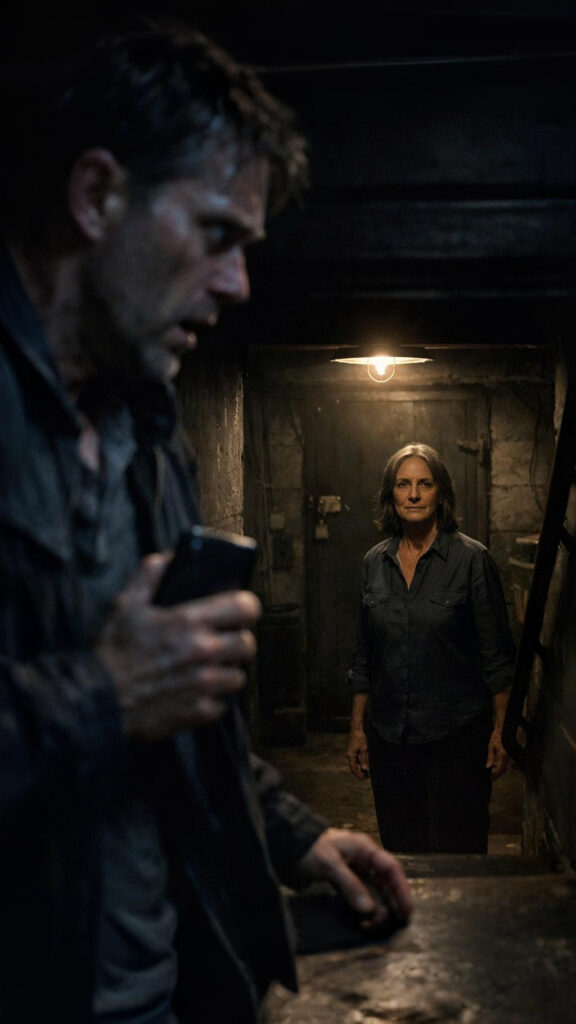
Chapter 1 – The Locked Door
The house used to feel warm, even when it was silent. Now it felt like a coffin.
She stood near the window, her fingers trembling as they touched the dusty glass. Outside, the world was indifferent—birds singing, a neighbor watering her flowers. No one knew she had been locked in.
Her son’s words still rang in her ears.
“You’ll rot in here!”
The slam of the door had been louder than any thunderstorm she’d ever heard.
He had done it before—raised his voice, slammed things, thrown blame like knives—but this time something inside him snapped. She saw it in his eyes, a coldness that didn’t belong to the boy she raised.
She shouted his name, once, twice, until her throat went dry.
Silence.
Then the faint click of the lock.
Her stomach twisted. The fridge was nearly empty—just a bottle of water, some leftovers. The cupboards offered nothing. He had planned this.
For a moment, she thought it was a cruel joke. That he would return in an hour, regret everything, fall to his knees like the little boy who used to cry after breaking a toy.
But hours turned into a night.
And the house began to breathe differently.
She wandered from room to room, touching the furniture like old memories. The couch where he used to sit watching cartoons. The kitchen table where he once did homework while she stirred soup. Every surface whispered betrayal now.
She tried the doors again. The front—locked. The back—bolted from outside. Even the windows wouldn’t open; he had replaced them with safety locks months ago, claiming he worried about her “forgetfulness.”
Her knees weakened. She slid down against the wall, the air thick and heavy, her heart thudding with disbelief.
How had love turned into this?
When her husband died, the boy had been her reason to keep breathing. She sold the old shop, paid for his college, even mortgaged the house to cover his debts. Every sacrifice felt worth it then—because he had promised to take care of her someday.
And now, here she was, shut inside by the same hands she once held to teach how to walk.
The hunger didn’t come first. It was the thirst, the dry mouth, the fatigue. The hours passed like shadows shifting across the walls. The clock ticked too loud, each second another reminder that no one was coming.
She spoke softly to herself, to the silence.
“Why, Daniel?”
Her voice broke, small and unfamiliar.
Maybe he wanted her out of the way. Maybe the money was the reason—the house was still in her name. Or maybe he simply stopped seeing her as human.
She didn’t know which hurt more.
By the second night, her fear began turning into something sharper. Not anger—yet—but a faint pulse of resistance. If he thought she would rot here, he was wrong.
She lit a candle and sat on the floor, listening to the hum of the old refrigerator. Beneath it, she noticed a draft of cold air coming from under the rug. Strange.
But she didn’t move it yet.
Instead, she closed her eyes, remembering his face as a child, covered in chocolate after sneaking cake before dinner. His laughter. His tiny hand clutching hers during storms.
Tears burned her eyes, but they didn’t fall. She couldn’t afford weakness. Not anymore.
Morning arrived pale and indifferent. Light streamed through the curtains, but it didn’t feel like freedom—it felt like mockery. She drank the last of the water. Her legs trembled. Still, she refused to sit still.
She started testing every corner of the house, knocking on walls, pulling drawers, searching for anything—food, a tool, a crack. She knew these walls better than anyone. She had cleaned them for decades.
That was when she remembered.
The basement.
Her late husband used to keep things down there—old furniture, boxes, maybe even the generator. Daniel had sealed the door after a leak years ago, said it was unsafe.
But she remembered another way in.
She pushed the rug aside. The faint outline of a wooden hatch appeared beneath the dust. Her heart quickened.
If she could get down there, maybe she’d find something he forgot.
Maybe his mistake.
She sat back and took a deep breath. For now, she had a plan, and that was more than fear.
Outside, the world went on—cars passing, birds calling, life moving without her.
Inside, behind locked doors, a mother’s silence began to shift into something new.
Not just survival.
Preparation.
Chapter 2 – The Basement Memory
The air in the house had changed. It smelled older now—like dust, wood, and something faintly metallic. She traced the lines on the floor where sunlight stopped, hesitating before the shadow that marked the edge of the rug.
Her fingers trembled as she peeled it back. The wooden hatch stared at her like a secret waiting to be confessed. She knelt beside it, brushed away the dust, and whispered, “You thought you sealed everything, Daniel…”
The boards creaked under her weight. It wasn’t the sound of fear anymore—it was the sound of a heartbeat returning after too long in silence.
She searched for something to pry it open. A metal spoon. A piece of wire. The old broom handle. It took time, and strength she didn’t know she still had, but finally, the wood cracked enough to lift.
The air rising from below was cold and heavy. It smelled of forgotten years.
For a moment, she hesitated. The darkness seemed endless. But the hunger, the thirst, and the humiliation burned stronger than her fear. She grabbed the candle, cupped her hand around the flame, and descended.
Each step down the narrow staircase groaned as if warning her to turn back.
The basement welcomed her with silence. Shelves lined the walls, stacked with boxes and tools wrapped in cobwebs. Her husband’s handwriting still marked a few of them—“Christmas,” “Old papers,” “Generator.”
She moved carefully, the candle flickering against damp stone. Her eyes adjusted, revealing the life they had once built together now buried under neglect. She ran her hand over an old trunk and smiled faintly. “You’d never believe this, Robert,” she whispered to her late husband.
But then something caught her eye.
In the far corner, behind an overturned chair, a small red light blinked. Slow, steady, rhythmic. Not something from her husband’s time. She frowned and moved closer.
It was a security camera. Or rather, a recording device—hidden, dusty, still powered somehow. The cable ran up along the wall and disappeared through the ceiling.
Her pulse quickened.
Daniel had set it up.
She traced the wire’s direction, realization crawling across her mind like frost. He had been recording her. Watching. Maybe even using her image to convince people she was “confused,” “unstable,” “unfit to manage her affairs.” The thought made her skin tighten with anger.
She pressed her ear to the ceiling. Above her, the faint vibration of a phone ringing somewhere upstairs. Of course—he’d locked her in but kept the cameras on. Always needing control, even from a distance.
She searched the boxes again, hoping for more. Beneath a pile of rags, she found a metal box with a lock that had rusted halfway through. She forced it open with a screwdriver.
Inside were papers, receipts, letters—and a USB drive. Her breath caught.
She turned it in her hand, the small device reflecting the candlelight. It could hold anything. Secrets. Proof. A way out.
She sat on the cold floor, staring at it, mind racing through every memory of her son: the birthday cards she’d written, the calls unanswered, the way he’d started talking to her like she was an inconvenience.
How long had he planned this?
She wanted to cry, but the tears wouldn’t come. Only a slow, rising sense of power. He thought she was trapped. He thought she was weak. But he had forgotten what she remembered, what she still knew.
Her husband had taught her things—how to use the generator, how to manage wiring, how to repair things “just in case.” That knowledge had always seemed useless before. Now, it was survival.
She connected the generator, coughed as the dust swirled, then smiled faintly when it started to hum. The small light of a computer monitor flickered on at the far end of the room. Her husband’s old desktop, still alive.
It took a moment to boot. The sound was like a ghost breathing back to life. She inserted the USB drive.
Dozens of video files appeared. She clicked the first one.
Her own face filled the screen.
She was sitting in the kitchen, talking to herself, folding napkins. Another clip—she was in her bedroom, arguing with Daniel, begging him to stop shouting. A third—he was recording her secretly, cutting the parts where he insulted her, leaving only her raised voice.
Her stomach turned.
So that was his mistake. He had left his evidence where she could find it.
She scrolled further, finding videos labeled with dates. Transactions. Property documents. He’d been preparing to declare her mentally incompetent, transfer the house to his name, and send her to a nursing home.
A quiet rage filled the basement.
She copied everything to another folder. Named it simply: “Truth.”
For the first time in years, she felt steady. Not safe yet, but strong.
The candle burned low, wax dripping onto her hand. She didn’t flinch. Upstairs, the phone rang again, then stopped. The world outside went on, unaware that a quiet revolution had begun beneath their feet.
When the generator finally went silent, she sat in the dark, holding the USB drive close to her chest. The shadows no longer frightened her.
They kept her company.
She whispered to the darkness, “You made one mistake, my son. You forgot who taught you how to survive.”
Then she smiled, small and sharp, already planning her next move.
Chapter 3 – The Message
The house was still locked, but it no longer felt like a prison. The fear that had once pressed against her chest had turned into something colder, steadier—like a blade being sharpened in silence.
She spent hours in the basement, her candle replaced by the dull blue glow of the old computer monitor. The generator rumbled faintly, a mechanical heartbeat that made her feel less alone. Every click of the mouse revealed another piece of her son’s deceit.
Bank transfers. Forged signatures. Video fragments edited to make her look confused, unstable, dangerous even.
He had built a case against her, carefully, over months—maybe years. She was the loving mother on paper, turned liability in his version of truth.
Now, she had all of it.
The USB drive sat beside her, full of proof. She traced its metal edge with her thumb, feeling the tremor of her pulse beneath her skin. It was small enough to fit in her pocket, yet heavy with everything he had stolen from her.
Upstairs, the phone rang again. She could hear it echo faintly through the floorboards. The sound was distant but sharp, slicing through the dark. He was calling. Probably expecting her silence.
Her lips curled into a small smile.
He thought she’d given up. That she was lying somewhere weak, helpless, maybe even gone. He had no idea what she’d found.
She climbed the stairs slowly, each step creaking under her bare feet. The air upstairs was warmer, but it felt thinner, like it resisted her presence. She passed through the kitchen, the cold plate still sitting on the table, untouched. Her reflection stared back from the window—pale, tired, but alive.
The phone rang again.
She picked it up before the last ring faded.
No words at first—only silence on the other end, and then his voice, casual, almost mocking.
“Still alive, huh? I thought maybe—”
“Daniel,” she interrupted softly. “You should come home.”
A pause. Then a nervous laugh. “What for? So you can guilt me again? I’ve had enough of your—”
“I found something,” she said. “Something you’ll want to see.”
The silence stretched longer this time. She could hear the faint hum of his office in the background, the click of a pen, the tension in his breath.
“What are you talking about?”
Her tone didn’t change. Calm. Even. “You left a mess downstairs. I think you should clean it up before someone else sees it.”
He said her name then, but not with affection. It came out as a question, a warning, a sign that the balance of power had shifted and he didn’t understand how.
“What did you do?”
She hung up.
For a moment, the silence felt absolute. Then she exhaled, steady and slow, as if releasing the years of fear that had held her still.
Outside, rain began to fall. The sound against the roof was soft but rhythmic, almost soothing. She moved through the rooms, closing curtains, unplugging the lamps, darkening the house. If he came, she wanted the advantage of shadows.
Downstairs, the USB drive waited.
She took it, slipped it into the pocket of her cardigan, and returned to the living room. The clock ticked. 11:17 a.m. If she knew him, he’d arrive before noon. He always preferred to face problems immediately, to crush them before they grew.
She remembered that from when he was little—how he would stomp on insects instead of stepping around them. Always control. Always destruction.
Now he was coming for her, but this time she wasn’t the one cornered.
She opened the back door—quietly, carefully—and left it unlocked. The smallest invitation. Let him think she was desperate or confused. Let him walk into the trap he built himself.
Then she sat in the armchair by the window, the phone beside her, the rain whispering on the glass.
She could almost hear his car before she saw it—the low hum of the engine, the tires on wet gravel. Then headlights flashed briefly through the curtains.
Her pulse stayed calm.
The door opened.
“Mother?” His voice was sharper now, laced with unease. “Where are you?”
She didn’t answer. She could hear his footsteps moving through the hallway, cautious, pausing between each step. He was looking for her, expecting weakness, maybe collapse.
She waited until he passed near the kitchen before speaking.
“Downstairs, Daniel.”
He froze. She could feel it even without seeing him.
“How did you—”
“You should come,” she said softly. “There’s something you need to see.”
The silence that followed was long. Then came the sound of his shoes against the wood, the slow creak of the hatch opening, the faint scrape of his breath as he descended.
She waited at the top, motionless, listening to him fumble in the dark. Then his voice rose, nervous, strained.
“What is this? What did you—”
She reached for the phone again, pressed a single button, and a message she had typed earlier appeared on his screen downstairs.
I know everything.
A pause.
And so will everyone else, unless you listen to me.
She heard the sound of his panic—a drawer opening, something falling, the sharp intake of breath. He understood now.
For the first time, she felt no guilt. No fear. Just clarity.
When he rushed back up the stairs, his face was pale, his voice shaking.
“What did you do?”
She met his eyes. They were the same eyes that had once looked up at her with innocence and love. Now they were filled with terror.
“I’m just returning what you gave me,” she said.
He reached for her arm, but she stepped back. Calm. Unflinching.
Outside, the rain grew louder, drowning the sound of his breath.
Somewhere beneath the floorboards, the generator hummed one last time before stopping—its power spent, its job complete.
And in that dim, trembling quiet, a mother stood taller than she had in years, while her son finally learned what it meant to be afraid.
Chapter 4 – The Return
He stood in the middle of the room, soaked from the rain, his eyes darting between her and the dark staircase that led to the basement. The sound of water dripping from his coat punctuated the silence like a clock ticking down.
She didn’t move. The chair beneath her creaked softly, her hands folded neatly on her lap. The old cardigan hung loose on her shoulders, and yet there was something regal about the way she sat—quiet, deliberate, as if she had all the time in the world.
He broke first.
“What do you want, Mother?” His voice trembled despite his attempt at control. “You’re making this worse for yourself.”
She tilted her head, studying him. “Worse for myself? Or worse for you?”
He swallowed hard. His gaze flicked to her phone on the table, to the faint blue light of the screen. The message she had sent him was still open in his mind, echoing. I know everything.
“Those files,” he said carefully, “they’re just old things. You don’t understand the context.”
“Context,” she repeated softly, as if tasting the word. “Is that what you call stealing your mother’s life?”
His jaw tightened. “You were losing control! You forgot bills, appointments—you even left the stove on once. I had to take responsibility.”
She leaned forward, her voice low. “You edited those videos. Cut the parts that made you look cruel. You made me look like I was falling apart.”
He didn’t deny it. That silence was louder than any confession.
The rain outside thickened, the sky pressing low against the windows. The smell of wet earth crept into the room.
She rose slowly, her movements deliberate, like someone reacquainting herself with the gravity of her own body. “You planned to lock me away. To take the house. The money. Everything.”
He stepped closer, lowering his voice. “You don’t know what you’re saying.”
“I know exactly what I’m saying,” she answered.
There was no hesitation now.
She walked past him toward the small writing desk near the wall, opened the drawer, and took out a single envelope. It was sealed, her handwriting neat, the kind she had used years ago when writing to his father overseas. She held it between two fingers.
“This,” she said, “is already in the mail. Copies of everything. To the bank. To the lawyer. To the police.”
His eyes widened. “You’re bluffing.”
She met his gaze. “Try me.”
The room went still.
For a long moment, he said nothing. His breathing quickened, shallow, like a trapped animal. Then his anger rose—sharp, defensive. He slammed his hand against the table, making the phone jump. “You think you can ruin me? After everything I’ve done for you?”
Her laughter was soft, almost kind. “Done for me? You locked me in my own house and called it care.”
He froze. The words landed like a slap.
The mask of confidence cracked, and beneath it was something almost pitiful—a man who had built his life on deceit and was now watching it collapse. He turned toward the window, running a trembling hand through his wet hair. “You don’t understand, Mother. I needed the money. I’m in trouble.”
She felt no sympathy. Not anymore.
“Trouble of your own making,” she said quietly. “You’ve been drowning for years, and instead of swimming, you tried to drag me down with you.”
His shoulders slumped. The fight seemed to drain out of him. For a moment, he looked younger—like the boy who used to come to her crying after nightmares. But that image didn’t last. The man standing before her was not that boy. He was a stranger wearing her son’s face.
He turned suddenly, desperate. “We can fix this. Delete everything. Pretend it never happened.”
“I can’t pretend anymore,” she said. “You’ve been pretending enough for both of us.”
The thunder outside rolled low and long.
She walked toward the door, taking the umbrella from the stand. He stared as she opened it, as if the very act of her leaving broke a rule he’d written long ago.
“Where are you going?”
“To breathe.”
She stepped outside. The rain hit her face like cold truth. The yard was half-flooded, but she didn’t care. Each step away from the house felt like shedding a layer of grief.
Behind her, through the window, she saw him standing still, staring out at her—small now, powerless.
When she reached the mailbox at the edge of the street, she placed the envelope inside. The metal clicked shut, sealing more than paper.
Her past was gone with that sound.
She stood there a moment, letting the rain wash the dust from her hair, the fear from her skin. For the first time in years, she felt weightless.
Inside the house, Daniel’s voice shouted her name, but it was distant, like a memory calling from another life.
She didn’t turn back.
Every step toward the end of the street was a new breath. Every drop of rain on her face was a small baptism.
And when she finally looked up, the clouds were breaking apart, revealing a thin, pale stripe of sky—faint, fragile, but real.
The storm was ending.
So was everything else.
Chapter 5 – The Reckoning
Morning came quietly, with the smell of wet soil and the hum of distant traffic. The storm had passed, but the house still held its shadow. Puddles glistened along the driveway like mirrors, reflecting fragments of a night that no longer belonged to her.
She stood by the window, a cup of lukewarm tea in her hands, watching the world stretch into motion again. It was strange, how ordinary everything looked. The same trees, the same road, the same silence—but she was not the same.
Inside, Daniel had barely slept. She heard him pacing during the night, footsteps heavy and uneven, the sound of drawers opening and closing, muttered curses. Now, the house felt divided—one heartbeat upstairs, one downstairs—each beating for different reasons.
She wasn’t afraid of him anymore. That part of her was gone. What remained was something sharper than fear, something that could no longer be broken.
The envelope was gone. Mailed. Irretrievable. It was no longer a weapon she held but a truth set free. And that truth had its own momentum now—quiet, invisible, unstoppable.
She moved slowly through the kitchen, collecting her things. A small suitcase. Her husband’s old photograph. A scarf she had knitted years ago when the winters still felt colder than loneliness.
The sound of footsteps came down the stairs.
“Where are you going?” His voice was rough, drained.
She didn’t answer right away. She folded the scarf, placed it neatly on top of the suitcase, and zipped it closed.
“Mother, I’m talking to you.”
Finally, she turned to him. His eyes were red, rimmed with exhaustion, his shirt still damp from the night before. There was no arrogance left, only confusion, the hollow look of someone realizing they had lost everything without knowing exactly when it happened.
“I’m leaving, Daniel,” she said. Her voice was calm, measured. “You need to figure out who you are without me.”
He laughed bitterly. “Without you? You’re destroying me. Do you even understand what you’ve done?”
“Yes,” she said softly. “For the first time, I do.”
He stepped closer. “You think the police will believe you? You think anyone will care? You’re old, you’re—”
She raised her hand. The gesture was quiet, final. “Don’t finish that sentence.”
He stopped. The silence between them was heavy, stretched thin like glass about to break.
“I believed in you,” she said after a moment. “Even when you stopped believing in yourself. I covered for you. I excused you. I called it love. But it wasn’t love—it was fear dressed as devotion.”
He blinked, speechless.
“I used to think being a good mother meant forgiving everything,” she continued. “Now I see it means knowing when to stop.”
He tried to speak again, but no words came.
She walked past him toward the door. He didn’t move. She could feel his eyes following her, desperate, hollow, searching for something to hold on to. But she was no longer there for him to hold.
Her hand lingered on the doorknob for a second. “You should eat,” she said quietly. “There’s soup in the fridge.”
He almost laughed at that, but it caught in his throat. The irony burned too much.
Outside, the air smelled like renewal. The grass sparkled with dew. She walked slowly down the path, her suitcase rolling behind her. Every step away from the house made it smaller, lighter, easier to leave.
Halfway to the street, she stopped and turned back. Through the window, she saw him—just a silhouette now, standing motionless in the same spot. For a brief second, she pitied him. But pity wasn’t love. It was closure.
She reached the bus stop and sat on the bench. The road stretched ahead, open and wide, the first road she had chosen for herself in decades.
When the bus arrived, she climbed aboard, found a seat by the window, and watched the house disappear behind the curve of the street.
For the first time, she didn’t look back twice.
She didn’t know exactly where she was going—maybe to her sister’s, maybe somewhere farther. It didn’t matter. Freedom didn’t need a destination. It only needed movement.
As the city rolled by, she took out her phone. A new message appeared from an unknown number: We received your documents. Please confirm your availability for a statement.
She smiled faintly. The system was slow, but justice had already begun its quiet march.
She leaned back against the seat, eyes half-closed, the sound of the bus merging with the pulse in her chest. The rhythm of life returning.
Somewhere behind her, a man sat alone in a house too quiet for repentance. The lights off. The weight of truth pressing down like the storm that had passed but never really left.
And somewhere ahead, beyond the rain-washed streets and gray morning light, a woman carried nothing but a suitcase and the peace of finally being free.
The world outside was ordinary again. But for her, it had never looked so vast.