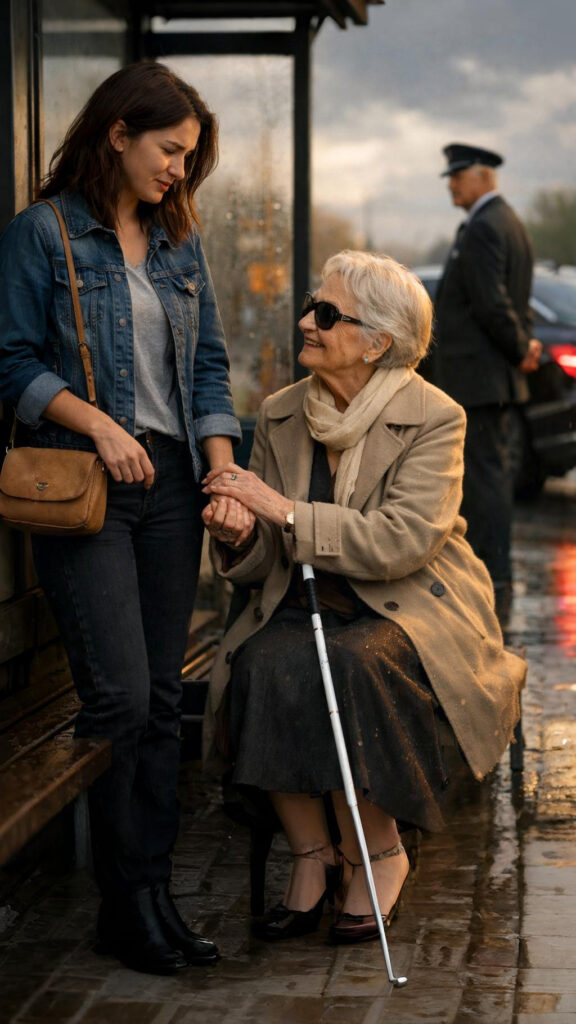
Chapter 1 – The Bus Stop
I didn’t think the argument would end like that.
Arguments never announce their endings. They just keep escalating until one person decides the other no longer deserves even the illusion of dignity.
The car slowed down too abruptly.
Not into a driveway.
Not near a store.
Not somewhere safe.
A bus stop.
Rust-stained bench.
A flickering timetable that hadn’t been updated in years.
Evening wind cutting through my coat.
My husband didn’t look at me when he parked.
His hands stayed on the steering wheel, knuckles tight, jaw clenched like he’d already rehearsed what came next.
“This is where you get off,” he said.
I laughed at first.
A small, confused sound.
The kind you make when reality hasn’t caught up with cruelty yet.
“You’re joking,” I said.
He finally turned his head then.
No anger.
That was worse.
Just fatigue.
As if I were the burden.
“I’m done,” he replied.
“I can’t do this anymore.”
I asked him where I was supposed to go.
He sighed, long and theatrical, like a man tired of explaining obvious things to a child.
“Figure it out.”
I reached into my purse.
Empty.
No wallet.
No phone.
No cash.
I looked back at him.
“You have my bag,” I said.
He shrugged.
“You shouldn’t have started the fight.”
That sentence landed harder than any slap could have.
The door unlocked with a dull click.
I didn’t move.
Years of marriage had trained my body to wait for permission, even when it wasn’t coming.
“Get out,” he said.
I opened the door.
Cold air rushed in, carrying the smell of exhaust and wet pavement.
I stepped onto the sidewalk.
The door slammed behind me.
The engine revved.
For one brief, ridiculous second, I thought he might stop.
That he’d roll down the window.
That he’d say he’d gone too far.
Instead, the car pulled away.
Red taillights shrinking.
Then gone.
I stood there, frozen, watching the road like it might bring him back.
It didn’t.
The bus stop sign creaked above me.
I sat down slowly, my knees protesting, my heart louder than the traffic.
Fifty-eight years old.
Married for thirty-six of them.
Left without money like a bad habit he’d finally broken.
I replayed the argument in my head.
Not because I thought I was wrong.
But because women my age are conditioned to audit themselves after being discarded.
Did I raise my voice?
Yes.
Did I ask questions he didn’t want to answer?
Also yes.
Did I remind him of sacrifices he preferred forgotten?
Absolutely.
That had been the real offense.
A car slowed down in front of me.
Black.
Immaculate.
Expensive in a way that announced itself without trying.
The window rolled down.
A woman leaned out.
Perfect hair.
Diamond earrings catching the streetlight.
A smile that didn’t reach her eyes.
She looked at me the way people look at abandoned furniture.
Then she laughed.
Soft. Amused.
“Are you waiting for a bus?” she asked.
I nodded.
She glanced at my coat.
My shoes.
The bench.
Then she said it.
“Act like you’re my granddaughter.”
I frowned, not understanding.
“My driver is coming,” she continued, still smiling.
“And I don’t like the way you’re sitting there. It looks… pitiful.”
Pitiful.
The word slid under my skin.
Before I could respond, she added casually, as if sharing gossip,
“Your husband will regret leaving you.”
She paused.
“By the richest man in town.”
Then the window rolled up.
The car pulled away.
I was alone again.
But something had shifted.
I didn’t know what she meant.
Or why she said it.
I only knew that the night suddenly felt less empty.
And that whatever had just begun at that bus stop…
wasn’t going to end the way my husband thought it would.
Chapter 2 – The Woman in the Car
The next morning I woke up still hearing her voice.
Not my husband’s—the other one.
The blind old lady from the car.
Except… was she blind?
Or had the darkness been something else, a disguise, a shadow behind the tinted glass?
Sleep hadn’t come easily. I had spent the night on a wooden bench outside a closed bakery, my coat pulled tight, the smell of yeast and rain mingling in the cold air. I watched streetlights blink off one by one until dawn arrived pale and indifferent.
Every memory of the night before returned in fragments.
The way my husband’s hands trembled when he said figure it out.
The way the woman’s tone shifted from pity to command.
The strange authority in her voice, soft but undeniable, as if she were used to obedience.
I replayed her words carefully, line by line.
“Act like you’re my granddaughter. My driver is coming.”
And then the prophecy that didn’t fit the moment at all—
“Your husband will regret leaving you by the richest man in town.”
Who said something like that to a stranger?
By mid-morning, hunger had begun gnawing at my patience. I found a small café that hadn’t opened yet and sat outside, hoping someone might mistake me for a customer and offer water. A bus passed, splashing dirty water over my shoes. I didn’t move.
That’s when I saw the car again.
Same black frame. Same spotless chrome.
The back window slid down just far enough for a voice to escape.
“I told you to act like my granddaughter,” she said.
I turned.
This time, I could see her clearly. White hair swept back neatly, large glasses shading eyes that seemed to see everything even without light. Her clothes were too elegant for morning, but she wore them like armor.
“I thought you were joking,” I said.
“Do I sound like a woman who jokes?”
No. She didn’t.
She motioned to the seat beside her. “Get in.”
I hesitated. Every instinct told me not to.
But every instinct had also told me my husband would never leave me at a bus stop, and that turned out to be false.
So I opened the door.
The scent inside was faintly floral, expensive, unfamiliar. A driver in uniform watched me through the rearview mirror but said nothing.
The woman turned slightly toward me. “You have nowhere to go.”
It wasn’t a question.
I nodded anyway.
“Then you’ll come with me,” she said.
“Why?”
She smiled faintly. “Because I like the look in your eyes. It’s the same look I had forty years ago, when my husband left me at a train station with nothing but my wedding ring.”
I blinked. “He left you?”
“Men like that always leave. But they regret it eventually.”
Her voice softened on the last word.
The car started moving, gliding through the city as if traffic bent around it. I watched the world blur outside the window—shops, houses, faces I didn’t recognize.
“Where are we going?” I asked.
“My home,” she said. “You’ll stay there for a while.”
I laughed nervously. “I can’t stay with a stranger.”
“You can,” she replied calmly, “because you don’t have anyone else.”
That truth cut deeper than I wanted to admit.
We drove for what felt like hours, until buildings thinned into fields and the city noise faded to a hum. Her house appeared like something out of a forgotten century—stone walls, ivy crawling up balconies, a fountain whispering in the courtyard.
The driver opened my door.
Inside, everything gleamed. Polished floors, chandeliers, silver frames filled with photographs that all seemed to belong to someone else’s life.
“Welcome home,” she said.
“It’s not my home,” I murmured.
She tilted her head, as if amused by the protest. “It will be.”
She led me through long hallways that smelled faintly of lavender and age. We stopped in front of a door carved with delicate patterns.
“This was my granddaughter’s room,” she said. “She died young.”
I lowered my gaze. “I’m sorry.”
“So am I.”
Her voice trembled briefly, but only briefly. “You’ll stay here. Rest. Eat. Then we’ll talk about what comes next.”
I wanted to ask what she meant, but something in her tone silenced me.
Later, as I stood by the window, I noticed servants moving quietly through the garden. They all looked at her with respect tinged with fear.
Who was this woman?
Dinner was served at a table longer than any I had ever seen. She sat at one end, I at the other. The distance felt symbolic.
Between mouthfuls, she asked questions—how long I’d been married, whether I had children, what kind of work I used to do. Her attention was sharp, like a blade hidden behind kindness.
When I told her about the argument, about being left at the bus stop, she didn’t flinch.
“He left you because he thought he could,” she said simply. “That kind of man only values what he controls.”
Her hand rested on the tablecloth, thin and steady. “You have two choices now. You can disappear quietly… or you can let him watch you rise higher than he ever imagined.”
I didn’t know whether to laugh or cry.
“I don’t even know who you are,” I whispered.
She smiled again, the same unsettling, gentle curve of her lips.
“You will,” she said. “But for now, call me Evelyn.”
The name hung in the air like a secret.
That night, I couldn’t sleep. I kept hearing the fountain outside, the rhythm of water falling over marble. Every sound in the mansion echoed like it carried meaning.
Somewhere down the corridor, I thought I heard Evelyn talking softly to someone. Then a man’s voice, low and deferential.
They mentioned my husband’s name.
I froze.
I told myself I must have misheard, that it was only my mind trying to fill the silence. But when I opened the curtain and looked outside, I saw Evelyn standing near the fountain, speaking to the driver.
She handed him something that caught the moonlight—paper, maybe, or a photograph.
Then she looked up toward my window.
Even from that distance, I could tell she knew I was watching.
Her lips moved silently.
And though I couldn’t hear the words, I understood the message.
Everything that had happened wasn’t random.
It had begun the moment she stopped her car at that bus stop.
And now, whether I wanted to or not, I was part of whatever she had planned.
Chapter 3 – The House of Secrets
I woke up to sunlight spilling through lace curtains, soft and unfamiliar. For a brief, confused moment, I forgot where I was. The sheets smelled faintly of rosewater. The kind of smell that belongs to a life of leisure, not to someone left at a bus stop.
Then I remembered Evelyn.
And the night before.
I sat up slowly, feeling the weight of exhaustion press against my ribs. My reflection in the vanity mirror startled me—hair tangled, eyes swollen from sleeplessness, an expression caught somewhere between disbelief and defiance.
A soft knock at the door interrupted my thoughts.
A young maid entered, her uniform crisp and her posture painfully straight. She carried a silver tray with breakfast: coffee, buttered toast, fruit arranged with surgical precision.
“Mrs. Evelyn asked me to tell you that you’ll be joining her in the garden after you eat,” the girl said quietly.
I nodded, and she slipped out without another word.
Outside, the estate stretched endlessly. A labyrinth of flowers, fountains, marble statues half-hidden under ivy. It was the kind of beauty that felt heavy, like it cost something invisible to maintain.
Evelyn was sitting beneath a wide parasol, a teacup balanced effortlessly in her hand. She wasn’t alone. The driver stood a few feet behind her, expression unreadable, as if carved from the same stone as the statues.
“Good morning, my dear,” she said. “Did you sleep well?”
“As well as someone can after their life collapses overnight.”
Her lips twitched—almost a smile.
“Collapse,” she repeated softly. “Such a useful word. It makes it sound like it happened on its own, doesn’t it? Like you weren’t pushed.”
I looked at her. “You know something.”
“I know many things.” She sipped her tea. “The question is—are you ready to know them too?”
The driver shifted slightly, eyes fixed somewhere beyond us. Evelyn motioned for him to leave. When he was gone, she leaned closer.
“Your husband,” she said slowly, “is not a man who acts without reason. He left you because he believes he’s already replaced you.”
I felt my chest tighten. “Replaced?”
“With a younger woman, naturally. They always choose youth when they’ve drained the soul of the one who built them.”
She said it so casually it almost sounded like gossip, but her gaze didn’t waver.
“How do you know this?” I asked.
“Because I make it my business to know what men like him do,” she replied. “And because, as I told you, I was once in your position.”
The breeze stirred the hem of her dress. She looked serene, almost saintly, but the words that followed weren’t soft.
“I took everything from the man who left me,” she said. “Everything he valued. His company. His friends. His reputation. He died alone, and I slept peacefully every night afterward.”
There was no pride in her tone—just certainty.
“You think I should do the same,” I said.
“I think you should stop apologizing for surviving.”
Her words lodged themselves in my mind, sharp and immovable.
For the rest of the day, I wandered the mansion like a ghost. Every room seemed to whisper pieces of Evelyn’s life—portraits of her in younger years, newspaper clippings framed in gold, photographs of men I didn’t recognize standing beside her, always smiling too wide.
I found a locked door at the end of the east hallway. Something about it drew me in. The handle was cold, the wood too new compared to the rest of the house. When I pressed my ear to it, I thought I heard movement inside. A soft shuffle. Then silence.
At dinner, I tried to ask.
“What’s behind the locked door in the east hall?”
Evelyn’s fork paused midair.
“There are places in this house that prefer to be left alone,” she said evenly.
“That’s not an answer.”
Her gaze flicked up to meet mine.
“Curiosity can be dangerous when it’s too loud,” she murmured. “Eat your soup.”
The subject was closed.
Later that night, I found myself staring out of my window again. The fountain sparkled under moonlight, and beyond it, Evelyn’s silhouette appeared in the courtyard. She was talking on a cordless phone, her voice low but urgent.
I cracked the window open just enough to catch fragments.
“…yes, she’s here… no, not yet… he doesn’t know…”
Then a pause.
“Make sure he sees her. I want him to see what he threw away.”
I stepped back from the window, my pulse hammering.
Was she talking about me? About my husband?
The next morning, she was her usual composed self, arranging flowers at the breakfast table.
“You look pale,” she said without looking up. “Bad dreams?”
“I heard you last night,” I said. “Talking about me.”
She smiled faintly, her hands steady as she trimmed a rose stem.
“You shouldn’t listen at windows, darling. It’s a habit of women who’ve been ignored too long.”
“Evelyn, what are you planning?”
She placed the scissors down carefully.
“Justice,” she said simply. “For both of us.”
Her calm terrified me more than anger ever could.
By afternoon, a new dress had been laid out on my bed. Elegant, expensive. Nothing I could ever have afforded. A note sat on top of it in Evelyn’s looping handwriting:
Dinner tonight. You’ll want to look your best.
When the car arrived, she didn’t tell me where we were going. The city lights returned, brighter and crueler than I remembered.
We stopped outside a restaurant with tall glass doors and valet attendants. Through the window, I saw him—my husband—laughing at a table with a woman half his age.
My breath caught.
Evelyn’s hand rested gently on my arm.
“Time for him to regret,” she whispered.
I turned toward her. “What are you going to do?”
Her smile was slow and deliberate.
“Nothing, my dear. You are going to walk in there.”
I stared at her, my heart racing.
“Why?”
“Because the richest woman in town doesn’t chase revenge,” she said. “She lets it arrive, dressed beautifully, right on time.”
The door opened, and I stepped out.
The night air was sharp, electric. Inside, laughter spilled from every corner. My husband hadn’t seen me yet.
But he would.
And when he did, nothing in his life would ever look the same again.
Chapter 4 – The Table of Mirrors
The restaurant smelled of expensive wine and polished arrogance. Soft jazz murmured from hidden speakers, and waiters floated between tables like ghosts trained never to interrupt.
I stood at the entrance, unsure whether to move or breathe. My husband sat near the window, head tilted toward the woman across from him. She laughed—a high, practiced sound—and rested her hand lightly on his wrist.
He looked younger. Or maybe just freer.
For a moment, I thought about leaving. Pretending I hadn’t seen any of it. Pretending I was someone else.
But Evelyn’s voice echoed in my mind.
Time for him to regret.
I straightened my shoulders. The dress she’d chosen for me clung perfectly, subtle but commanding, the kind of fabric that didn’t need jewelry to prove its worth.
As I walked across the room, conversations faltered. Heads turned, curiosity humming like static.
My husband looked up halfway through a laugh. His expression shifted—confusion first, then disbelief, and finally, the kind of fear that hides behind anger.
“Margaret?” he said, rising halfway from his seat. “What the hell are you doing here?”
I smiled, gentle, calm. “Having dinner.”
The younger woman blinked at me, clearly piecing together who I was. “You didn’t tell me your wife—”
He cut her off too quickly. “Ex-wife. We’re not—”
“Not yet,” I said, my tone light but unshakable. “But I’m sure you’re working on that.”
A waiter appeared as if summoned by the tension. “Madam, do you have a reservation?”
“Of course,” I said, glancing toward the far end of the room. Evelyn was seated there, serene as ever, a glass of champagne in hand. She raised it slightly in my direction, an invisible signal.
“She’s with me,” she called to the waiter.
My husband turned sharply. “You know her?”
I let the question hang.
Evelyn gestured to the empty chair beside her. “Come, my dear. Let’s not keep the evening waiting.”
I crossed the room under a dozen watchful eyes. Each step felt steadier than the last. When I reached her table, Evelyn’s expression was unreadable, but satisfaction shimmered behind her calm.
“Well done,” she whispered as I sat.
“I wasn’t sure I could,” I murmured back.
“You already did,” she said. “He’s unraveling.”
From across the room, I could feel my husband’s gaze burning into us. He was whispering harshly to his companion, probably inventing excuses. His gestures grew sharp, his face flushed.
Evelyn leaned forward slightly. “Do you remember what I told you? That he left you because he thought you’d disappear?”
I nodded.
“Now he’s realizing you were never the one who vanished. He was.”
Our dinner arrived in quiet procession—plates of artful excess, silver cutlery gleaming under candlelight. I barely tasted the food. My appetite had shifted from hunger to something more precise.
After a while, I excused myself. “I’ll be right back.”
Evelyn smiled knowingly. “Go on, then. The stage is yours.”
I walked toward my husband’s table. The younger woman looked up, startled. He tried to speak first, but I didn’t give him the chance.
“I came to thank you,” I said softly.
He frowned. “For what?”
“For leaving me.”
His mouth opened, then closed again.
“You were right,” I continued. “I had forgotten who I was. I built everything around you—your career, your comfort, your pride. When you left me there, at that bus stop, I thought you ended my story. But you just turned the page.”
The woman beside him looked uncomfortable. She reached for her bag.
I leaned slightly closer to him. “And the next chapter? It won’t include you.”
He tried to laugh, but it came out uneven. “You think you can start over at your age?”
I tilted my head. “I don’t think. I already have.”
Then I turned, leaving him frozen in his chair, surrounded by the echoes of a dinner that suddenly tasted bitter.
When I returned to Evelyn, she was watching with quiet delight.
“Perfect,” she said.
“I didn’t plan any of that,” I admitted.
“Of course not. Truth doesn’t need rehearsal.”
We finished dinner without speaking much more. When the check came, Evelyn didn’t even glance at it. The waiter bowed slightly, murmuring something about her usual arrangement.
Outside, the night air felt cleaner. Sharper.
The car waited at the curb, headlights glowing like patient eyes. Evelyn took my arm as we walked.
“Well,” she said, “that was satisfying.”
I laughed softly. “For you, maybe.”
“For both of us,” she corrected. “Revenge shared is always sweeter.”
We rode in silence for a while. The city lights faded, replaced by the rhythm of tires on asphalt. I thought it was over—that the confrontation, the spectacle, had closed the wound.
But Evelyn wasn’t done.
“There’s something else you need to see,” she said suddenly.
“What do you mean?”
“You’ll understand when we arrive.”
The car turned onto a narrow road I didn’t recognize. Trees pressed close on either side, and the night seemed thicker there, quieter.
We stopped in front of a gated property. The sign beside it bore a familiar name—one I hadn’t expected to see again.
It was my husband’s company.
The driver opened the gate.
“Evelyn,” I whispered, “why are we here?”
She smiled faintly. “Because you deserve to know how deep betrayal runs. And because some debts aren’t settled with words.”
The car rolled forward, slow and deliberate. Through the glass, I saw the building ahead—dark, imposing, a monument to everything he’d ever valued.
Evelyn’s reflection in the window looked almost otherworldly.
“Tomorrow morning,” she said quietly, “he’ll learn that the richest woman in town just became his company’s largest shareholder.”
I turned to her, stunned.
“You bought him out?”
“No,” she said, eyes gleaming. “We did.”
The road curved toward the mansion, the night swallowing our silence.
I didn’t know whether to be afraid or grateful. Maybe both.
But one thing was certain—whatever story had begun at that bus stop was no longer mine alone.
It belonged to us now.
To the woman who had found me broken.
And to the woman she was teaching me to become.
Chapter 5 – The Quiet Storm
The morning came dressed in silence. No birds, no movement, just the echo of a night that hadn’t truly ended.
I stood on the balcony of Evelyn’s mansion, coffee trembling slightly in my hand. Below, the gardens stretched out in perfect order—every leaf trimmed, every petal disciplined into beauty.
But even perfection has a pulse. I could feel it beneath the calm surface. Something was moving.
Evelyn had disappeared early, leaving only a note: Be ready by noon. Wear something that makes you feel powerful.
I almost laughed at the irony. Power, I thought, was something I had learned to hide under politeness. But now, with her influence pressing quietly against me, it began to resurface like an old language I once spoke fluently.
I chose a navy-blue suit Evelyn had sent the night before. Tailored, elegant, too expensive for someone who still carried the habit of folding grocery receipts into her wallet.
At noon sharp, the driver appeared. “Mrs. Evelyn is waiting at the office,” he said.
The word office made me uneasy. It sounded sterile, foreign, masculine. But I followed.
The city looked different this time—not as a labyrinth I’d been abandoned in, but as a territory I was learning to reclaim.
When we arrived, the building loomed like an accusation. My husband’s company. His pride. The empire he’d built on my quiet sacrifices.
Evelyn was standing in the lobby, perfectly composed in cream and pearls. The receptionist straightened at the sight of her, lowering her voice in that automatic tone reserved for people who hold unspoken authority.
“Shall we?” Evelyn said, gesturing toward the elevator.
Inside, the mirrored walls reflected us from every angle. I caught my own gaze—steady now, sharper than before.
“What exactly are we doing?” I asked.
“Taking back what was stolen,” she replied simply.
When the elevator doors opened, I understood.
The conference room was already full. Men in tailored suits, assistants with laptops, whispers slicing through the air like knives. My husband sat at the head of the table, unaware.
He looked older than I remembered. The arrogance was still there, but it trembled slightly around the edges.
Evelyn entered first. Silence followed her like a shadow.
“Good afternoon,” she said smoothly. “I believe you’ve been informed of the change in ownership.”
He frowned. “Change in—what are you talking about?”
She placed a folder on the table. “As of this morning, controlling interest in this company belongs to my investment group. Which, as of five minutes ago, includes your former wife.”
The words hit the room like thunder muffled in velvet.
He stared at me, disbelieving. “Margaret?”
I met his gaze without flinching. “Good morning.”
“This is insane,” he muttered, flipping through the papers Evelyn had slid toward him. His hands trembled. “You—this can’t be legal.”
“It’s entirely legal,” Evelyn said. “You’ve been selling shares for months to cover your personal debts. You just didn’t notice who was buying them.”
I watched the realization wash over him. The arrogance drained from his face, replaced by something I’d never seen before—fear.
Evelyn leaned back in her chair, serene. “You always underestimate the quiet ones.”
He looked at me again. “You let her do this?”
“I didn’t let her,” I said. “I learned from her.”
He pushed away from the table, pacing. “You think this is victory? You think this will make you whole?”
“No,” I said softly. “But it will make you small.”
Evelyn smiled faintly. “Gentlemen, I believe that concludes today’s meeting. We’ll be sending updates through our legal team.”
We left before anyone could speak again.
In the elevator, the silence felt heavier than applause.
“You handled that beautifully,” Evelyn said.
“I didn’t do anything.”
“Oh, but you did,” she replied. “You looked at him as an equal. That’s rarer than revenge.”
Back at the mansion, she poured two glasses of champagne.
“To liberation,” she said, raising hers.
I hesitated. “To survival,” I corrected.
We drank.
Hours passed. The sun softened into evening. I found myself wandering the east corridor again, drawn to that locked door.
It was open this time.
The room inside was small, lined with photographs—black-and-white images, faded letters, newspaper articles. At the center stood a single framed portrait of a young woman.
Evelyn’s granddaughter.
She looked nothing like Evelyn. Or maybe too much like her.
Footsteps behind me.
“I wondered when you’d find it,” Evelyn said quietly.
I turned. “She was beautiful.”
“She was everything I wasn’t at that age. Brave, careless, in love with a man who promised her forever.” Evelyn’s voice wavered slightly. “He worked for this company. Your husband’s company.”
I froze. “What happened to her?”
“She trusted him.” Evelyn’s gaze darkened. “And when she found out what he’d done—what your husband’s partners had done—she couldn’t bear the shame. They silenced her. Buried the truth. I buried her.”
The air left my lungs.
“So this—this was about revenge for her.”
Evelyn’s eyes met mine. “It started that way. But you gave it meaning again. You made it justice.”
I didn’t know what to say.
We stood there, two women connected by loss and fury, bound by the strange grace of timing.
Finally, she touched my arm gently. “You can stay here, if you wish. Or you can leave and start anew. Either way, you’re free now.”
I wanted to ask what freedom meant to a woman who built her life around vengeance. But I didn’t.
That night, I packed my bags. Not because I wanted to escape, but because the past no longer had a home in me.
When I went downstairs, Evelyn was waiting by the door.
“Leaving already?”
“I think it’s time,” I said.
She nodded. “Then take this.”
She handed me an envelope. Inside, a deed. A small cottage by the sea, registered in my name.
“For when you remember who you were before all of this,” she said.
I hugged her—something neither of us expected.
Her voice softened near my ear. “He’ll call. They always do. Don’t answer.”
I smiled. “I won’t.”
As I drove away, the mansion disappeared behind the trees, swallowed by twilight.
The road opened before me like a blank page.
For the first time in years, I didn’t feel like a supporting character in someone else’s story.
The storm had passed.
And in its quiet aftermath, I realized something Evelyn had never said aloud—
that sometimes, the truest kind of power isn’t in taking back what was stolen.
It’s in no longer needing it at all.