Chapter 1 — The Call That Left Me Alone
My husband stepped outside to take a call during our first normal dinner in months.
That alone should have warned me.
We were seated near the back of the restaurant, the kind of place that pretends to be intimate by lowering the lights and raising the prices. He had chosen it, insisting it was “good for us.” I remember smoothing my napkin over my lap, the habit of a woman who spent decades trying to appear calm even when she wasn’t.
When his phone vibrated, he glanced at the screen and froze for half a second too long.
“I need to take this,” he said, already standing.
Not excuse me.
Not I’ll be right back.
Just that.
I watched him walk toward the door, shoulders tight, one hand shielding the phone as if I might read secrets from across the room. The door closed behind him. The noise of the restaurant rushed back in, louder than before, like the world reclaiming its space now that he was gone.
I sat there alone.
At sixty-two, you learn the weight of silence. You learn how loud it can be.
I told myself not to overthink it. I had spent most of my marriage telling myself that. Don’t overthink. Don’t ask too much. Don’t make scenes. Women my age were trained well.
The waiter passed by twice without stopping. Couples laughed. Glasses clinked. Somewhere near the bar, someone celebrated a birthday I wasn’t invited to.
Minutes passed.
Then more.
I checked my watch.
Seven minutes.
Ten.
I felt something familiar crawl up my spine. That old feeling of being set aside. Paused. Forgotten until useful again.
My thoughts drifted backward, uninvited. To years of adjusting my life around his calls. His meetings. His emergencies. I had cooked dinners that went cold. Canceled plans. Missed birthdays. Sat in parked cars while he finished “just one more thing.”
And still, I waited.
I always waited.
I caught my reflection in the dark window beside the table. Gray hair pulled back neatly. Lines around my mouth that hadn’t always been there. A woman who had given her best years to making a marriage look whole from the outside.
I wondered, not for the first time, when I had stopped being the priority and started being the furniture.
A hostess approached and asked softly if everything was alright.
“Yes,” I lied, the word automatic.
She nodded, but her eyes lingered with something like pity.
Another five minutes passed. My phone stayed silent. No message. No update. No apology.
I imagined him outside, pacing. Laughing. Whispering. Choosing words carefully — just not for me.
I told myself I would give it two more minutes. That was generous. I had always been generous.
While I waited, I noticed the woman at the next table glance at me. Then look away. Then glance again. She was younger. Maybe forty. With someone who leaned toward her when she spoke.
I looked down at my hands. They were folded tightly, knuckles pale.
That was when the realization landed, slow and heavy.
If he didn’t come back, no one here would be surprised.
Including me.
The door finally opened.
I looked up instinctively, my body still trained to respond to him first.
But it wasn’t my husband who walked in. Just a man heading to the bar, shaking rain from his coat.
The door closed again.
And something inside me shifted — not dramatically, not yet — but enough to feel dangerous.
I was alone at a table meant for two, waiting for a man who had made it clear, in a thousand small ways over the years, that I came second to whatever lived on the other end of his phone.
I didn’t know it then, but that call wasn’t just pulling him away from the table.
It was pushing me closer to a decision I had never imagined I’d have the courage to make.
Chapter 2 — The Stranger’s Whisper
The air in the restaurant had changed.
Or maybe it was me.
The longer he stayed outside, the heavier the space around me became. The laughter from the other tables sounded rehearsed, like a play I was no longer part of. The candle between the wine glasses had burned down to a small, nervous flame.
I reached for my water, just to have something to do with my hands.
They trembled slightly.
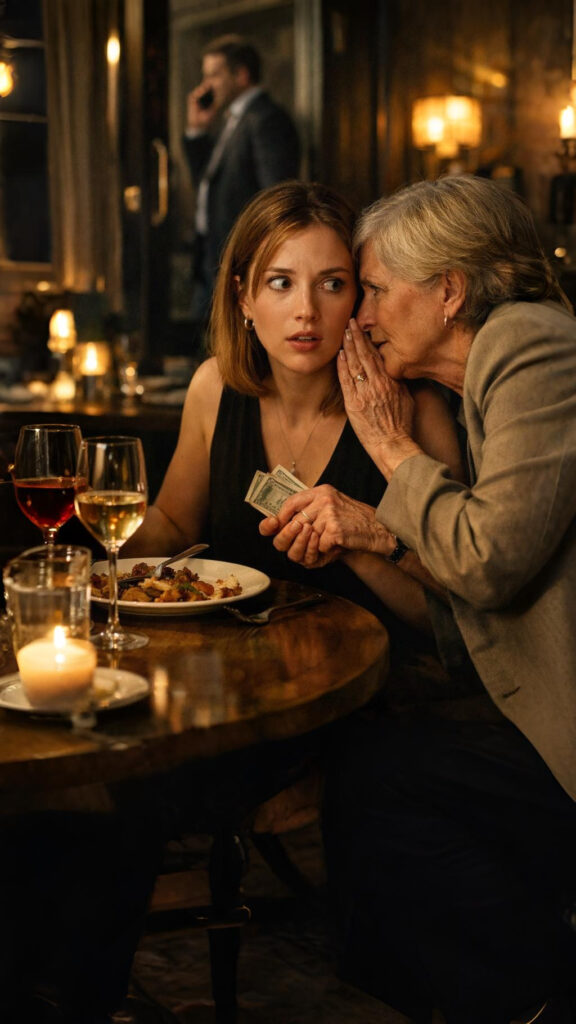
That’s when she appeared.
She wasn’t the kind of woman you notice right away. Her clothes were plain, her hair silver and pulled back in a way that said she didn’t care for appearances anymore. But her eyes—steady, searching—found mine like they’d been waiting for me to look up.
She sat two tables away, alone, her dinner barely touched.
I remember thinking she reminded me of someone’s retired teacher. The kind who used to know everything before you said it.
Our eyes met once. She smiled softly, almost apologetically, and looked down again. I tried to return the smile, but it felt wrong on my face.
Seconds later, the door opened again. A rush of cold air, a figure in a dark coat. My heart leapt before I even saw the face.
Not him.
I sank a little deeper into my chair, the heat of embarrassment crawling up my neck.
When I looked up again, the older woman was watching me. Not with curiosity, but with something sharper. Awareness. Concern, maybe. The kind you feel before you have proof that something’s wrong.
She leaned toward me, ever so slightly. Her lips moved.
I couldn’t hear her.
I frowned, confused, and she gestured as if asking me to come closer. I hesitated, then leaned just enough for her voice to find me across the noise.
“Do you trust the man you came with?” she asked.
I blinked.
“I—of course,” I whispered, though it came out like a question.
Her gaze didn’t move. “No, you don’t,” she said quietly. “I can see it.”
Before I could respond, the waiter appeared beside me with polite indifference. “Would you like me to refresh your drink, ma’am?”
I shook my head quickly, avoiding both their eyes. “No, thank you.”
When he left, the woman was still watching me.
Still certain.
Still calm.
It felt absurd to be speaking to a stranger about my husband, yet something about her tone cut through my defenses like a blade through fabric. I glanced toward the restaurant door again.
Still closed.
The woman reached into her purse. Her hands moved with purpose, not hesitation. She pulled out something small — folded bills. American, crisp. She held them low, out of sight of anyone else.
I stared.
“What are you—”
“Take it,” she interrupted, her voice low, steady, but urgent now. “Don’t ask questions.”
I didn’t move.
She slipped from her chair, came closer, and in one smooth motion, pressed the cash into my palm. Her hand was warm, trembling just slightly, like she was afraid someone would see.
And then she leaned in, close enough that I could smell rain in her hair.
“Call a taxi,” she whispered. “Climb out through the bathroom window. Do it now.”
For a second, I thought she was joking.
Some bizarre prank, or a mistake, or confusion. Maybe she’d mistaken me for someone else.
But her eyes didn’t waver. There was no humor there.
Only fear.
“Why?” I asked, voice breaking.
She didn’t answer.
She just looked toward the door — the one my husband had disappeared through — and then back at me, shaking her head once. “Please,” she said softly. “Before he comes back.”
My pulse stuttered.
I wanted to laugh. To tell her she was crazy. That my husband wasn’t dangerous, that this wasn’t one of those stories you read about in the news. But deep inside, something twisted sharply, like recognition.
He had lied before. Not big lies, not yet — but small ones that left marks.
Where he was.
Who called.
Why his hands sometimes shook after dinner.
The kind of lies you forgive until they turn into a life you don’t recognize.
“I don’t understand,” I murmured.
“You don’t have to,” she said. “Just leave.”
She straightened and walked away, slow and deliberate, as if she hadn’t just set my world spinning. Her check was already paid. Her purse over her shoulder. She didn’t look back.
I stared at the money in my hand.
Crumpled now, as if it had always belonged to me.
The restaurant noise faded. My thoughts didn’t.
Everything around me blurred into one long hum — the clinking glasses, the quiet music, the scrape of a chair leg. My heartbeat filled the gaps between sounds.
Then I saw him.
Through the window, across the street. My husband. Standing in the rain, phone pressed to his ear. Smiling. A kind of smile I hadn’t seen in years.
He turned slightly, and I saw her.
A shadow under an umbrella. Close. Too close.
My throat went dry.
The old woman’s words echoed so loudly in my mind that I thought someone else must have heard them too.
Call a taxi. Climb out through the bathroom window.
My hand closed around the money.
My chair scraped the floor as I stood.
Nobody looked up.
Nobody ever does when a woman leaves quietly.
I walked toward the back, past the kitchen doors, past the sign that said Restrooms. The tile floor glowed under the dim light.
I locked the stall behind me and sat for a moment, trying to breathe. The world had turned small. Just me, my shaking hands, and the weight of a stranger’s warning.
I thought of the years spent waiting. Of the nights I cooked dinner for a man who never came home on time. Of how easily I’d accepted silence as normal.
And then I heard his voice outside the door. Calm. Controlled. Talking to someone — maybe the waiter — asking if I’d been there all along.
My decision wasn’t clear. It didn’t come like lightning. It came like the tide — quiet, certain, unstoppable.
I stood.
I checked the small window above the sink. It was open just enough. Rain slipped through in tiny streaks.
The woman had known.
I didn’t know her name.
I didn’t know what she’d seen.
But for the first time in years, I listened to someone who didn’t want anything from me.
I climbed onto the counter, steadying myself on trembling knees. The window frame was cold beneath my fingers.
Outside, the rain hit the pavement in wild rhythms. A cab’s headlights passed in the distance.
I hesitated once.
Then I pushed myself through the narrow frame — heart racing, breath burning, dress catching on the metal edge — until the night swallowed me whole.
Chapter 3 — The Night I Ran
The rain hit me first. Cold, sharp, honest.
It didn’t ask questions, didn’t care where I’d come from.
It just washed everything away — the perfume, the warmth of the restaurant, the illusion of safety.
I landed awkwardly on the wet ground, knees scraping the pavement, dress tangled around my legs. For a moment, I crouched there behind the dumpsters, breathless, heart thundering against my ribs like it wanted to escape too.
The window above me clicked shut.
It was done.
I was outside.
I remember thinking how absurd it was — a woman my age, sixty-two, crawling out of a restaurant bathroom window like a fugitive. My hair stuck to my face. My heels sank into the mud. My mind screamed to go back, explain, laugh it off as a misunderstanding.
But my body didn’t move that way. It had already chosen.
I straightened slowly, clutching my purse to my chest. The street was dimly lit, quiet except for the hum of distant traffic and the steady whisper of rain. I could still see the front of the restaurant from the alley’s mouth. Through the glass, the glow of candles flickered like nothing had changed.
For a few seconds, I waited — half expecting him to appear, searching, angry, pretending to care.
He didn’t.
That silence told me more than words ever had.
I stepped into the street, the world stretching wide and unfamiliar. Cars passed by, spraying water across my shoes. I raised my hand, uncertainly, and a yellow cab slowed to a stop, headlights cutting through the rain like twin questions.
The driver leaned toward the window.
“You need a ride, ma’am?”
His voice was calm, ordinary.
And I wanted to cry because of how normal it sounded.
“Yes,” I said, climbing in. My voice didn’t sound like mine. “Just… anywhere. Away from here.”
He blinked, surprised, but nodded. The door shut with a solid click.
The city blurred past as we pulled away.
Only then did I look at the cash the old woman had given me — damp now, the ink smudged slightly from my fingers. Enough for the ride, maybe a little more. A stranger’s mercy folded into my hand like fate.
I wondered if she was still inside, watching the table where I’d sat alone. I wondered if she’d done this before — if she made a habit of rescuing women who didn’t yet know they needed saving.
“Where to?” the driver asked again, softer this time. “Can’t just drive forever.”
I gave the first address that came to mind.
A hotel I’d seen once on the way to the grocery store.
A place I’d never had a reason to enter until now.
He nodded and turned down another street.
The city looked different through the cab window — the reflections stretching and bending across the glass like ghosts. My own face stared back at me, older than I remembered, streaked with mascara and rain. A stranger too.
I pressed my palm against the cool glass. The restaurant was far behind now, swallowed by distance and night.
I thought of him, sitting down again, realizing I was gone.
Would he call my name?
Would he even notice?
Would he think I’d gone to the bathroom and never come back?
The thought almost made me laugh — a dry, tired sound. He’d probably finish his meal. Pay the bill. Blame me for ruining the evening.
That was the kind of man he was.
When the cab stopped, the meter glowed red.
“Here we are,” the driver said. “That’ll be twenty-seven fifty.”
I handed him the money, too much of it, and said, “Keep the change.”
He gave me a long look, then nodded.
“Take care, miss.”
The word miss hit me strangely. I hadn’t been called that in years.
The lobby smelled like lemon cleaner and stale air. A man behind the counter looked up, bored, as I walked in dripping rain onto the floor.
“One night,” I said. “Just one.”
He slid a form toward me. I filled it in without thinking, hand shaking slightly when I wrote my name.
For a second, I hesitated — then crossed out my last name and wrote only my first.
It felt small, but it was something.
In the elevator, I caught my reflection again in the mirrored wall. My hair was wild, my lipstick faded, my eyes wide with something that wasn’t quite fear anymore.
Freedom looks strange at first.
The room was small and cold, with a single window overlooking the parking lot. I sat on the edge of the bed, shoes still on, purse still clutched to my lap. The silence was thick and alive.
My phone buzzed once. Then again.
His name lit up the screen.
Then disappeared.
Then came back.
I didn’t answer.
I couldn’t.
After the third call, he stopped. Then the messages began — short, demanding ones, each colder than the last.
Where are you.
Come back now.
We need to talk.
What are you doing.
I turned the phone face down. The vibration against the blanket sounded like a heartbeat that didn’t belong to me anymore.
I stood and walked to the window. The rain had slowed to a drizzle, and the parking lot lights shimmered on the wet asphalt. Somewhere out there, I thought, the old woman was probably asleep, her conscience light, her mission complete.
I whispered a thank you to no one in particular.
When I looked down at myself — soaked dress, trembling hands, hair clinging to my neck — I realized something strange: I wasn’t ashamed. Not of running, not of being afraid, not even of being old and alone. For the first time, I wasn’t performing for anyone.
The clock on the bedside table ticked softly.
Midnight.
Then one.
Then two.
I didn’t sleep.
Instead, I sat there, thinking about every version of me that had stayed quiet, waited, compromised. The woman who had believed she was lucky to be chosen, even when she was barely noticed.
That woman had stayed behind in the restaurant.
By morning, I had a plan — not a grand one, just enough to keep breathing. A call to the bank. A small bag of essentials. Maybe a new phone. Maybe a new name. Nothing dramatic, nothing cinematic. Just the first steps of a life that belonged only to me.
When the sun finally broke through the clouds, it painted the room gold. I stood in the light and felt the weight in my chest lift, slowly, carefully, like the first deep breath after years of holding it in.
I wasn’t safe yet.
I wasn’t healed.
But I was gone.
And that, for now, was enough.
Chapter 4 — The Echo After Silence
The morning came quietly, slipping beneath the curtains like it was afraid to wake me.
For a long time, I didn’t move.
The hotel room was drenched in pale light, dust particles floating lazily through the air. My shoes were still by the door, the damp dress hanging over a chair, heavy with last night’s rain. I could still smell the restaurant — the perfume of strangers, the faint trace of his cologne that had followed me out into the night.
It all felt unreal, like a scene I had watched instead of lived.
The phone on the bedside table blinked. Missed calls. Messages. The proof that my absence had been noticed — maybe not with concern, but with control. I didn’t touch it. I wasn’t ready to hear his voice, not even through text.
Instead, I sat on the bed, hands resting on my knees, waiting for my thoughts to settle into something solid.
They didn’t.
A woman doesn’t wake up free and suddenly know what to do with it. Freedom is loud at first. It echoes. It makes the quiet feel heavier than the noise ever did.
I stood, pacing the small room. The carpet muffled my steps. Every sound I made seemed too loud, too sharp. Even the click of the bathroom door startled me.
I turned on the shower, letting the steam fill the room until I couldn’t see myself in the mirror.
When I stepped in, the water was scalding. It burned my skin, and I let it. I wanted it to. I wanted to wash away the years of pretending, the layers of patience that had built up like dust over time.
The water turned cold before I realized I’d been standing there too long.
Wrapped in a towel, I stared at the window. The world outside looked cleaner than I remembered — new, but not forgiving. I watched the cars go by, each one a reminder that people out there had places to go, lives that moved forward.
Mine had stopped.
But maybe it could start again.
There was a knock at the door.
I froze.
For a moment, my mind leapt to every possible danger.
He found me.
He tracked me down.
He never let things go.
But when I peered through the peephole, it was only the housekeeper — young, distracted, holding a basket of towels. She smiled when I opened the door, unaware that she’d just unclenched my entire body.
“Housekeeping?”
“Later,” I said softly. “Please.”
She nodded, left the towels by the door, and moved on. The hallway silence returned, but the air felt slightly safer now. I leaned against the door, breathing deeply until my heartbeat slowed.
That was when I decided to call someone.
Not him. Never him.
Someone else.
I thought of my sister — the one who had stopped calling years ago after I’d defended him during a family argument. I thought of my old friend Laura, who had once said, You’ll lose yourself if you keep excusing him. I had lost her too. One by one, people had left until he was all I had, and even that wasn’t really mine.
My fingers hovered over my phone.
Then I powered it on.
The screen lit up with messages.
Some short, some long, all from him.
Where are you?
You’re overreacting.
Come back and we’ll talk like adults.
If you think this will get you sympathy, it won’t.
Don’t make me come find you.
The words blurred, but the tone was unmistakable. It was the same tone he used when he pretended to be calm — when he wanted to sound reasonable, right before the storm.
I deleted them one by one.
Each swipe felt like a breath of air I hadn’t known I needed.
Then, with trembling hands, I opened a new message window and typed a single name: Laura.
Her number was still there. Somehow, I had never deleted it.
My message was short.
I left him. I don’t know what to do next.
For a while, nothing came back. I set the phone down and began to pack the few things I had — my ID, the cash, a change of clothes I’d bought from the hotel gift shop. I was halfway through folding the towel when the phone buzzed.
Her reply was simple.
Where are you?
I hesitated, then sent the address.
A few minutes later:
Stay there. I’m coming.
It didn’t feel real until I saw her in the doorway two hours later — hair pulled back, sunglasses in her hand, that familiar half-smile that used to mean you’re being foolish but I love you anyway.
She didn’t ask questions right away.
She just wrapped her arms around me, tight and unshaking, the way no one had in years.
For a long time, neither of us spoke.
Finally, she whispered, “You look different.”
“I feel different,” I said. “But I’m scared.”
“You’re supposed to be,” she answered. “It means you’re awake.”
We sat on the edge of the bed, and I told her everything — the dinner, the call, the stranger’s warning, the escape through the window. She listened without interrupting, except once, when I said the old woman’s words aloud.
“Call a taxi and climb out through the bathroom window.”
Laura exhaled softly.
“She saved you,” she said.
I nodded, the truth of it still too big to hold.
“She did.”
“What will you do now?”
I looked toward the window, where the sun was beginning to fade again, turning the light soft and golden.
“I don’t know,” I said. “But for the first time, it feels like the question belongs to me.”
Laura smiled — not the kind of smile that fixes things, but the kind that promises to stay while you try.
That night, I slept for the first time without waiting for a door to open or a voice to rise. I dreamed of the restaurant, the candlelight, the sound of rain. But this time, when I looked up from my table, there was no phone call, no absence, no reason to wait.
Only the echo of a whisper, fading into peace.
Chapter 5 — The Quiet Before Becoming
The world looked different in daylight. Not softer, just more honest.
You can see the stains daylight hides. The fine cracks in things you once believed were whole.
Laura drove while I watched the city pass by through the passenger window. Every street looked familiar, but not the same. It was as if leaving had sharpened my vision, peeled something away from the world. Even the sky looked clearer, bluer, wider.
We didn’t talk much at first. She knew when to stay quiet — a skill my husband never learned.
Every once in a while, she’d glance at me, her hand drumming softly on the steering wheel, like she was keeping time for something fragile.
“You should stay at my place for a while,” she said finally. “At least until you figure out your next move.”
I nodded. My throat felt dry. “I don’t want to be a burden.”
She laughed gently. “You’ve never been one. You just forgot how not to apologize.”
The words landed deep, like truth always does when you’re not ready for it.
The drive to her house took an hour. Small towns blurred into open roads, and open roads turned into silence. Somewhere between exits, my mind began to replay pieces of my old life — the mornings spent making coffee he never drank, the careful makeup, the measured words. It felt like watching someone else’s memories.
When we arrived, the sun had already tilted west. Her house sat on the edge of town, surrounded by trees that bent in the wind. It smelled faintly of lavender and old books. The kind of place that felt lived in, not just occupied.
“Come in,” she said, holding the door open. “Shoes off. Tea first, tears later.”
That made me laugh — a real laugh this time, small and shaky but real.
Inside, everything was warm. Wooden floors. A cat sleeping in a chair. The hum of something cooking on the stove. I hadn’t realized how much I missed the sound of domestic peace — not the silence of tension, but the quiet of safety.
I followed her to the kitchen, where she handed me a mug of tea.
“Sugar?” she asked.
I shook my head. “No. I want to taste it.”
The words surprised me as soon as I said them.
Laura smiled. “Then you’re already starting.”
We sat by the window while rain began again, soft this time. The world outside looked like watercolor — blurred edges, faint light.
For a long while, we didn’t speak.
Then, she asked, “What will you tell him?”
“Nothing,” I said. “Not yet. Maybe not ever.”
“You think he’ll stop looking?”
I looked down at the tea, the reflection of my face trembling in the surface. “He won’t. But he’ll tire eventually. He always does.”
Laura reached across the table, covering my hand with hers. “Then we’ll keep you hidden until he does.”
The simplicity of that promise nearly broke me.
Later that evening, I unpacked the small bag I’d brought. Each item felt strange in this new space — my toothbrush, my wallet, my wedding ring. I took the ring off and set it on the nightstand. The skin beneath it was pale, marked by years of wearing the same lie.
In the mirror, I studied my reflection. The lines on my face looked deeper, but they felt like evidence, not flaws. Proof of survival.
I whispered to the woman staring back, “You did it.”
She didn’t smile, but her eyes softened, as if to say, Not yet. But soon.
That night, Laura made soup and we ate in the living room, wrapped in blankets, the cat purring between us. The normalcy of it felt almost sacred.
When I finally went to bed, I left the lamp on. Old habits die slowly, and I wasn’t ready for full darkness yet. I lay there listening to the rain and the distant hum of the refrigerator. Every sound was proof that I still existed.
Sleep came in fragments. Dreams mixed with memories. Sometimes, I saw the woman from the restaurant — the stranger with silver hair — standing in the doorway, watching me with calm certainty. Other times, I saw myself, younger, still waiting at that table, still believing the door would open and everything would make sense again.
I woke up before dawn, heart pounding, but the fear faded quickly. I was safe. The air smelled of coffee and rain. Laura was already awake, reading by the window.
“Couldn’t sleep?” she asked.
“I did,” I said. “Just not for long.”
“That’s enough for now.”
I nodded.
We ate breakfast in silence. I kept glancing at my phone on the counter, face down, afraid to turn it over. But I knew what I had to do.
I picked it up, scrolled to his name, and pressed delete contact.
No fanfare. No drama. Just gone.
The absence was immediate and strange, like removing a splinter you’d forgotten was still inside you. A small ache, then a lightness.
I turned the phone off and set it aside.
Outside, the rain had stopped. The sun was beginning to rise, faint and careful, like it was learning how to warm me again.
Laura poured more coffee. “So,” she said, “what now?”
I smiled — a slow, uncertain smile. “Now,” I said, “I find out who I am without waiting for permission.”
She raised her mug in a quiet toast. “To beginning again.”
I lifted mine to meet hers. “To finally belonging to myself.”
And for the first time in decades, the words didn’t feel borrowed. They felt like home.