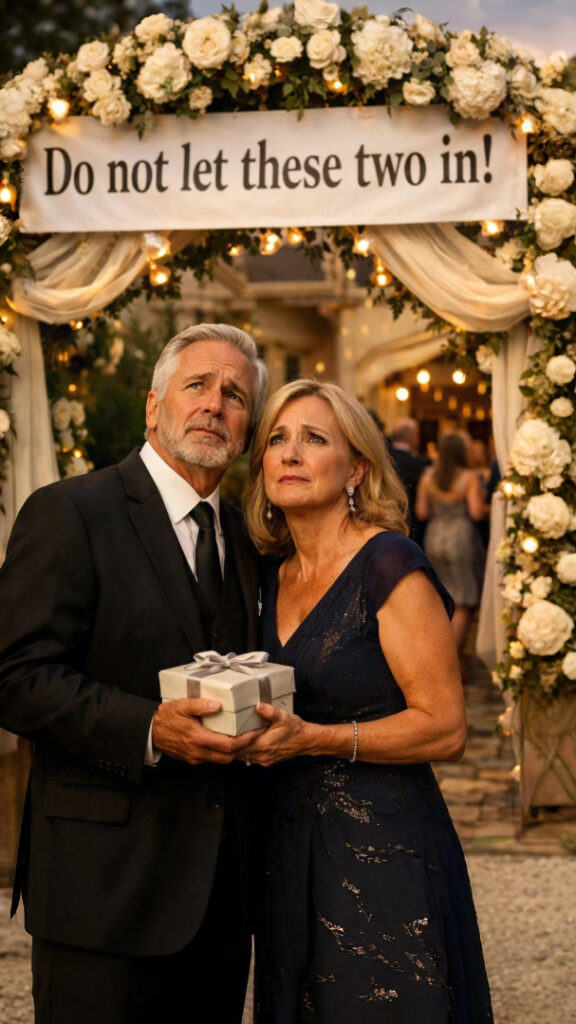
Chapter 1 — The Wedding Morning
I woke up earlier than usual that day. The house felt unusually quiet, the kind of silence that holds its breath before something sacred—or disastrous—unfolds. My hands trembled as I buttoned the pale blue dress I had chosen weeks ago. It wasn’t new, but it was elegant. I’d told myself that our daughter would want me to look my best. After all, this was her day.
In the mirror, I barely recognized the woman staring back. Sixty years of life had softened and weathered me in equal measure. There were lines around my mouth, yes, but they had been carved by laughter, by sleepless nights, by lullabies whispered to a little girl who once called me her best friend.
My husband knocked gently on the bedroom door.
“Ready, love?” he asked, holding his tie in one hand, uncertainty in his eyes.
I nodded, though my throat felt tight. He looked handsome, dignified. Nervous too. We hadn’t heard from our daughter all morning—not a message, not even a short voice note. But we told ourselves it was normal. Brides have a million things to do, a thousand emotions to manage.
We left the house in silence, each pretending we weren’t thinking the same thing: that something about this day felt slightly off, though neither of us could name it. The sky was cloudless, almost cruelly perfect. The kind of day you’d remember forever.
The drive to the venue took about an hour. My husband kept both hands firmly on the wheel, as if loosening his grip might let the doubt between us escape. I stared out the window, watching fields roll past, the same road we’d traveled years ago to take her to school, to college, to her first job interview. Life has a way of circling back, doesn’t it?
When we arrived, the parking lot was already full. Guests milled about in pastel dresses and crisp suits, laughter bubbling like champagne. For a moment, I felt pride swelling inside me. Our little girl did this. She found love, built a life, and today she would begin her own chapter.
My husband reached for my hand. “Let’s go find her,” he said.
We walked toward the entrance, arm in arm. Music floated through the air—something classical, gentle, familiar. The scent of roses mixed with the warm air, and my heart softened. I imagined her face when she saw us, maybe surprised, maybe emotional, but happy that we came.
Then I noticed the whispers. Subtle at first, like the shift of wind through leaves. A few glances in our direction, quickly averted. Someone’s laughter faltered when I met their eyes. I tried to smile, though confusion prickled in my chest.
We reached the main gate, decorated with ribbons and flowers. That’s when I saw it.
A large board stood beside the entrance, right next to a table with the seating chart and photos of the couple. But it wasn’t the decorations that caught my breath. It was the picture—our picture—pinned neatly to the board. A photo of my husband and me, taken years ago at a family gathering.
Beneath it, written in bold red letters, were the words:
“Do not let these two in.”
I froze. The world around me blurred. Laughter, music, the sound of cameras clicking—all of it faded into a low hum, like air being sucked out of the moment.
My husband’s jaw clenched. He didn’t speak, didn’t move. I turned to him, hoping to see disbelief, maybe a nervous smile that would tell me it was some kind of cruel joke. But his face was pale.
“This has to be a mistake,” I whispered, but even as I said it, the truth pressed against my ribs. It wasn’t.
A young usher approached us, eyes darting nervously between the sign and our faces. “I’m sorry, ma’am… sir… I was told—”
My husband lifted a hand, stopping him. His voice was calm, too calm. “No need to explain.”
We turned away. I could feel the heat behind my eyes, the pressure of tears I refused to let fall. The gravel crunched under our shoes as we walked back to the car. Behind us, the music swelled again, drowning out the sound of humiliation.
Neither of us spoke during the drive home. The silence between us was heavy but shared—like an old wound being reopened in unison. I stared at the road ahead, my reflection ghosting against the window.
And all I could think was:
How does a daughter forget the hands that once held her?
The sun was still shining when we reached our street, but it no longer felt like light. It felt like exposure. Like everything we had done, every sacrifice, was being burned away by that merciless sky.
We parked the car. My husband stayed behind the wheel for a moment, unmoving. Then, finally, he exhaled.
“She made her choice,” he said quietly.
I nodded. But in my heart, something was already beginning to shift—something small, sharp, and irreversible.
That was the morning our daughter got married.
And the morning something inside me began to break.
Chapter 2 — The Silence After the Door Closed
The house felt heavier when we returned. Every sound echoed too loudly—the click of the key, the sigh of the door, the rustle of fabric as I hung my purse on the chair. I wanted to speak, to say something, anything that might make sense of what had just happened. But words seemed too fragile for the weight pressing on my chest.
My husband went straight to the kitchen, his movements deliberate. He poured himself a glass of water, drank it in one long swallow, and stared at the sink as though it could answer him. I stood in the doorway, still clutching my shawl, the lace trembling in my hands.
“She must have had a reason,” I said finally. The words escaped like a prayer, or a lie I needed to believe.
He didn’t answer.
Outside, the afternoon light spilled through the curtains in uneven stripes. Dust drifted in it, slow and aimless. Somewhere in the distance, a dog barked, a car door slammed, life continued—oblivious to the quiet disaster that had taken place.
I walked to the living room. The wedding gift still sat on the coffee table, wrapped neatly in silver paper, tied with a white ribbon. My handwriting on the tag looked foreign now. To our beloved daughter and her future. I had written it with hope. With pride. With love that still believed it had a place.
I sank onto the couch. My knees felt weak, my breath uneven. The memory replayed, sharp as glass—the photo, the red letters, the faces of people pretending not to see. Each detail burned a little deeper.
“Do not let these two in.”
It wasn’t just a message. It was a verdict.
My husband entered the room quietly, his face unreadable. He sat beside me, not too close, not far. The kind of distance that comes from trying to protect what little is left.
“She didn’t want us there,” he said, his voice low. “No mistake. No misunderstanding.”
I turned to him. “But why? What did we do?”
He shook his head, staring straight ahead. “You know how she’s been these past years. Always finding fault. Always rewriting the past.”
I wanted to protest, but the truth was too complicated to deny. We hadn’t spoken properly in months. She said we were controlling, that we never supported her choices. I thought it was just youth—grown-up rebellion with a wedding ring on top. I thought time would fix it, the way it always had.
Now time had run out.
I pressed my palms against my eyes, trying to hold back the sting. Behind the darkness, memories flickered like old film reels—the first dress I sewed for her school play, the nights I stayed awake with fevered hands on her forehead, the mornings she’d crawl into our bed just to “borrow warmth.”
How could that same child become the woman who put our picture beside a warning sign?
My husband stood, restless. “I’m going to check on the garden,” he muttered. It was what he always did when emotions threatened to spill. I watched him step outside, the screen door creaking behind him.
I sat alone, surrounded by wedding silence.
The clock ticked too loudly. Every minute dragged through molasses. I wondered what they were doing at that exact moment—if she was laughing, dancing, cutting the cake. If she noticed our absence. If she cared.
I imagined the guests whispering, asking questions. Maybe someone finally told her. Maybe she looked around, searching for us, and realized we were gone.
A small, cruel part of me hoped she did.
The sun dipped lower, stretching long shadows across the room. The wrapped gift gleamed faintly in the dim light. I reached out and touched the ribbon, feeling its smoothness, its uselessness. That box had become a symbol of everything unspoken, everything refused.
When my husband returned, his hands were dirty from the soil. He sat down again without a word. The silence between us was familiar now, like a worn-out piece of furniture we no longer noticed.
After what felt like hours, he finally said, “Do you think she’ll call?”
I didn’t answer right away. I thought about the phone, how close it sat, how heavy it had become. I thought about all the times I’d been the one to reach out first, to apologize for things I didn’t do, to mend what she had torn.
“No,” I said softly. “Not tonight.”
He nodded once, as if that confirmed something he had already accepted.
The evening deepened. We didn’t turn on the lights. The house stayed in half-shadow, the kind that blurs edges and hides tears.
Somewhere, three hours later—though we couldn’t know it then—our daughter’s perfect wedding began to crumble. Maybe it was a careless comment from a guest, or a missing presence in the family photos. Maybe guilt arrived like an uninvited guest, whispering in her ear.
But in that moment, in our quiet house, we didn’t feel vengeance or satisfaction. Only the ache of two hearts that had been written out of their own story.
I stood by the window, looking at the darkening sky. The first star appeared, trembling faintly. My mother used to say you should make a wish on the first one you see.
I closed my eyes.
I didn’t wish for forgiveness. Or even for her to call.
I wished only to stop replaying that sign in my mind.
But the words refused to leave.
Do not let these two in.
Even in the silence, they kept echoing.
Chapter 3 — The Weight of Three Hours
It had been three hours since we left the wedding. I knew because the clock above the mantelpiece had marked every passing minute like a quiet accusation. I hadn’t moved much. I sat on the same spot on the couch, my back straight at first, then slowly sinking under the heaviness of everything unspoken.
The gift was still there. Untouched. I had begun to hate the sight of it. The silver paper gleamed mockingly each time the headlights of a passing car flashed through the window. It looked festive. Hopeful. Out of place.
My husband was in his study, pretending to read. I could hear the faint rustle of paper, the slow turning of pages that meant he wasn’t absorbing a single word. Every few minutes, his chair creaked. That was his rhythm of grief—controlled, contained, mechanical.
I envied him for it.
I stood and walked to the kitchen. The tea kettle sat unused on the stove. I turned the knob, lit the flame, and watched the small blue fire flicker beneath the metal. The soft hiss was oddly comforting, a reminder that the world still obeyed some kind of logic, even if our daughter didn’t.
I poured the water, added a spoonful of honey, and sat at the table. My reflection floated faintly in the dark windowpane. I looked older than I remembered. Not just tired—older. Like something inside me had been peeled away.
I tried to picture her face when she saw that sign, the one with our photo. Had she laughed? Had she frowned and said, “Oh, I didn’t mean it that way”? Or had she simply walked past it, without a pause, without a thought, the way people step over a crack in the sidewalk?
I stirred the tea and watched the honey swirl like smoke.
The phone was on the counter. Silent. Still. Its screen a black mirror.
I told myself I wouldn’t look at it again. But I did. Every few minutes, I did. It became a kind of torture—hope disguised as habit.
When the clock struck eight, my husband came into the kitchen. His face was lined, his shoulders stiff. He poured himself some tea without asking. We didn’t need to talk about it.
“She’ll call,” I said quietly, though I didn’t know who I was trying to convince.
He nodded but didn’t reply. He took a sip, winced at the heat, and stared out the window.
Outside, the garden lights flickered on. The roses I’d planted last spring glowed faintly in the night. She used to help me plant them when she was little. She’d dig the holes too shallow, laugh when the dirt stained her knees. I used to scold her gently and then end up laughing too.
We were inseparable once. That memory felt cruel now.
I broke the silence. “Do you think she meant for us to see it? That sign?”
He hesitated. “Maybe she thought we wouldn’t come.”
That thought stung in a new way. That our love had been so doubted she assumed we’d simply stay away. I clenched the cup tighter.
“She knew we would come,” I whispered. “She knew exactly what she was doing.”
He didn’t argue. He didn’t have to.
The kettle clicked again, cooling, settling into silence.
Nine o’clock. Still no call.
I turned on the TV for noise. A comedy show, something bright and hollow. Laughter erupted from the screen, too loud, too false. I turned it off after a minute.
The quiet that followed felt deeper than before.
I picked up my phone. Checked the messages. Nothing. Then I opened the gallery and found her picture—the one from her graduation. Her hair was longer then, her smile easy and unguarded. I remembered how she’d thrown her arms around me that day, whispering, “I couldn’t have done it without you.”
How far away that girl seemed now.
At ten, my husband went to bed. “You should rest,” he said.
I nodded, though I knew I wouldn’t. I waited until he was gone before standing and walking to the window again. The night air pressed cold against the glass. In the distance, the faint hum of traffic. Somewhere, people were still celebrating, dancing, toasting.
And maybe, somewhere in that golden hall we had been barred from, someone had finally told her what she’d done.
I imagined it clearly. The whisper passing between guests, the uneasy glances. Her brow furrowing. Her confusion giving way to shock. Then—realization.
I wanted to believe that, at that exact moment, she felt the same cold rush of humiliation that had washed over me. That she understood the depth of what she had done.
But the thought didn’t bring satisfaction. Only sadness.
The phone buzzed suddenly, and my heart leapt. I grabbed it—but it was only a notification from the news. My pulse slowed painfully.
I laughed then, quietly, bitterly. A sound that didn’t belong to me.
When midnight came, I finally turned off the lights. The wrapped gift still sat untouched, reflecting a shard of moonlight from the window. I almost unwrapped it, just to destroy it, to make it stop looking so… hopeful.
But I couldn’t.
Because some part of me—foolish, stubborn—still wanted her to have it. Still wanted her to know that even after everything, we came bearing love.
Before going to bed, I whispered into the dark, “She’ll realize. One day she’ll realize.”
And though I didn’t know it then, that realization had already begun—three hours after we left, when the music faltered, when the whispers started, when she looked around and saw that two empty seats were waiting for the people she had shut out.
But that night, in our quiet house, we only had silence.
And the silence was louder than any apology could ever be.
Chapter 4 — When the Music Stopped
The next morning arrived slowly, like a reluctant guest who didn’t want to face the aftermath of the night before.
I woke before the sun, my eyes open but my body unwilling to move. The house still carried the faint scent of last night’s tea, a ghost of warmth in a room that had turned cold.
The clock read six-thirty. Too early for calls, too late for dreams.
I sat up, wrapped the blanket around my shoulders, and listened to the sound of my husband’s steady breathing beside me. He had fallen asleep with his glasses still on, the book unopened on his chest. That’s how he handled pain—he wrapped it in routine, covered it with silence, and called it strength.
I envied him, again.
In the kitchen, I made coffee. The familiar hiss of the machine filled the quiet, grounding me in something ordinary. The cup warmed my hands, but my mind was elsewhere—three hours away, in a reception hall filled with flowers and secrets.
I imagined her face again. The moment the whispers began.
Maybe it was her maid of honor who told her. Maybe it was the photographer, the one I’d spoken to on the phone weeks ago about family portraits. I could almost hear his voice saying softly, “They’re not here. Your parents.”
I imagined her laughter faltering, her smile freezing mid-sentence. Maybe she looked toward the door, expecting us to appear at any second, holding the gift, tears of pride in our eyes. Maybe she asked someone to check outside.
Maybe she saw the sign again.
And in that instant, the whole illusion shattered—the music, the smiles, the perfect day she had built over a foundation of denial.
The thought should have comforted me, but it didn’t.
There is no joy in another person’s regret, especially when that person once called you mother.
My husband came into the kitchen, rubbing his temples. He sat without speaking. I poured him coffee, placed it in front of him. He didn’t thank me, but he didn’t need to. After forty years together, our language had grown beyond words.
He took a sip, grimaced at the bitterness. “You didn’t sleep,” he said.
“No,” I answered.
He nodded, as though that was enough.
Outside, a thin mist hung over the garden. The roses were heavy with dew, bending slightly, fragile yet stubborn. I watched them from the window, remembering the first morning after she was born. The same pale light, the same ache in my chest. Only that time, it was love that hurt.
Now it was everything else.
I turned away from the window. “Do you think she knows?”
“She knows,” he said quietly. “By now, she knows.”
I wanted to ask how he could be so certain, but something in his tone silenced me. He wasn’t guessing. He was remembering.
He told me later that around midnight, while I was half-asleep on the couch, his phone had buzzed. A message request. A number he didn’t recognize at first.
It was from her maid of honor.
She wrote, ‘Mr. and Mrs. L., I just wanted to say I’m sorry for what happened today. She’s devastated. I think she finally understands.’
He hadn’t replied. He hadn’t told me, either. Not until that morning, when he saw that my hope was cracking and needed something to hold onto.
“She’s devastated,” I repeated, tasting the word. It sounded too big, too dramatic. But maybe that’s what it took for her to see what she’d done.
I sat down across from him, feeling my chest tighten. “Do you think she’ll call?”
He met my eyes. “Eventually. But not yet. Pride is louder than guilt.”
He was right. He usually was.
The day stretched endlessly. I tried to keep busy—laundry, dishes, sorting through drawers—but every task circled back to her. Her baby clothes folded away in a box. The photo albums stacked in the hallway. The echoes of her laughter trapped between walls that had heard too much.
By afternoon, I couldn’t pretend anymore. I sat on the floor with the album in my lap, the wedding gift still gleaming nearby. Page after page, I flipped through her childhood. The birthdays. The scraped knees. The family vacations where we smiled through exhaustion just to make her happy.
Every photograph was proof of something real, something that existed long before the shame of yesterday.
How do you lose a child who’s still alive?
The question burned.
When my husband found me there, he didn’t say a word. He just sat down beside me, his shoulder against mine, and together we turned the pages in silence.
It was evening when the phone finally rang.
The sound startled us both. It was sharp, unexpected, almost cruel in its suddenness. I hesitated, staring at it. My hands refused to move.
“Answer it,” he said softly.
I picked it up. The screen showed her name. My breath caught.
For a moment, I just stared, the letters blurring. I could end the ache with one press of my finger. I could hear her voice again. I could forgive her before she even asked.
But something inside me resisted.
Not out of anger, but exhaustion.
I let it ring.
The sound filled the kitchen, then faded, leaving the house even quieter than before.
When it stopped, I set the phone down carefully, almost gently.
“She’ll call again,” I said, though I wasn’t sure if I meant it as hope or as warning.
He looked at me, his eyes unreadable. “You don’t have to answer right away.”
I nodded. My hands were trembling, but my heart was steady for the first time since that sign.
Outside, the mist had lifted. The garden was clear, washed clean by morning dew. The roses stood taller now, their petals open wide to the fading light.
I watched them for a long time, until the darkness began to creep in again.
And though the phone stayed silent for the rest of the night, I knew something had shifted. Not forgiveness. Not yet.
But the beginning of it.
Quiet.
Small.
Uncertain.
Like a heartbeat after a long silence.
Chapter 5 — The Call That Didn’t Wait
It came in the afternoon, two days later.
The sky was heavy with clouds, the kind that look ready to break but never do. The kind that make the world hold its breath. I was folding laundry in the living room when the phone rang again.
This time, I didn’t freeze.
My hands kept moving, steady, automatic—fold, press, place. But my ears caught the sound like a pulse. It wasn’t loud, yet it filled every corner of the room, threading itself into the silence that had settled between these walls.
My husband looked up from his armchair. He didn’t say anything, but the question was in his eyes.
I let it ring twice more before I answered.
Her voice was smaller than I remembered. Softer. It trembled around the edges, like a child trying not to cry.
“Mom?”
That single word cracked something inside me—not all the way through, but enough to make the air feel different.
I said nothing at first. Just listened.
“I… I don’t even know where to start,” she said. “I thought maybe you’d never pick up.”
Her voice broke, and I heard the faint echo of traffic behind her. She was outside somewhere. Alone.
“I saw the pictures,” she went on. “Someone posted them. You weren’t there. I thought maybe you decided not to come. But then they told me—”
She stopped. The silence on her end was thick with shame.
“They told me about the sign,” she whispered. “Mom, I swear I didn’t know. I didn’t. I never—”
I closed my eyes. Her words hit me like wind through an open window—cold, real, uninvited.
I wanted to believe her. God knows I did.
But I could still see the letters in my mind. Still hear the usher’s nervous voice. Still feel the sting of humiliation in front of strangers who pretended not to look.
“You didn’t know?” I asked, my voice quieter than I expected.
“No,” she said quickly. “It was his idea. He said it would avoid ‘problems.’ He said you’d make things emotional, that it would be easier if—”
She stopped again, and I could almost see her covering her mouth, realizing what she’d admitted.
“He said it was for the best,” she finished weakly.
For a long time, neither of us spoke. The ticking clock filled the space between us, every second scraping across the wound that hadn’t yet closed.
When I finally spoke, it wasn’t anger that came out—it was something slower, heavier.
“You stood beside that sign all day,” I said. “You took photos in front of it. You smiled. You never wondered why we weren’t there?”
Her breath hitched. “I… I did. But he said you’d refused to come. He said you sent the gift back.”
“The gift,” I repeated softly. I looked over at it still sitting, untouched, on the table. The silver paper now dulled from the dust.
“I’m so sorry, Mom,” she said. Her voice cracked completely now, raw and pleading. “I wanted to call that night, but I couldn’t. He—he said it would ruin everything. But it’s been haunting me. I can’t sleep. I can’t stop seeing your faces.”
There was no satisfaction in hearing that. Only an ache that stretched from the past into the present, an ache that had no shape, no cure.
“I raised you to be brave,” I said quietly. “To think for yourself. To stand up when something feels wrong.”
“I know,” she whispered. “I failed you.”
“No,” I said after a long pause. “You failed yourself.”
Her sobs filled the line then, uneven, desperate. I let them come. I didn’t try to stop her. Some storms have to run their course.
When she finally spoke again, her voice was a whisper. “Can I come see you?”
I hesitated. The instinct to say yes rose immediately—because love, no matter how bruised, still recognizes its own child. But then I looked around the room. The photo albums still open on the floor. The untouched gift. The quiet strength of my husband sitting nearby, pretending not to listen.
“Not yet,” I said gently.
She inhaled sharply. “Please, Mom, I just want to explain—”
“Not yet,” I repeated. “Some things need silence before they can be understood.”
She didn’t argue. She just cried quietly, the kind of crying that comes from the bones, not the eyes. I listened until the sound began to fade, replaced by her slow, broken breathing.
When the call ended, I sat still for a long time. The house felt suspended in that fragile moment between storm and calm.
My husband finally spoke. “She called?”
“Yes.”
He nodded once, not asking more. He knew I wasn’t ready to unpack it.
We spent the rest of the evening in near silence. The sound of the rain began faintly outside, gentle at first, then steady. It was the kind of rain that cleans, not destroys.
I walked to the window and watched it fall over the garden. The roses bent under the water, but none of them broke. Their petals glistened, soft and trembling, but still standing.
That night, I didn’t dream of the sign. Or the hall. Or the laughter that had excluded us.
I dreamt of her as a child, running barefoot through the garden, her hair wet from the rain, calling for me with a voice full of joy.
When I woke, I was crying, but the tears felt different this time.
Lighter.
Like something inside me was loosening its grip, little by little.
Forgiveness doesn’t announce itself. It arrives quietly, hidden beneath exhaustion and truth.
And as the morning light crept into the room, I realized something simple but certain—
The next time she called, I would answer.