Chapter 1 — The Promise of “One Hour” and the Silent Abandonment
She said it like it was nothing.
“Mom, can you watch them for an hour? I just need to run an errand.”
An hour. Sixty minutes.
I remember nodding, already wiping my hands on the dish towel, already making space on the couch for little shoes, little hands, little noise. I didn’t ask where she was going. I didn’t want to. Mothers learn when silence is safer than questions.
The three of them came in like sunlight — a tangle of laughter, backpacks, and snack crumbs. Emily, eight years old, already trying to mother the younger ones. Noah, five, holding a toy car so tight it left a mark on his palm. And baby Grace, still smelling of milk and sleep.
I remember thinking, They’ll be gone soon. Just an hour.
That hour never ended.
When the clock ticked past midnight, I called her phone. Straight to voicemail. The next morning, the same. I left messages — soft at first, then desperate. I told myself maybe she was sick, maybe she’d had an accident, maybe she was scared to ask for help. Anything was better than the truth my mind whispered.
The children woke asking for breakfast. I made pancakes and told them their mother would be back soon. I didn’t believe it, but they needed to.
Days turned into weeks. I went to her apartment — empty. Rent unpaid. Clothes gone. No note. No goodbye. Just three small lives left on my doorstep like forgotten mail.
I went to the police once. I told them my daughter was missing, but they looked at me with that mix of pity and procedure. “She’s an adult,” one of them said. “Maybe she just needs time.”
Time. What a cruel word that became.
I didn’t file anything else. Didn’t push. Didn’t ask. Some part of me was ashamed — as if her disappearance were a punishment I somehow deserved. I’d raised her alone, done what I could with too little, too tired, too soon. Maybe she’d just had enough of me.
The kids stopped asking after a while. Children adapt faster than adults. They began to call my house home.
Every night, I’d stand by the window after they slept. I’d imagine headlights in the driveway, her voice calling from the dark, “Mom, I’m sorry.”
But the road stayed quiet.
That first Christmas was the hardest. I set three small plates beside mine and left one extra on the counter — just in case she came. The cookies went stale before I threw them away.
People in town started to talk. “Poor thing,” they said at the grocery store. “Raising them all over again.” I smiled, nodded, never corrected them. Because how do you explain abandonment that wears a familiar face?
There were nights I hated her. Nights I prayed for her safety. Sometimes both in the same breath.
And still, life went on.
Emily grew taller. Noah learned to read. Grace stopped calling me Grandma and started calling me Mom without even realizing it. I didn’t correct her either.
Every milestone carved a deeper ache inside me. Every candle blown out without their mother watching felt like a quiet accusation. I kept her picture in the kitchen, behind the flour jar, where the kids couldn’t see it. I’d look at it sometimes — her smiling, free, too young to have become a ghost.
Thirteen years later, people would say I was strong. That I saved those kids. That I gave them a life. But strength wasn’t what kept me going. It was duty. And fear. Fear that if I faltered, they’d have no one left at all.
And still, there were mornings when I’d wake and almost forget — just for a second — that she was gone. Then I’d hear Grace calling from the bedroom, “Mom, breakfast?” and the illusion would break like glass.
Sometimes I wondered if she ever thought of us. If she remembered the sound of their laughter, the way Noah used to sleep holding her hair. Or if she’d erased it all, the way you erase a wrong number.
It took me years to stop checking the window. To stop hoping for footsteps on the porch. But I never threw her number away.
Because she’d said “an hour.” And somewhere deep down, even after all the pain, a part of me was still counting.
Chapter 2 — Thirteen Years Raising Them as My Own
The first year felt like waiting.
Every knock on the door made my heart race. Every car that slowed near the house pulled me to the window. I lived between breaths, between the thought that she might come back and the certainty that she wouldn’t.
The children didn’t understand time the way I did. They only knew hunger, school, scraped knees, and the sound of my voice when I tried to be both mother and grandmother. I became their anchor because I had to, even when I felt like I was drowning myself.
Money was the first problem. My pension barely stretched, but I learned to make it do. I sold my husband’s old tools, took in mending, cooked for church fundraisers. I stopped buying new clothes, stopped thinking about things like birthdays for myself. Every cent went to them — school shoes, cereal, doctor visits.
Numbers still echo in my head.
$42 for a field trip.
$178 for a broken arm.
$312 for Christmas gifts I couldn’t afford but bought anyway because they deserved normal.
And thirteen birthdays, three graduations, countless sleepless nights.
I used to keep notebooks — every expense, every little note she’d missed. I told myself I’d give them to her when she came back, to prove I’d only borrowed her children, never taken them. After a while, I stopped writing. There was no one left to show.
The neighbors whispered that I was too old for this. They weren’t wrong. My back hurt, my hands stiffened in the cold, but there was no time for pain. The mornings started at six, the nights ended whenever the last of them stopped crying over something I couldn’t fix.
Emily grew serious. Too serious for a child her age.
One night she asked, “Grandma, is Mommy dead?”
I froze. I wanted to say no. I wanted to believe it myself. But lies don’t sit well in a mouth already filled with prayers.
“I don’t know, sweetheart,” I whispered. “Maybe she just got lost.”
She didn’t ask again.
Noah was different. Angry, wild sometimes. He once broke a picture frame because it held her face. I didn’t scold him. I understood. We all wanted to break something that day.
Grace… she was too little to remember. To her, I was Mom from the beginning. When teachers asked about parents, she always wrote my name. The first time she did it, I cried in the bathroom so they wouldn’t see. It felt like love and betrayal at the same time.
The house changed with them.
The walls filled with their drawings, their laughter, their arguments. It became a home again, though not the one I’d imagined. I fixed leaky pipes with duct tape, painted over handprints, learned how to use the internet just to help with homework.
Sometimes, late at night, I’d sit in the quiet and talk to her — my missing daughter.
“You’d be proud of them,” I’d say. “They’re good kids. Smart. Kind. Everything you were before…”
Before what? Before life twisted her into someone I didn’t recognize? I never finished that thought.
Years blurred together. I stopped counting birthdays and started counting milestones. Emily’s first day at college. Noah’s first job at the gas station. Grace’s first heartbreak.
I thought I’d done it. That I’d given them something steady in the middle of so much loss. I thought maybe that was enough.
But there were moments, small and sharp, when I’d see her in them. The way Emily brushed her hair behind her ear, the way Noah laughed from his chest, the way Grace tilted her head when thinking. Ghosts hiding in their gestures.
I’d kept her room untouched for years. It became a museum of someone who used to exist — the perfume bottles empty, a faded jacket, a letter she once wrote me about how grateful she was for everything I’d done. I read that letter when things got too heavy. It reminded me that, at least once, she’d loved me.
Then one winter morning, I finally boxed it all up. The clothes, the letter, the pieces of her that hurt too much to look at. I sealed the last box with trembling hands and tucked it in the attic, telling myself I was making space for the future.
And for a while, we were happy. A quiet kind of happiness — fragile, like glass left in sunlight. We had traditions: Friday pancakes, Sunday walks, bedtime stories that stretched too long. We became a family without even noticing when it happened.
When the school forms came each year, under “guardian,” I always wrote my name. No one questioned it. No one asked about her. It was as if the world had quietly agreed to forget she ever existed.
But I never forgot.
Every New Year’s Eve, I’d whisper a promise to the dark: “Wherever you are, I forgive you.”
And I meant it.
Thirteen years. That’s how long it took to build something whole from what she broke. Thirteen years of patching wounds, of learning to smile without looking over my shoulder.
So when the doorbell rang that spring afternoon, and I opened it to see her standing there — older, sharper, wearing a suit and a stranger’s eyes — it was like watching a ghost crawl back into flesh.
Beside her, a man in a gray suit held a briefcase.
“Mom,” she said, her voice steady, rehearsed. “We need to talk.”
I looked past her, out to the driveway where a car idled. My heart sank.
Because after thirteen years of silence, she hadn’t come back alone. She’d brought a lawyer.
Chapter 3 — The Return and the Accusation
For a long moment, I didn’t move. The air between us was thick with silence, the kind that smells like old memories and something spoiled. She stood there—my daughter—on my porch, her posture perfect, her eyes unfamiliar. The man beside her adjusted his tie, the metallic click of his briefcase echoing like a sentence being sealed.
“Can we come in?” she asked.
Her voice was calm. Too calm. It had the weight of preparation, the tone of someone who had practiced every word before saying it.
I stepped aside, not because I wanted to, but because my body moved out of habit. Mothers always make space, even when they shouldn’t.
She walked into the living room like a guest, scanning the furniture, the family photos on the wall. Her gaze lingered on one—Grace’s graduation, the three children smiling, me in the middle. She didn’t smile back.
“You’ve redecorated,” she said.
“I had to,” I replied softly. “It’s been thirteen years.”
The lawyer cleared his throat. “Mrs. Carter, we’re here regarding the custody of Emily, Noah, and Grace.”
The words didn’t make sense at first. Custody. Thirteen years. My heart stumbled trying to catch up.
“They’re adults,” I said. “Emily’s twenty-one. Noah’s eighteen. Grace’s sixteen. What are you talking about?”
My daughter turned to me, and for a moment, I saw something flicker in her expression—hesitation, maybe. But it vanished quickly, replaced by something colder.
“You took them,” she said. “You kept them from me. You disappeared.”
I laughed, a dry sound that hurt coming out. “I disappeared?”
The lawyer opened his briefcase and took out a folder. He laid it neatly on the coffee table like a coffin lid. “We have evidence, Mrs. Carter, that you intentionally hid the children from their biological mother. For thirteen years.”
My legs weakened. I sat down. The room felt tilted, the floor pulling away.
“You left them,” I whispered. “You left them on my porch and never came back. You said—” My voice broke. “You said it would be one hour.”
“I was in a bad place,” she said, too evenly. “I made mistakes. But you had no right to keep them from me. No right to replace me.”
I looked at her—at the pressed suit, the painted nails, the polished shoes—and tried to find my little girl, the one who used to sleep with her head on my lap. She wasn’t there. Only this woman who spoke through rehearsed words and legal language.
“They cried for you,” I said quietly. “Every night for months. I told them you’d come back.”
“I did,” she said. “Now.”
Her “now” sounded like an accusation. Like a sentence meant to erase everything between then and this moment.
The lawyer began explaining procedures, hearings, petitions. His voice blurred into background noise. I looked around the room—at the toys still on the shelf, the worn couch, the photos of birthdays and Christmas mornings. Thirteen years of love, of scraped knees and laughter, of sacrifices she’d never see.
When he finished, I said, “Why are you doing this?”
She didn’t answer right away. Instead, she took a folded piece of paper from her purse and placed it on the table beside the folder. “You’ll understand soon.”
Then she stood, signaling the end of their visit.
The door closed behind them with a soft click, but the echo stayed.
I sat for hours, staring at that folded paper. I didn’t want to touch it. The house felt smaller, the air thinner. It was as if all those years had been built on sand, and she’d just whispered the word that made it collapse.
When the kids came home that evening, I hid the paper in the drawer under the phone. They laughed about something that happened at work, Grace complained about homework, Noah asked what was for dinner. Life went on, blissfully unaware that it had just been put on trial.
That night, I didn’t sleep. I went to her old room—the one I’d boxed up and stored in the attic—and sat there in the dark. I tried to remember the moment she turned into someone capable of this. Maybe it wasn’t one moment. Maybe it was hundreds of tiny ones, spread across years I wasn’t watching closely enough.
In the morning, I called the number on the paper. The secretary confirmed it: a custody hearing had been scheduled. She used the phrase potential abduction case.
I almost dropped the phone.
Abduction.
The word stayed with me all day, clinging to everything I touched.
I went to the bank, to the grocery store, walked past people who smiled and waved. None of them knew that somewhere, on paper, I was now a criminal.
That evening, I opened the old notebook—the one I’d kept for her, with every receipt, every note, every memory. I thought maybe it could help me. Proof that I hadn’t stolen anything.
But paper can’t measure love.
And love, it turns out, doesn’t count as evidence.
When I looked out the window, the street was empty again. But this time, I wasn’t waiting for her. I was preparing for her.
The woman who had left for an hour had returned to destroy the life built in her absence.
And for the first time in thirteen years, I didn’t know if I’d survive her coming back.
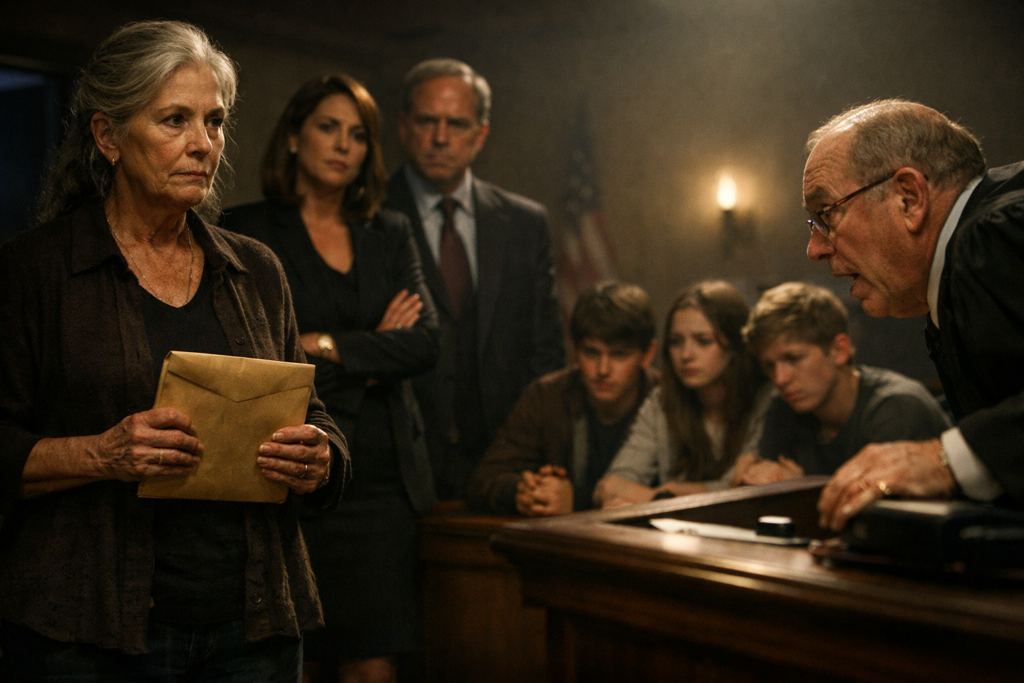
Chapter 4 — The Courtroom and the Envelope
The courthouse smelled like disinfectant and fear. I had never been there before, not like this. The walls were too white, the floors too shiny, as if they were trying to hide the ugliness that happened inside.
Emily sat beside me, her hands clenched, her jaw tight. She had refused to stay home. “If she’s really doing this,” she’d said, “I want to look her in the eye.”
Noah was quieter. He hadn’t spoken much since we got the notice. He kept staring at his shoes, tapping his thumb against his leg like he was keeping time with something only he could hear.
Grace wasn’t allowed to come. She was still a minor, still under the shadow of the case that now carried my name in bold black letters: The State vs. Margaret Carter — Custody and Abduction Inquiry.
I read those words so many times they lost meaning. Abduction. As if love could be mistaken for theft.
When she walked in, my heart dropped. My daughter — Lila — in a navy dress, hair pinned back, posture flawless. The lawyer followed, carrying the same briefcase, his shoes clicking in rhythm with hers. She looked younger than I remembered. Or maybe it was just that I had aged thirteen years all at once.
She didn’t look at me. Not once.
The judge entered. We stood. The sound of chairs scraping the floor felt like thunder.
Then it began.
Her lawyer spoke first — smooth, confident, rehearsed. He told the story of a young mother in crisis, manipulated by her own mother, who “took advantage of her emotional instability” to steal her children. He used words like “coercion,” “control,” “unauthorized custody.” He said I’d prevented all contact, that I’d forged documents, hidden addresses. Lies, stacked neatly like bricks.
I wanted to shout. To stand and tell them what really happened — the empty house, the unanswered calls, the crying children who waited by the window every night. But when my lawyer tapped my arm and whispered, “Wait for your turn,” I bit my tongue until it bled.
Then Lila spoke.
Her voice trembled at first, but it found rhythm quickly. She talked about postpartum depression, about fear, about how she’d wanted to get help and come back but couldn’t find the strength. How I had “cut her out.” How I’d refused to let her see them when she “tried to reconnect.”
I looked at Emily. Tears welled in her eyes, not from sadness, but disbelief.
“That’s not true,” she whispered.
I reached for her hand, but she pulled away — not from me, but from the weight of what she was hearing.
When it was finally my turn, I stood. My knees shook, but my voice didn’t.
“She left them,” I said. “On my porch. She said she’d be gone for an hour.”
Lila shook her head, eyes glistening. “That’s not how it happened.”
“She didn’t come back. Not that night. Not that week. Not that year.” I turned toward the judge. “I raised those children. I worked. I starved. I sacrificed everything to keep them safe.”
The lawyer interrupted, holding up a paper. “Can you prove that, Mrs. Carter?”
Proof. The word cut through me like a blade.
“I have notebooks,” I said. “Receipts. Photos. Letters.”
But he smiled, the kind of smile that belongs to people who think truth can be folded into a briefcase. “Love is not a legal document,” he said.
The room went quiet.
That’s when I remembered the envelope.
For thirteen years, it had sat sealed in my dresser drawer. I never opened it. It had arrived a few days after she left — no return address, just my name, written in her handwriting. I’d thought it was her goodbye. Or an apology. But I couldn’t bring myself to read it. I kept it like a wound that hadn’t yet healed.
Now, standing there, something inside me shifted.
“I have one more thing,” I said.
I pulled it from my bag. The paper was yellowed, the edges soft from years of being handled but never read.
Lila frowned. “What is that?”
“Something you sent me,” I said.
I handed it to the judge. “It’s sealed. It’s been sealed for thirteen years.”
He nodded, opening it carefully, his eyes scanning the page. His brow furrowed. Then he looked up at her, then back at me.
“Miss Carter,” he said slowly, “do your children know about this?”
Lila’s face went pale. “About what?”
He handed the letter to the clerk, who read it aloud, her voice steady and clear.
It wasn’t long. Just a few lines, written in the same messy handwriting I remembered.
Mom, I can’t do this anymore. I need time away. Please take care of them until I can fix myself. I know you’ll do better for them than I ever could. Don’t let them know how broken I am. Tell them I love them. Tell them I’ll come back when I’m ready.
The room went still. Even the air seemed to stop moving.
Emily gasped. Noah looked up for the first time in days.
The judge exhaled, setting the letter down carefully as though it were fragile. “This changes everything,” he said.
Lila opened her mouth, but no sound came. Her lawyer leaned in, whispering, but she shook her head, tears pooling in her eyes.
I stood there, not triumphant, not vindicated — just tired.
The judge looked at me again. “Mrs. Carter, you should have presented this sooner.”
“I didn’t know,” I said. “I couldn’t open it.”
He nodded, softer now. “Well, it appears your daughter entrusted the children to you voluntarily. That nullifies the abduction claim. The court will need to review this, but…”
He looked at Lila again. “I suggest, for everyone’s sake, that we stop here.”
When it ended, no one spoke. Lila gathered her papers with shaking hands. Emily sat beside me, her hand finally finding mine.
Outside, the sun was too bright. It hurt to look at.
“Do they know about this?” the judge’s words echoed in my mind.
Not yet, I’d thought. But they would.
Because the truth, once opened, cannot be sealed again.
Chapter 5 — What They Didn’t Know
When we got home from court, the house felt different. Not smaller, not darker—just quieter in a way that didn’t belong to silence. It was the kind of quiet that follows a storm, when you’re not sure if the air is finally calm or just catching its breath.
Emily went straight to her room. I heard drawers opening, the rustle of papers. She was trying to make sense of something that couldn’t be ordered or filed away.
Noah stood in the hallway, his hands in his pockets, staring at the floor. “So that’s it?” he asked.
“That’s it,” I said softly.
He nodded but didn’t move. I could see the tremor in his jaw, the effort it took to hold himself together. He wasn’t angry—not yet—but he would be. Anger always comes after disbelief.
Grace came home later. She’d heard from her friends that something had happened, that her sister and I had been at court. I tried to prepare the words, but when she asked, “What was it about, Grandma?” the words dissolved.
She still called me Grandma. She always had.
I sat her down and told her the truth, or at least the part of it that could be spoken without breaking her.
“Your mother came back,” I said. “She thought I took you away from her.”
Grace’s eyes widened. “What? But she left.”
“I know.”
“Why would she say that?”
Because guilt wears many faces. Because time can rewrite a story until the villain looks like the victim. Because pain needs someone to blame.
But I didn’t say any of that.
“She made a mistake,” I told her. “She thought she was doing what’s right.”
Grace looked at me the way children look at adults when they sense there’s more to the story. “Did she say anything to me?”
“She asked about you.” That was true. She had asked, her voice breaking when she heard Grace’s age, when she realized how much time she’d lost.
Grace nodded slowly. “I don’t remember her.”
And there it was—the quietest tragedy of all.
That night, when the house was finally still, I sat in the kitchen with the envelope lying open in front of me. The letter had aged like a secret—faded ink, creases like veins. I read it again, slowly, tracing each word with my finger.
She had written it in pain. That much I could see. The loops of her handwriting were unsteady, the lines uneven. She hadn’t meant to vanish forever. Maybe she had really believed she’d come back. But life has a way of swallowing good intentions whole.
Emily joined me. Her eyes were red. She sat down without asking and took the letter from my hands.
“I don’t get it,” she whispered. “Why didn’t she come back? Why wait thirteen years?”
“I don’t know,” I said. “Maybe she thought she wasn’t ready. Maybe she thought she was protecting you.”
“Protecting us?” She let out a sharp laugh that didn’t sound like her. “She abandoned us.”
“She was sick, Emily. Lost. Sometimes people disappear long before they leave.”
Emily looked at me for a long time, and when she finally spoke, her voice was small again, like when she was little. “Did you hate her?”
The question lingered in the air.
I thought about the years, the nights I cried into her old sweater, the birthdays spent pretending everything was fine. “No,” I said at last. “I never hated her. I hated what she did. But not her.”
Emily folded the letter carefully, the way you handle something sacred. “Are you going to tell Grace the rest?”
“Not yet,” I said. “Not until she asks.”
When Emily went to bed, I stayed where I was. The window above the sink reflected my face—older now, softer in some ways, harder in others. I wondered what Lila was doing at that moment. Whether she was sitting in some hotel room, crying. Whether she had anyone who called her “Mom” now.
A week later, a small envelope arrived in the mail. No return address again. Just my name. Inside, a single line written in the same uneven hand:
I’m sorry, Mom. I didn’t know how to come back.
No explanation. No phone number. Just that.
I didn’t tell the kids. I tucked it beside the old letter, inside the same drawer. Some things are better left folded between the past and the present.
Life resumed its rhythm. Emily went back to school. Noah started working longer hours. Grace hummed when she cooked, something she’d learned from me. The shadows of the courtroom began to fade, replaced by the ordinary chaos of living.
But sometimes, when I sat alone on the porch at dusk, I’d see a car slow near the house and my heart would skip, just for a second, before the engine carried it away.
I’d whisper to the night, as I had all those years ago, “You can still come home.”
And though I no longer believed she would, I kept the porch light on—because once, long ago, she’d said she’d only be gone an hour.
And part of me, foolish or faithful, was still waiting for that hour to end.