Chapter 1 — The Emergency and the Abandonment
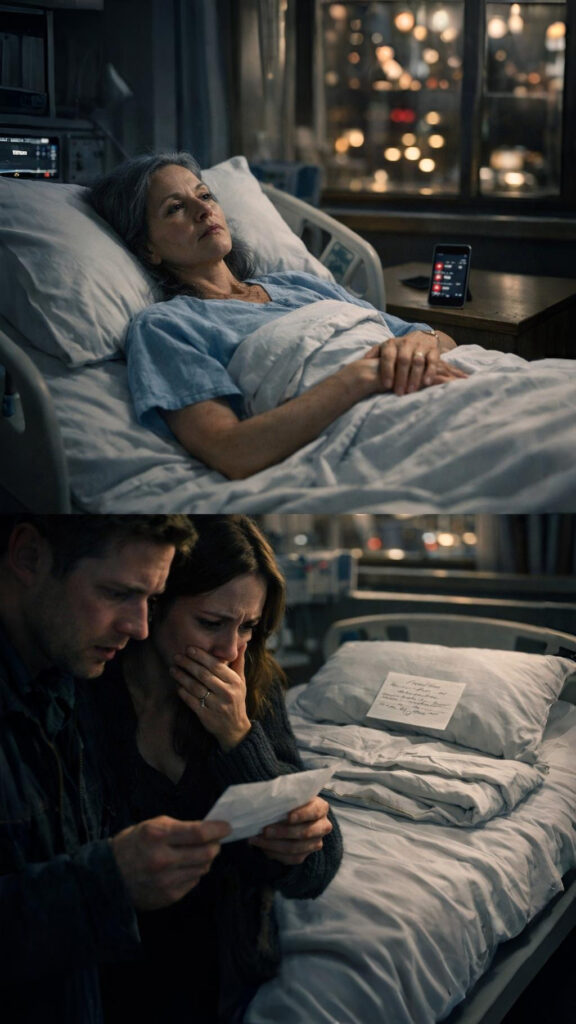
The room spun before her eyes. One moment, she was reaching for the kettle; the next, the floor met her body with a hollow thud. A sharp pain climbed from her chest to her jaw. Her breath came in broken pieces, thin as thread. She tried to call for help, but her voice was nothing more than a whisper swallowed by the empty kitchen.
The neighbors found her minutes later.
An ambulance arrived, its siren cutting through the quiet neighborhood like a cry of warning.
At the hospital, fluorescent lights glared down, sterile and cold. Nurses moved quickly, voices overlapping in urgent tones. “She’s critical. Get the oxygen mask. Call her family.”
They dialed her eldest son first.
“Sir, your mother’s condition is serious. We need you to come right away.”
On the other end, a pause. Then laughter and music in the background.
“Now’s not a good time,” he said. “My wife’s having a party. We’ll come later.”
The doctor tried again, voice steady but strained. “Sir, this could be her last chance. She needs you here.”
“Then call me if something changes,” he replied before hanging up.
The line went dead.
They tried the younger one next. No answer. Just the echo of a voicemail greeting, cheerful and distant.
Inside the sterile room, machines beeped in steady rhythm. Oxygen hissed softly, like a whisper of time slipping away. The old woman’s eyes fluttered open, catching the shadow of the nurse by her side.
“Did you call them?” she asked. Her voice trembled, fragile but still carrying hope.
“Yes, ma’am. They said they’d come soon.”
A small smile tugged at her lips. It was not a smile of belief, but of habit — the kind people wear to hide disappointment. She nodded, eyes turning toward the ceiling where the light flickered in irregular patterns.
Hours passed.
The party music miles away grew louder in her mind than the heart monitor beside her bed.
She imagined them — her sons, their wives, the laughter, the clinking of glasses. Maybe they even toasted to something. Life. Success. Family. How ironic.
A nurse adjusted the blanket over her chest. “You have beautiful children,” she said softly, trying to fill the silence.
The woman exhaled slowly. “They were,” she murmured. “When they still remembered who taught them to love.”
The nurse didn’t reply. There are moments where silence feels kinder than words.
That night, her condition worsened. The doctors worked around her, machines beeping faster, numbers flashing red. Somewhere in the chaos, her hand reached toward the nightstand where her small purse lay. Inside it, a folded photograph — two young boys, arms around her neck, grinning with missing teeth.
She pressed it to her chest.
“I forgave them long ago,” she whispered.
No one heard.
Outside the hospital, the city kept living. Cars passed, lights changed, laughter spilled from open windows. Somewhere, music played — the same music her son’s wife had chosen for the party.
Inside, the monitor’s rhythm slowed. Nurses exchanged worried glances. A doctor checked her pulse, gave quiet instructions, and the room fell into that strange kind of stillness that feels heavier than noise.
But she wasn’t gone. Not yet.
Her breath steadied, faint but determined. The body, even in pain, sometimes refuses to give up before the heart has said what it needs to say.
When dawn touched the horizon, she opened her eyes again. The window was tinted pink by the rising sun. She looked at the clock on the wall — 6:42 a.m. Still no visitors.
She smiled faintly. “Always late,” she whispered.
In that moment, a quiet clarity settled in her chest — not bitterness, but understanding. Love, she thought, doesn’t disappear. It just changes form when ignored too long.
She didn’t know if she’d make it through the day, but she knew this: if she left this world now, they would remember only what they failed to do.
And that, she decided, was enough.
The nurse entered again, checking her vitals, surprised to see her awake. “You’re a fighter,” she said gently.
The old woman looked at her and smiled, voice soft but certain. “No. Just someone who’s finally learning when to stop waiting.”
The nurse didn’t understand what she meant. Not yet.
But soon, everyone would.
Chapter 2 — The Solitude and the Silent Confession
The room had grown smaller. Not in size, but in feeling. The white walls seemed to move closer each day, pressing the air around her chest until even breathing felt like effort. The television played softly in the background, some morning show with people laughing too loudly, their voices bouncing against her silence.
She had not received a single call.
Not from her sons. Not from anyone. The phone sat on the bedside table, its dark screen reflecting the weak light of the window. She stared at it for hours, waiting for it to come alive. It never did.
A nurse changed her IV bag, smiling kindly. “You’re getting stronger,” she said.
The woman nodded. “Stronger for what?” she murmured, but the nurse didn’t hear.
After she left, the old woman closed her eyes and listened to the rhythmic hum of machines. They were her only company now. Machines didn’t judge. Machines didn’t forget.
She thought about her house — or what used to be hers. The small garden she planted every spring, the chipped kitchen tiles she always meant to replace, the photo frames collecting dust on the mantel. She wondered if her sons ever noticed the missing things when they visited. Probably not. They always came in a rush, half-listening, checking their watches, promising to stay longer next time.
Next time never came.
She remembered birthdays spent alone, dinners reheated, gifts bought with care but never delivered. It wasn’t the neglect that hurt — it was the habit of being forgotten. Over the years, she had learned how to shrink her needs until they could fit inside a sigh.
“Mom, you worry too much,” her eldest used to say whenever she asked him to visit. “We’re busy, that’s all. You know how life is.”
She did know. That was the problem.
When the night settled again, she reached for the small notebook in her drawer. The cover was worn, its pages filled with shaky handwriting. It wasn’t a diary — she had never liked calling it that. It was more like a conversation with someone who would actually listen.
She wrote slowly, every word deliberate.
They didn’t come.
Even when the doctor said it might be my last night, they didn’t come.
I should feel angry, but I don’t. Maybe disappointment is just love that’s run out of places to go.
Her hand trembled. She paused, letting the pen rest. The sound of her own breathing felt louder than the room itself.
The next morning, a volunteer came by with a tray of books. “Would you like something to read?” she asked.
The woman smiled politely. “No, thank you. I’m done reading other people’s stories. I’m finally finishing mine.”
The volunteer tilted her head, unsure what she meant. But the old woman had already turned back toward the window, her gaze lost somewhere far beyond it.
Outside, rain began to fall. Thin, silvery lines running down the glass. She imagined her sons’ faces — the curve of their smiles, the way their eyes used to light up when she tucked them into bed. She remembered the nights she stayed awake, sewing their school uniforms by hand because she couldn’t afford new ones.
The hours she spent waiting at the bus stop after work, groceries heavy in her arms, just to bring home their favorite food.
The years she worked double shifts to pay for their education.
The way she clapped at every graduation, tears of pride filling her eyes.
And the silence that followed once they moved out.
Love, she thought, isn’t always enough to keep people close. Sometimes, it becomes invisible the moment they no longer need it.
That afternoon, the doctor visited. “Your test results look better,” he said. “You might be able to go home soon.”
“Home,” she repeated. The word lingered on her tongue like something distant. “Where is that now?”
The doctor smiled, not understanding. “You’ll rest better there.”
When he left, she whispered to the empty room, “Maybe.”
Her reflection in the window startled her — thin face, pale skin, eyes sunken but sharp. It had been years since she’d looked at herself long enough to really see. There was strength still there, hidden beneath the wrinkles. Strength that had carried others more than herself.
That night, she wrote again.
If I leave this place, I won’t go back to that house. Not the one filled with memories of waiting. I want to leave something behind — something they’ll have to read.
They won’t come until it’s too late. But that’s all right. Sometimes too late is exactly when people start to see.
Her handwriting wavered near the end. A single tear fell on the paper, smudging the last line. She didn’t wipe it away. It looked right there — imperfect, human, true.
For the first time in years, she didn’t feel afraid.
Not of dying.
Not of being forgotten.
Because she knew she wouldn’t be — not after what she planned to leave behind.
She closed the notebook, slid it under her pillow, and turned off the light.
The machines hummed on. The rain stopped.
And for the first time, sleep came without dreams.
Chapter 3 — The Relapse and the Final Decision
The following morning, the hospital smelled of disinfectant and faint coffee. The woman lay still, watching sunlight crawl slowly up the white wall. She had slept, but it hadn’t felt like rest—more like a pause between long thoughts. Her body was tired, but her mind had been awake all night, moving through corridors of memory.
She touched the pillow beneath her head and felt the notebook hidden underneath. Just knowing it was there calmed her. Words had always been her quiet rebellion.
When the nurse entered, she pretended to sleep. There were things she didn’t want interrupted. The nurse checked her vitals, adjusted the blanket, and left with the same hurried kindness as always.
The moment the door clicked shut, the woman opened her eyes. The morning light had grown brighter, sharp enough to reveal the age of everything—the walls, her skin, the folded photograph on the nightstand.
Her sons were still young in that picture. They were standing in a park, holding ice cream cones, their smiles wide and effortless. Her husband had taken the photo. He’d passed away years ago, but in that frozen image, he still lived behind the camera, steady hands capturing what he thought would last forever.
She pressed her fingers against the glass. “You were wrong,” she whispered. “Nothing lasts unless someone chooses to stay.”
A sudden pain shot through her chest. Not the same as before, but close enough to remind her. She reached for the call button but stopped halfway. The pain faded, slow, leaving behind only the dull echo of fear. She breathed through it, eyes closed.
Not yet, she thought. There was still something to finish.
Later that day, the doctor came by, clipboard in hand, voice careful. “We’ll need to keep you for observation a few more days,” he said.
She nodded, but her gaze had already drifted elsewhere.
After he left, she picked up the pen again. Her handwriting was weaker this time, the letters trembling across the page.
I used to believe love was proven by how much we give. I was wrong. It’s proven by who stays when there’s nothing left to take.
She stopped, staring at that sentence for a long time. Then she turned the page and continued writing—slowly, deliberately, like carving her story into stone.
She wrote about the early years: the laughter in the kitchen, the smell of bread rising in the oven, her sons racing through the hallway in socks too big for their feet. She wrote about nights spent fixing broken toys, mornings waiting at the window for them to come home late from school.
She wrote about pride, and worry, and the slow erosion of both.
And then, she wrote about the silence that followed.
When her hand began to shake too much to continue, she rested the pen beside her and looked out the window again. The world outside looked indifferent. People walked with purpose. Cars moved. Lives went on.
She smiled faintly. “That’s the way it should be,” she murmured.
Hours passed unnoticed. The light dimmed, the walls turned golden, and the nurse returned to check her again.
“Would you like some dinner?”
“No, thank you. I’m not hungry.”
“Are you in pain?”
“No,” she said softly. “Not anymore.”
The nurse lingered, sensing something unspoken. “You should try to eat a little. You’ll need your strength.”
“For what?” she asked, almost gently. The nurse couldn’t answer, so she left the tray on the side table and slipped out quietly.
The woman waited until the footsteps faded, then reached for the notebook once more. She tore out the last written pages and folded them neatly. Her movements were slow but sure.
From her purse, she took an envelope and slid the papers inside. On the front, she wrote their names—To my sons, when you finally come.
Her handwriting looked frail, uneven, yet certain.
She set the envelope on the table where it would be impossible to miss.
The pain returned that night. Stronger this time. She didn’t press the button for help. Not out of surrender, but out of peace.
The world grew quiet again. The machines hummed softly, their rhythm steady and mechanical. She breathed in time with them, her chest rising and falling like the tide.
She thought about the last time she held her sons as children, both asleep on her lap after a storm. Their hair smelled of rain and mud. She remembered thinking she’d never be alone again.
Funny how promises made in innocence dissolve the quickest.
She smiled to herself—not bitterly, but with the kind of tenderness that only comes after understanding.
“I forgive you,” she whispered to the dark. “But I won’t wait for you anymore.”
The pain pulsed once more, sharper now, but she let it pass. There was nothing to fear. She had written everything that needed to be said.
Her hand brushed the envelope one last time before resting beside it. The monitor kept beeping, slow and even. Her breathing steadied.
And then, somewhere between one heartbeat and the next, she drifted—not away, but into the quiet she had been chasing all along.
When morning came, the nurse entered with a smile and froze. The sunlight filled the room, touching the stillness like a final blessing.
The envelope sat on the table, her name written in shaky but determined script.
And beneath the faint hum of machines, there was only peace.
Chapter 4 — The Late Return
The hospital smelled different when they arrived. Cleaner, quieter. The kind of quiet that doesn’t wait for laughter or conversation — only conclusions.
Her eldest son walked ahead, phone still in hand, screen lighting his face in cold blue flashes. His wife followed behind, sunglasses perched on her head though there was no sun inside. The younger son trailed last, slower, uncertain, a guilt he didn’t yet want to name sitting heavy in his stomach.
At the reception desk, the nurse looked up. “Can I help you?”
“We’re here for Mrs. Alcott,” the eldest said, his tone brisk. “Our mother. She was admitted a week ago.”
The nurse blinked once, hesitated. Then she checked the chart on her screen. Her fingers hovered for a moment, and her expression softened. “Room 213,” she said. “End of the hall.”
He nodded, motioning for the others to follow. The corridor stretched long and sterile. Every step echoed. The younger son noticed how the walls seemed too white, how even the air felt expectant — as though the building itself was holding its breath.
When they reached the door, he hesitated before opening it. Something in the silence on the other side made his hand tremble.
“Go on,” his brother said.
He pushed it open.
The room was bright, curtains drawn back to let in morning light. The bed was neatly made, sheets tucked in tight. There was no one in it.
For a second, no one spoke.
“Maybe they moved her,” the eldest said, already reaching for the nurse call button. But before he pressed it, his wife’s voice cut through the stillness.
“There’s something on the table.”
An envelope. Cream-colored. Their names written across the front in uneven handwriting.
The younger one stepped closer, but his brother was faster, snatching it up before he could reach. His thumb traced the letters. They were shaky, uncertain — but deliberate.
He opened it.
The first page was covered in familiar handwriting, slightly slanted, the ink faint in some places, pressed too hard in others.
My sons,
If you’re reading this, then the time we kept promising each other has finally run out.
The eldest swallowed hard, his voice quieter now. “She wrote us a letter.”
“Read it,” the younger whispered.
He continued, though the words came slower, as if each one weighed more than the last.
I waited. I always did. For birthdays, for holidays, for phone calls that never came. But the waiting became heavier than the love it was built on. And so, I stopped.
The words blurred slightly, not from the paper — from his eyes. He blinked hard and kept reading.
Do you remember the night your father died? You both promised me we’d stay together, that family would mean something. I believed you. Maybe that was my mistake. Belief can be a dangerous kind of hope.
The younger son turned toward the window, gripping the edge of the curtain. “She can’t be—” He couldn’t finish the sentence.
His brother kept reading, voice cracking in places he tried to steady.
I don’t blame you. Life teaches us to rush, to forget, to prioritize everything that screams louder than love. But one day, you’ll understand that silence speaks, too — especially the silence of someone who once waited for your voice.
The room felt smaller now, suffocating in its stillness.
I’ve left the house to neither of you. It will go to the shelter down the road — the one that feeds the people no one visits. Maybe my walls will hear laughter again there.
A pause. Then the final lines, each one deliberate.
If you come looking for me now, don’t go to the cemetery. Go somewhere quiet. Sit for a while. And when the silence starts to hurt, that’s me — finally being heard.
The letter ended there.
The eldest lowered the paper slowly, eyes fixed on nothing. His wife took a step back, unsure what to say. The younger brother turned, voice trembling. “She was alone, and we—”
“Don’t,” the elder snapped, though his voice broke halfway through.
They stood in that room, the three of them surrounded by the hum of machines that no longer mattered. On the bedside table, the photo frame caught the sunlight — two boys, smiling, arms wrapped around a woman who once thought love would be enough.
The younger one reached for it, tracing the glass. “We didn’t even come,” he whispered. “They told us it was her last chance, and we—”
“She wasn’t supposed to die,” the elder said, almost defensively, but it sounded hollow. “They said she was stable.”
“She wasn’t.”
He looked down at the letter again. The words blurred once more. There was no denial left to cling to, no party, no excuses. Only the truth written in her hand — soft, final, undeniable.
He folded the letter, held it against his chest. “We should’ve been here.”
The younger one didn’t reply. His silence said enough.
Outside, the hospital carried on. A child laughed somewhere in the hallway. A nurse pushed a cart past the door. Life moved, as it always did, indifferent to the lessons people learned too late.
The eldest placed the letter back on the table, beside the untouched dinner tray the nurse hadn’t yet cleared away.
“She forgave us,” he said, barely audible.
The younger shook his head. “No. She just stopped waiting.”
Neither of them moved for a long time.
When they finally did, the sunlight had shifted, painting the room in softer gold. They walked out quietly, the echo of their footsteps following them down the corridor — two shadows carrying the weight of a silence they could never answer again.
Chapter 5 — The Letter and the Shock
They didn’t speak in the car. The engine hummed, the wipers brushed away a light drizzle, and the city moved around them as if nothing extraordinary had happened. The letter sat between them on the seat, folded carefully, almost sacred. No one dared touch it again.
The younger son stared out the window. The world blurred by — gray buildings, people with umbrellas, a mother holding her child’s hand as they crossed the street. That image cut deeper than he expected. He swallowed hard.
“She didn’t deserve this,” he whispered.
His brother tightened his grip on the steering wheel. “I know.”
But he said it like someone who wanted to believe it was still possible to fix something. It wasn’t.
When they reached her house, the yard was overgrown, the gate squeaked when it opened. The house looked smaller now, emptied of its heartbeat. The porch light was still on — she had always kept it that way, saying light made a home feel less lonely.
Inside, everything was neat. The air smelled faintly of lavender and dust. On the table, a vase with dried flowers still stood, their color faded but intact. There were slippers by the door, a folded blanket on the couch, and an unfinished crossword puzzle on the armrest, as though she might return any minute to finish it.
The silence pressed down on them.
The younger one walked through the house slowly, tracing the edges of furniture with his fingertips. He noticed small details he’d never seen before — the cracks in the paint near the window, the tiny framed photos on the bookshelf, the faint scent of her perfume still clinging to the air.
He stopped at the kitchen counter. A note lay there, tucked beneath a mug. It wasn’t the same letter — this one was short, a few lines written in the same trembling hand.
For whoever enters this house last, it began.
He unfolded it carefully, calling out, “There’s another note.”
His brother appeared behind him. “Read it.”
He cleared his throat, voice unsteady.
Don’t be sad that you came too late. Be grateful you came at all. Life gives us many chances, but it only gives us one ending. Make yours kinder than mine.
Beneath it, her name. Just her name.
The eldest sat down heavily, the chair scraping the floor. His hand covered his mouth. For a long moment, neither said anything.
The younger one set the note back on the counter, aligning it perfectly as if misplacing it would be disrespect.
He looked around again. “She must’ve written it days before.”
“Maybe the night she—” His brother stopped, unable to finish.
They stood there in that kitchen — the same one where they had eaten birthday cakes, where she had bandaged their scraped knees, where she had once laughed so hard her eyes filled with tears.
Now the walls held only echoes.
“I can’t believe we didn’t come,” the younger one said finally, his voice cracking. “Even when they called. Even when they said—”
“I didn’t think it was serious,” the elder interrupted, but it sounded weak, rehearsed, useless.
“You never think anything’s serious until it’s too late.”
The younger one turned away, his eyes glistening. He walked to the window and stared out at the rain beginning to fall again, soft and steady.
“I keep seeing her face,” he said quietly. “The last time I saw her, she smiled at me from the porch. I waved, said I’d visit next week. She said, ‘Next week is fine, dear.’” He swallowed. “That was a year ago.”
His brother pressed his palms against his face. “We can’t change it.”
“No,” the younger whispered. “But we can carry it.”
They stayed like that for a while — two grown men standing in the quiet remains of the life that raised them.
On the mantel, a small framed picture caught the light. It was the same photograph that had rested by her hospital bed — the one of her with her sons as boys, smiling in a park. The glass reflected the rain running down the window, as if the sky itself was crying for her.
The eldest stood, crossed the room, and picked up the frame. He wiped the dust away with his sleeve.
“She never stopped loving us,” he said, voice hollow. “She just stopped waiting.”
He placed the photo back and straightened it carefully.
The rain grew heavier. It filled the silence, softened the edges of the world outside.
The younger one turned to him. “What happens to the house now?”
“She said it goes to the shelter.”
He nodded slowly. “Then let’s make sure they take good care of it.”
Neither of them spoke after that. They began to gather her things — not to keep, but to give away. Clothes folded gently into boxes, old letters stacked in drawers, books arranged in neat piles. Every object carried a weight, a memory, a quiet accusation.
By evening, they sat on the floor, surrounded by her life reduced to cardboard and silence.
The younger brother looked around and said softly, “She was right about silence. It does speak.”
His brother nodded, eyes fixed on nothing.
Outside, a faint light flickered from the streetlamp. The rain slowed, tapering into a mist. Somewhere far away, a clock chimed seven.
The house was still. Peaceful, even.
And in that stillness, her presence lingered — not as a ghost, not as a voice, but as the quiet truth she left behind:
Love, once ignored, doesn’t vanish.
It waits.
And when it finally leaves, it takes the light with it.