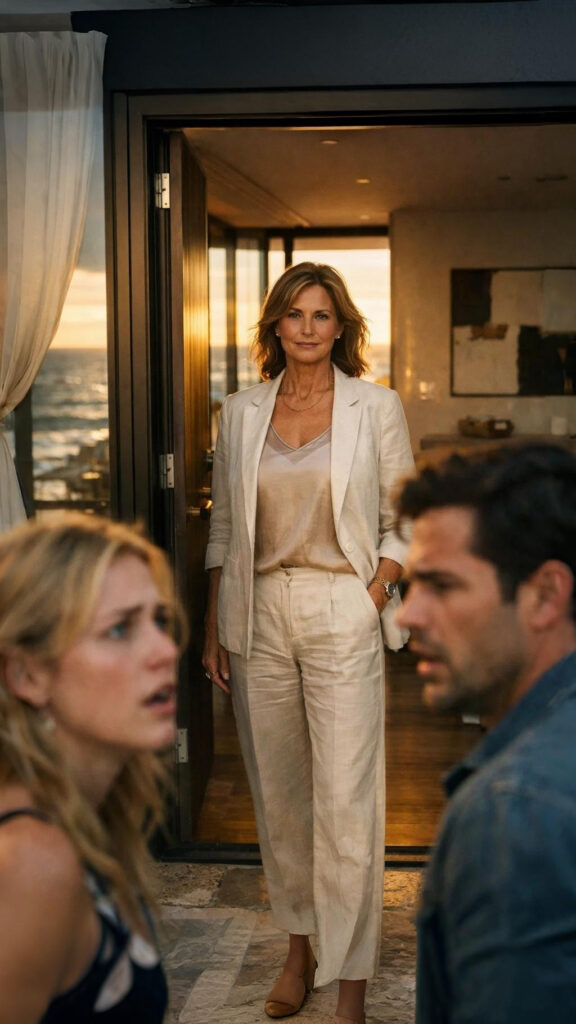
Chapter 1 — The Unexpected Return
It had been twelve years since anyone had knocked on my door with a familiar face. Twelve years since my phone had last lit up with my daughter’s name. The silence had stretched so long that I learned to live inside it, like a house that stops echoing because no one calls from the other side of the room.
That morning, the sea was calm. The air smelled of salt and warm sand. I had just finished arranging flowers on the veranda when I heard it—a knock, urgent and uncertain. For a moment, I thought it was a delivery, maybe the gardener. But when I opened the door, the world shifted.
There they were.
My daughter, Emma, and her husband, Daniel. Both standing there like ghosts unsure of their welcome. Emma’s hair had new streaks of gray, but her eyes were still sharp, calculating. Daniel had that same faint smile he always wore when he wanted something.
“Mom,” she said softly, her voice trembling as if rehearsed. “We were… in the area.”
In the area.
The phrase clanged in my head like an empty tin cup. The nearest town was forty minutes away; no one was “in the area” unless they meant to be.
I didn’t move aside immediately. I let the silence fill the doorway, let them see the house behind me—its high ceilings, the light spilling over polished wood, the art that hinted at a life rebuilt. I saw Daniel’s gaze flick across the marble floor, the ocean view beyond the glass. His smile faltered.
“Come in,” I said finally, my tone even.
They stepped over the threshold like strangers entering a museum, whispering with their eyes. I noticed Emma’s fingers grazing the furniture, testing its reality. She used to hate the sea. Said it was for people who had nowhere else to go.
Now she looked around as if she’d just discovered paradise.
We sat in the living room. The ocean hummed outside, the waves distant but constant. I poured coffee, steady hands, quiet rhythm. Emma tried to fill the silence with words that dissolved as soon as they touched the air.
“You’ve done well for yourself,” Daniel said, studying the silver watch on his wrist more than my face.
“I learned to survive,” I replied.
The sentence hung there, heavier than it should have been. They both looked at me, unsure if it was an accusation or a confession.
For twelve years, I had built this life alone. Brick by brick, hour by hour, not to prove them wrong—but to remember who I was before I became useful to others. The beach house was more than a home; it was a reclamation.
Emma’s eyes softened for a moment. “You didn’t tell me you moved here.”
“You didn’t ask,” I said.
Her lips parted, then closed again. The weight of all those unspoken years settled between us. Birthdays missed. Holidays ignored. The hospital stay I faced alone. The letter I once sent, never answered.
I looked at her and realized something unsettling—I no longer needed her to explain. The wound had already scarred.
Daniel cleared his throat. “It’s beautiful here. Must’ve cost a fortune.”
His tone was casual, but his curiosity wasn’t. I saw the gleam behind it—the quick calculation of numbers, inheritance, ownership. I said nothing, letting him twist in his own politeness.
The tide was rising outside. I could hear it in the rhythm of the waves. Emma leaned back, trying to smile, but her eyes betrayed a hint of panic, as if she feared that the woman before her wasn’t the same mother she’d once known.
“I’m glad you came,” I said finally.
And I meant it—though not for the reasons they hoped.
Because when I looked at their pale faces, the desperate politeness that cracked around the edges, I saw something familiar: need. Not love, not reconciliation. Need.
And that, I thought, was the beginning of everything.
They had come not to visit, but to reclaim something they thought they’d lost.
But what they didn’t know—what they couldn’t yet see—was that the woman they’d left behind twelve years ago had died long before this meeting.
The one standing before them now was someone entirely different.
Chapter 2 — The Forgotten Years
That night, after they left the living room claiming exhaustion, I stayed awake listening to the sea. The waves broke against the rocks like memories resurfacing. It had been twelve years since I’d heard my daughter’s laughter in the next room—now it echoed faintly, strange and unfamiliar.
I sat by the window, coffee cooling in my hands, and let the past come back in fragments. It never arrived as a whole story anymore—just shards, moments, like seashells scattered by time.
The night she left.
The slammed door.
The silence that followed.
I had given her everything then. Not just money—years. My strength, my health, the best of my youth. I worked two jobs when she was in college, sold my jewelry to pay for her wedding, even borrowed money to help Daniel start his company.
They said it was temporary.
They promised to pay me back.
But when I got sick and needed them, their phones stopped answering.
I remembered sitting by a hospital window, staring at the parking lot below, waiting for a visit that never came. Nurses brought me water and small talk, but not the face I wanted to see. Days passed like that, slow and echoing. And when I was discharged, there was no one waiting outside.
That was the moment I realized I was no longer part of their family story.
The house I used to live in—the one filled with laughter, chaos, the smell of Emma’s cooking—had been sold without my consent. “It’s for your own good, Mom,” she said over the phone, her voice polite, almost distant. “You can stay with Aunt Rose for a while.”
A while stretched into years.
I slept in a small guest room, packed with boxes of someone else’s memories, and learned the art of disappearing quietly.
When Aunt Rose passed away, she left me a small inheritance. Not much, but enough to buy a patch of freedom. I invested it carefully, studied, learned. I started working again, small projects at first, then something larger. The company that Daniel once mocked—“Mom, that’s too ambitious for your age”—became the foundation of everything I owned now.
The two-million-dollar house wasn’t luck. It was built on solitude and stubbornness.
I looked at the sleeping house around me. Their suitcases were in the guest rooms, expensive luggage, neatly zipped. I could almost feel their anticipation—the way Daniel had glanced at the painting above the fireplace, at the gold frame, at the faint reflection of greed in his own eyes.
Emma had tried to mask hers better. She spoke about missing me, about guilt, about family. But her hands fidgeted every time I mentioned the word “ownership.”
“Mom,” she had said earlier, “this place… it feels like a dream. How did you do it all on your own?”
I smiled, not out of pride but out of the simple joy of mystery. “By remembering what you forgot,” I told her.
She didn’t ask what that meant.
The wind pressed against the windows, rattling them gently. Somewhere inside, a door creaked—this house had its own language, its own ways of warning me.
I got up and walked through the hallway, the floorboards warm beneath my feet. I paused by their doors. Behind one, Daniel’s soft snores; behind the other, silence. I wondered if she was awake, staring at the ceiling as I was, wondering how to ask the questions she came here for.
I wasn’t angry anymore. That part of me had burned away years ago. What I felt now was something steadier—clarity. I finally understood that love, when one-sided, becomes a kind of servitude. And I had served long enough.
I returned to the living room, touched the frame of an old photograph on the shelf. Emma at six years old, missing front tooth, hair tangled from the wind. Me beside her, laughing. I barely recognized myself.
The woman in the picture didn’t know yet what love could cost.
I put the photo face down.
Tomorrow would bring questions. Invitations disguised as affection. I could already hear Daniel saying something like, “We’ve been struggling lately,” while Emma added, “We just need a little help to get back on our feet.”
But tonight wasn’t for planning defense. Tonight was for remembering the years they chose to forget.
The smell of sea salt drifted through the window again, gentle and familiar. I closed my eyes and let it wash over me.
Twelve years of silence had not broken me. They had built me.
And now, they had returned to find that I no longer lived in their shadow.
They just didn’t know it yet.
Chapter 3 — The Real Reason
Morning came with the sound of gulls and coffee brewing. I had risen early, long before the sun, out of habit more than anticipation. The house felt different with them inside it—unbalanced, like a melody played one note too high.
When I stepped into the kitchen, Emma was already there. She wore the same robe she’d borrowed the night before, standing by the window with a cup in her hands. Her reflection in the glass looked like a stranger’s—tense, rehearsing something.
“Morning, Mom,” she said, turning with a smile that didn’t quite reach her eyes.
“Morning.” I poured myself a cup, sat opposite her, and waited.
Small talk came first. It always does when people want something. Weather, the view, how peaceful it must be to live by the sea. Then, slowly, the conversation began to tilt.
“You’ve really done so well,” she said again, her tone casual but tight. “It’s just… surprising. I mean, after everything.”
“After being left behind?” I asked.
She flinched, looked down at her cup. “That’s not fair.”
“Fair,” I echoed, almost laughing. “That’s an interesting word.”
Before she could reply, Daniel appeared. Shirt ironed, smile polished. He kissed her cheek, then looked around as if evaluating property.
“This place is incredible,” he said. “You know, we’ve always dreamed of something like this.”
“I’m sure you have,” I murmured.
He laughed lightly, pretending not to hear the edge in my voice.
As we ate breakfast, I watched them exchange glances, silent communications sliding between them like invisible threads. They were trying to measure me—how much I’d changed, how much I remembered, how much I might be willing to give.
When Daniel finally spoke again, it was with the casual tone of a man circling the truth.
“Emma mentioned you’ve been investing,” he said. “Real estate, right? Must be quite a portfolio by now.”
I looked at him, smiled slightly. “Enough to be comfortable.”
“That’s great,” he said quickly. “Because, well, we’ve had a rough couple of years. The business took a hit during the market drop, and we’ve been trying to recover. It’s been… hard.”
There it was.
Emma’s eyes flicked up to mine, searching for sympathy, the kind she used to find so easily. But the woman sitting across from her now wasn’t the same mother who once pawned her wedding ring to pay their debts.
I stirred my coffee slowly, letting the silence drag.
“I’m sorry to hear that,” I said.
Daniel leaned forward, eager. “We’ve got plans to rebuild—good ones, solid ones. We just need a little support to get started again. And you’ve always been such a believer in family helping family.”
Emma placed her hand on mine, soft, pleading. “We wouldn’t ask if it wasn’t serious.”
Her touch was the same as when she was a little girl asking for candy—gentle, rehearsed, certain I couldn’t say no.
I withdrew my hand. “You’re right. You wouldn’t ask if it wasn’t serious. But you also wouldn’t be here if you didn’t already know the answer.”
Daniel blinked. “What’s that supposed to mean?”
“It means I know why you came.”
The sound of the sea filled the pause that followed. Emma’s mouth opened, then closed again. Daniel’s jaw tightened. The mask was beginning to slip.
He tried to recover. “We came because we missed you, because—”
“Because you saw the photos,” I interrupted. “The magazine feature. ‘Widow Rebuilds Fortune by the Sea.’ You saw the house. The price tag.”
Their silence was louder than any denial.
For a moment, I almost pitied them. Almost.
Emma’s voice trembled when she spoke again. “Mom, that’s not fair. We were wrong before, but we’re here now. Can’t we just start over?”
“Start over,” I repeated softly. “Where was that start when I was in the hospital? When you sold the house I paid for and kept the money? When you told people I was living comfortably, while I was sleeping on a borrowed couch?”
Her face flushed red, and Daniel’s hand closed over hers.
“Mom,” he said, “let’s not dig into the past. We’re trying to move forward.”
I smiled faintly. “You mean upward.”
The clock ticked between us. The ocean crashed against the rocks outside, steady, unbothered.
I leaned back in my chair, studying them both. The desperation they tried so hard to hide was visible now—in the twitch of Emma’s fingers, in the tightness around Daniel’s mouth.
They hadn’t come for reconciliation. They’d come for rescue.
And they were realizing, too late, that I wasn’t the kind of woman who could be used twice.
“I’ll think about it,” I said at last, standing.
Relief washed over their faces so quickly it almost made me laugh.
“I’ll think about what to do with this new beginning,” I added. “But don’t assume it will include you.”
Daniel tried to respond, but I’d already turned away.
As I walked toward the veranda, the sea wind met me, sharp and alive. I let it fill my lungs, cool and salt-heavy. Behind me, the murmur of their voices grew urgent, whispering plans they still thought could work.
But I already knew what was coming.
This visit wasn’t a reunion—it was a transaction.
And like any transaction built on deceit, it was only a matter of time before the debt came due.
Chapter 4 — The Silent Turn
The following days unfolded with a strange stillness, like the sea before a storm. Emma and Daniel stayed longer than they had planned, or at least longer than they pretended to plan. Each morning they emerged later, smiling too brightly, complimenting the breakfast I’d already finished.
They were polite. Excessively so.
Daniel offered to fix things that didn’t need fixing. A door hinge, a lamp cord, the railing by the stairs. He moved through the house like a guest pretending to be useful, but his eyes wandered—counting rooms, estimating worth.
Emma spent most of her time by the window, pretending to admire the view. Sometimes I caught her reflection watching me instead, measuring my calm, waiting for cracks that never came.
The air between us was soft but brittle, ready to shatter.
At lunch one afternoon, Daniel brought up the topic again, disguised in conversation. “You know, Mom,” he began, voice almost cheerful, “Emma and I have been looking at properties near here. Nothing fancy, just a little place by the water.”
“How nice,” I said, cutting my food slowly. “Will you be paying for it with the business that no longer exists?”
He froze. Emma’s fork clinked against her plate.
“I didn’t mean—” he started, but I raised a hand.
“It’s fine,” I said. “Dreams are expensive. I know that better than anyone.”
Silence swallowed the table. Outside, a bird screeched somewhere in the dunes, sharp and distant.
That night, I found them whispering in the hallway, their voices low but urgent. My name slipped between their sentences. I didn’t need to hear every word to understand.
They were running out of time.
And they still believed I might save them.
The next morning, I changed the rules.
When Emma came down for breakfast, the table was empty. No coffee, no plates. Only a note resting beneath a seashell. Gone into town. Back later. Make yourselves at home.
I took the car and drove along the coastline, the wind tangling my hair. Freedom has a particular sound—the engine against the surf, the hum of a road that leads nowhere you owe to anyone.
I stopped at a small café by the pier. The owner knew me; he poured my tea without asking. “You look thoughtful today,” he said.
“I’m remembering who I used to be,” I replied.
He smiled. “That’s a good thing to do, as long as you don’t stay there.”
I didn’t.
By the time I returned home, the house was alive with tension. Emma stood near the balcony, phone in hand, voice shaking as she spoke into it. She ended the call quickly when she saw me.
“Everything okay?” I asked.
“Just… bills. Things we need to take care of,” she said. Her smile was too small, too forced.
Daniel appeared moments later, holding a folder. “We’ve been thinking,” he said. “If we could borrow a small amount, just until things stabilize—”
I interrupted him with a gentle laugh. “A small amount. How small?”
He hesitated, then named a number.
I didn’t flinch. “That’s not small,” I said.
“It’s temporary,” he insisted. “We’ll pay you back.”
The lie tasted old, recycled from a dozen years ago.
“Daniel,” I said softly, “you don’t need to lie. Not here.”
He opened his mouth, then closed it again. His eyes darted toward Emma, but she looked away.
I stood, walking to the window. The ocean was restless now, waves slapping against the rocks. “Do you know why I bought this house?” I asked.
Neither answered.
“I bought it because it faced the horizon,” I continued. “I wanted to wake up every day and see proof that something endless still existed. Something that didn’t depend on anyone’s permission.”
When I turned back, Emma’s eyes were wet. “Mom, we made mistakes. But we’re trying to fix them. We came here because we thought maybe—maybe you’d still care.”
“I do,” I said. “Just differently.”
The words came quietly, but they struck her harder than I intended.
She looked as if she might speak again, but Daniel touched her arm. “Let’s give her time,” he muttered, leading her away.
Time was exactly what I needed.
Later, when the house had gone silent again, I opened my desk drawer and took out a folder of my own. Inside were documents I hadn’t yet decided how to use—bank transfers, property deeds, the final draft of a decision I’d been shaping for months.
I reread the letter at the top, the one addressed to my lawyer.
Every sentence was a step toward freedom.
They had come to collect what they thought was theirs. But they would leave with something far heavier—the understanding that I was no longer theirs to use.
As night fell, I lit a candle and sat by the window. The sea was dark now, flecked with silver light. Somewhere behind the guest-room door, Emma was crying quietly. I didn’t move to comfort her.
Not out of cruelty, but because I had finally learned that comfort is not the same as love.
Love had boundaries. And mine had just been drawn.
When I blew out the candle, the flame flickered and died, leaving the room bathed in moonlight.
It felt like the beginning of something irreversible.
Chapter 5 — The Pressure Rising
The tension in the house grew like humidity before a storm—thick, invisible, but everywhere. Each day seemed quieter, yet beneath that quietness, something dangerous was forming.
Emma avoided my eyes most mornings now. She pretended to read by the window, a book that never seemed to move past the same page. Daniel, on the other hand, had become restless. He paced when he thought I wasn’t watching, tapping his phone screen over and over, like a man waiting for a message that never came.
One afternoon, as I worked in the garden, I heard their voices through the open door. Low, fast, urgent. I couldn’t make out every word, but my name was there—woven between whispers of money, papers, worth.
I kept trimming the roses, each cut clean and deliberate. I had learned to do everything quietly, even when anger pressed against my ribs.
Later that evening, Daniel tried again.
He joined me in the living room, pretending to admire the painting on the wall. “You’ve got an eye for beauty,” he said, too casually. “Pieces like this… they appreciate in value, you know.”
“I know,” I replied, without looking up from my book.
“Would you ever consider selling?”
“Not this one.”
He hesitated, then smiled. “You always were sentimental.”
I closed the book. “Not sentimental. Selective.”
For a moment, our eyes met. There was a challenge there—his masked as politeness, mine as patience. He broke the stare first.
Emma came in then, holding her phone, cheeks flushed. “Mom, we were wondering if we could talk.”
I nodded, gesturing to the sofa.
She sat, smoothing her skirt like a nervous child. “We didn’t want to bring this up again, but… things have gotten worse. We might lose the house.”
“Which house?” I asked.
“Our house,” she said quickly. “The one we bought after—after everything.”
“Ah,” I said. “The one you bought with my savings.”
Her face fell. “Mom, that’s not fair. We were young. We didn’t understand.”
“You understood enough to sign your name on the deed.”
Daniel leaned forward. “This isn’t helping. We’re not here to argue. We’re just asking for a little support. Temporary. We can even draft a formal agreement.”
The desperation in his voice cracked through the calm he’d tried to maintain. His mask was slipping faster now.
I studied them both. “You’ve already been given everything once,” I said. “Why do you think you deserve more?”
“Because we’re family,” Emma whispered.
That word. Family. It had once been a shelter; now it was a weapon they used to pry open guilt.
I stood, needing air. “Family should mean something,” I said. “But you only remember me when you’re drowning.”
Daniel’s temper flickered, a small, sharp spark. “We came all this way because we thought you’d changed. But you’re still bitter, still holding onto the past.”
I turned toward him, calm but cold. “The past holds onto me, Daniel. You just helped it build a house.”
He opened his mouth to respond, but Emma’s hand stopped him. “Please,” she said softly. “Don’t. Not tonight.”
I left them there and walked outside. The sea was dark, restless under the moonlight. I breathed it in—salt and silence—and tried to let it steady me.
Inside, through the glass, I could see them arguing. Their silhouettes sharp against the light. I couldn’t hear the words, but I didn’t need to. I knew the rhythm of that kind of desperation. It was the sound of people who thought time would always forgive them.
The next morning, the shift came.
Emma was distant, but Daniel was different. Too kind. Too careful. He complimented everything—the breakfast, the view, even my choice of music. The sudden warmth was its own warning.
By afternoon, I discovered why.
In the study, a drawer had been left slightly open. Inside, the folder where I kept certain documents—the ones they should never have seen—had been moved. Only slightly, but enough to tell me they’d been there.
When I stepped back into the hallway, Daniel was waiting.
“Looking for something?” he asked lightly.
I met his gaze. “You?”
He smiled, but his eyes were sharp. “You don’t trust anyone, do you?”
“Trust has to be earned,” I said. “And I’ve already paid too high a price for it.”
He laughed softly, the sound brittle. “We’re not the villains here, you know.”
“Then stop acting like it.”
He left, slamming the door harder than necessary.
That night, I locked my study. I didn’t sleep. I listened. The creaks, the distant voices, the rhythm of footsteps across the tile. The sea wind moaned through the open vents, carrying something that almost sounded like warning.
When dawn came, I knew something had changed in me too.
They wanted control. They wanted what they thought I owed them.
But I wasn’t afraid anymore.
Let them push. Let them twist the story, as they always had. This time, I would not bend.
Because I had already written the ending—they just hadn’t read it yet.