Chapter 1 — The Mother’s Day Card
The table was bright with flowers and porcelain plates, but the air was heavy.
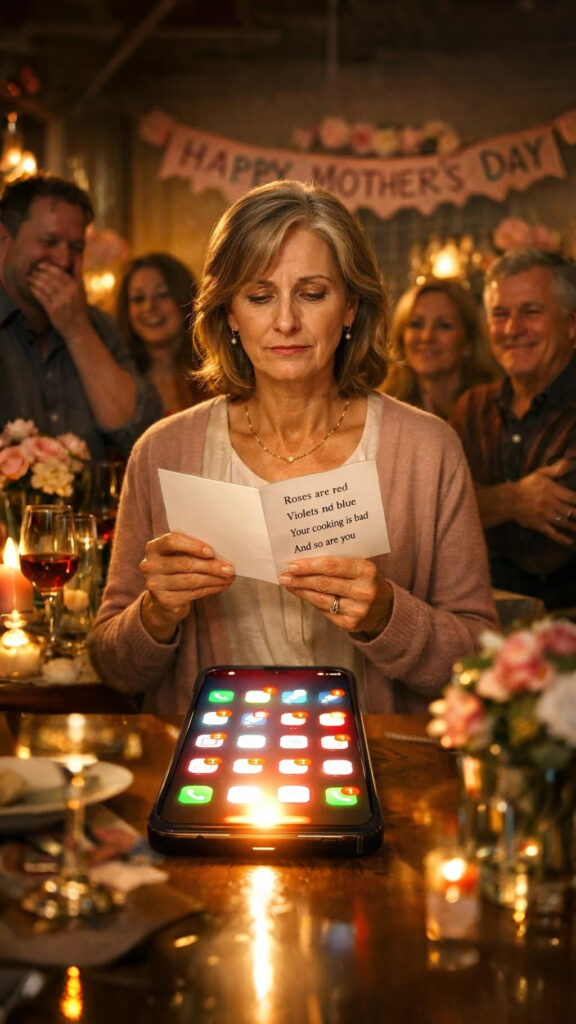
Someone had placed a pink envelope by my plate, the kind a child would use for something innocent.
My daughter smiled as if she were proud of it. “Go on, Mom. Read it out loud,” she said, her tone light, but her eyes waiting for something else.
I hesitated, the way you hesitate before opening an envelope you already know will hurt.
Still, I opened it. The card smelled faintly of perfume, roses, maybe. The letters were written in glittery ink, the kind I used to buy for her school projects.
“Roses are red,” it began.
The laughter started even before I finished.
“Violets are blue,” I read, my voice smaller now.
“You are a heavy burden. Nobody wants you here.”
For a moment, I didn’t understand. I stared at the words, as if reading them again might change their meaning.
But they stayed cruel, shimmering under the kitchen light.
The laughter grew louder.
My son-in-law chuckled, slapping his knee. My granddaughter giggled without knowing why.
And my daughter—the same daughter who used to crawl into my bed during thunderstorms—was laughing too.
“Come on, Mom, it’s just a joke,” she said between breaths, waving her hand.
A joke.
I looked around the table, the food untouched, the gifts unopened. The smell of roast chicken and wine mixed with something sour—the embarrassment that filled the room.
I smiled, because that’s what I had always done.
The smile of a mother who forgives before being asked.
The smile of someone used to swallowing pain before it spills into the open.
But something in me trembled.
Not just from the words, but from the laughter.
The laughter said it wasn’t a mistake. It said they meant it.
I placed the card back on the table, neatly, as though it were fragile.
“I see,” I whispered. My voice cracked slightly, and that only made them laugh harder.
My daughter reached over, touched my hand with a grin that didn’t reach her eyes. “Mom, don’t be dramatic. We were only teasing.”
Teasing. Such a small word for cruelty dressed in ribbons.
I excused myself quietly. The room didn’t even pause. Plates clinked, forks scraped. The celebration went on without me, like I had never been there.
In the bathroom mirror, my reflection looked older than I remembered. My eyes had grown tired in ways I couldn’t hide.
Behind me, through the door, I could still hear them talking. Laughing.
Each laugh another stitch closing the distance between us.
I splashed cold water on my face.
It didn’t help.
I remembered all the other Mother’s Days—when she’d make me cards covered in hearts, when I’d hang them on the refrigerator for weeks.
Now, that same hand had written something meant to humiliate.
And she hadn’t even flinched while I read it aloud.
I walked back to the dining room, collected my purse, my coat.
“Where are you going, Mom?” my daughter asked, still smiling, still amused.
“Home,” I said. “I think I’ve celebrated enough.”
She rolled her eyes. “Oh, come on, don’t make it awkward.”
But I was already at the door.
Outside, the evening was cool, almost gentle. The kind of air that carries the smell of lilacs and wet earth.
The laughter was still echoing behind the windows as I closed the gate.
I stood there for a moment, not sure if I should cry or laugh myself.
Then I felt something strange—quiet, steady, almost invisible.
A small click inside me.
The sound of something shifting, something waking.
I didn’t know it then, but that moment, standing on the sidewalk with the card still burning in my hand, was the beginning of everything that would follow.
The night swallowed the house behind me, and I began walking, not sure where to go, but knowing I couldn’t go back.
The words from the card followed me like a whisper.
“Roses are red, violets are blue…”
I almost smiled then. Because I knew, one day soon, those same words would return to them.
But not as a joke.
As justice.
Chapter 2 — The Forgotten Sacrifices
That night I couldn’t sleep.
The words from the card replayed in my head like a song with no mercy, looping over and over until even the silence carried its rhythm.
I sat in my chair by the window, the one I had bought secondhand when my daughter first left for college. Back then, I used to sit there waiting for her calls. She’d tell me about her exams, her friends, how expensive the city was. I always listened, even when she called only to complain. I sent money I didn’t have. I skipped meals I pretended I wasn’t hungry for.
That’s what mothers do, I told myself.
The room smelled faintly of lavender detergent and loneliness.
In the dim light, I could see the old photo frames on the shelf — her graduation, her wedding, the day she held her first baby.
In every picture, I was there in the background, holding something, fixing something, paying for something.
Never the focus, always the frame.
I remembered the years I worked double shifts at the bakery, the smell of dough sticking to my hands even after washing them. My knees would ache so badly that I sometimes cried in the shower. But I kept going. Because she needed a computer. Then a car. Then money for her honeymoon.
When her husband lost his job, it was my savings that kept their lights on.
When their baby was born, it was me who stayed up all night so they could sleep.
When she said, “You’re the only one I can count on,” I believed it.
It’s strange how love can blind you more completely than hate.
I poured myself some tea, though it had long gone cold. The city outside was quiet, but inside me, something was cracking.
It wasn’t anger — not yet.
It was exhaustion that had grown teeth.
In the dark, I whispered to no one, “How did it come to this?”
The kettle didn’t answer.
I thought of that card again — glittery ink, childish handwriting, cruel rhyme.
Was that how she really saw me? A burden? A weight she couldn’t wait to put down?
Once, she used to call me her best friend. She used to cry on my shoulder after every heartbreak. I used to tell her she was strong, that she’d make it through anything.
Maybe I made her too strong — strong enough to forget where she came from.
I leaned back and closed my eyes.
The images came fast, like a slideshow I hadn’t asked to see.
Her as a little girl, clinging to my hand at the doctor’s office.
Her teenage years, slamming doors and shouting she hated me — but always coming back for advice.
Her wedding day, when she asked me to walk behind her instead of beside her.
I had told myself it didn’t matter.
That love doesn’t keep score.
But maybe it should.
Because now, sitting alone in the dark, I realized I had been keeping score after all — just quietly, in my bones, in the tiredness that never went away.
The years.
The money.
The birthdays spent alone so she could travel with her husband’s family.
The promises that never returned.
And still, when the phone rang, I always answered.
But not tonight.
Tonight, I let it ring.
The sound filled the room, sharp and persistent. It wasn’t her — just some telemarketer probably — but even that small act of ignoring it felt like rebellion.
Maybe that’s how it begins, I thought. Not with anger, but with silence.
I looked at the envelope again, still lying on the table. I hadn’t thrown it away. Maybe I wanted to keep it, not as a wound, but as proof.
A small, glittering tombstone for the version of me that believed kindness was enough.
When dawn came, the light fell across the card. The words sparkled in the sun, cruel and beautiful, like something alive.
“Roses are red…”
I smiled bitterly. How childish, how ridiculous — and yet it worked. That single card had peeled away decades of illusions in one cruel gesture.
I stood up, stretched my aching back, and went to the closet. Inside were boxes — old bills, letters, receipts — every trace of a life spent giving.
Every sacrifice itemized in dust.
I ran my fingers over the labels I had written years ago: Tuition payments, Medical bills, Wedding loans.
Each one told a story she had long forgotten.
Each one whispered the same truth.
You were never enough unless you were useful.
I sat down on the floor and began sorting through them. Not to cry — not even to remember — but to understand.
Because for the first time in my life, I wanted to see my sacrifices for what they really were: not proof of love, but evidence of neglect.
The sun climbed higher, washing the room in gold.
Somewhere outside, I heard laughter from a neighbor’s yard — light, unburdened laughter.
It didn’t hurt this time. It just reminded me that joy still existed somewhere, maybe waiting for me.
By the time the clock struck nine, I had filled two garbage bags with old papers.
I tied them neatly and left them by the door.
It felt symbolic somehow — the first step in cleaning out something much deeper.
I made a new cup of tea.
No sugar. No honey. Just bitter and real.
I lifted the cup to my lips and said softly to the empty room, “Never again.”
The card was still on the table, glitter catching the morning light.
But now, it no longer looked like a wound.
It looked like a beginning.
Chapter 3 — The Silence That Changed Everything
It had been three days since Mother’s Day, and the house had grown quiet. Not the kind of quiet that soothes, but the kind that waits.
My phone blinked occasionally, small bursts of light in the dark. I ignored them. Messages, missed calls, little digital ghosts trying to drag me back into the same cycle.
I let them pile up.
The first message was from my daughter: Mom, why aren’t you answering?
Then another: Are you still upset about the card? Come on, it was just a joke.
By the time she sent the tenth one, the words had changed tone. Less amused, more confused.
I didn’t respond.
I didn’t even open the messages. There was nothing left to say that hadn’t already been said through years of unspoken taking.
The quiet began to stretch itself across the rooms. It crept through the curtains, settled on the furniture, filled the space where her laughter used to echo.
It felt strange at first. Unnatural. Like wearing someone else’s coat. But then it started to feel… peaceful.
For the first time in a long time, no one was asking me for anything.
No one was calling about bills, favors, babysitting, emergencies.
The silence became my companion — not loneliness, but rest.
I cooked for myself. Simple meals.
One plate, one fork, one quiet dinner.
I took long walks in the park, where nobody knew my name. I watched the leaves move with the wind, each one following its own path, not clinging to any branch longer than it needed to.
That’s what I wanted to learn — how to let go gracefully.
At night, I turned off the phone completely. The blinking light stopped, and the darkness became whole again.
But on the fourth night, something inside me shifted. Not doubt, but awareness.
The silence was no longer just peace — it was power.
Every unanswered call became a mirror, forcing them to see themselves without my presence smoothing things over.
Every ignored message made them realize that my availability had been a privilege, not a duty.
I could almost picture her now, sitting at her kitchen table, tapping her phone, waiting for a reply that wouldn’t come.
The same table where she’d handed me that cruel card just days before.
I didn’t feel revenge.
Just distance.
And clarity.
On the fifth day, the phone rang again. The screen flashed her name, over and over, as if urgency could erase what was said.
I watched it ring until it stopped.
Then it rang again.
Twenty-seven times that morning.
I let them all go unanswered.
By the afternoon, it wasn’t just her — her husband called, then my granddaughter’s school, then an unknown number. The silence I had built was beginning to make noise in their world.
I imagined their conversations.
“She’s fine,” he’d probably say. “She’s just being dramatic.”
And she’d answer, “No, something’s wrong. She’s never this quiet.”
That was true. I had never been quiet before.
I had always explained, apologized, softened every harsh moment.
Silence was a language I was only now learning to speak, and it turned out to be fluent in power.
By evening, the phone had counted fifty-seven missed calls.
Fifty-seven — one for every year of my life, almost poetic in its symmetry.
I finally turned the phone face down, unplugged the charger, and opened the window. The air outside was cold but alive. It carried the scent of rain, of beginnings washing away old things.
Somewhere in the distance, thunder rolled — low, deliberate. I smiled.
Maybe it was selfish to feel so calm while they panicked. But selfishness had always been forbidden territory for me. Now, stepping into it felt like breathing again.
I thought about what she must be thinking.
Maybe she imagined me crying, or ill, or lost. Maybe she finally realized that kindness has limits.
But the truth was simple.
I wasn’t broken.
I was resting.
The card still sat on my nightstand. I had kept it there deliberately, a reminder of where the silence began.
Each glittery letter now looked ridiculous, powerless.
I ran my finger over the words — you are a heavy burden.
How strange that a sentence meant to hurt had become the key that unlocked me.
The phone vibrated once more, the screen lighting up the dark room.
I didn’t even look at it.
Instead, I whispered to the quiet, “Let them wonder.”
And they did.
For the first time, my absence spoke louder than all my years of presence.
For the first time, I wasn’t the background of anyone’s story — I was the missing piece they didn’t know how to replace.
Outside, the rain began to fall softly against the glass.
Each drop sounded like a promise kept to myself.
I closed my eyes, letting the rhythm of it fill the space where guilt used to live.
I didn’t owe anyone an explanation.
Not anymore.
The silence that once frightened me now felt sacred.
And as the phone stopped ringing, I realized something deeper — it wasn’t that they needed me to answer.
It was that they needed to know I still existed for them.
But for the first time, I existed for myself.
Chapter 4 — The Panic and the Turning Point
By the seventh day, the silence had become news.
The phone no longer rang; it screamed. Every few minutes, a new number flashed across the screen, then another, then another. Fifty-seven missed calls had become eighty-three. Then a hundred.
I didn’t answer any of them.
At first, it was easy. There was a quiet satisfaction in watching the panic spread on the other side of the screen. But soon, I began to sense it — the shift. The laughter that had filled that dining room on Mother’s Day was gone now, replaced by unease, maybe even guilt.
Still, I said nothing.
They sent texts in groups: Mom, please, we’re worried. Just say something.
Then voice messages, her voice trembling now instead of mocking.
“I didn’t mean it that way, okay? It was supposed to be funny. Please don’t ignore me like this. You’re scaring everyone.”
Everyone.
Interesting word. It sounded like a family suddenly remembering they had one more member.
I listened to one of the messages — just one — long enough to hear her breath catch before she said my name. That’s when I turned off the phone again.
Let them wonder.
Outside, the rain had passed. The city seemed washed clean, every surface gleaming, every sound sharper. I went for a walk, this time without checking the time. The world kept moving, indifferent and beautiful. I had missed that — the feeling of being small, unimportant, free.
For years I had lived orbiting their needs, their schedules, their moods. My life had revolved around their crises. But now, without their noise, I could hear myself again.
At a small café near the park, I sat by the window and watched strangers talk, laugh, touch hands across the table. Nobody recognized me. Nobody expected anything.
The waitress smiled. “Refill?”
“Yes,” I said. “Please.”
Just that. No guilt attached.
Later that day, when I returned home, I noticed a car parked outside. My daughter’s car.
My stomach tightened.
She was standing at the gate, her arms crossed, her face pale. When she saw me, she ran forward.
“Mom! For God’s sake, where have you been? I’ve been calling all week!”
Her voice cracked — part anger, part fear.
I didn’t rush to answer. I placed my bag down, took a slow breath, and met her eyes.
“I’ve been here,” I said. “Just quiet.”
“Quiet?” she repeated, as if the word itself offended her. “You scared me! You scared all of us! Do you have any idea how worried we were?”
I tilted my head. “Worried? You?”
The sarcasm slipped out before I could stop it, soft but sharp.
She flinched. “That’s not fair.”
“Neither was that card.”
Her lips parted, but no words came out. The silence between us stretched, long and heavy. For a moment, I almost felt sorry for her. Almost.
“I didn’t mean it,” she whispered finally. “It was stupid. Everyone laughed, and I just… went along. Please, Mom, can we stop this? Come back for dinner. Let’s talk.”
Her eyes were red. Her hands trembled slightly.
But I could still see it — that expectation beneath the apology. The assumption that I would forgive her the way I always did.
I thought of all those years. The sacrifices. The phone calls that always started with “Mom, can you…?” and ended with me giving something up.
I shook my head. “No, not tonight.”
“Why? You’re being cruel now,” she said, her tone rising. “You’re punishing me.”
“I’m resting,” I said. “That’s all.”
She blinked, taken aback by the calm in my voice. It wasn’t anger she saw now — it was distance.
Her husband got out of the car, watching from behind her. “Come on,” he said softly. “Let’s go.”
She hesitated, looking at me as if trying to find the mother she used to manipulate so easily.
But that woman was gone.
When the car finally drove away, the air around me felt lighter. Not triumphant, not victorious — just honest.
Inside, I made myself tea. The same cup, the same routine. But the silence felt different now. It wasn’t just mine — it was something I had earned.
The next morning, there was a letter at my door. No envelope, just folded paper with hurried handwriting.
Mom, please. I’m sorry. I said things I didn’t mean. I love you. I just don’t know how to fix this.
I sat down with the letter in my hands, feeling its weight. The words looked desperate, uneven, as if written between tears.
For the first time in years, I didn’t rush to comfort her. I didn’t reach for the phone, or plan how to make it better. I simply read it, folded it neatly, and set it aside.
She needed to feel this.
The absence. The space she had created with her own cruelty.
That afternoon, the phone rang again — just once.
Then again.
And again.
I didn’t pick up, but I smiled this time. The silence was no longer a wall; it was a mirror.
They were finally hearing what I had been trying to say for years, only now without words.
That I existed beyond their needs.
That my love was not infinite.
That even mothers can grow tired of being invisible.
As the sun set, I stepped outside and breathed in the cool air. The world didn’t look different, but I did.
And somewhere, deep inside, a voice whispered — steady, unafraid, and new:
This is only the beginning.
Chapter 5 — The Final Answer
The days began to fall into rhythm. I woke early, made coffee, opened the curtains, and listened to the world outside. Children walking to school. A dog barking at the gate across the street. The sound of ordinary life moving forward, unaware that mine had changed entirely.
I had not spoken to my daughter since that day at the gate. She still called, still sent messages that grew softer with each attempt. At first, her tone was demanding. Then pleading. Then quiet, almost childlike, as if she were the one seeking forgiveness from a mother who had turned into something unfamiliar.
I didn’t answer. Not out of cruelty, but out of clarity.
There are wounds that silence heals better than words ever could.
One afternoon, I found myself walking past the post office. I stopped at the window where cards were displayed — bright colors, golden edges, endless greetings.
One caught my eye. A Mother’s Day card. Roses, violets, ribbons. The same formula. The same lie.
I stood there for a long moment, remembering that day, that table, the sound of laughter that had sliced through me. I almost smiled.
Then I walked inside.
I bought a plain white card — no decorations, no glitter, no prewritten words. Just blank space.
That night, I sat at my desk and wrote with steady hands.
Roses are red. Violets are blue. You taught me pain. I learned strength from you.
I paused, staring at the words. It wasn’t revenge. It was truth distilled into something simple enough for her to understand. I didn’t sign it. She would know it was from me.
The next morning, I mailed it. No message, no call, no warning. Just a quiet reply to what had started everything.
For the rest of the day, I felt strangely light. I went to the market, bought fresh bread, talked to the woman at the flower stall. Her name was Elena. We spoke about tulips, about how long they last in water. She didn’t know it, but that small conversation felt like a door opening.
When I got home, I left my phone on the counter. It rang again that evening — not insistently, just once. I didn’t look at it right away. Instead, I watched the sunset paint the sky orange and lavender, like bruises healing.
Eventually, I checked.
One new message.
Mom, I got your card.
Then nothing.
No explanation, no apology, just acknowledgment. But it was enough. She had received it — the silence, the distance, the truth. It had reached her.
For the first time in years, I didn’t feel the urge to fix things. I didn’t feel guilt twisting inside me. I didn’t feel responsible for her emotions.
All I felt was space — wide, open, quiet space.
I started changing the house little by little. I painted the walls a soft green. I moved the dining table closer to the window, where the light could reach it. I took down old pictures that had long stopped bringing joy and replaced them with landscapes — fields, oceans, skies.
Each small change felt like reclaiming a piece of myself.
Sometimes I wondered if she’d come by again. If she’d stand at the gate, holding that white card, not knowing what to say. Maybe she would. Maybe she wouldn’t.
It no longer mattered.
I had spent so many years measuring love by what I gave away. Now I was learning a different kind of love — the kind that begins quietly, within.
That night, as I lay in bed, I realized something strange. The house didn’t feel empty anymore. The silence had texture, like a familiar melody humming through the walls.
I reached for the lamp, turned it off, and whispered to the dark, “I’m not a burden.”
The words didn’t sound defensive anymore. They sounded like truth.
Somewhere in another part of the city, my daughter was probably staring at that card, trying to decide whether to call again or not. Maybe she was realizing what I had always known — that love, when taken for granted, eventually demands a reckoning.
My phone stayed silent.
It felt right that way.
Outside, the night air carried the faint scent of lilacs. I closed my eyes and breathed deeply, letting the quiet settle into me.
This was not the ending I once imagined — no dramatic reunion, no tears, no apologies whispered through the phone.
It was better.
It was freedom.
And for the first time in my life, that was enough.