Chapter 1 — The Humiliation at the Hotel
The lobby smelled of sea salt and polished marble. I loved that scent. It reminded me of beginnings — of the first stone I placed on this very ground twenty-seven years ago, when I had nothing but a loan, two hands that never stopped trembling, and a dream that everyone said was too big for a woman alone.
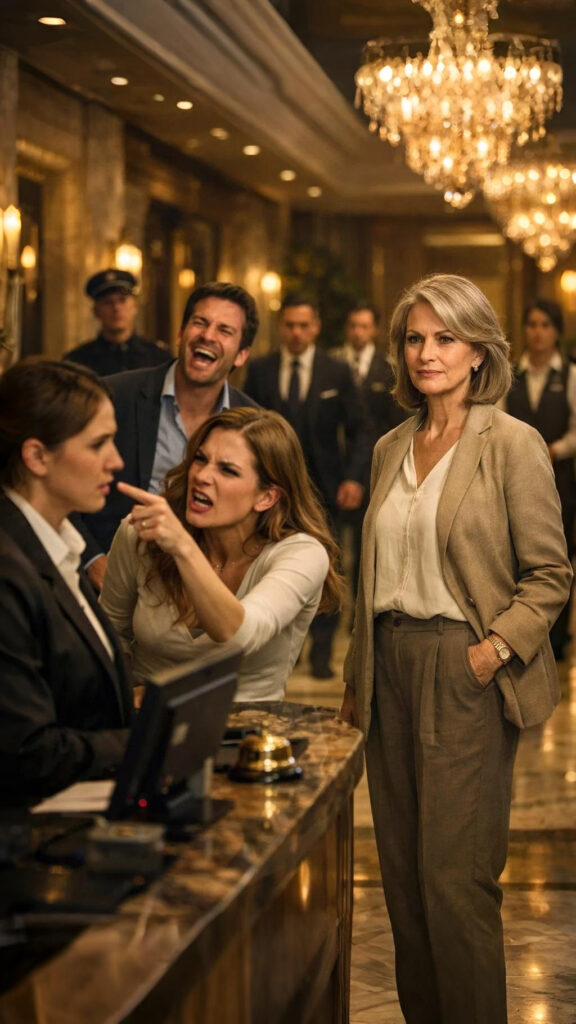
Now, I stood in the same lobby, watching my son check in with his wife. My daughter-in-law’s heels clicked sharply across the tiles, the sound of someone used to getting attention. She tossed her sunglasses on the counter and snapped her fingers toward the young receptionist.
“Do you even understand English?” she barked. “We booked a sea-view suite. Not this backroom nonsense.”
The receptionist flinched, bowing slightly, fumbling with the computer. I stepped closer, intending to calm her, but before I could speak, my daughter-in-law turned, eyes narrowing.
“Don’t talk to the old lady,” she said, waving her hand like shooing away a fly. “She’s just a cleaning lady.”
Her words hit me with the force of a slap.
The receptionist froze. My son — my only son — laughed. Loud, careless, the kind of laugh that fills a room and leaves scars behind.
“She loves pretending to help,” he said, grinning at his wife. “Mom always feels useful around people in uniforms.”
I stood there, the echo of their laughter bouncing off the marble, blending with the soft hum of the lobby’s air conditioning. I could see our reflections in the glass behind the counter — them, polished and confident; me, small and old, dressed simply in beige trousers and a linen shirt.
It was almost funny how easily people mistake humility for insignificance.
The receptionist, her face pale, glanced at me with confusion. She knew who I was. Every staff member did. But my raised hand stopped her from saying a word. I didn’t want to expose anything yet. Not in anger. Not in front of that kind of audience.
My daughter-in-law kept complaining, pointing at her luggage, her nails clicking against the marble. “Just fix it, will you? And someone tell this woman to stop standing there. It’s creepy.”
My son leaned against the counter, scrolling on his phone. “Honey, relax,” he said without looking up. “Let them figure it out. She’s used to these small-town hotels. You can’t expect much.”
Small-town hotels.
I built this place from the ground up. Each chandelier, each tile, every photograph hanging on the walls carried a memory — the first storm that flooded the lobby, the first guest who refused to pay, the first smile I received when someone called this place beautiful.
And now, standing there, invisible in the middle of my own creation, I felt a quiet ache rise in my chest — not from anger, but from recognition. Recognition of how far my son had drifted from the boy who once helped me scrub floors at dawn.
“Would you like me to show you to your suite?” the receptionist asked timidly, her voice trembling.
“Yes, please,” I said before my daughter-in-law could answer. “The sea-view suite, correct?”
The young woman nodded, grateful.
But my daughter-in-law turned sharply, her tone slicing the air. “No one asked you! I swear, old people don’t know how to stay in their lane anymore.”
She laughed, tugging at my son’s arm as if the world owed her amusement.
He laughed too.
I smiled. A quiet, small smile. Because sometimes silence holds more power than any shout.
The elevator doors opened with a soft chime. They stepped inside, their laughter trailing behind like perfume — sweet and poisonous. I stayed in the lobby, watching the doors close, the reflection of my calm face fading in the polished metal.
For a moment, I felt the weight of years pressing on my shoulders — the long nights, the unpaid bills, the hands blistered from scrubbing when I couldn’t afford staff. But beneath that heaviness, something else stirred.
Not sorrow.
Clarity.
I looked at the receptionist again. “Please make sure their suite is ready,” I said softly. “And tell the manager I’ll be in my office shortly.”
She nodded, relief flickering in her eyes.
As I walked toward the private corridor, my steps echoed differently now — slower, deliberate, the rhythm of someone who remembered her own worth.
They thought I was just a cleaning lady.
That was fine.
Soon enough, they would learn who really owned the ground beneath their feet.
Chapter 2 — The Silent Past of the Real Owner
The office smelled faintly of cedar and coffee. The same blend I used to stay awake during nights when I couldn’t afford sleep.
I closed the door behind me, letting the sound of the lobby fade into silence. The laughter of my son and his wife still echoed in the back of my mind, sharp as broken glass. I sat at my desk, tracing the familiar grain of the wood — this desk that had once been an old kitchen table, sanded and polished until it looked respectable.
Respectable. A word I chased for most of my life.
There were photos on the shelf — the first construction crew, me in a hard hat too big for my head, grinning beside the concrete skeleton of a dream. My son was five then. He used to bring me sandwiches wrapped in newspaper, his hands sticky with peanut butter.
He would say, “One day, Mom, I’ll buy you a big house by the ocean.”
And I would smile, thinking, You don’t need to. I’m building it already.
I remember the day the bank almost took it away. I had missed two payments, the roof leaked, and the guests complained about everything from towels to noise. I was exhausted, my fingers raw, my back screaming. But I kept going.
Because failure wasn’t an option when you had a child who depended on you.
I hired anyone who would work for little money. I cleaned rooms myself, sometimes slept in the laundry room to save time. The sheets smelled of bleach and salt, and some nights, I cried quietly so no one would hear.
But slowly, the hotel became something more than a building. It became my proof. Proof that I could survive betrayal, poverty, loneliness. Proof that a woman abandoned with a child could build something the world would respect.
And yet, all these years later, the same child who watched me build it stood in my lobby and laughed at me.
I looked at his photo again — him at ten, holding a bucket of paint, smiling proudly. Then another — his graduation. Then the last one, his wedding. I wasn’t in that picture. They told me there wasn’t enough space in the family frame.
I took a deep breath, pushing away the sting.
The intercom buzzed softly. “Mrs. Almeida,” the receptionist’s voice came through, careful. “They’ve reached their suite. Should I note them as VIP guests?”
A pause.
“No,” I said. “Just treat them as regular guests. Nothing more, nothing less.”
The word regular tasted strangely satisfying.
Outside the window, the ocean shimmered beneath the setting sun. The same sea I used to stare at when I needed courage. I’d promised myself once that I’d never let anyone make me feel small again. But today, for a brief moment, I had.
Maybe that was the reminder I needed.
A knock on the door. The general manager entered quietly, a polite smile on his face. “Madam, I wasn’t aware your family had arrived. Should we—”
“Do nothing special,” I interrupted. “Just keep things running smoothly.”
He nodded, though curiosity flickered behind his professionalism. Everyone on staff knew about my son — the one who left, who married money, who only visited when he needed something.
After the manager left, I opened the old ledger I still kept on the desk. The first page bore my handwriting, shaky but proud: ‘Hotel do Mar — founded with courage, built with love.’
Every name written after that represented a guest, a story, a piece of my survival.
I closed the book gently.
Sometimes people forget the foundation that holds them up. They walk on floors someone else built, sleep under roofs someone else repaired, laugh in rooms warmed by someone else’s sacrifice.
But foundations remember.
The next morning, I walked through the halls before dawn, as I always did. The world was quiet then, soft light spilling through the windows. I checked the flowers in the vases, straightened a painting.
The staff greeted me with respect, as always — small nods, warm smiles. They knew. They always knew who I was.
I stopped near the suite where my son and his wife were staying. The door was closed, muffled laughter behind it. I could almost see them through the wood — comfortable, entitled, unaware that their arrogance stood on my years of sweat and sacrifice.
I turned away, calm but resolved.
They had mistaken me for a cleaning lady.
It wasn’t an insult. It was prophecy. Because soon, I would clean — not floors or windows, but the dust that had settled on truth.
The truth of who I was.
The truth they’d chosen to forget.
As I walked back toward my office, the morning staff began arriving, bustling with quiet energy. The hotel was alive again, breathing through its walls. My walls.
I smiled faintly, the kind of smile that comes not from joy, but from the certainty that something is about to change.
And this time, the change would begin with me.
Chapter 3 — The Unexpected Revelation
Breakfast at the hotel was always my favorite time of day. The air filled with the smell of coffee, warm pastries, and the hum of guests starting their morning stories. Usually, I sat quietly near the corner table, observing. Today, however, everything felt different.
My son and his wife had descended the grand staircase with the elegance of people who believed the world turned for them. She wore a bright silk dress that looked out of place at eight in the morning, her heels striking the marble like tiny hammers. My son walked slightly behind her, half-smiling, scrolling through his phone.
I watched from a distance, cup in hand. The staff moved around them with polite precision. No one made a mistake; everyone had been told — subtly — to keep the truth quiet until I decided otherwise.
When the waitress approached their table, my daughter-in-law snapped her fingers. “Two lattes. Extra hot. And don’t make me repeat myself like yesterday.”
The waitress hesitated, glancing briefly in my direction. I nodded once, signaling her to continue.
The young woman smiled stiffly and hurried off.
My daughter-in-law sighed dramatically, crossing her arms. “I swear, this hotel is so disorganized. No wonder it’s empty in the off-season.”
“It’s fine, darling,” my son muttered, eyes still on his phone. “We’ll find something better next year.”
Something better.
It was always about “better.” A better school, a better car, a better woman for him to marry — at least in his father’s eyes. And when I couldn’t be “better,” I became invisible.
I set down my cup and stood.
The manager entered the dining area at that moment, clipboard in hand. He saw me first, then glanced toward their table. His lips parted as if to speak, but I shook my head lightly. Not yet.
I walked toward them. Each step steady, unhurried, carrying the weight of years and the patience of someone who had waited too long.
My daughter-in-law noticed me first. Her brows lifted, irritation already forming. “Oh, it’s the cleaning lady again. I was wondering when you’d show up. Could you tell someone to bring fresh towels to our suite? The ones from yesterday smelled… old.”
I stopped beside their table, my shadow falling across the white linen. The manager froze nearby, unsure whether to intervene.
My son looked up, his face shifting from indifference to mild embarrassment. “Mom, please. Don’t make a scene. We’re having breakfast.”
The word Mom hung in the air, heavy and cold. The waitress, the other guests, even the manager turned toward us. My daughter-in-law blinked, confusion spreading across her face.
“Wait,” she said slowly, her tone almost a whisper. “Mom? What do you mean, Mom?”
I didn’t answer her. Instead, I looked at the manager and said calmly, “Could you remind the guests who they’re speaking to?”
He hesitated for only a moment. “Of course, Mrs. Almeida. Everyone, this is the owner of Hotel do Mar.”
The words rippled through the room like a wave hitting the shore. Conversations stopped. Silverware clinked softly against porcelain.
My daughter-in-law’s face drained of color. “The… owner?” she stammered. “You’re joking.”
But my son knew better. His mouth opened slightly, his phone slipping from his hand onto the table. The sound echoed in the silence.
I didn’t gloat. I didn’t smile. I simply stood there, letting the truth breathe.
The manager continued, perhaps a little too proudly now. “Mrs. Almeida built this hotel herself. She’s been running it for nearly three decades.”
A murmur spread among the guests. Someone whispered, “Incredible,” another said, “That’s her?”
My daughter-in-law shifted uncomfortably, her fingers trembling around the edge of her napkin. “I— I didn’t know,” she managed to say, forcing a laugh. “I thought you were just—”
“Just what?” I asked quietly.
She swallowed. “Just helping around.”
“I do help around,” I said. “Because work doesn’t stop when you own something. You only understand value when you’ve built it yourself.”
She looked down, unable to meet my eyes. My son stared at his plate, his jaw tense, pride clashing with guilt.
I turned to the waitress. “Please make sure they’re well served,” I said softly. “They’re my guests.”
Then, to my son, “Enjoy your stay. The suite you’re in — it was the first one I finished when the roof was still leaking. You helped me paint it once, remember?”
His lips parted, but no words came. Only silence.
I left the dining room without waiting for a response. The murmur of conversation slowly resumed behind me, hesitant at first, then louder.
Back in my office, I looked at the framed blueprint on the wall. The same one from twenty-seven years ago. My handwriting still circled the words “Sea-view suite — for him.”
For him.
A mother’s dream can be both gift and curse. We build worlds for our children, hoping they’ll find shelter there. But sometimes they forget who built the walls.
A soft knock came at the door. The manager entered again. “That was… quite something, madam.”
I sighed, leaning back. “It wasn’t meant to be dramatic. Just necessary.”
He nodded. “Do you want me to make any changes to their booking?”
“No,” I said. “Let them stay. Comfort can teach just as much as discomfort — if you know where to look.”
After he left, I sat alone, listening to the faint hum of the ocean through the glass. The tide was high today. I thought of how the sea never stopped coming back, no matter how many times it retreated.
Maybe that’s what strength really was.
Coming back, again and again.
The revelation was out now. And though I hadn’t planned it this soon, it had unfolded with a strange calm. Not revenge — just truth finally stepping into the light.
And sometimes, truth was all the revenge one needed.
Chapter 4 — The Shock and the Shift of Power
For the rest of the morning, the hotel seemed to move differently. The air was thicker, slower, as though the walls themselves were listening. Whispers floated from table to table, soft as the rustle of linen napkins. The “cleaning lady” had become the owner — and everyone wanted to see how the story would end.
I stayed in my office, pretending to read emails. In truth, I was giving them time — time to let the shame settle, time to realize what respect costs when you’ve never paid for it yourself.
When I finally stepped into the hallway, I saw my son waiting. He looked smaller than I remembered. The confidence that once lived on his shoulders was gone, replaced by a stiffness that didn’t belong to him.
“Mom,” he began, his voice caught somewhere between apology and pride.
I waited.
“I didn’t know you were… planning to say anything,” he said, trying to smile. “You could have told us before we arrived. It would’ve—”
“Changed how you treated me?” I asked.
He hesitated. “That’s not fair.”
“It’s exactly fair.”
The silence that followed was heavy. Not the comfortable kind, but the kind that sits between two people who used to understand each other and no longer do.
He rubbed his temple. “She didn’t mean what she said yesterday. You know how she gets when she’s nervous.”
“Nervous people apologize, Daniel. They don’t humiliate others to feel taller.”
He sighed, eyes flicking toward the window, toward the sea. “You’re right,” he said quietly. “But she didn’t know. None of us did.”
“That’s the point,” I said. “You didn’t ask. You assumed.”
He said nothing. I could see him searching for the boy I remembered — the one who used to run barefoot through the half-built halls, laughing when the rain came in through the ceiling.
But that boy was gone. Replaced by a man who only looked backward when it hurt.
The door opened again, and my daughter-in-law stepped in. She had changed her outfit, her lipstick, her tone. Her eyes flickered nervously between us.
“Mrs. Almeida,” she said, the words tight but forcedly polite. “I owe you an apology.”
I looked at her for a moment, letting the silence do the work. She squirmed.
“I didn’t know,” she continued. “If I had, I would never—”
“You would have,” I interrupted softly. “Because that’s who you are right now. You see uniforms and think of people beneath you. You see age and think of irrelevance. It’s not what you said that disappointed me, dear. It’s how easily it came out.”
Her lips parted, but she found no answer.
Daniel shifted, uncomfortable. “We’ll go if you want,” he said, his voice tight. “We don’t want to make a scene.”
I studied them — my son and the woman he’d chosen. Two people so different from the world I came from, yet somehow shaped by it. I thought of all the years I’d spent trying to give him a life without struggle, not realizing that in doing so, I’d stolen from him the very thing that gave mine meaning.
“You’ll stay,” I said. “But not as guests of honor. As guests, like everyone else. You’ll pay your bill. You’ll treat my staff with respect. That’s all I ask.”
She nodded quickly, eyes glassy, muttering a thank-you. He looked at me, searching for something — maybe forgiveness, maybe understanding.
“You built all this,” he said quietly. “I never really… saw it.”
“No,” I said. “You saw it. You just never looked long enough to understand what it took.”
They left together, their steps slow, uncertain.
After they were gone, I stood by the window again. The sea stretched endlessly beyond the glass, its surface restless but patient. I had always admired that — how it could rage and calm within the same hour, never apologizing for its depth.
By afternoon, word had spread beyond the hotel. Some guests congratulated me. Others avoided eye contact, as though witnessing the shift in power made them uncomfortable. But I didn’t need their approval. The only thing I needed was clarity — and that, I already had.
Later, when I passed the poolside terrace, I saw them again. My daughter-in-law was quiet now, her laughter replaced by a fragile politeness. She thanked the waiter, smiled too much, tried to look gracious. My son watched me as I walked by, his expression unreadable.
“Mom,” he called softly. “Can we have dinner tonight? Just the three of us?”
I stopped, the sunlight glinting off the water behind him.
“Dinner?” I asked.
“Yes. I think we should talk.”
I nodded slowly. “Eight o’clock. The garden table.”
His relief was visible, a small smile tugging at the corner of his mouth.
But as I turned away, I knew that dinner wouldn’t be about reconciliation. It would be about truth — the kind that either mends or breaks for good.
The kind that leaves no room for pretending.
Back in my office, I took out the old photograph again — him, five years old, standing in front of the unfinished lobby. His face beamed with pride, his little hands covered in dust. He had looked at me then as though I could do anything.
Somewhere along the way, that faith had turned into pity, and pity into arrogance.
I ran my fingers along the photo’s edge.
Power wasn’t about owning a hotel. It wasn’t about money or authority. It was about dignity — the quiet, unshakable kind that no one could take away.
And for the first time in years, I felt it again.
Not the kind that dominates, but the kind that stands firm. The kind that remembers who built the walls.
Outside, the sun was beginning to set. The sky turned the same color as the tiles I’d chosen decades ago — a warm coral that made everything glow softly, as if forgiving the day for what it had done.
Maybe forgiveness would come too.
But not yet.
Chapter 5 — The Dinner in the Garden
By the time the sun began to fade, the hotel lights flickered on, one by one, soft and golden against the deepening blue of the sky. The garden smelled of jasmine and salt. A faint wind moved through the palms, rustling their leaves like whispers.
I arrived first. The table was set beneath the large fig tree, the one I’d planted the same year Daniel graduated. I remembered how he’d laughed when I told him that one day its branches would give shade to families who came here on vacation.
Now, the branches swayed above me, strong and full, as if they’d grown from every wound I’d ever endured.
When Daniel and his wife arrived, their steps were hesitant. They had dressed for formality — as if clothing could undo what had already been done. She wore pearls that glimmered nervously against her throat. He carried a bottle of wine I recognized — expensive, foreign, unnecessary.
“Mom,” he said, pulling out a chair for me. “Thank you for coming.”
I sat down, gesturing for them to do the same. The waiter approached, silent as always, serving soup that no one touched.
The first few minutes were thick with silence. She stirred her spoon around the bowl, eyes low. He cleared his throat, searching for courage among the clinking silverware.
“I know yesterday was… bad,” Daniel began. “I should have stopped it. I should have said something.”
“Yes,” I said.
He nodded, accepting the truth like medicine — bitter but necessary.
She looked up, her voice small. “I didn’t mean to insult you. I swear I didn’t. I just— I assumed you were staff because—”
“Because of how I was dressed?” I asked.
Her cheeks flushed. “Yes. I thought…”
“That people who work are lesser?”
She shook her head quickly. “No, I just—”
“Don’t lie to me,” I said softly. “It’s not an offense to admit what you thought. It’s an offense to pretend you didn’t.”
Daniel reached for his glass, his hands trembling slightly. “Mom, please. We’re trying to apologize.”
“And I’m listening,” I said. “But apologies mean nothing without understanding.”
The waiter returned, setting down the main course. None of us touched it. The smell of rosemary and lemon drifted through the air, almost mocking in its comfort.
“I built this place from nothing,” I said quietly. “Every brick, every nail, every room. I’ve scrubbed floors, washed sheets, cooked meals, balanced accounts, fought banks. And in all that time, I never once thought less of the people who helped me. Because they built it too.”
My voice stayed calm, but I could feel it — the weight of all those years pressing against my ribs.
“I didn’t know,” Daniel said again, the same words he’d used before, as if repetition could erase guilt.
“I know you didn’t,” I replied. “You never asked. That’s worse.”
He looked at me then — really looked. His eyes, the same shade as his father’s, glistened under the warm lights. “I’m sorry, Mom.”
It was simple, quiet, and for the first time, real.
His wife swallowed, her voice breaking slightly. “I’m sorry too. You didn’t deserve that.”
“No,” I said. “But perhaps I needed it.”
They both looked confused. I leaned back, the chair creaking softly.
“I forgot what it felt like to be underestimated,” I continued. “It reminded me who I am. Not just the owner. The woman who survived long enough to own something.”
For a while, no one spoke. The sound of the ocean filled the silence — waves hitting the rocks, steady, eternal.
Finally, Daniel said, “I think I’ve been pretending for a long time. Pretending I was above where I came from. Maybe I was embarrassed that you worked so hard.”
I smiled faintly. “Hard work shouldn’t embarrass you. But ungratefulness should.”
He nodded, eyes down. She reached for his hand under the table, her fingers trembling slightly. There was no arrogance left in her now, only shame — and perhaps, the beginning of awareness.
The waiter returned to clear the untouched plates. I stopped him. “Leave the wine,” I said. “We’ll need it.”
When he left, I poured three glasses, my hand steady.
“To truth,” I said.
Daniel hesitated, then lifted his glass. “To truth,” he echoed.
His wife followed quietly. “To truth.”
We drank in silence. The wine was smooth and dry, the kind that lingers on the tongue, making every word after it taste honest.
When the glasses were empty, I stood.
“Tomorrow,” I said, “you’ll both join me for breakfast with the staff. No pearls, no suits. Just you — as yourselves.”
His wife looked startled. “Breakfast? With the staff?”
“Yes. If you want to stay here, you’ll see what it means to work for something. You’ll serve coffee, fold napkins, maybe even clean a room. Don’t worry — I’ll be right there beside you.”
Daniel nodded slowly. “Alright,” he said.
His wife opened her mouth to protest, then closed it again. Something in my tone told her this wasn’t a suggestion.
As they rose from the table, I watched the two of them walk back toward the hotel, their silhouettes framed by the garden lights. For the first time since they’d arrived, they walked quietly — no laughter, no arrogance. Just thought.
When they were gone, I stayed beneath the fig tree. The air was cooler now, the scent of jasmine stronger. I looked up at the branches, at the stars caught between the leaves.
Sometimes, power doesn’t roar. It whispers.
It asks for patience instead of revenge.
And in that quiet, I felt something shift — not in them, but in me. The anger had burned away, leaving only the steady glow of clarity.
Tomorrow, they would learn humility.
And maybe, if the lesson took root, they would learn love too.