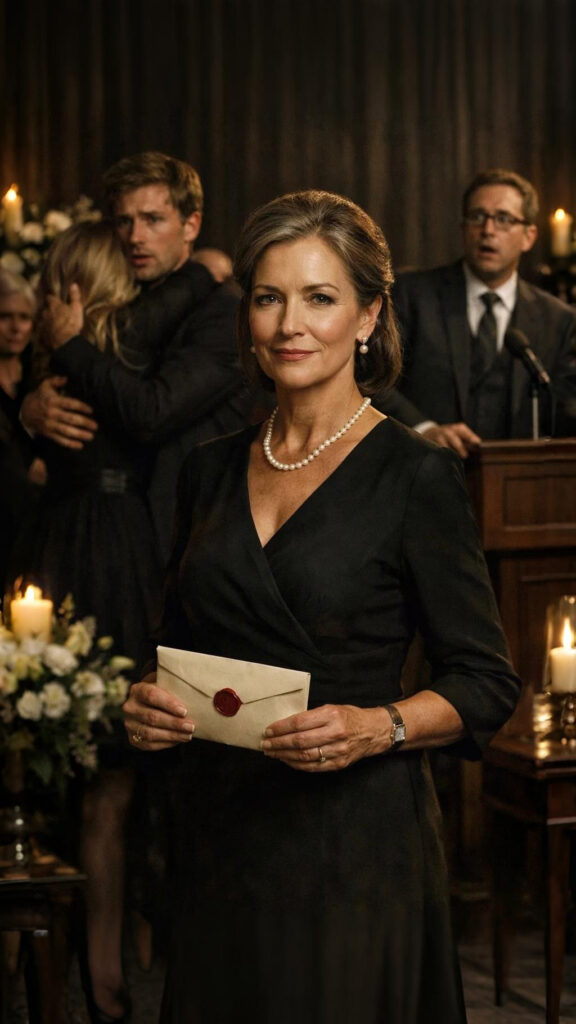
Chapter 1 – The Funeral and the Final Betrayal
The church smelled of lilies and damp marble.
Every whisper felt sharp, slicing through the silence like cold rain. I stood beside the coffin, my black gloves trembling slightly, not from grief—at least, not the kind they expected—but from something closer to disbelief.
They said he had been a good man. A family man.
The words echoed like lies I had memorized too many times to forget.
When the lawyer arrived, people leaned forward in their seats, hungry for gossip disguised as sympathy. He cleared his throat, unfolded a crisp document, and began to speak in that detached tone that lawyers use when pretending not to enjoy the chaos they deliver.
“My condolences,” he said first, and then paused, as if savoring the moment before lighting the match. “According to Mr. Howard’s last will and testament, all assets—properties, accounts, and investments—will be inherited by Miss Clarissa Moore.”
Miss Clarissa Moore.
The name fell like a stone into the room.
The mistress.
The woman who had stood quietly in the back row, dressed in a black dress too elegant for mourning. She didn’t look down. She didn’t even pretend to cry.
Then my son—our son—turned to her.
He didn’t hesitate. He walked to her, hugged her tightly, and whispered the word that drained the last warmth from my body.
“Mom.”
The room gasped. Someone dropped a tissue box. A woman covered her mouth in horror.
But I just smiled.
It was small, deliberate, and sharp enough to unsettle anyone watching. Because while they saw a widow stripped of everything, I knew something they didn’t.
The real will was safe.
I watched Clarissa’s eyes flick toward me, curious, maybe even afraid. She thought she had won. That the game was over. She didn’t know that the man she stole from me had left behind not just lies, but traces—careless details, forgotten papers, signatures that didn’t match.
People began to murmur around us. The lawyer kept talking, listing properties and bank accounts as if he were auctioning my life in front of me. My son stood beside Clarissa now, holding her hand. He couldn’t even meet my eyes.
“Are you alright?” someone asked.
I nodded.
But my mind was far from that church. I was back in the years when I worked double shifts so he could build his company. I was remembering the nights I waited for him, the dinners that went cold, the lies that grew heavier with time.
The truth had been buried long before he was.
When the ceremony ended, people filed out, whispering pity into the air like perfume. Clarissa stayed close to the lawyer, her expression a mix of triumph and caution. My son avoided me altogether. He looked like a stranger wearing my child’s face.
At the entrance, as the rain began to fall, the lawyer approached me.
“I’m truly sorry, Mrs. Howard. I know this must be difficult.”
I met his gaze calmly. “Difficult?” I said softly. “No. Unexpected, perhaps.”
He frowned, unsure whether I was grieving or mocking him. I didn’t clarify.
Instead, I looked past him, to Clarissa and my son sharing an umbrella. Their silhouettes blurred by the rain, walking away together.
For years, I had been the quiet backbone of their comfort. The one who paid, who forgave, who endured.
Now, in a strange twist, their betrayal had freed me from all of it.
I turned back toward the coffin.
The wood gleamed under the church’s dim light, polished and proud, like he always was.
“I hope it was worth it,” I whispered.
Then I straightened my shoulders, adjusted my gloves, and walked out into the rain.
Because what no one knew—not my son, not the mistress, not even the smug lawyer—was that the document he read was not the only one signed before my husband died.
And when the time came, I would show them.
Not in anger. Not in desperation.
But in truth.
The kind of truth that burns slowly—until there’s nothing left to hide behind.
Chapter 2 – The Past of Sacrifices and Blindness
There was a time when our house felt alive. The walls hummed with laughter, the kitchen smelled of cinnamon and burnt coffee, and my son used to run through the hallway calling for his father. I remember that man, the one I fell in love with. Or maybe I just remember the idea of him—before the shadows began to grow behind every business trip, every late-night call, every “you wouldn’t understand.”
I was young when we met, naïve enough to believe that devotion guaranteed love. He was charming, magnetic, with a voice that could turn guilt into gratitude. When he said he needed me, I thought it meant forever. So I gave him everything.
The first years were built on promises. He wanted to start a company, and I believed in him more than I believed in myself. I sold the small apartment my parents had left me. I used my savings, took an extra job, and told myself it was temporary. It wasn’t.
While he built his empire, I built our life—alone.
The nights were endless, filled with waiting. Waiting for headlights to appear in the driveway. Waiting for a phone call that never came. Waiting for a man who had already moved elsewhere, into another heart, another bed.
But I didn’t see it then. Or maybe I refused to.
Because I had a child to raise, a mortgage to pay, and a reputation to protect. People saw us as the perfect couple. The successful husband, the devoted wife. I smiled at the charity events, dressed elegantly, said all the right things. I carried his name like a crown made of glass.
I told myself love demanded endurance. That every disappointment was just a test of strength.
When he came home smelling of perfume that wasn’t mine, I washed his shirts and said nothing. When he stopped calling me by my name, I convinced myself that marriage simply changed over time.
And when he began to leave for weekends that turned into weeks, I took care of everything. The house, the bills, the company taxes, the school meetings. I became both parents while he played the role of a generous stranger.
I remember the night I found the first note. It was hidden inside his jacket pocket—short, elegant handwriting. “Thank you for tonight. You make everything worth it.” I sat on the bed for hours, staring at the words until they blurred into nothing.
I didn’t confront him. Not then.
I told myself it was a misunderstanding. That denial was easier than destruction.
But I started keeping track. Receipts, dates, lies disguised as business dinners. I didn’t realize it yet, but I was already preparing for the day I’d need proof.
The years went by. My son grew up watching me bend so that no one else would break. He adored his father, and I let him. I never poisoned his love, even when I tasted bitterness in mine. I wanted him to believe in something pure, even if I had to lie for it to exist.
When the company began to thrive, my husband changed again. He became distant in a new way—cold, proud, unreachable. I was useful, not loved. The accountant, the hostess, the invisible partner who signed documents and smiled in photos.
He gave me jewelry to cover up guilt. I wore it like armor.
And then came Clarissa. The name I would only learn much later, but whose presence I already felt. A shadow on the edges of his words. The perfume that lingered too long. The laughter on the phone when he thought I was asleep.
I began to wonder what kind of blindness keeps a woman loyal to a man who has already left.
Perhaps the blindness of love. Or maybe fear—fear of facing a life wasted on someone unworthy.
Still, I stayed. I stayed because I believed that one day, he would see me again. Not as a habit, not as a burden, but as the woman who built his entire world.
The day never came.
Instead, I found myself at his bedside, years later, watching the machines breathe for him. The mistress came once, pretending to be a family friend. I didn’t speak. I let her hold his hand, her fingers brushing the wedding ring that was still on his finger.
When he died, the nurse handed me a small envelope. His handwriting on the front. “For you.”
Inside, there was no apology. No confession. Just a key.
It opened a safe in his office—a place I hadn’t entered in months. And there, among old files and contracts, I found two wills. One signed in haste, written in anger. The other—older, more deliberate—still bearing the lawyer’s official seal.
In that moment, everything aligned. Every humiliation, every sacrifice, every long night of silence.
He had loved her enough to betray me. But he had feared me enough to keep the truth hidden.
And that, I realized, was my power.
So when I stood at the funeral, listening to the false will being read, I wasn’t surprised. I wasn’t broken. I was prepared.
Because grief had already taught me everything I needed to know about deception.
And I had learned to wait.
Chapter 3 – The Discovery of the Deception and the Silent Preparation
The morning after the funeral, the house felt hollow. The kind of silence that isn’t peace but aftermath. I walked through the rooms as though I were a guest in my own life, tracing the outlines of furniture we’d chosen together, the photos still hanging on the wall—his smile, my obedience, our illusion.
On the table near the window sat the safe key. I had left it there after the funeral, deliberately visible, like a reminder of a secret that no one else knew existed.
The lawyer’s words still echoed in my mind. “All assets… will be inherited by Miss Clarissa Moore.”
A simple sentence that had burned through everything I thought I was.
But pain, once it hardens, becomes clarity.
So I went to his office.
It was untouched—smelled faintly of tobacco and expensive paper. His desk was immaculate, as always. I unlocked the safe, my hands steady, and opened it to face what I already expected: the documents, the ledgers, the numbers that told a story much truer than the one I had been living.
There were two wills. The first one, the one the lawyer had read, was cleanly printed and dated three months before his death. The other was handwritten, older, bearing signatures, seals, and amendments. I recognized my own handwriting on some of the notes in the margins—he had made me help draft it years ago.
He’d left everything to me and to our son.
It wasn’t greed that made my breath catch. It was the realization of how deeply he had changed—or how deeply he had hidden himself.
The newer will bore Clarissa’s name, written in ink too fresh, with a signature too careful.
Something was wrong with it. The shape of his “H,” the angle of his strokes. It was close—but not exact.
I didn’t need to be an expert to know that it wasn’t his hand.
I pulled out the magnifier from his desk drawer. My husband had been a man of details; he used to examine contracts down to the comma. I examined him now. The pen pressure was uneven. The curves inconsistent. Whoever had forged this had studied him well—but not enough.
I sat there for hours, surrounded by evidence of betrayal, not just emotional but legal, deliberate, almost theatrical.
I thought about Clarissa. The way she stood behind the lawyer, her head tilted, pretending to mourn while watching me like a hawk. She had planned this. And she wasn’t alone.
The realization came slowly, like a shadow lengthening on the wall.
My son.
His expression at the funeral—guilt hiding behind forced affection. His hands trembling slightly when he called her “Mom.”
He knew.
I felt the kind of pain that no mother should feel, one that burns quietly, without tears. I had given him everything—my time, my strength, my love—and he had traded it for a lie wrapped in luxury.
But I didn’t break. Not this time.
Instead, I began to move with purpose.
I called a friend from the old days—a notary who had retired years ago but still owed me a favor. I asked her to meet me discreetly. I said it was about a personal matter, something delicate.
That evening, as the city lights flickered outside, I laid the two wills before her. She looked at me, then at the papers, her eyes narrowing as she examined the signatures.
“This one,” she said, tapping the document Clarissa had presented, “isn’t his. It’s clever, but it’s not his.”
“How can you tell?”
“Your husband always used pressure on the downward stroke. Look here—the ink flow breaks halfway. Someone tried to mimic him, but they didn’t know his hand as well as you did.”
The truth, spoken aloud, felt heavier than silence.
I thanked her and took both documents back. Before leaving, she touched my hand.
“Be careful,” she said softly. “They’ve already shown you what they’re capable of.”
I didn’t answer.
Because I wasn’t afraid. I was done being the woman who waited, who endured. This was no longer about grief. It was about justice—mine.
That night, I locked the real will inside my desk drawer, sealing it in a folder marked Insurance Papers. I left the forged one inside the safe, right where it had been.
If they came looking, they would find exactly what they expected.
The next morning, my son came to visit. He didn’t come alone. Clarissa stood beside him, wrapped in a coat too elegant for mourning. Her smile was thin, professional.
“Mother,” he said, not quite meeting my eyes, “we came to check if you’re managing okay. You don’t have to worry about the house. Clarissa and I will handle everything from now on.”
“How thoughtful,” I replied, stirring my tea. “But I’ve been managing this house long before either of you decided to care about it.”
Clarissa placed a gentle hand on my arm, her tone honeyed. “You’ve been through so much. We just want to make sure you’re comfortable.”
I looked at her fingers resting on my sleeve. “Comfort,” I said slowly, “has never been something others gave me. I learned to build it myself.”
Her hand froze.
My son shifted uncomfortably, muttering something about needing to discuss property taxes.
I let them talk, watching their faces carefully. Every word, every nervous glance, told me what I already knew—they were preparing to claim what they thought was theirs.
When they finally left, I closed the door, locking it with quiet precision.
The house was silent again. But this time, it wasn’t empty.
It was waiting.
So was I.
Because when people spend years underestimating you, they never notice the moment you begin to fight back.
And mine had just begun.
Chapter 4 – The Confrontation at the Funeral and the Revelation of the True Will
The day of the memorial gathering arrived two weeks later. It was Clarissa’s idea, or at least that’s what my son said when he called to invite me. His voice was stiff, rehearsed, the way someone sounds when they’re afraid of what they’ve done but pretending it’s for the best.
He said, “It’s what Dad would’ve wanted—a small event, just family and friends. Clarissa is helping with the arrangements.”
I could almost hear her standing beside him, whispering which words to choose.
I accepted.
The truth doesn’t reveal itself in solitude—it needs witnesses.
When I arrived, the atmosphere was all polished smiles and false condolences. The venue was a rented hall near the cemetery, decorated with expensive flowers and photographs of a man who looked honorable, even noble. My husband’s legacy, repainted by the people who had buried his honesty long before they buried him.
Clarissa moved through the crowd like a queen attending her coronation. Every gesture deliberate, every word dipped in charm. She wore a black dress again—different fabric, same intention. Grief as performance.
My son stayed close to her. His eyes darted toward me a few times, but he didn’t approach. I could see the unease building behind his polite smile. He didn’t know how much I knew. Not yet.
The lawyer was there too, the same man who had read the forged will at the funeral. He greeted me with awkward sympathy, his confidence thinner now. Perhaps he’d begun to suspect something. Or perhaps he simply feared scandal.
I sat near the front, silent, invisible to most.
They spoke about my husband’s “integrity,” his “devotion to family,” his “unbreakable love.” I listened, letting the lies pile up like dust. Every word another nail in the coffin of truth.
When the speeches ended, Clarissa stepped forward. Her voice trembled delicately, the kind of trembling that invites admiration.
“He was my soul,” she said. “He taught me kindness, purpose, and what it means to be truly loved. I will honor his memory by protecting what he left behind.”
What he left behind. My house. My savings. My son. My name.
The room erupted in polite applause. I felt the sound vibrate against my skin, hollow and distant.
Then the lawyer cleared his throat again. “Before we conclude, I’d like to clarify a few legal details regarding Mr. Howard’s estate. There’s been some confusion about documentation.”
Clarissa turned sharply toward him, her smile faltering.
Confusion. The perfect word to begin with.
I rose before he could continue. The movement drew eyes, whispers rippling through the crowd. My son froze. Clarissa stiffened.
“If there’s confusion,” I said calmly, “perhaps it’s time to remove it.”
I opened the small leather bag I carried and pulled out a folder—the same one that had sat in my desk drawer since the night of discovery. I placed it on the table near the podium.
“This,” I said, “is the last valid will of Richard Howard. Signed, witnessed, and sealed. I thought it might interest those of you who’ve been misled.”
The lawyer’s face drained of color. “Mrs. Howard… where did you—”
“From the place he left it,” I interrupted. “Where he knew I would find it.”
A murmur swept through the room. Cameras lifted discreetly. The air changed—thick, electric, waiting.
Clarissa laughed, but it came out brittle. “That’s absurd. Everyone here knows Richard made his wishes clear. This is just—grief confusing your judgment.”
“Then let’s verify it,” I said. “You wouldn’t object to that, would you?”
The lawyer hesitated, glancing between us. Finally, he opened the folder. The older will lay inside, the ink faded but authentic. The notary’s stamp gleamed faintly under the lights.
He compared the signatures, his hands trembling. Then, without looking up, he said quietly, “This signature… matches the verified sample on record. The other document… doesn’t.”
Silence. Heavy and absolute.
Clarissa’s face hardened, her charm collapsing like wet paint. My son stepped forward, his voice low. “Mother, what are you doing?”
“What I should have done long ago,” I said.
He looked from me to the lawyer, then to Clarissa, realization dawning too late. The pieces of the lie he had joined were crumbling in front of everyone.
Clarissa tried again, desperation replacing grace. “That document is outdated! He changed his mind! He wanted me to have it all!”
The lawyer finally looked up, his voice firmer now. “Miss Moore, without verified evidence of that, the previous will stands. Mrs. Howard is the rightful heir to the estate.”
The crowd began to whisper again, louder this time. Pity turned toward Clarissa. Admiration turned toward me. The balance of the room shifted.
Clarissa’s mask cracked completely. “You can’t do this,” she hissed, stepping closer. “You don’t understand what he and I had!”
“Oh, I understand perfectly,” I said, meeting her gaze. “You had what was never yours. And now, it’s over.”
My son stood between us, ashamed, broken in a way that even I couldn’t fix.
“I thought…” he began, but his voice failed him.
“I know what you thought,” I said gently. “And you’ll live with it.”
He turned away, tears glinting in the corners of his eyes.
I picked up the folder, closed it, and handed it back to the lawyer. “Please ensure this time the truth is filed properly.”
He nodded, still pale.
Then I faced the crowd. “Thank you for your condolences,” I said. “But the only thing I needed to bury was the lie.”
No one spoke. Even Clarissa remained motionless, her perfect posture trembling under the weight of exposure.
I walked out of the hall slowly, every step deliberate. The rain had started again, soft but steady, washing the day clean.
Behind me, the noise of the room grew distant—a fading echo of deceit undone.
And for the first time in years, I breathed without weight.
Justice doesn’t always shout. Sometimes, it whispers in public and leaves everyone else speechless.
Chapter 5 – The Liberation and the New Beginning
The day after the confrontation, the house felt different. Lighter, somehow. The walls no longer echoed with the ghosts of his voice, the unspoken apologies, or the lies that had lived here longer than I had realized.
For the first time in decades, I woke without the weight of him.
The morning light filtered through the curtains, soft and unfamiliar. It touched everything that once belonged to “us,” and in that light, it was finally mine. The porcelain cups, the books he never read, the piano I played alone—each one no longer proof of servitude, but of survival.
I brewed coffee slowly, deliberately. The sound of it pouring into the cup felt ceremonial, like reclaiming something sacred.
Freedom doesn’t arrive with trumpets. It comes quietly, disguised as an ordinary morning.
Later that day, I went to the lawyer’s office. The same man who had once read the forged will now stood to greet me with an uneasy smile. He spoke with the cautious respect people reserve for those they underestimated.
“Mrs. Howard,” he began, “everything has been verified. The estate, the accounts, the property—legally and officially, it’s yours.”
I nodded, my voice calm. “Then let’s proceed with transferring the titles.”
He shuffled papers nervously, clearing his throat. “There will likely be challenges. Miss Moore may attempt to contest it, though with the evidence you’ve presented, she has little ground.”
“She can try,” I said simply.
He blinked, unsure whether I was joking. I wasn’t.
When I left, the sky was bright and mercilessly blue. Clarissa would be making her calls by now, her allies shrinking with every answer. My son, I imagined, was silent somewhere, drowning in the realization of what he had helped destroy. I didn’t hate him. But I no longer pitied him either.
Love, once cracked, doesn’t mend—it transforms.
That evening, I returned to the garden. It had been neglected for years, overrun by weeds that grew wild like the secrets he’d left behind. I put on gloves, took the shears, and began to cut, one branch at a time. It wasn’t about plants. It was about reclaiming breath.
I found myself whispering, almost without realizing, “It’s mine again.”
The garden answered with silence, but a kinder one this time.
A week passed. The newspaper printed a small column about the scandal—a contested inheritance, a widow proving forgery, a mistress exposed. The kind of story people discuss over coffee and forget by afternoon. But I wasn’t forgotten. Not by them.
Clarissa sent a letter. Just one line.
“You think you’ve won.”
I didn’t reply. Victory doesn’t need an audience.
My son came days later. He stood at the door like a stranger asking for forgiveness but unsure what it costs.
“Mother,” he said, his voice fragile. “I made a mistake.”
I studied him carefully, the boy I had raised, now a man shaped by his father’s reflection.
“Yes,” I said. “You did.”
He lowered his eyes. “She lied to me. She said Dad wanted—”
“She said what you needed to hear,” I interrupted softly. “The same way he once did.”
He flinched. The truth is never cruel—it’s only sharp to those who’ve lived in comfort.
“I want to make things right,” he said finally. “If you’ll let me.”
I didn’t answer immediately. I poured him tea, the same way I used to when he was a child after a bad dream. He held the cup with both hands, his fingers trembling.
“You can start,” I said, “by learning what right actually means.”
He nodded, tears threatening to spill but never falling. When he left, I didn’t feel emptiness. I felt distance—the good kind, the necessary kind.
At night, I sat by the window, looking out at the garden. The moonlight stretched across the trimmed branches, the soil freshly turned.
Everything that once felt like an ending now looked like soil waiting for new roots.
I began to make plans—not for rebuilding what had been lost, but for creating something entirely different. I called an old friend from university, someone I hadn’t spoken to in years. She was surprised to hear my voice.
“I thought you disappeared,” she said.
“I almost did,” I replied. “But I’m back.”
We talked about travel, about art classes she’d started taking, about a small house she’d bought by the sea.
“Come visit,” she said, half-laughing.
“Maybe I will,” I answered, and this time I meant it.
After the call, I opened the drawers of his office—now my office—and began throwing things away. Contracts, letters, ties still knotted. I kept only one thing: a single photograph. The three of us, years ago, before betrayal took shape. I placed it in a box and sealed it. Not out of longing, but closure.
Some memories deserve to rest.
The next morning, I booked a flight. One-way. No destination that needed permission.
As I packed, I felt the strange weight of unfamiliar peace. The kind that doesn’t come from revenge or victory, but from the absence of fear.
Standing by the door, I looked back once. The house didn’t look empty anymore. It looked complete, as if it had witnessed my transformation and approved of it.
I smiled, softly, the same way I had at the funeral—but this time it wasn’t armor.
This time, it was truth.
And as I stepped into the sunlight, I realized something simple, something I had never truly understood until then.
I hadn’t inherited his fortune.
I had inherited myself.