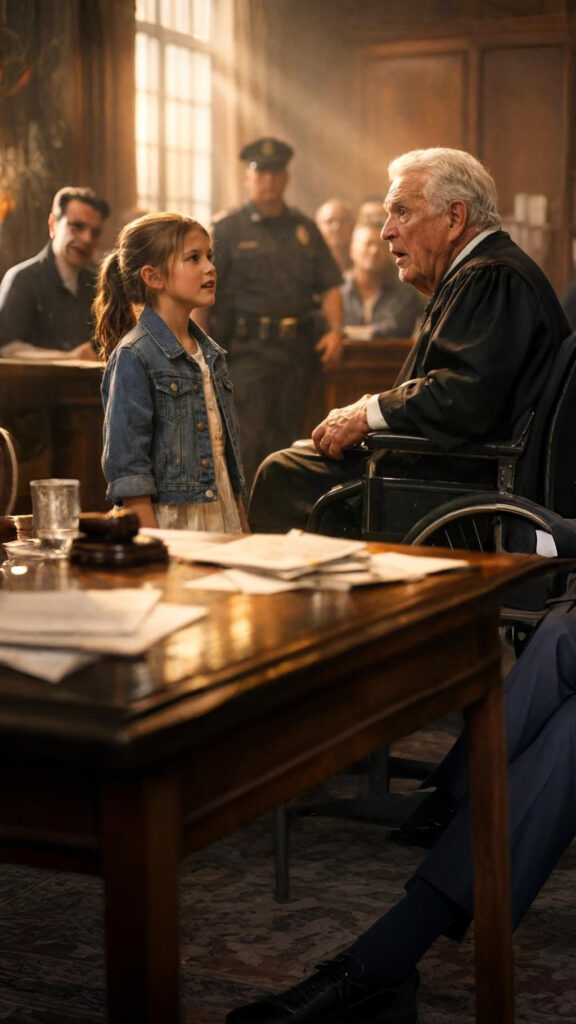
Chapter 1 — The Laughter of the Court
“Sit down. You’re embarrassing yourself.”
The words cut through the courtroom before any explanation, before any name was spoken, before anyone bothered to look twice at the woman standing near the defense bench.
She did not raise her voice.
She did not protest.
She only tightened her fingers around the strap of her worn handbag and obeyed.
The judge had not ordered it.
A man had.
He sat relaxed, legs crossed, suit flawless, confidence leaking from every careless gesture. His voice carried the certainty of someone who had never been told no in that room.
A few people smiled.
Someone laughed softly.
The mother lowered her head as she sat. She was used to that tone. She had learned, over the years, that silence hurt less than resistance.
Across the room, her son stood frozen.
He had arrived late, breath uneven, jacket still open. He had run up the courthouse steps believing he still had time. Believing the truth mattered.
Now he realized it didn’t.
Not here.
Not today.
The accusation had already been framed as fact.
The narrative was neat, polished, untouchable.
The man in power spoke again, louder this time, for everyone to hear.
“This woman obstructed justice. Interfered with evidence. People like her think rules don’t apply.”
His eyes never left the judge, but the message was aimed elsewhere.
At the son.
The judge adjusted his glasses, bored, already leaning toward agreement. Papers were shuffled. A clerk cleared her throat. The machinery of condemnation moved efficiently.
The son finally spoke.
“That’s not true.”
The sound of his voice turned heads. Some curious. Some annoyed.
The man smiled.
“Are you her lawyer?” he asked, amused.
“No,” the son said. “I’m her son.”
That did it.
The smile widened.
The air shifted.
“Then you should be quiet,” the man replied. “Before you make this worse for her.”
A pause followed. Heavy. Deliberate.
The threat wasn’t shouted.
It didn’t need to be.
The son felt it settle in his chest, slow and suffocating. He knew what that man could do. Everyone in that room did. Careers had ended with less. Lives had bent permanently under that calm, polite authority.
The judge leaned forward.
“Young man, this is not the place—”
“If you let this continue,” the son interrupted, his voice steady in a way that surprised even him, “you’re condemning an innocent person.”
A ripple of murmurs crossed the benches.
The man laughed. Not loudly. Not crudely.
The laugh of someone entertained.
“Innocent?” he repeated. “She’ll be lucky if she walks out of here today.”
The mother looked up then. Just for a second.
Her eyes met her son’s.
There was fear there.
But more than that, there was something else.
A silent plea.
Don’t.
The son swallowed.
He had promised her, years ago, that one day things would change. That the world wouldn’t always push them down. That dignity wasn’t reserved for people with titles.
He hadn’t known how.
He just believed it.
Now the room waited for him to break. To step back. To sit down like he had been told.
Instead, he took a breath and said the sentence that would echo far beyond that courtroom.
“If you release my mother,” he said, slowly, clearly, “I will put you back on your feet.”
The silence that followed was sharp.
Then laughter exploded.
Not one voice.
Many.
Some laughed openly.
Others hid smiles behind hands and folders.
The judge raised an eyebrow, incredulous.
“Is this a joke?” the man asked, eyes shining with mockery. “Do you even know who you’re speaking to?”
The son did.
And he knew something else too.
But no one in that room could see it yet.
Chapter 2 — The Man Who Never Lost
The laughter did not fade immediately.
It lingered, echoing against the wooden walls, feeding on itself until it became part of the room’s identity. This was a place where outcomes were predictable. Where power wore a suit and certainty came pre-approved.
The man waited for the noise to settle, enjoying it.
He leaned back slightly, hands resting on the armrests, as if the courtroom were his private office and everyone else temporary furniture.
“You’ll put me back on my feet,” he repeated, slowly.
As if tasting the absurdity.
His gaze finally dropped from the judge to the son.
“You don’t even know what you’re saying.”
A few heads nodded.
Agreement came easily when it was safe.
The son did not respond right away. He stood there, shoulders squared, eyes fixed on the man, as if measuring something invisible. Not anger. Not fear.
Calculation.
The judge cleared his throat again.
“This court will not tolerate—”
“Five minutes,” the man interrupted, lifting a finger without looking away from the young man. “Let him entertain us.”
The judge hesitated. Just enough to show who truly decided what was tolerated.
The mother felt her stomach tighten.
She leaned forward in her seat, whispering urgently.
“Please,” she said. “Stop.”
Her voice trembled, but not from weakness. From experience. She had learned how quickly situations like this turned cruel when pride was challenged.
The son glanced at her.
Only for a moment.
“I’m not doing this for them,” he said quietly. “I’m doing it for you.”
The man chuckled.
“How touching.”
He rose from his chair then, unhurried, adjusting his cufflinks as he stood. Tall. Composed. A man accustomed to commanding rooms without effort.
“You know,” he said, addressing the court, “people like him show up every year. Big words. Empty hands. They think courage can replace competence.”
He turned again to the son.
“Do you have any idea what’s at stake here?”
The son nodded once.
“Yes.”
That answer drew less laughter.
The man tilted his head, intrigued despite himself.
“Then enlighten us.”
The son inhaled.
“Right now,” he said, “this case isn’t about my mother. It’s about what happens in seventy-two hours if the documents you’re hiding are exposed.”
The room shifted.
Not dramatically.
Subtly.
A clerk stopped writing.
One of the attorneys looked up.
The man’s smile tightened, just a fraction.
“You should be careful,” he said. “False accusations carry consequences.”
“They’re not accusations,” the son replied. “They’re timelines.”
A pause.
The judge frowned.
“What documents?” he asked.
The man laughed again, but this time it came a beat too late.
“There he goes,” he said. “Spinning fantasies. I suggest we end this circus.”
But the son continued.
“The offshore transfer,” he said. “The one routed through a shell foundation registered under your wife’s maiden name. The one scheduled to finalize on Friday at 4:30 p.m.”
The silence this time was different.
No laughter followed.
The man stared at him, searching for the crack. The bluff. The stumble that would give this away as desperation.
It didn’t come.
“That transfer,” the son went on, “violates three compliance statutes and triggers an automatic audit if delayed. Which is why you need this case closed today.”
The mother’s breath caught.
She didn’t understand the words.
But she understood the tone.
The judge straightened in his seat.
“Young man,” he said slowly, “how do you know this?”
The son finally looked around the room.
At the faces that had laughed.
At the certainty that was starting to erode.
“I know,” he said, “because you’re not prosecuting my mother.”
He turned back to the man.
“You’re using her.”
The man stepped forward.
One step.
Not aggressive.
Controlled.
“Enough,” he said, his voice lower now. “You’re done.”
The son met his gaze.
“Let her go,” he said. “And I’ll fix it.”
A murmur rippled through the benches.
“Fix what?” someone whispered.
The man’s jaw tightened.
“You think you can clean a mess like this?” he asked. “Do you even understand the scale of what you’re claiming?”
The son nodded again.
“I do.”
The judge looked between them, unsettled.
“This court needs clarity,” he said. “Now.”
The man exhaled sharply, irritation breaking through his polish.
“You want clarity?” he snapped, turning to the judge. “He’s bluffing. And if you entertain this nonsense—”
“You have forty-eight hours,” the son interrupted. “Not seventy-two. You lost a day trying to scare us.”
The man froze.
Just for a second.
Long enough for everyone to see it.
The first crack.
Chapter 3 — When Certainty Begins to Shake
No one spoke after that.
The silence was no longer polite or confused.
It was alert.
The kind that appears when people realize they may have laughed too soon.
The man recovered first. He always did. Years of control had taught him how to move past surprises without revealing damage.
He smiled again.
But this time, it didn’t reach his eyes.
“You’re making very specific claims,” he said calmly. “Claims that could destroy your life if they’re wrong.”
The son didn’t answer immediately.
He took a step closer to the defense table, placing both hands on its edge, grounding himself. His breathing remained steady, but inside, time felt compressed. He knew there would be no second chance after this moment.
“I didn’t come here to threaten you,” he said. “I came to offer you a way out.”
A few people shifted in their seats.
The judge leaned back, studying the young man with a different expression now. Less irritation. More caution.
“Explain yourself,” the judge said.
The man snapped his head toward him.
“Your Honor, this is highly inappropriate. This individual has no standing—”
“Sit down,” the judge replied.
Two words.
The same ones that had been thrown so casually at the mother earlier.
The man hesitated.
Just a breath too long.
Then he sat.
The son noticed.
Everyone did.
The mother clasped her hands together, knuckles whitening. She had spent her life reading danger in small movements. She felt it now, creeping closer, wrapping around her chest.
“Please,” she whispered again, barely audible. “This isn’t your fight.”
He didn’t look at her this time.
If he did, he might stop.
The judge folded his hands.
“You said forty-eight hours,” he said. “Why?”
The son lifted his eyes.
“Because the intermediary bank flagged irregularities yesterday,” he replied. “They sent a compliance notice this morning.”
The judge’s eyebrows rose slightly.
“That information isn’t public.”
“No,” the son agreed. “It isn’t.”
The man stood up abruptly.
“This is over,” he said sharply. “You’re done humiliating this court.”
The judge’s voice hardened.
“Sit. Down.”
The gavel tapped once.
Not hard.
Not loud.
But decisive.
The man complied, his jaw clenched now, restraint visibly straining.
The son continued.
“You needed a distraction,” he said. “A reason to keep attention away from financial movements that couldn’t withstand scrutiny.”
He gestured subtly toward his mother.
“She was convenient. Low-risk. No resources to fight back.”
A murmur spread.
“That’s a lie,” the man snapped.
The son nodded.
“That’s what everyone says at first.”
The judge looked toward the prosecution’s table.
“Counsel,” he said, “were you aware of any parallel investigations related to this party?”
The prosecutor hesitated.
A fraction of a second.
Enough.
“I… was not informed,” she said carefully.
The man shot her a look.
Sharp. Warning.
The mother felt a strange sensation then.
Not relief.
Not hope.
Something heavier.
Realization.
She had been right all along. This had never been about what she did. Or didn’t do. She had simply been in the wrong place, under the wrong shadow.
The son straightened.
“I know you’re wondering why I care,” he said, addressing the room. “Why I would risk everything for this.”
He paused.
“Because I’ve seen what happens when people like him don’t get stopped.”
The man laughed again, but this time the sound was brittle.
“You talk as if you’ve done this before.”
“I have,” the son said.
The judge’s gaze sharpened.
“In what capacity?”
The son hesitated.
Not because he didn’t know the answer.
Because once spoken, there would be no turning back.
“Privately,” he said. “Quietly. For people who couldn’t afford mistakes.”
The man leaned forward.
“And yet here you are,” he said. “Standing in a courtroom, begging.”
The son shook his head.
“I’m not begging,” he said. “I’m negotiating.”
The word landed hard.
Negotiating.
A few people exchanged glances.
The judge sat still, weighing something unseen.
“What exactly are you offering?” he asked.
The son met his eyes.
“A solution that keeps this out of the public record,” he said. “That prevents a chain reaction you won’t be able to control.”
The man scoffed.
“And in return?”
The son turned, finally, toward his mother.
Her eyes were fixed on him now. Wide. Searching.
“You release her,” he said. “Immediately. Charges dropped. No conditions.”
The man laughed.
“Unbelievable,” he said. “You think you can dictate terms here?”
The son looked back at him.
“I think,” he said quietly, “you’re running out of options.”
The judge exhaled slowly.
“This court will take a brief recess,” he said. “Ten minutes.”
The gavel struck.
The sound echoed.
Not like an ending.
Like a door opening somewhere no one expected.
Chapter 4 — The Weight of Ten Minutes
The courtroom emptied slowly.
Not because anyone was told to leave, but because no one knew where to stand anymore. Conversations dropped to whispers. Phones appeared, then disappeared again, as if even messages felt dangerous now.
The man remained seated.
Still.
Silent.
His lawyers leaned toward him, speaking quickly, urgently. He waved them off with a subtle movement of his hand, eyes fixed on a single point ahead. Control was his language, and he refused to let panic translate his thoughts.
The mother was escorted to a bench near the wall.
She sat carefully, as if the floor itself might give way beneath her. Her hands trembled in her lap. Not from fear of punishment anymore.
From fear of consequence.
Her son approached her slowly.
“You shouldn’t have done this,” she said, her voice low, strained. “You don’t know what he’s capable of.”
“I know,” he replied.
“That’s what scares me.”
He crouched slightly so they were eye level.
“I didn’t come unprepared,” he said. “I promise.”
She searched his face, looking for the boy she had raised. The one who used to study late at night at the kitchen table, surrounded by borrowed books and quiet determination.
She saw him.
But she also saw someone else now.
Someone sharper.
Heavier.
Across the room, the man stood abruptly and walked toward them.
The sound of his shoes against the marble floor cut through every whisper.
People turned instinctively.
He stopped a few steps away from the son.
“You think this makes you brave?” he asked quietly. “Cornering me like this?”
The son rose to his full height.
“I think it makes this honest.”
The man smiled thinly.
“You’re playing a dangerous game.”
“No,” the son said. “You are. I’m just pointing out the rules.”
The man leaned closer.
“You don’t have leverage,” he said. “You have information. And information disappears.”
The son didn’t flinch.
“So do people,” he replied.
The words hung between them.
Not as a threat.
As a fact.
For the first time, the man’s composure slipped.
Not visibly.
Internally.
Because he recognized that tone.
He straightened.
“You want your mother free,” he said. “Fine. Let’s talk terms.”
The son shook his head.
“No private deals,” he said. “Everything goes on record.”
The man laughed softly.
“You’re demanding transparency from me? In a courtroom you walked into five minutes ago?”
“I’m demanding accountability,” the son replied. “From someone who’s never faced it.”
The judge returned before the man could respond.
Ten minutes had passed faster than expected.
Everyone stood.
The judge took his seat, expression unreadable.
“Before we proceed,” he said, “this court needs clarity on several matters that have been raised.”
His eyes moved to the man.
“Specifically,” he continued, “the alleged financial transactions and the urgency surrounding this case.”
The man inhaled.
Deep. Controlled.
“There is nothing to clarify,” he said. “This is a distraction.”
The judge nodded slowly.
“Perhaps,” he said. “But distractions usually don’t come with timestamps.”
A subtle murmur.
The son stepped forward again.
“I can submit proof,” he said. “Not speculation. Not theories. Documentation.”
The man turned sharply.
“You will do no such thing.”
The judge raised a hand.
“He may,” he said. “If it exists.”
The son reached into his jacket.
The room leaned in.
He removed nothing dramatic. No folder. No envelope.
Just a phone.
He placed it gently on the clerk’s desk.
“Encrypted files,” he said. “Transaction trails. Audit flags. Correspondence.”
The clerk looked uncertain.
The judge nodded.
“Have them verified.”
The man’s lawyers surged into motion now, voices overlapping.
“Your Honor—”
“This is improper—”
“There are protocols—”
The judge struck the gavel once.
“Enough.”
Silence snapped back into place.
The clerk connected the device to the court system.
Seconds stretched.
The mother closed her eyes.
She didn’t pray.
She remembered.
Long nights.
Sacrifices.
The belief that doing things right mattered, even when no one rewarded it.
A notification appeared on the screen.
Then another.
The clerk’s expression changed.
She looked up at the judge.
“These files reference active accounts,” she said carefully. “Some are… concerning.”
The man stood again.
“This is absurd,” he said. “I won’t sit here while fabricated data is—”
“Sit,” the judge said. “Now.”
The word carried weight this time.
The man obeyed.
Slowly.
The judge turned to the son.
“You claimed you could put him back on his feet,” he said. “Explain that.”
The son nodded.
“Right now,” he said, “his entire structure is one audit away from collapse. Investors will flee. Partners will disappear. The fallout won’t stop with him.”
The judge listened intently.
“I can contain it,” the son continued. “Correct the filings. Re-route the damage. Make it legal.”
The man scoffed.
“And why would I trust you?”
The son met his gaze.
“Because if you don’t,” he said, “this leaves the room.”
He gestured subtly toward the phone.
“And once it does,” he added, “no one puts anything back on its feet.”
The judge exhaled.
“This court is not a marketplace,” he said. “But it will not be used as a shield either.”
He turned to the mother.
“Madam,” he said gently, “you are released from custody pending further review.”
Her breath broke free in a quiet gasp.
She looked at her son.
Then back at the judge.
“Thank you,” she whispered.
The man stared straight ahead.
Rigid. Silent.
The judge leaned forward.
“This matter,” he said, “is far from over.”
The son knew that.
He also knew something else.
The real fight hadn’t even begun.
Chapter 5 — What He Had Been Hiding
The courthouse steps felt different on the way down.
Not lighter.
Heavier.
The mother held the railing as she descended, each step careful, as if freedom itself were fragile. She didn’t speak. Words felt too small for what had just happened.
Outside, the city moved as usual.
Cars passed.
People laughed.
Life continued, unaware that a quiet earthquake had started inside a courtroom a few floors above.
The son walked beside her, close enough to catch her if her legs failed. He watched her hands more than her face.
“You’re shaking,” he said softly.
She nodded.
“I didn’t think I would be,” she replied. “But I am.”
They reached the sidewalk.
Only then did she stop and turn to him fully.
“What you did in there,” she said. “That wasn’t courage.”
He waited.
“That was certainty,” she continued. “And I don’t know where it came from.”
He looked past her, toward the street, as if the answer might be waiting there.
“Neither did they,” he said.
Behind them, the courthouse doors opened again.
The man emerged surrounded by lawyers, voices low, urgent, overlapping. Cameras appeared instantly, drawn by instinct more than instruction. He waved them away, jaw tight, eyes scanning the crowd.
Then he saw the son.
For a moment, the noise around him faded.
He broke away from his lawyers and crossed the distance between them with purpose. Not hurried. Not hesitant.
Determined.
“This isn’t finished,” he said, stopping a few feet away.
The mother stiffened.
The son placed himself slightly in front of her.
“I know,” he replied.
“You embarrassed me,” the man said quietly. “That comes at a cost.”
The son met his gaze.
“So does underestimating people.”
The man smiled thinly.
“You think today proved something,” he said. “It didn’t. It delayed things.”
The son nodded.
“That’s all I needed.”
The man frowned.
“Needed for what?”
“For you to start making mistakes,” the son replied.
A flicker crossed the man’s face.
Gone as quickly as it appeared.
“You should enjoy this moment,” he said. “They don’t last.”
He turned and walked away, swallowed by aides and cameras.
The mother exhaled shakily.
“He’s not done,” she said.
“No,” the son agreed. “He’s desperate.”
They went home together.
A small apartment. Clean. Quiet. The kind of place built from discipline rather than comfort.
The mother sat at the kitchen table, hands wrapped around a cup of tea she hadn’t touched.
“I thought you worked in consulting,” she said slowly.
“I do,” the son replied.
“That wasn’t consulting.”
“No,” he admitted. “It wasn’t.”
She looked at him now. Really looked.
“You’ve been hiding things from me.”
He sat across from her.
“Protecting,” he corrected gently.
Her eyes softened.
“From what?”
He hesitated.
“From knowing how ugly it gets,” he said.
Silence settled between them.
Then she nodded.
“Tell me anyway.”
He leaned back, choosing his words carefully.
“I fix failures,” he said. “Quietly. Financial collapses. Compliance disasters. Things powerful people don’t want public.”
Her grip tightened around the cup.
“And you learned this where?”
“After I lost my job,” he said. “The one that paid for everything.”
She remembered that time.
The sudden layoff.
The long nights.
The way he stopped talking about his future.
“They blamed you,” she said.
“They needed someone,” he replied. “I was convenient.”
Her chest tightened.
“And today,” she said, “you recognized yourself in me.”
He didn’t deny it.
That night, across the city, the man sat alone in his office.
Lights dim.
Phone buzzing nonstop.
Reports lay scattered across his desk.
Compliance alerts.
Partner emails.
Questions he could no longer ignore.
He replayed the courtroom in his mind.
The certainty in the son’s voice.
The precision of his claims.
Too precise.
He reached for his phone and made a call.
“I need a background check,” he said. “Everything.”
The answer came quickly.
And with it, unease.
The name meant nothing publicly.
But privately?
It carried weight.
History.
The man leaned back in his chair.
For the first time in years, he didn’t feel in control.
Across the city, the son lay awake, staring at the ceiling.
He knew what was coming.
Retaliation.
Pressure.
Escalation.
He welcomed it.
Because the more the man pushed, the more he would expose himself.
And this time, there would be no one left to sit him down and tell him he was embarrassing himself.